

Kielbasa, fully cooked, unheated
Whole food · Sausages and Luncheon Meats

Photo: Wikipedia
Kielbasa is a coarse-ground, smoked Polish sausage with a distinctively rich, garlicky flavor and a satisfying, slightly snappy bite. Its high fat content (nearly 30g per 100g) gives it a succulent, juicy texture even when eaten cold. Nutritionally, it's a dense source of energy and protein, but its primary macronutrient is fat.
Calorie split: 13% protein · 5% carbs · 82% fat
↓ Full nutrition💚 Why it's loved
People love kielbasa for its bold, savory flavor profile—a perfect balance of smoke, garlic, and marjoram that requires no additional seasoning. Its incredible versatility allows it to be sliced into salads, fried with cabbage, or simply eaten cold as a hearty snack.
⚠️ Watch-outs & how to enjoy it better
Its high fat and sodium content can be a concern for heart health and blood pressure management. To counteract this, pair it with fiber-rich vegetables like sauerkraut or a fresh salad, and practice strict portion control (stick to a 2-3 oz serving). The curing process also involves nitrates, which some prefer to limit.
Key benefits
- Excellent source of high-quality protein (21.7g per 100g).
- Provides essential B vitamins, particularly B12 and niacin.
- Zero carbohydrates, making it suitable for low-carb and ketogenic diets.
- High in minerals like selenium and phosphorus.
- Shelf-stable when unopened due to smoking and curing.
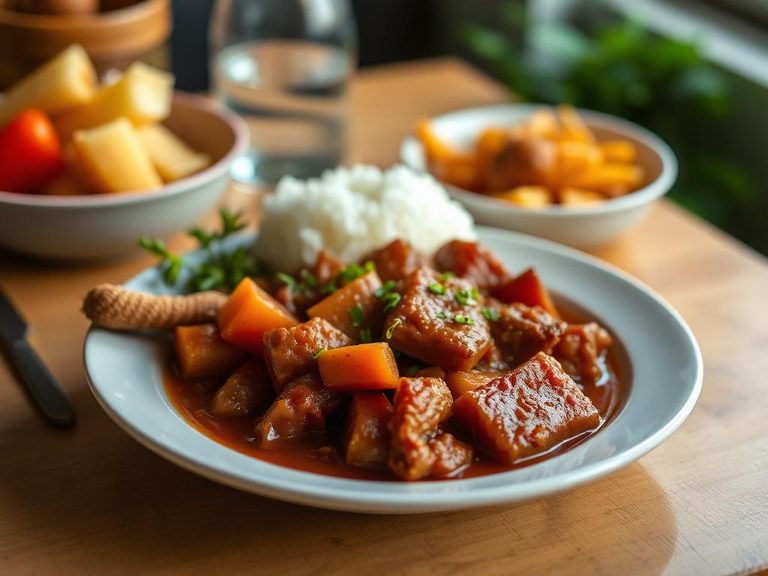
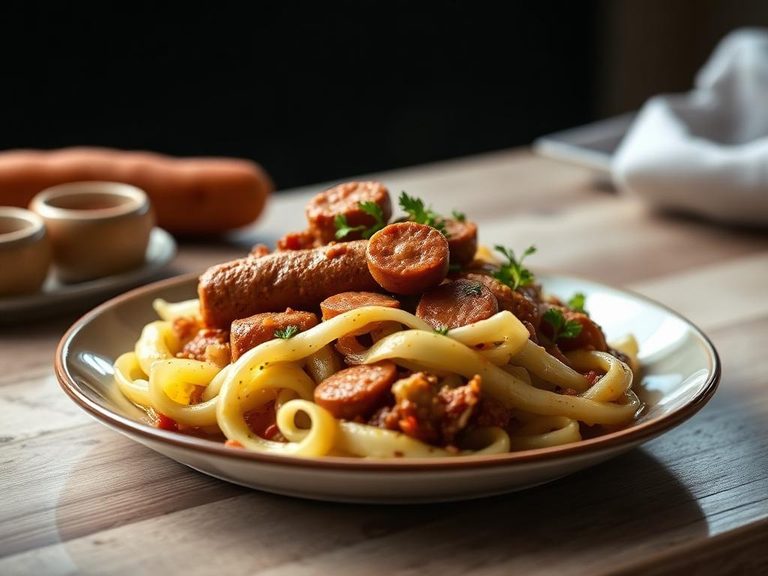
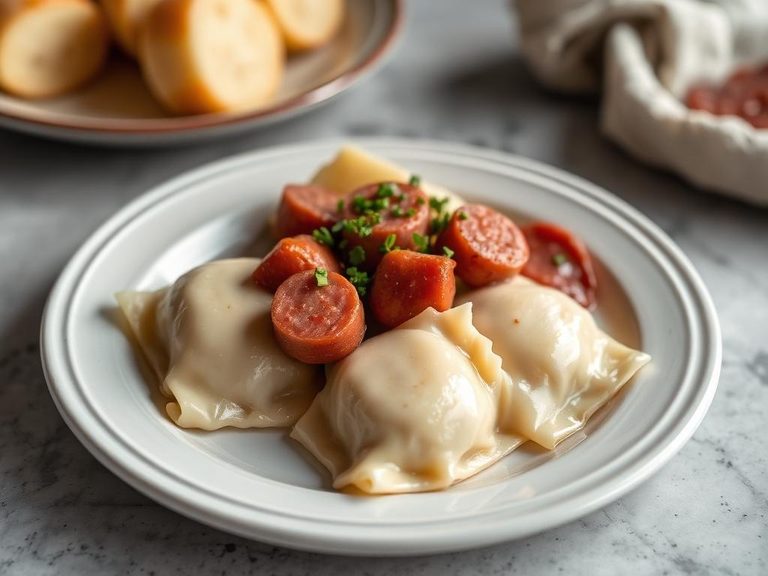
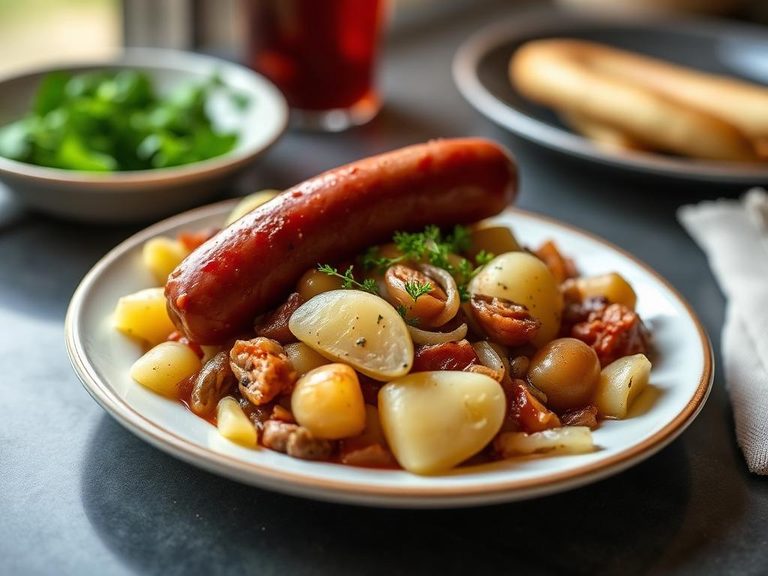
🍽️ Popular dishes


🌍 Where it's eaten
💡 Did you know?
The word 'kielbasa' is the Polish word for sausage, but in the U.S. it specifically refers to a particular type of Polish smoked sausage, often made in a U-shape.
Full nutrition (USDA data · scales with serving)
| Water | 52.8 g |
| Energy | 325 kcal |
| Energy | 1359 kj |
| Protein | 10.8 g |
| Total lipid (fat) | 29.6 g |
| Ash | 3.0 g |
| Carbohydrate, by difference | 3.7 g |
| Fiber, total dietary | 0.00 g |
| Total Sugars | 2.0 g |
| Sucrose | 0.00 g |
| Glucose | 1.6 g |
| Fructose | 0.00 g |
| Lactose | 0.00 g |
| Maltose | 0.45 g |
| Galactose | 0.00 g |
| Calcium, Ca | 24.0 mg |
| Iron, Fe | 0.75 mg |
| Magnesium, Mg | 14.0 mg |
| Phosphorus, P | 168 mg |
| Potassium, K | 217 mg |
| Sodium, Na | 928 mg |
| Zinc, Zn | 1.3 mg |
| Copper, Cu | 0.07 mg |
| Manganese, Mn | 0.05 mg |
| Selenium, Se | 17.6 ug |
| Vitamin C, total ascorbic acid | 19.1 mg |
| Thiamin | 0.15 mg |
| Riboflavin | 0.16 mg |
| Niacin | 3.1 mg |
| Pantothenic acid | 0.59 mg |
| Vitamin B-6 | 0.10 mg |
| Folate, total | 1.0 ug |
| Folic acid | 0.00 ug |
| Folate, food | 1.0 ug |
| Folate, DFE | 1.0 ug |
| Choline, total | 38.3 mg |
| Betaine | 3.4 mg |
| Vitamin B-12 | 0.68 ug |
| Vitamin B-12, added | 0.00 ug |
| Vitamin A, RAE | 8.0 ug |
| Retinol | 8.0 ug |
| Carotene, beta | 0.00 ug |
| Carotene, alpha | 0.00 ug |
| Cryptoxanthin, beta | 0.00 ug |
| Vitamin A, IU | 27.0 iu |
| Lycopene | 0.00 ug |
| Lutein + zeaxanthin | 0.00 ug |
| Vitamin E (alpha-tocopherol) | 0.42 mg |
| Vitamin E, added | 0.00 mg |
| Tocopherol, beta | 0.04 mg |
| Tocopherol, gamma | 0.37 mg |
| Tocopherol, delta | 0.00 mg |
| Tocotrienol, alpha | 0.01 mg |
| Tocotrienol, beta | 0.05 mg |
| Tocotrienol, gamma | 0.01 mg |
| Tocotrienol, delta | 0.13 mg |
| Vitamin D (D2 + D3), International Units | 30.0 iu |
| Vitamin D (D2 + D3) | 0.70 ug |
| Vitamin D2 (ergocalciferol) | 0.00 ug |
| Vitamin D3 (cholecalciferol) | 0.70 ug |
| Vitamin K (phylloquinone) | 0.30 ug |
| Vitamin K (Dihydrophylloquinone) | 0.00 ug |
| Vitamin K (Menaquinone-4) | 15.7 ug |
| Alcohol, ethyl | 0.00 g |
| Caffeine | 0.00 mg |
| Theobromine | 0.00 mg |
Fat & fatty acid profile (per 100g)
| Fatty acids, total saturated | 9.7 g |
| SFA 4:0 | 0.00 g |
| SFA 6:0 | 0.00 g |
| SFA 8:0 | 0.00 g |
| SFA 10:0 | 0.03 g |
| SFA 12:0 | 0.03 g |
| SFA 14:0 | 0.38 g |
| SFA 15:0 | 0.03 g |
| SFA 16:0 | 6.1 g |
| SFA 17:0 | 0.11 g |
| SFA 18:0 | 3.0 g |
| SFA 20:0 | 0.05 g |
| SFA 22:0 | 0.01 g |
| SFA 24:0 | 0.00 g |
| Fatty acids, total monounsaturated | 12.2 g |
| MUFA 14:1 | 0.03 g |
| MUFA 15:1 | 0.00 g |
| MUFA 16:1 | 0.63 g |
| MUFA 16:1 c | 0.62 g |
| MUFA 17:1 | 0.09 g |
| MUFA 18:1 | 11.1 g |
| MUFA 18:1 c | 10.9 g |
| MUFA 20:1 | 0.25 g |
| MUFA 22:1 | 0.09 g |
| MUFA 22:1 c | 0.09 g |
| MUFA 24:1 c | 0.01 g |
| Fatty acids, total polyunsaturated | 5.3 g |
| PUFA 18:2 | 4.6 g |
| PUFA 18:2 n-6 c,c | 4.6 g |
| PUFA 18:2 CLAs | 0.05 g |
| PUFA 18:3 | 0.25 g |
| PUFA 18:3 n-3 c,c,c (ALA) | 0.24 g |
| PUFA 18:3 n-6 c,c,c | 0.01 g |
| PUFA 18:3i | 0.00 g |
| PUFA 18:4 | 0.00 g |
| PUFA 20:2 n-6 c,c | 0.17 g |
| PUFA 20:3 | 0.06 g |
| PUFA 20:3 n-3 | 0.03 g |
| PUFA 20:3 n-6 | 0.03 g |
| PUFA 20:4 | 0.10 g |
| PUFA 20:5 n-3 (EPA) | 0.00 g |
| PUFA 22:4 | 0.04 g |
| PUFA 22:5 n-3 (DPA) | 0.02 g |
| PUFA 22:6 n-3 (DHA) | 0.01 g |
| Fatty acids, total trans | 0.23 g |
| Fatty acids, total trans-monoenoic | 0.19 g |
| TFA 16:1 t | 0.01 g |
| TFA 18:1 t | 0.18 g |
| TFA 22:1 t | 0.00 g |
| TFA 18:2 t not further defined | 0.04 g |
| Fatty acids, total trans-polyenoic | 0.04 g |
| Cholesterol | 61.0 mg |
Amino acid profile (per 100g)
| Tryptophan | 0.11 g |
| Threonine | 0.40 g |
| Isoleucine | 0.44 g |
| Leucine | 0.84 g |
| Lysine | 0.78 g |
| Methionine | 0.27 g |
| Cystine | 0.14 g |
| Phenylalanine | 0.40 g |
| Tyrosine | 0.33 g |
| Valine | 0.51 g |
| Arginine | 0.70 g |
| Histidine | 0.34 g |
| Alanine | 0.69 g |
| Aspartic acid | 0.97 g |
| Glutamic acid | 1.7 g |
| Glycine | 0.74 g |
| Proline | 0.73 g |
| Serine | 0.47 g |
| Hydroxyproline | 0.26 g |
FAQ
Is kielbasa already cooked?
Yes, traditional kielbasa is fully cooked during the smoking process. It is safe to eat cold straight from the package, though many prefer to heat it for enhanced flavor and texture.
What's the best way to cook pre-cooked kielbasa?
Pan-frying slices until crispy, grilling, or simmering in a stew are popular methods. Heating renders some fat, crisping the exterior, and melds flavors with other ingredients.
Can I freeze kielbasa?
Yes, it freezes very well. Wrap tightly in plastic wrap or freezer paper, or use a freezer bag. It will maintain best quality for 1-2 months.
Nutrient density (calculated · NRF9.3)
Nutrient Rich Foods index: beneficial nutrients (protein, fiber, vitamins, minerals) minus saturated fat, added sugar & sodium, per 100 kcal.
NRF9.3 index — Fulgoni, Keast & Drewnowski, 2009. Computed from USDA nutrients.
Weight-loss friendliness (composite index)
Energy density 3.25 kcal/g · 13% calories from protein · 0.0 g fiber · 2.0 g sugar per 100 g.
Composite of energy density (Rolls et al., 1999), protein & fiber satiety, minus sugar. A calculated heuristic — ranks satiety-per-calorie, not a clinical measure.
Dietary load (calculated from USDA values)
Potential renal acid load. Positive = acid-forming, negative = alkaline-forming.
Sodium-to-potassium ratio: 4.28 (lower is better — aim for ≤ 1)
Sodium:potassium per WHO potassium guidance. Computed from USDA nutrients.