Milk, whole, 3.25% milkfat, with added vitamin D
Whole food · Dairy and Egg Products
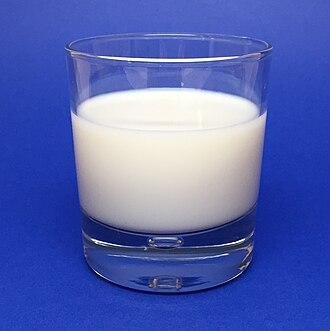
Photo: Wikipedia
Whole milk with added vitamin D is a creamy, opaque white liquid with a rich, slightly sweet flavor and a smooth, full-bodied mouthfeel. Its signature 3.25% milkfat provides a satisfying richness that coats the palate. Nutritionally, it's a standout source of high-quality protein and calcium, with the added vitamin D crucial for bone health.
💚 Why it's loved
People love whole milk for its comforting, nostalgic creaminess and pure, mild sweetness that elevates both sweet and savory dishes. Its unparalleled versatility makes it a foundational ingredient in everything from morning coffee and cereal to creamy sauces and baked goods.
⚠️ Watch-outs & how to enjoy it better
Whole milk is a common allergen (contains milk protein) and is high in saturated fat, which some may need to limit. Those with lactose intolerance may experience digestive discomfort. To counteract this, lactose-free versions are widely available, and for saturated fat, it can be used in moderation or substituted with plant-based milks in some recipes.
Key benefits
- Excellent source of calcium for bone and teeth strength
- Provides high-quality, complete protein for muscle maintenance
- Fortified with vitamin D to enhance calcium absorption
- Contains naturally occurring nutrients like potassium and B12
- The fat content aids in the absorption of fat-soluble vitamins (A, D, E, K)
🍽️ Popular dishes





🌍 Where it's eaten
💡 Did you know?
The white color of milk comes from casein micelles, which scatter all wavelengths of visible light equally, while the fat globules contribute to its creamy texture.
Full nutrition (scales with serving)
| Water | 88.1 g |
| Energy | 60.0 kcal |
| Energy | 252 kj |
| Nitrogen | 0.51 g |
| Protein | 3.3 g |
| Total lipid (fat) | 3.2 g |
| Total fat (NLEA) | 2.8 g |
| Ash | 0.80 g |
| Carbohydrate, by difference | 4.7 g |
| Sugars, Total | 4.8 g |
| Sucrose | 0.00 g |
| Glucose | 0.00 g |
| Fructose | 0.00 g |
| Lactose | 4.8 g |
| Maltose | 0.00 g |
| Galactose | 0.00 g |
| Calcium, Ca | 123 mg |
| Iron, Fe | 0.00 mg |
| Magnesium, Mg | 11.9 mg |
| Phosphorus, P | 101 mg |
| Potassium, K | 150 mg |
| Sodium, Na | 38.0 mg |
| Zinc, Zn | 0.41 mg |
| Copper, Cu | 0.00 mg |
| Manganese, Mn | 0.00 mg |
| Iodine, I | 37.9 ug |
| Selenium, Se | 1.9 ug |
| Thiamin | 0.06 mg |
| Riboflavin | 0.14 mg |
| Niacin | 0.10 mg |
| Pantothenic acid | 0.36 mg |
| Vitamin B-6 | 0.06 mg |
| Folate, total | 0.00 ug |
| Choline, total | 17.8 mg |
| Choline, free | 3.0 mg |
| Choline, from phosphocholine | 1.3 mg |
| Choline, from phosphotidyl choline | 1.7 mg |
| Choline, from glycerophosphocholine | 10.3 mg |
| Choline, from sphingomyelin | 1.4 mg |
| Betaine | 0.70 mg |
| Vitamin B-12 | 0.54 ug |
| Vitamin A, RAE | 32.0 ug |
| Retinol | 31.0 ug |
| Carotene, beta | 7.0 ug |
| cis-beta-Carotene | 2.0 ug |
| trans-beta-Carotene | 5.0 ug |
| Carotene, alpha | 0.00 ug |
| Cryptoxanthin, beta | 0.00 ug |
| Cryptoxanthin, alpha | 0.00 ug |
| Lycopene | 0.00 ug |
| cis-Lycopene | 0.00 ug |
| trans-Lycopene | 0.00 ug |
| cis-Lutein/Zeaxanthin | 0.00 ug |
| Lutein | 5.0 ug |
| Zeaxanthin | 1.0 ug |
| Vitamin E (alpha-tocopherol) | 0.05 mg |
| Tocopherol, beta | 0.00 mg |
| Tocopherol, gamma | 0.00 mg |
| Tocopherol, delta | 0.00 mg |
| Tocotrienol, alpha | 0.00 mg |
| Tocotrienol, beta | 0.00 mg |
| Tocotrienol, gamma | 0.00 mg |
| Tocotrienol, delta | 0.00 mg |
| Vitamin D (D2 + D3), International Units | 38.0 iu |
| Vitamin D (D2 + D3) | 1.0 ug |
| Vitamin D2 (ergocalciferol) | 0.00 ug |
| Vitamin D3 (cholecalciferol) | 1.0 ug |
| 25-hydroxycholecalciferol | 0.00 ug |
| Fatty acids, total saturated | 1.9 g |
| SFA 4:0 | 0.07 g |
| SFA 5:0 | 0.00 g |
| SFA 6:0 | 0.05 g |
| SFA 7:0 | 0.00 g |
| SFA 8:0 | 0.03 g |
| SFA 9:0 | 0.00 g |
| SFA 10:0 | 0.08 g |
| SFA 11:0 | 0.00 g |
| SFA 12:0 | 0.10 g |
| SFA 14:0 | 0.30 g |
| SFA 15:0 | 0.03 g |
| SFA 16:0 | 0.86 g |
| SFA 17:0 | 0.02 g |
| SFA 18:0 | 0.31 g |
| SFA 20:0 | 0.00 g |
| SFA 21:0 | 0.00 g |
| SFA 22:0 | 0.00 g |
| SFA 23:0 | 0.00 g |
| SFA 24:0 | 0.00 g |
| Fatty acids, total monounsaturated | 0.69 g |
| MUFA 12:1 | 0.00 g |
| MUFA 14:1 c | 0.02 g |
| MUFA 15:1 | 0.00 g |
| MUFA 16:1 c | 0.04 g |
| MUFA 17:1 | 0.01 g |
| MUFA 17:1 c | 0.01 g |
| MUFA 18:1 c | 0.61 g |
| MUFA 20:1 c | 0.00 g |
| MUFA 22:1 c | 0.00 g |
| MUFA 22:1 n-9 | 0.00 g |
| MUFA 22:1 n-11 | 0.00 g |
| MUFA 24:1 c | 0.00 g |
| Fatty acids, total polyunsaturated | 0.11 g |
| PUFA 18:2 c | 0.10 g |
| PUFA 18:2 n-6 c,c | 0.08 g |
| PUFA 18:2 CLAs | 0.01 g |
| PUFA 18:3 c | 0.01 g |
| PUFA 18:3 n-3 c,c,c (ALA) | 0.01 g |
| PUFA 18:3 n-6 c,c,c | 0.00 g |
| PUFA 18:4 | 0.00 g |
| PUFA 20:2 c | 0.00 g |
| PUFA 20:2 n-6 c,c | 0.00 g |
| PUFA 20:3 c | 0.00 g |
| PUFA 20:3 n-3 | 0.00 g |
| PUFA 20:3 n-6 | 0.00 g |
| PUFA 20:3 n-9 | 0.00 g |
| PUFA 22:3 | 0.00 g |
| PUFA 20:4 | 0.00 g |
| PUFA 20:4c | 0.00 g |
| PUFA 20:5c | 0.00 g |
| PUFA 20:5 n-3 (EPA) | 0.00 g |
| PUFA 22:2 | 0.00 g |
| PUFA 22:5 c | 0.00 g |
| PUFA 22:4 | 0.00 g |
| PUFA 22:5 n-3 (DPA) | 0.00 g |
| PUFA 22:6 c | 0.00 g |
| PUFA 22:6 n-3 (DHA) | 0.00 g |
| Fatty acids, total trans | 0.11 g |
| Fatty acids, total trans-monoenoic | 0.10 g |
| TFA 14:1 t | 0.01 g |
| TFA 16:1 t | 0.01 g |
| TFA 18:1 t | 0.08 g |
| TFA 20:1 t | 0.00 g |
| TFA 22:1 t | 0.00 g |
| Fatty acids, total trans-dienoic | 0.02 g |
| TFA 18:2 t not further defined | 0.02 g |
| Fatty acids, total trans-polyenoic | 0.00 g |
| TFA 18:3 t | 0.00 g |
| Cholesterol | 12.0 mg |
| Tryptophan | 0.04 g |
| Threonine | 0.15 g |
| Isoleucine | 0.17 g |
| Leucine | 0.33 g |
| Lysine | 0.30 g |
| Methionine | 0.09 g |
| Phenylalanine | 0.16 g |
| Tyrosine | 0.16 g |
| Valine | 0.21 g |
| Arginine | 0.13 g |
| Histidine | 0.10 g |
| Alanine | 0.11 g |
| Aspartic acid | 0.28 g |
| Glutamic acid | 0.79 g |
| Glycine | 0.07 g |
| Proline | 0.33 g |
| Serine | 0.19 g |
| Hydroxyproline | 0.00 g |
| Cysteine | 0.04 g |
FAQ
What's the difference between whole milk and other fat percentages?
Whole milk contains its natural 3.25% milkfat. Reduced-fat (2%), low-fat (1%), and skim (0%) milks have had varying amounts of the cream (fat) removed, which also reduces calories and saturated fat but can change the texture and flavor.
Why is vitamin D added to milk?
Vitamin D is added to help the body absorb calcium more effectively, promoting bone health. It's a public health measure to combat vitamin D deficiency, which is common due to limited sun exposure.
Can whole milk be used in coffee and cooking?
Absolutely. Its high fat content makes it excellent for frothing in lattes and cappuccinos, and it adds richness to sauces, soups, and baked goods without curdling as easily as lower-fat milks when heated.