

Vegetable juice cocktail, low sodium, canned
Whole food · Vegetables and Vegetable Products

Photo: Wikipedia
A vibrant, savory blend of vegetable juices like tomato, carrot, celery, and beet, canned for shelf-stability. It delivers a smooth, drinkable texture with a balanced, slightly earthy sweetness and a pronounced umami backbone. Nutritionally, it's a low-calorie, hydrating option that provides a concentrated dose of vegetable-derived vitamins and minerals.
Calorie split: 17% protein · 70% carbs · 13% fat
↓ Full nutrition💚 Why it's loved
People love it as a versatile base for cocktails like the Bloody Mary or as a quick, savory drink that feels both nourishing and flavorful. Its deep, complex taste profile makes it a staple in home bars and a comforting, familiar flavor in many households.
⚠️ Watch-outs & how to enjoy it better
Despite being 'low sodium,' canned versions can still contain significant sodium, which may concern those monitoring blood pressure. The natural sugars, while low, can contribute to blood sugar spikes if consumed in large quantities without protein or fat. Tip: Pair a serving with a hard-boiled egg or a handful of nuts to slow sugar absorption and add satiety.
Key benefits
- Excellent source of vitamins A and C from tomato and carrot
- Provides electrolytes like potassium for hydration
- Contains lycopene, an antioxidant linked to heart health
- Low in calories and fat, suitable for weight management
- Offers a convenient way to increase daily vegetable intake
🍽️ Popular dishes


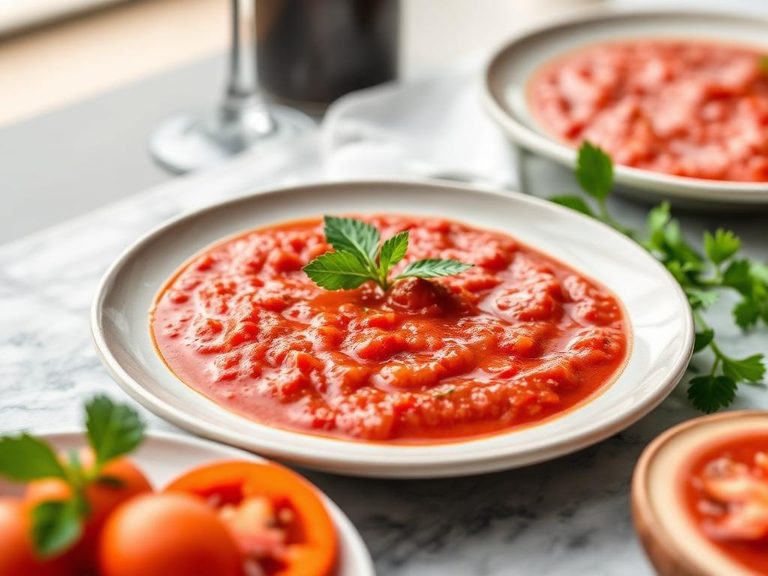
🌍 Where it's eaten
💡 Did you know?
The original 'vegetable juice cocktail' was popularized in the 1930s by the Campbell Soup Company under the V8 brand, marketing it as a complete serving of vegetables in one glass.
Full nutrition (USDA data · scales with serving)
| Water | 94.1 g |
| Energy | 19.0 kcal |
| Energy | 78.0 kj |
| Protein | 0.91 g |
| Total lipid (fat) | 0.32 g |
| Ash | 0.82 g |
| Carbohydrate, by difference | 3.8 g |
| Fiber, total dietary | 0.50 g |
| Total Sugars | 2.8 g |
| Sucrose | 0.09 g |
| Glucose | 1.3 g |
| Fructose | 1.4 g |
| Lactose | 0.00 g |
| Maltose | 0.00 g |
| Galactose | 0.00 g |
| Starch | 0.30 g |
| Calcium, Ca | 15.0 mg |
| Iron, Fe | 0.29 mg |
| Magnesium, Mg | 12.0 mg |
| Phosphorus, P | 19.0 mg |
| Potassium, K | 204 mg |
| Sodium, Na | 55.0 mg |
| Zinc, Zn | 0.12 mg |
| Copper, Cu | 0.07 mg |
| Manganese, Mn | 0.08 mg |
| Selenium, Se | 0.20 ug |
| Vitamin C, total ascorbic acid | 54.3 mg |
| Thiamin | 0.05 mg |
| Riboflavin | 0.03 mg |
| Niacin | 0.72 mg |
| Pantothenic acid | 0.25 mg |
| Vitamin B-6 | 0.07 mg |
| Folate, total | 21.0 ug |
| Folate, food | 21.0 ug |
| Choline, total | 8.1 mg |
| Betaine | 0.80 mg |
| Vitamin B-12 | 0.00 ug |
| Vitamin B-12, added | 0.00 ug |
| Vitamin A, RAE | 35.0 ug |
| Retinol | 0.00 ug |
| Carotene, beta | 377 ug |
| Carotene, alpha | 93.0 ug |
| Cryptoxanthin, beta | 0.00 ug |
| Vitamin A, IU | 706 iu |
| Lycopene | 7119 ug |
| Lutein + zeaxanthin | 278 ug |
| Vitamin E (alpha-tocopherol) | 1.0 mg |
| Vitamin E, added | 0.00 mg |
| Tocopherol, beta | 0.02 mg |
| Tocopherol, gamma | 0.06 mg |
| Tocopherol, delta | 0.00 mg |
| Tocotrienol, alpha | 0.00 mg |
| Tocotrienol, beta | 0.34 mg |
| Tocotrienol, gamma | 0.00 mg |
| Tocotrienol, delta | 0.00 mg |
| Vitamin D (D2 + D3), International Units | 0.00 iu |
| Vitamin D (D2 + D3) | 0.00 ug |
| Vitamin K (phylloquinone) | 6.1 ug |
| Vitamin K (Dihydrophylloquinone) | 0.00 ug |
| Alcohol, ethyl | 0.00 g |
| Caffeine | 0.00 mg |
| Theobromine | 0.00 mg |
Fat & fatty acid profile (per 100g)
| Fatty acids, total saturated | 0.09 g |
| SFA 4:0 | 0.00 g |
| SFA 6:0 | 0.00 g |
| SFA 8:0 | 0.00 g |
| SFA 10:0 | 0.00 g |
| SFA 12:0 | 0.00 g |
| SFA 14:0 | 0.00 g |
| SFA 15:0 | 0.00 g |
| SFA 16:0 | 0.06 g |
| SFA 17:0 | 0.00 g |
| SFA 18:0 | 0.02 g |
| SFA 20:0 | 0.01 g |
| SFA 22:0 | 0.00 g |
| SFA 24:0 | 0.00 g |
| Fatty acids, total monounsaturated | 0.06 g |
| MUFA 14:1 | 0.00 g |
| MUFA 15:1 | 0.00 g |
| MUFA 16:1 | 0.00 g |
| MUFA 16:1 c | 0.00 g |
| MUFA 17:1 | 0.00 g |
| MUFA 18:1 | 0.06 g |
| MUFA 18:1 c | 0.06 g |
| MUFA 20:1 | 0.00 g |
| MUFA 22:1 | 0.00 g |
| MUFA 22:1 c | 0.00 g |
| MUFA 24:1 c | 0.00 g |
| Fatty acids, total polyunsaturated | 0.08 g |
| PUFA 18:2 | 0.07 g |
| PUFA 18:2 n-6 c,c | 0.07 g |
| PUFA 18:2 CLAs | 0.00 g |
| PUFA 18:3 | 0.01 g |
| PUFA 18:3 n-3 c,c,c (ALA) | 0.01 g |
| PUFA 18:3 n-6 c,c,c | 0.00 g |
| PUFA 18:3i | 0.00 g |
| PUFA 18:4 | 0.00 g |
| PUFA 20:2 n-6 c,c | 0.00 g |
| PUFA 20:3 | 0.00 g |
| PUFA 20:3 n-3 | 0.00 g |
| PUFA 20:3 n-6 | 0.00 g |
| PUFA 20:4 | 0.00 g |
| PUFA 20:5 n-3 (EPA) | 0.00 g |
| PUFA 22:4 | 0.00 g |
| PUFA 22:5 n-3 (DPA) | 0.00 g |
| PUFA 22:6 n-3 (DHA) | 0.00 g |
| Fatty acids, total trans | 0.00 g |
| Fatty acids, total trans-monoenoic | 0.00 g |
| TFA 16:1 t | 0.00 g |
| TFA 18:1 t | 0.00 g |
| TFA 22:1 t | 0.00 g |
| TFA 18:2 t not further defined | 0.00 g |
| Fatty acids, total trans-polyenoic | 0.00 g |
| Cholesterol | 0.00 mg |
Amino acid profile (per 100g)
| Tryptophan | 0.01 g |
| Threonine | 0.03 g |
| Isoleucine | 0.02 g |
| Leucine | 0.03 g |
| Lysine | 0.03 g |
| Methionine | 0.01 g |
| Cystine | 0.01 g |
| Phenylalanine | 0.03 g |
| Tyrosine | 0.01 g |
| Valine | 0.02 g |
| Arginine | 0.02 g |
| Histidine | 0.01 g |
| Alanine | 0.03 g |
| Aspartic acid | 0.14 g |
| Glutamic acid | 0.45 g |
| Glycine | 0.02 g |
| Proline | 0.02 g |
| Serine | 0.03 g |
FAQ
Is low-sodium vegetable juice as nutritious as fresh vegetables?
It retains many vitamins and antioxidants, but the canning process can reduce heat-sensitive nutrients like vitamin C. It's a great supplement but shouldn't replace whole vegetables in your diet due to differences in fiber content.
Can I use this as a base for soup?
Absolutely. It's a classic starter for minestrone, tomato-based soups, and stews, adding depth and vegetable flavor without the need for extensive chopping.
Why does it sometimes separate in the can?
Natural separation of vegetable solids and liquids is normal. Simply shake the can well before opening to recombine everything for consistent flavor and texture.
Nutrient density (calculated · NRF9.3)
Nutrient Rich Foods index: beneficial nutrients (protein, fiber, vitamins, minerals) minus saturated fat, added sugar & sodium, per 100 kcal.
NRF9.3 index — Fulgoni, Keast & Drewnowski, 2009. Computed from USDA nutrients.
Weight-loss friendliness (composite index)
Energy density 0.19 kcal/g · 19% calories from protein · 0.5 g fiber · 2.8 g sugar per 100 g.
Composite of energy density (Rolls et al., 1999), protein & fiber satiety, minus sugar. A calculated heuristic — ranks satiety-per-calorie, not a clinical measure.
Dietary load (calculated from USDA values)
Potential renal acid load. Positive = acid-forming, negative = alkaline-forming.
Sodium-to-potassium ratio: 0.27 (lower is better — aim for ≤ 1)
Sodium:potassium per WHO potassium guidance. Computed from USDA nutrients.