

Vegetable juice cocktail, canned
Whole food · Vegetables and Vegetable Products

Photo: Wikipedia
This is a smooth, savory-sweet blend of tomato, carrot, celery, and other vegetables, canned for shelf-stable convenience. It offers a bright, tangy flavor with a thin, juice-like texture, and is notably low in calories while providing a modest source of natural sugars and a touch of fiber.
Calorie split: 17% protein · 70% carbs · 13% fat
↓ Full nutrition💚 Why it's loved
People love it for its refreshing, savory flavor that's less acidic than pure tomato juice, and its versatility as a quick drink, cocktail base, or soup starter.
⚠️ Watch-outs & how to enjoy it better
Canned versions can be high in sodium, which may concern those monitoring salt intake. The natural sugars, while not added, can still contribute to blood sugar fluctuations if consumed in large quantities. Choose low-sodium versions and pair with a source of protein or healthy fat (like nuts or cheese) to help stabilize blood sugar response.
Key benefits
- Very low in calories, making it suitable for calorie-conscious diets.
- Provides a convenient source of vegetable nutrients like lycopene and beta-carotene.
- Contains no added fats, making it a lean beverage option.
- Offers a small amount of dietary fiber from the blended vegetables.
- Shelf-stable and ready to drink, requiring no preparation.
🍽️ Popular dishes


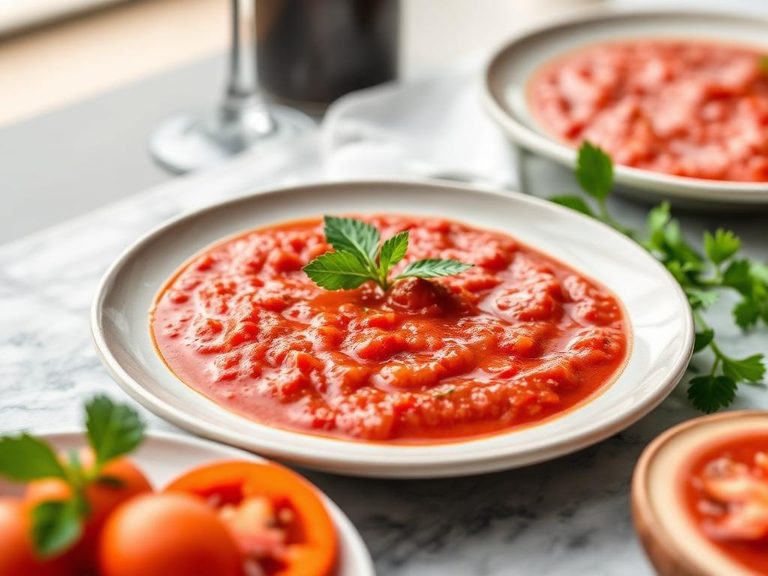
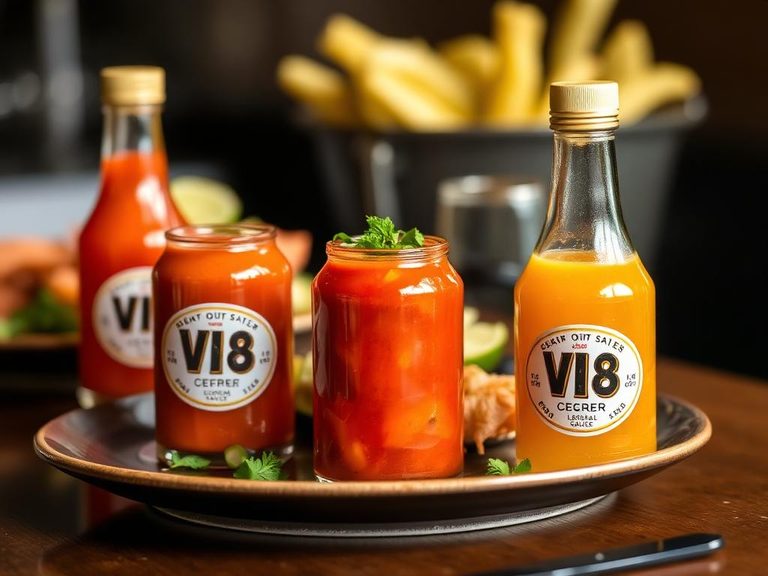
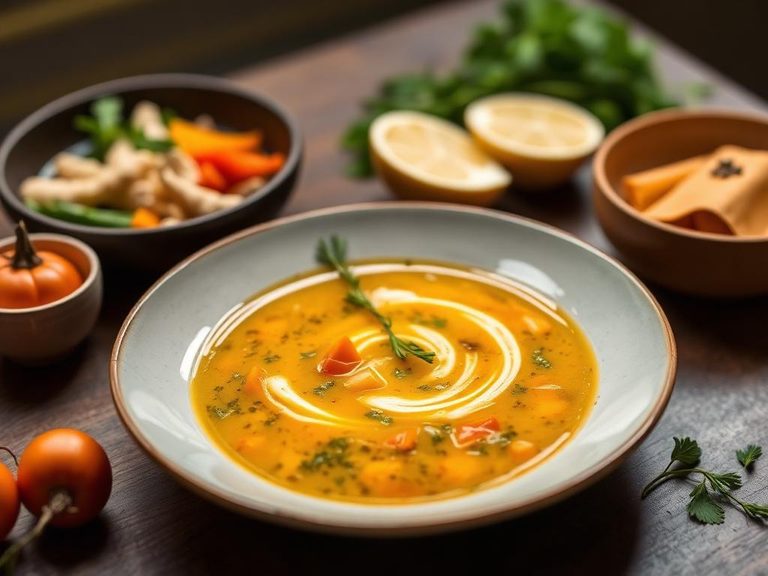
🌍 Where it's eaten
💡 Did you know?
The iconic V8 vegetable juice brand was created in 1933 by a Florida resident who blended eight vegetables, including tomatoes, carrots, and celery, into a single canned drink.
Full nutrition (USDA data · scales with serving)
| Water | 94.1 g |
| Energy | 22.0 kcal |
| Energy | 92.0 kj |
| Protein | 0.93 g |
| Total lipid (fat) | 0.31 g |
| Ash | 0.80 g |
| Carbohydrate, by difference | 3.9 g |
| Fiber, total dietary | 0.50 g |
| Total Sugars | 2.8 g |
| Sucrose | 0.07 g |
| Glucose | 1.4 g |
| Fructose | 1.4 g |
| Lactose | 0.00 g |
| Maltose | 0.00 g |
| Galactose | 0.00 g |
| Starch | 0.30 g |
| Calcium, Ca | 14.0 mg |
| Iron, Fe | 0.28 mg |
| Magnesium, Mg | 11.0 mg |
| Phosphorus, P | 19.0 mg |
| Potassium, K | 185 mg |
| Sodium, Na | 169 mg |
| Zinc, Zn | 0.12 mg |
| Copper, Cu | 0.07 mg |
| Manganese, Mn | 0.08 mg |
| Selenium, Se | 0.20 ug |
| Vitamin C, total ascorbic acid | 54.3 mg |
| Thiamin | 0.05 mg |
| Riboflavin | 0.03 mg |
| Niacin | 0.72 mg |
| Pantothenic acid | 0.25 mg |
| Vitamin B-6 | 0.07 mg |
| Folate, total | 21.0 ug |
| Folic acid | 0.00 ug |
| Folate, food | 21.0 ug |
| Folate, DFE | 21.0 ug |
| Choline, total | 8.1 mg |
| Betaine | 0.80 mg |
| Vitamin B-12 | 0.00 ug |
| Vitamin B-12, added | 0.00 ug |
| Vitamin A, RAE | 35.0 ug |
| Retinol | 0.00 ug |
| Carotene, beta | 377 ug |
| Carotene, alpha | 93.0 ug |
| Cryptoxanthin, beta | 0.00 ug |
| Vitamin A, IU | 706 iu |
| Lycopene | 7119 ug |
| Lutein + zeaxanthin | 278 ug |
| Vitamin E (alpha-tocopherol) | 1.0 mg |
| Vitamin E, added | 0.00 mg |
| Tocopherol, beta | 0.03 mg |
| Tocopherol, gamma | 0.06 mg |
| Tocopherol, delta | 0.00 mg |
| Tocotrienol, alpha | 0.00 mg |
| Tocotrienol, beta | 0.34 mg |
| Tocotrienol, gamma | 0.00 mg |
| Tocotrienol, delta | 0.00 mg |
| Vitamin D (D2 + D3), International Units | 0.00 iu |
| Vitamin D (D2 + D3) | 0.00 ug |
| Vitamin K (phylloquinone) | 6.1 ug |
| Vitamin K (Dihydrophylloquinone) | 0.00 ug |
| Alcohol, ethyl | 0.00 g |
| Caffeine | 0.00 mg |
| Theobromine | 0.00 mg |
Fat & fatty acid profile (per 100g)
| Fatty acids, total saturated | 0.09 g |
| SFA 4:0 | 0.00 g |
| SFA 6:0 | 0.00 g |
| SFA 8:0 | 0.00 g |
| SFA 10:0 | 0.00 g |
| SFA 12:0 | 0.00 g |
| SFA 14:0 | 0.00 g |
| SFA 15:0 | 0.00 g |
| SFA 16:0 | 0.06 g |
| SFA 17:0 | 0.00 g |
| SFA 18:0 | 0.02 g |
| SFA 20:0 | 0.01 g |
| SFA 22:0 | 0.00 g |
| SFA 24:0 | 0.00 g |
| Fatty acids, total monounsaturated | 0.06 g |
| MUFA 14:1 | 0.00 g |
| MUFA 15:1 | 0.00 g |
| MUFA 16:1 | 0.00 g |
| MUFA 16:1 c | 0.00 g |
| MUFA 17:1 | 0.00 g |
| MUFA 18:1 | 0.06 g |
| MUFA 18:1 c | 0.06 g |
| MUFA 20:1 | 0.00 g |
| MUFA 22:1 | 0.00 g |
| MUFA 22:1 c | 0.00 g |
| MUFA 24:1 c | 0.00 g |
| Fatty acids, total polyunsaturated | 0.08 g |
| PUFA 18:2 | 0.06 g |
| PUFA 18:2 n-6 c,c | 0.06 g |
| PUFA 18:2 CLAs | 0.00 g |
| PUFA 18:3 | 0.01 g |
| PUFA 18:3 n-3 c,c,c (ALA) | 0.01 g |
| PUFA 18:3 n-6 c,c,c | 0.00 g |
| PUFA 18:3i | 0.00 g |
| PUFA 18:4 | 0.00 g |
| PUFA 20:2 n-6 c,c | 0.00 g |
| PUFA 20:3 | 0.00 g |
| PUFA 20:3 n-3 | 0.00 g |
| PUFA 20:3 n-6 | 0.00 g |
| PUFA 20:4 | 0.00 g |
| PUFA 20:5 n-3 (EPA) | 0.00 g |
| PUFA 22:4 | 0.00 g |
| PUFA 22:5 n-3 (DPA) | 0.00 g |
| PUFA 22:6 n-3 (DHA) | 0.00 g |
| Fatty acids, total trans | 0.00 g |
| Fatty acids, total trans-monoenoic | 0.00 g |
| TFA 16:1 t | 0.00 g |
| TFA 18:1 t | 0.00 g |
| TFA 22:1 t | 0.00 g |
| TFA 18:2 t not further defined | 0.00 g |
| Fatty acids, total trans-polyenoic | 0.00 g |
| Cholesterol | 0.00 mg |
Amino acid profile (per 100g)
| Tryptophan | 0.01 g |
| Threonine | 0.03 g |
| Isoleucine | 0.02 g |
| Leucine | 0.03 g |
| Lysine | 0.03 g |
| Methionine | 0.01 g |
| Cystine | 0.01 g |
| Phenylalanine | 0.03 g |
| Tyrosine | 0.01 g |
| Valine | 0.02 g |
| Arginine | 0.02 g |
| Histidine | 0.01 g |
| Alanine | 0.03 g |
| Aspartic acid | 0.14 g |
| Glutamic acid | 0.46 g |
| Glycine | 0.02 g |
| Proline | 0.02 g |
| Serine | 0.03 g |
FAQ
Is vegetable juice cocktail the same as 100% vegetable juice?
No. A 'cocktail' typically contains added salt, sugar, or flavorings and may have a lower percentage of vegetable juice than a product labeled '100% vegetable juice.'
Can I use this in cooking?
Yes, it's excellent as a low-calorie liquid base for soups, stews, or braising meats, adding flavor without significant fat or calories.
Does it retain the nutrients of fresh vegetables?
While canning preserves many heat-sensitive nutrients, some vitamins (like vitamin C) may be reduced. However, minerals and antioxidants like lycopene remain stable and bioavailable.
Nutrient density (calculated · NRF9.3)
Nutrient Rich Foods index: beneficial nutrients (protein, fiber, vitamins, minerals) minus saturated fat, added sugar & sodium, per 100 kcal.
NRF9.3 index — Fulgoni, Keast & Drewnowski, 2009. Computed from USDA nutrients.
Weight-loss friendliness (composite index)
Energy density 0.22 kcal/g · 17% calories from protein · 0.5 g fiber · 2.8 g sugar per 100 g.
Composite of energy density (Rolls et al., 1999), protein & fiber satiety, minus sugar. A calculated heuristic — ranks satiety-per-calorie, not a clinical measure.
Dietary load (calculated from USDA values)
Potential renal acid load. Positive = acid-forming, negative = alkaline-forming.
Sodium-to-potassium ratio: 0.91 (lower is better — aim for ≤ 1)
Sodium:potassium per WHO potassium guidance. Computed from USDA nutrients.