

Hummus, commercial
Whole food · Legumes and Legume Products
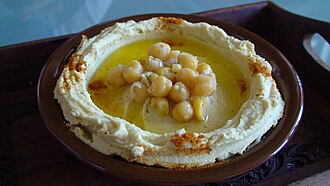
Photo: Wikipedia
Commercial hummus is a creamy, savory emulsion of cooked chickpeas, tahini, lemon, and garlic, with a smooth, slightly grainy texture and a rich, nutty flavor. It's a calorie-dense dip, with a significant portion of its energy coming from healthy fats, particularly from the tahini. A 100g serving provides a good source of plant-based protein and fiber, making it a satisfying and nutrient-dense food.
Calorie split: 12% protein · 24% carbs · 64% fat
↓ Full nutrition💚 Why it's loved
People love hummus for its creamy, savory flavor and incredible versatility—it's a staple dip, spread, and sauce across many cultures. Its satisfying texture and ability to pair with everything from fresh vegetables to warm pita bread make it a universally beloved comfort food.
⚠️ Watch-outs & how to enjoy it better
Commercial hummus can be high in sodium and fat, which may be a concern for those monitoring salt intake or on low-fat diets. It is also a common allergen (due to tahini/sesame and chickpeas), and its high fiber content can cause digestive discomfort for some; pairing it with low-fiber foods and drinking water can help mitigate this.
Key benefits
- High in plant-based protein for muscle maintenance.
- Rich in dietary fiber to support digestive health.
- Provides healthy unsaturated fats from tahini and olive oil.
- Contains essential minerals like iron, magnesium, and phosphorus.
- A versatile, satisfying base for meals and snacks.
🍽️ Popular dishes

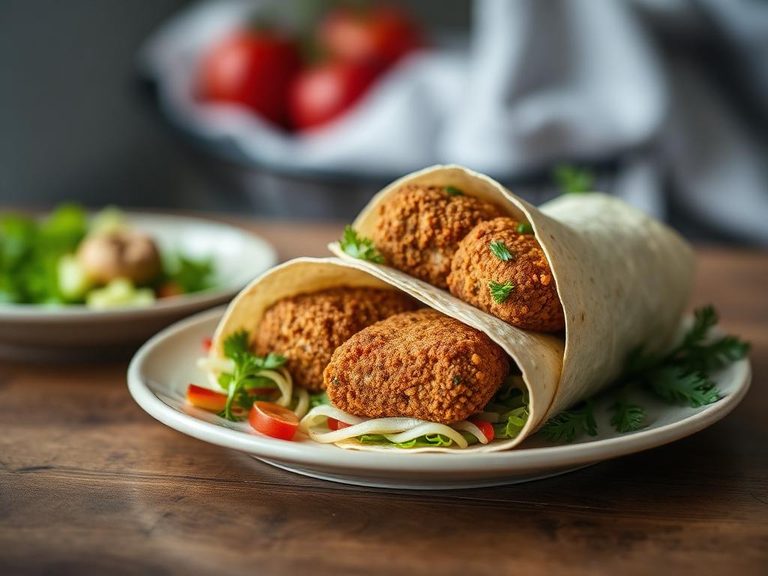
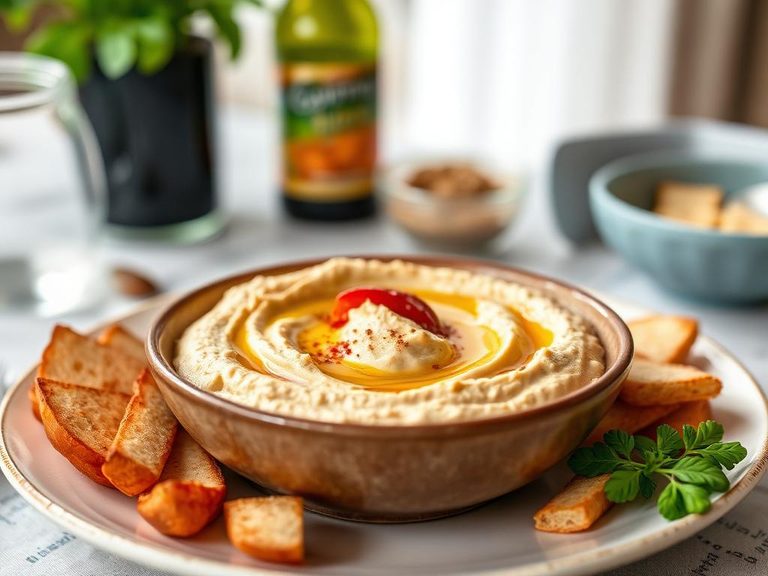


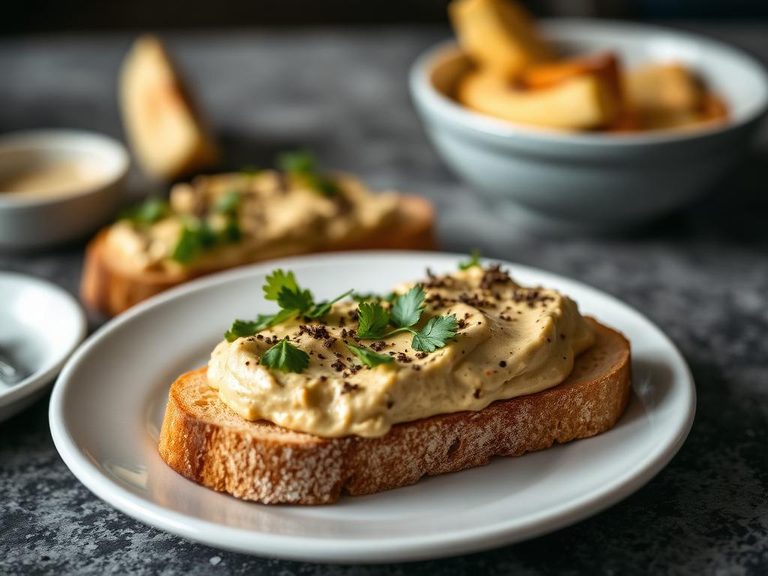
🌍 Where it's eaten
💡 Did you know?
The world's largest serving of hummus, weighing over 10,000 kilograms, was made in Lebanon in 2010.
Full nutrition (USDA data · scales with serving)
| Water | 57.4 g |
| Energy | 237 kcal |
| Energy | 992 kj |
| Protein | 7.8 g |
| Total lipid (fat) | 17.8 g |
| Ash | 2.0 g |
| Carbohydrate, by difference | 15.0 g |
| Fiber, total dietary | 5.5 g |
| Total Sugars | 0.62 g |
| Sucrose | 0.34 g |
| Glucose | 0.00 g |
| Fructose | 0.28 g |
| Lactose | 0.00 g |
| Maltose | 0.00 g |
| Galactose | 0.00 g |
| Starch | 8.1 g |
| Calcium, Ca | 47.0 mg |
| Iron, Fe | 2.5 mg |
| Magnesium, Mg | 75.0 mg |
| Phosphorus, P | 181 mg |
| Potassium, K | 312 mg |
| Sodium, Na | 426 mg |
| Zinc, Zn | 1.4 mg |
| Copper, Cu | 0.38 mg |
| Manganese, Mn | 1.2 mg |
| Selenium, Se | 4.7 ug |
| Vitamin C, total ascorbic acid | 0.00 mg |
| Thiamin | 0.16 mg |
| Riboflavin | 0.13 mg |
| Niacin | 1.0 mg |
| Pantothenic acid | 0.35 mg |
| Vitamin B-6 | 0.15 mg |
| Folate, total | 48.0 ug |
| Folic acid | 0.00 ug |
| Folate, food | 48.0 ug |
| Folate, DFE | 48.0 ug |
| Vitamin B-12 | 0.00 ug |
| Vitamin B-12, added | 0.00 ug |
| Vitamin A, RAE | 1.0 ug |
| Retinol | 0.00 ug |
| Carotene, beta | 12.0 ug |
| Carotene, alpha | 0.00 ug |
| Cryptoxanthin, beta | 3.0 ug |
| Vitamin A, IU | 23.0 iu |
| Lycopene | 0.00 ug |
| Lutein + zeaxanthin | 258 ug |
| Vitamin E (alpha-tocopherol) | 1.5 mg |
| Vitamin E, added | 0.00 mg |
| Tocopherol, beta | 0.34 mg |
| Tocopherol, gamma | 11.0 mg |
| Tocopherol, delta | 2.1 mg |
| Tocotrienol, alpha | 0.00 mg |
| Tocotrienol, beta | 0.00 mg |
| Tocotrienol, gamma | 0.00 mg |
| Tocotrienol, delta | 0.00 mg |
| Vitamin D (D2 + D3), International Units | 0.00 iu |
| Vitamin D (D2 + D3) | 0.00 ug |
| Vitamin K (phylloquinone) | 22.8 ug |
| Vitamin K (Dihydrophylloquinone) | 0.00 ug |
| Vitamin K (Menaquinone-4) | 0.00 ug |
| Alcohol, ethyl | 0.00 g |
| Caffeine | 0.00 mg |
| Theobromine | 0.00 mg |
Fat & fatty acid profile (per 100g)
| Fatty acids, total saturated | 2.6 g |
| SFA 4:0 | 0.00 g |
| SFA 6:0 | 0.00 g |
| SFA 8:0 | 0.00 g |
| SFA 10:0 | 0.00 g |
| SFA 12:0 | 0.00 g |
| SFA 14:0 | 0.01 g |
| SFA 15:0 | 0.00 g |
| SFA 16:0 | 1.7 g |
| SFA 17:0 | 0.01 g |
| SFA 18:0 | 0.73 g |
| SFA 20:0 | 0.07 g |
| SFA 22:0 | 0.04 g |
| SFA 24:0 | 0.03 g |
| Fatty acids, total monounsaturated | 5.3 g |
| MUFA 14:1 | 0.00 g |
| MUFA 15:1 | 0.00 g |
| MUFA 16:1 | 0.02 g |
| MUFA 16:1 c | 0.02 g |
| MUFA 17:1 | 0.01 g |
| MUFA 18:1 | 5.3 g |
| MUFA 18:1 c | 5.3 g |
| MUFA 20:1 | 0.06 g |
| MUFA 22:1 | 0.00 g |
| MUFA 22:1 c | 0.00 g |
| MUFA 24:1 c | 0.00 g |
| Fatty acids, total polyunsaturated | 8.8 g |
| PUFA 18:2 | 8.1 g |
| PUFA 18:2 n-6 c,c | 8.1 g |
| PUFA 18:2 CLAs | 0.00 g |
| PUFA 18:3 | 0.72 g |
| PUFA 18:3 n-3 c,c,c (ALA) | 0.71 g |
| PUFA 18:3 n-6 c,c,c | 0.01 g |
| PUFA 18:3i | 0.00 g |
| PUFA 18:4 | 0.00 g |
| PUFA 20:2 n-6 c,c | 0.00 g |
| PUFA 20:3 | 0.00 g |
| PUFA 20:3 n-3 | 0.00 g |
| PUFA 20:3 n-6 | 0.00 g |
| PUFA 20:4 | 0.01 g |
| PUFA 20:5 n-3 (EPA) | 0.00 g |
| PUFA 22:4 | 0.00 g |
| PUFA 22:5 n-3 (DPA) | 0.00 g |
| PUFA 22:6 n-3 (DHA) | 0.00 g |
| Fatty acids, total trans | 0.02 g |
| Fatty acids, total trans-monoenoic | 0.01 g |
| TFA 16:1 t | 0.00 g |
| TFA 18:1 t | 0.01 g |
| TFA 22:1 t | 0.00 g |
| TFA 18:2 t not further defined | 0.01 g |
| Fatty acids, total trans-polyenoic | 0.01 g |
| Cholesterol | 0.00 mg |
Amino acid profile (per 100g)
Estimated from Hummus, home prepared — USDA does not publish this profile for Hummus.
| Tryptophan | 0.06 g |
| Threonine | 0.18 g |
| Isoleucine | 0.21 g |
| Leucine | 0.35 g |
| Lysine | 0.29 g |
| Methionine | 0.08 g |
| Cystine | 0.07 g |
| Phenylalanine | 0.26 g |
| Tyrosine | 0.13 g |
| Valine | 0.21 g |
| Arginine | 0.50 g |
| Histidine | 0.13 g |
| Alanine | 0.21 g |
| Aspartic acid | 0.54 g |
| Glutamic acid | 0.88 g |
| Glycine | 0.22 g |
| Proline | 0.20 g |
| Serine | 0.24 g |
FAQ
Is hummus healthy?
Yes, hummus is generally considered healthy due to its high protein, fiber, and healthy fat content. However, commercial versions can be high in sodium and calories, so moderation is key.
What is hummus made of?
Traditional hummus is made from cooked chickpeas, tahini (sesame paste), lemon juice, garlic, and salt. Commercial versions may include additional preservatives or oils.
Can I eat hummus on a low-carb diet?
Hummus contains carbs from chickpeas, but it's also high in fiber, which can help manage blood sugar. It can fit into a low-carb diet in moderation, especially when paired with non-starchy vegetables.
Nutrient density (calculated · NRF9.3)
Nutrient Rich Foods index: beneficial nutrients (protein, fiber, vitamins, minerals) minus saturated fat, added sugar & sodium, per 100 kcal.
NRF9.3 index — Fulgoni, Keast & Drewnowski, 2009. Computed from USDA nutrients.
Weight-loss friendliness (composite index)
Energy density 2.37 kcal/g · 13% calories from protein · 5.5 g fiber · 0.6 g sugar per 100 g.
Composite of energy density (Rolls et al., 1999), protein & fiber satiety, minus sugar. A calculated heuristic — ranks satiety-per-calorie, not a clinical measure.
Dietary load (calculated from USDA values)
Potential renal acid load. Positive = acid-forming, negative = alkaline-forming.
Sodium-to-potassium ratio: 1.37 (lower is better — aim for ≤ 1)
Sodium:potassium per WHO potassium guidance. Computed from USDA nutrients.