

Restaurant, Chinese, sweet and sour pork
Whole food · Restaurant Foods
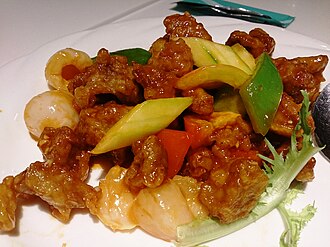
Photo: Wikipedia
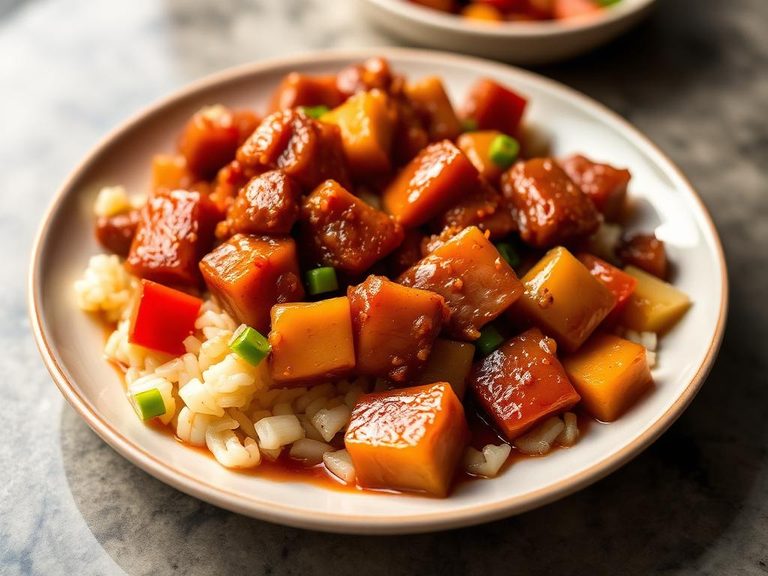
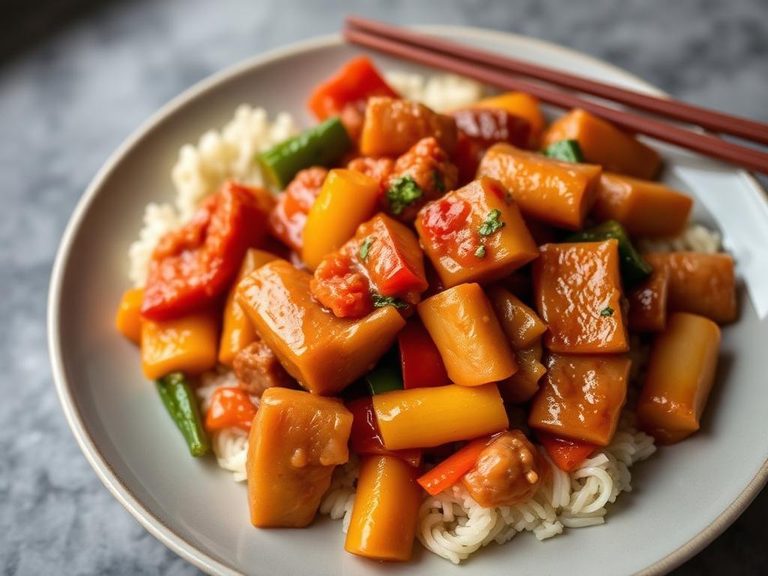
Sweet and sour pork is a vibrant Chinese dish featuring bite-sized pieces of pork that are typically battered, deep-fried until crispy, and then tossed in a glossy, tangy sauce made from vinegar, sugar, and often fruit like pineapple. The texture is a delightful contrast between the crunchy exterior and tender meat, while the flavor profile balances a sharp, acidic tang with a sweet, fruity finish. Nutritionally, it is a calorie-dense dish, with a significant portion of its energy coming from fat and refined carbohydrates due to the frying process and sugary sauce.
Calorie split: 14% protein · 39% carbs · 47% fat
↓ Full nutrition💚 Why it's loved
People love sweet and sour pork for its addictive balance of tangy and sweet flavors, which create a uniquely satisfying taste experience. The crispy texture of the fried pork, combined with the glossy, sticky sauce, makes it a comforting and indulgent favorite across many cultures.
⚠️ Watch-outs & how to enjoy it better
The dish is high in calories, fat, and refined sugars, which can lead to blood sugar spikes and may not be suitable for those monitoring their intake. To counteract this, opt for smaller portions, pair it with steamed vegetables or brown rice to add fiber, and choose restaurants that use lighter frying techniques or less sugar in their sauce.
Key benefits
- Provides a quick source of energy from carbohydrates and fats
- Contains a moderate amount of protein from the pork
- Offers a satisfying, flavorful meal experience that can boost mood
- Often includes vegetables like bell peppers and onions, adding some vitamins
- A popular and accessible dish in many Chinese restaurants worldwide
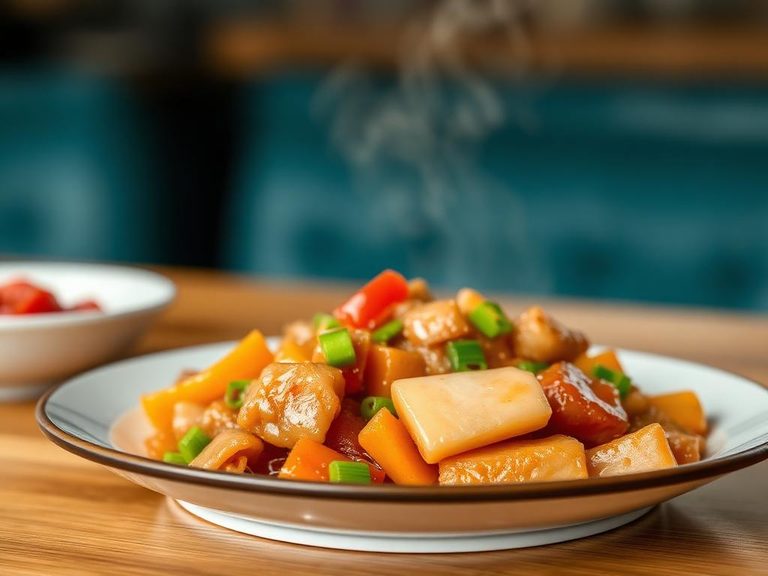
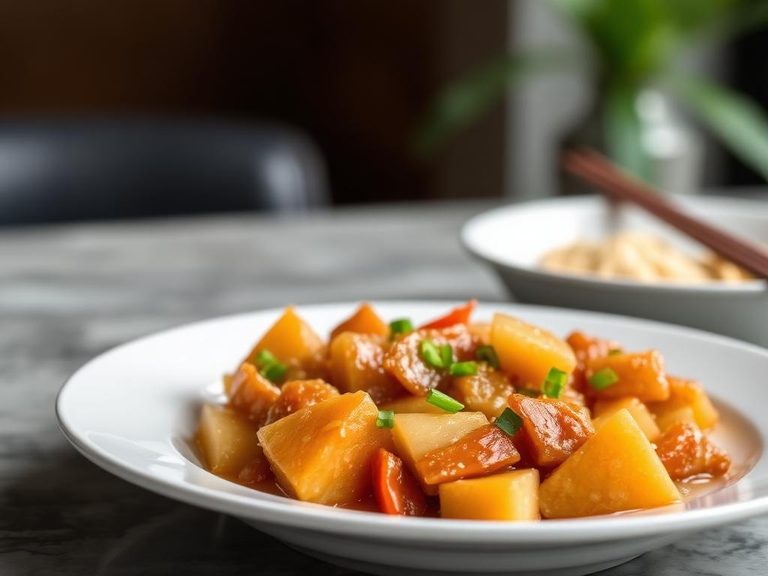
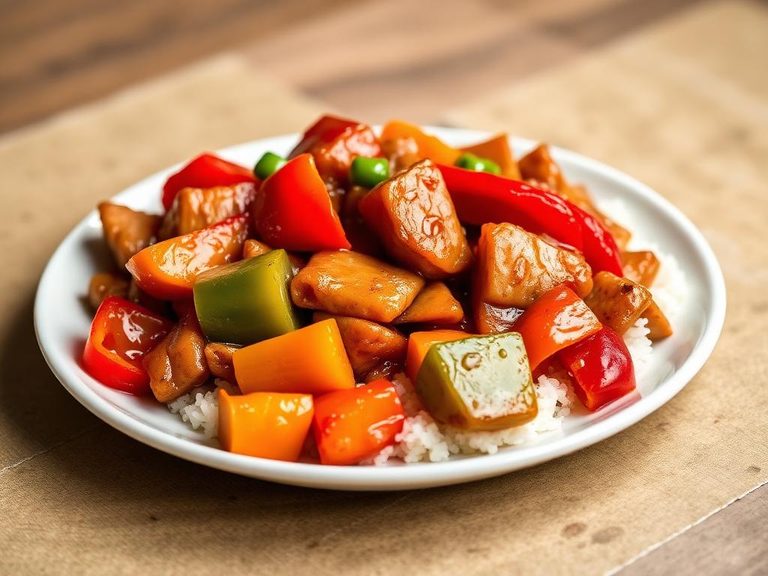
🍽️ Popular dishes
🌍 Where it's eaten
💡 Did you know?
The iconic sweet and sour sauce in many Westernized versions is often colored with food dye to achieve its bright red or orange hue, a practice that originated in the 19th century to mimic the appearance of traditional Chinese sauces made with hawthorn or plum.
Full nutrition (USDA data · scales with serving)
| Water | 50.8 g |
| Energy (Atwater General Factors) | 260 kcal |
| Energy | 260 kcal |
| Energy | 1090 kj |
| Nitrogen | 1.4 g |
| Protein | 8.9 g |
| Total lipid (fat) | 13.6 g |
| Total fat (NLEA) | 13.3 g |
| Ash | 1.3 g |
| Carbohydrate, by difference | 25.5 g |
| Carbohydrate, by summation | 23.0 g |
| Fiber, total dietary | 1.0 g |
| Sugars, Total | 10.3 g |
| Sucrose | 4.5 g |
| Glucose | 3.0 g |
| Fructose | 2.9 g |
| Lactose | 0.00 g |
| Maltose | 0.00 g |
| Galactose | 0.00 g |
| Starch | 11.7 g |
| Calcium, Ca | 46.0 mg |
| Iron, Fe | 3.1 mg |
| Magnesium, Mg | 13.0 mg |
| Phosphorus, P | 133 mg |
| Potassium, K | 152 mg |
| Sodium, Na | 304 mg |
| Zinc, Zn | 1.1 mg |
| Copper, Cu | 0.06 mg |
| Manganese, Mn | 0.17 mg |
| Selenium, Se | 9.7 ug |
| Vitamin C, total ascorbic acid | 2.3 mg |
| Thiamin | 0.23 mg |
| Riboflavin | 0.10 mg |
| Niacin | 2.1 mg |
| Pantothenic acid | 0.44 mg |
| Vitamin B-6 | 0.17 mg |
| Choline, total | 32.4 mg |
| Choline, free | 3.5 mg |
| Choline, from phosphocholine | 0.80 mg |
| Choline, from phosphotidyl choline | 16.2 mg |
| Choline, from glycerophosphocholine | 7.3 mg |
| Choline, from sphingomyelin | 4.6 mg |
| Betaine | 7.4 mg |
| Vitamin B-12 | 0.19 ug |
| Vitamin A, RAE | 29.0 ug |
| Retinol | 2.0 ug |
| Carotene, beta | 259 ug |
| Carotene, alpha | 139 ug |
| Cryptoxanthin, beta | 0.00 ug |
| Lycopene | 199 ug |
| Lutein + zeaxanthin | 22.0 ug |
| Vitamin E (alpha-tocopherol) | 0.89 mg |
| Tocopherol, beta | 0.06 mg |
| Tocopherol, gamma | 3.3 mg |
| Tocopherol, delta | 1.3 mg |
| Tocotrienol, alpha | 0.00 mg |
| Tocotrienol, beta | 0.00 mg |
| Tocotrienol, gamma | 0.01 mg |
| Tocotrienol, delta | 0.00 mg |
| Vitamin K (phylloquinone) | 27.8 ug |
| Vitamin K (Menaquinone-4) | 2.0 ug |
Fat & fatty acid profile (per 100g)
| Fatty acids, total saturated | 2.7 g |
| SFA 4:0 | 0.00 g |
| SFA 6:0 | 0.00 g |
| SFA 8:0 | 0.01 g |
| SFA 10:0 | 0.01 g |
| SFA 11:0 | 0.00 g |
| SFA 12:0 | 0.00 g |
| SFA 14:0 | 0.04 g |
| SFA 15:0 | 0.00 g |
| SFA 16:0 | 1.8 g |
| SFA 17:0 | 0.02 g |
| SFA 18:0 | 0.72 g |
| SFA 20:0 | 0.04 g |
| SFA 22:0 | 0.04 g |
| SFA 24:0 | 0.01 g |
| Fatty acids, total monounsaturated | 3.5 g |
| MUFA 14:1 c | 0.00 g |
| MUFA 15:1 | 0.00 g |
| MUFA 16:1 c | 0.07 g |
| MUFA 17:1 | 0.01 g |
| MUFA 17:1 c | 0.01 g |
| MUFA 18:1 c | 3.3 g |
| MUFA 20:1 | 0.07 g |
| MUFA 20:1 c | 0.07 g |
| MUFA 22:1 c | 0.00 g |
| MUFA 24:1 c | 0.00 g |
| Fatty acids, total polyunsaturated | 7.0 g |
| PUFA 18:2 c | 6.2 g |
| PUFA 18:2 n-6 c,c | 6.2 g |
| PUFA 18:2 CLAs | 0.01 g |
| PUFA 18:3 c | 0.79 g |
| PUFA 18:3 n-3 c,c,c (ALA) | 0.79 g |
| PUFA 18:3 n-6 c,c,c | 0.00 g |
| PUFA 18:4 | 0.00 g |
| PUFA 20:2 c | 0.01 g |
| PUFA 20:2 n-6 c,c | 0.01 g |
| PUFA 20:3 c | 0.01 g |
| PUFA 20:3 n-3 | 0.00 g |
| PUFA 20:3 n-6 | 0.00 g |
| PUFA 20:4 | 0.03 g |
| PUFA 20:4c | 0.03 g |
| PUFA 20:5c | 0.00 g |
| PUFA 20:5 n-3 (EPA) | 0.00 g |
| PUFA 22:2 | 0.00 g |
| PUFA 22:5 c | 0.00 g |
| PUFA 22:4 | 0.01 g |
| PUFA 22:5 n-3 (DPA) | 0.00 g |
| PUFA 22:6 c | 0.00 g |
| PUFA 22:6 n-3 (DHA) | 0.00 g |
| Fatty acids, total trans | 0.09 g |
| Fatty acids, total trans-monoenoic | 0.03 g |
| TFA 16:1 t | 0.00 g |
| TFA 18:1 t | 0.03 g |
| TFA 22:1 t | 0.00 g |
| Fatty acids, total trans-dienoic | 0.05 g |
| TFA 18:2 t not further defined | 0.05 g |
| Cholesterol | 24.0 mg |
Amino acid profile (per 100g)
| Tryptophan | 0.10 g |
| Threonine | 0.37 g |
| Isoleucine | 0.38 g |
| Leucine | 0.71 g |
| Lysine | 0.66 g |
| Methionine | 0.21 g |
| Cystine | 0.11 g |
| Phenylalanine | 0.34 g |
| Tyrosine | 0.25 g |
| Valine | 0.41 g |
| Arginine | 0.54 g |
| Histidine | 0.29 g |
| Alanine | 0.47 g |
| Aspartic acid | 0.77 g |
| Glutamic acid | 1.9 g |
| Glycine | 0.40 g |
| Proline | 0.45 g |
| Serine | 0.38 g |
FAQ
Is sweet and sour pork healthy?
Sweet and sour pork is generally considered an indulgent dish rather than a health food. It is high in calories, fat, and sugar due to the deep-frying process and sugary sauce. However, it can be part of a balanced diet if consumed in moderation and paired with vegetables or whole grains.
What is the main ingredient in sweet and sour pork?
The main ingredient is pork, typically cut into bite-sized pieces, which is battered and deep-fried. The sauce is made from vinegar, sugar, and often includes pineapple, bell peppers, and onions.
Can I make sweet and sour pork healthier at home?
Yes, you can make a healthier version by baking or air-frying the pork instead of deep-frying, using less sugar in the sauce, and adding more vegetables. Using lean cuts of pork and whole-grain batter can also improve its nutritional profile.
Nutrient density (calculated · NRF9.3)
Nutrient Rich Foods index: beneficial nutrients (protein, fiber, vitamins, minerals) minus saturated fat, added sugar & sodium, per 100 kcal.
NRF9.3 index — Fulgoni, Keast & Drewnowski, 2009. Computed from USDA nutrients.
Weight-loss friendliness (composite index)
Energy density 2.60 kcal/g · 14% calories from protein · 1.0 g fiber · 0.0 g sugar per 100 g.
Composite of energy density (Rolls et al., 1999), protein & fiber satiety, minus sugar. A calculated heuristic — ranks satiety-per-calorie, not a clinical measure.
Dietary load (calculated from USDA values)
Potential renal acid load. Positive = acid-forming, negative = alkaline-forming.
Sodium-to-potassium ratio: 2.00 (lower is better — aim for ≤ 1)
Sodium:potassium per WHO potassium guidance. Computed from USDA nutrients.