

Fast foods, chicken tenders
Whole food · Fast Foods
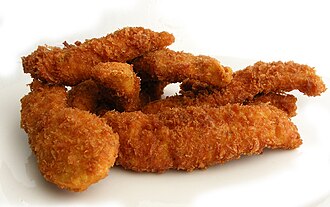
Photo: Wikipedia
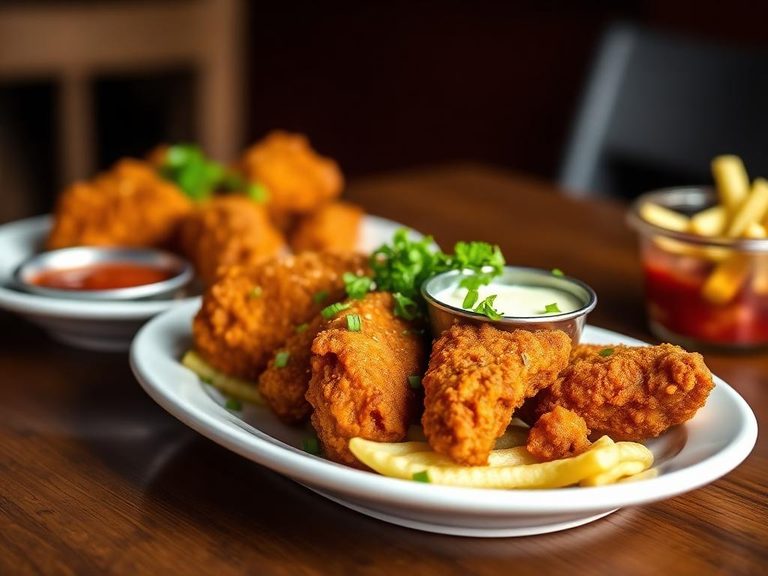
Fast-food chicken tenders are strips of white-meat chicken, typically breast or tenderloin, coated in a seasoned flour batter and deep-fried to a golden, crunchy exterior. The inside remains juicy and tender, offering a satisfying contrast in texture. Nutritionally, they provide a significant protein boost (19g per 100g) but are also calorie-dense due to the frying process and breading.
Calorie split: 28% protein · 25% carbs · 46% fat
↓ Full nutrition💚 Why it's loved
People love the universal appeal of the crispy, savory coating giving way to juicy chicken—a comforting, nostalgic flavor and texture combination. Their versatility makes them perfect for dipping in a variety of sauces, from classic honey mustard to spicy buffalo.
⚠️ Watch-outs & how to enjoy it better
The deep-frying process adds significant calories, unhealthy fats, and often high sodium, which can be problematic for heart health and blood pressure. The refined flour breading can cause rapid blood-sugar spikes. To counteract this, pair tenders with fiber-rich sides like a green salad or steamed vegetables, choose grilled versions when available, and practice portion control by limiting intake to 3-4 tenders.
Key benefits
- High-quality, complete protein source for muscle maintenance.
- Convenient and widely available quick meal option.
- Often a familiar, kid-friendly food that can be a gateway to protein intake.
- Can be a base for balanced meals when paired with sides.
🍽️ Popular dishes
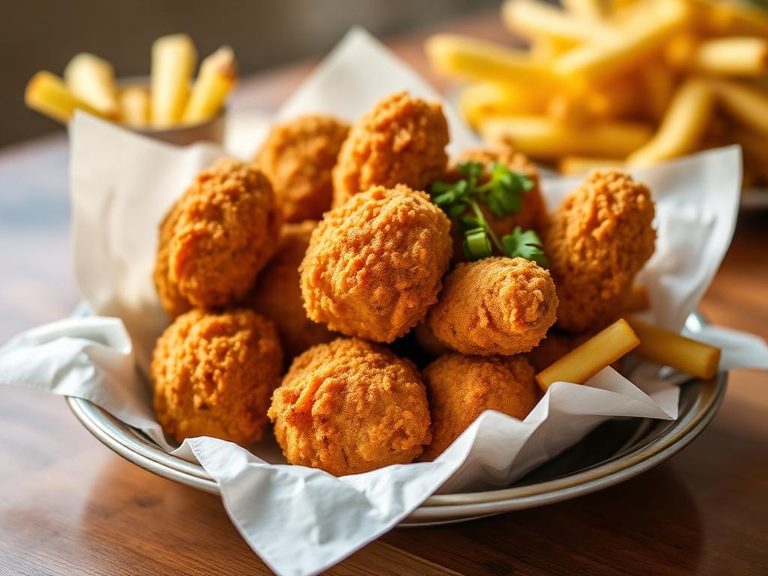

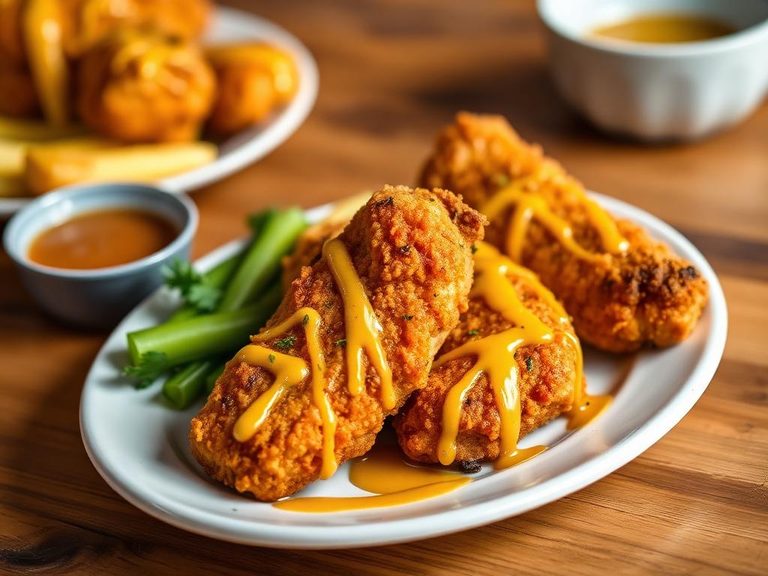
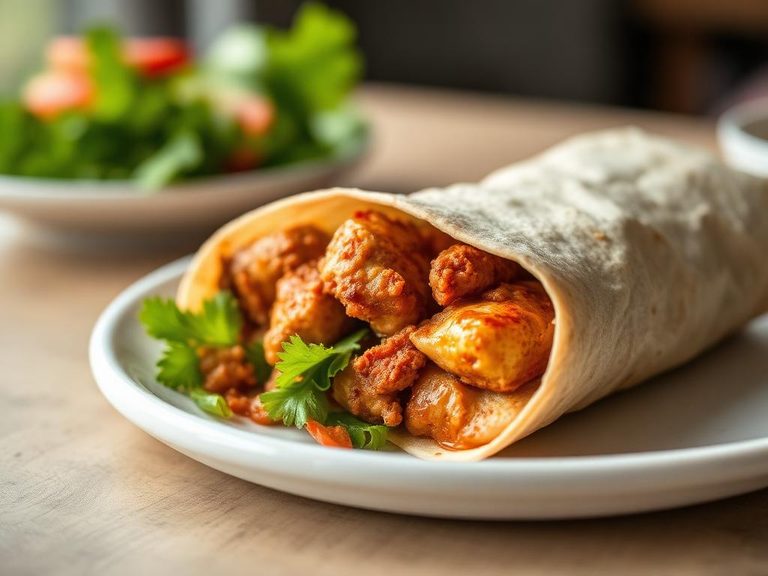
🌍 Where it's eaten
💡 Did you know?
The term 'chicken finger' is believed to have originated in the 1970s in New Hampshire, where a restaurant claimed to serve chicken so tender it could be eaten with just your fingers.
Full nutrition (USDA data · scales with serving)
| Water | 46.6 g |
| Energy | 271 kcal |
| Energy | 1136 kj |
| Protein | 19.2 g |
| Total lipid (fat) | 13.9 g |
| Ash | 2.9 g |
| Carbohydrate, by difference | 17.3 g |
| Fiber, total dietary | 1.2 g |
| Total Sugars | 0.40 g |
| Sucrose | 0.40 g |
| Glucose | 0.00 g |
| Fructose | 0.00 g |
| Lactose | 0.00 g |
| Maltose | 0.00 g |
| Galactose | 0.00 g |
| Starch | 17.0 g |
| Calcium, Ca | 17.0 mg |
| Iron, Fe | 0.73 mg |
| Magnesium, Mg | 28.0 mg |
| Phosphorus, P | 282 mg |
| Potassium, K | 373 mg |
| Sodium, Na | 769 mg |
| Zinc, Zn | 0.71 mg |
| Copper, Cu | 0.07 mg |
| Manganese, Mn | 0.23 mg |
| Selenium, Se | 17.5 ug |
| Vitamin C, total ascorbic acid | 1.1 mg |
| Thiamin | 0.11 mg |
| Riboflavin | 0.18 mg |
| Niacin | 8.2 mg |
| Pantothenic acid | 1.2 mg |
| Vitamin B-6 | 0.43 mg |
| Folate, total | 19.0 ug |
| Folic acid | 6.0 ug |
| Folate, food | 13.0 ug |
| Folate, DFE | 23.0 ug |
| Choline, total | 43.7 mg |
| Vitamin B-12 | 0.16 ug |
| Vitamin B-12, added | 0.00 ug |
| Vitamin A, RAE | 3.0 ug |
| Retinol | 2.0 ug |
| Carotene, beta | 2.0 ug |
| Carotene, alpha | 0.00 ug |
| Cryptoxanthin, beta | 0.00 ug |
| Vitamin A, IU | 11.0 iu |
| Lycopene | 0.00 ug |
| Lutein + zeaxanthin | 83.0 ug |
| Vitamin E (alpha-tocopherol) | 3.2 mg |
| Vitamin E, added | 0.00 mg |
| Tocopherol, beta | 0.13 mg |
| Tocopherol, gamma | 5.6 mg |
| Tocopherol, delta | 0.51 mg |
| Tocotrienol, alpha | 0.14 mg |
| Tocotrienol, beta | 0.16 mg |
| Tocotrienol, gamma | 0.05 mg |
| Tocotrienol, delta | 0.00 mg |
| Vitamin D (D2 + D3), International Units | 7.0 iu |
| Vitamin D (D2 + D3) | 0.20 ug |
| Vitamin D3 (cholecalciferol) | 0.20 ug |
| Vitamin K (phylloquinone) | 8.0 ug |
| Alcohol, ethyl | 0.00 g |
| Caffeine | 0.00 mg |
| Theobromine | 0.00 mg |
Fat & fatty acid profile (per 100g)
| Fatty acids, total saturated | 2.5 g |
| SFA 4:0 | 0.00 g |
| SFA 6:0 | 0.00 g |
| SFA 8:0 | 0.00 g |
| SFA 10:0 | 0.00 g |
| SFA 12:0 | 0.00 g |
| SFA 14:0 | 0.03 g |
| SFA 15:0 | 0.00 g |
| SFA 16:0 | 1.8 g |
| SFA 17:0 | 0.01 g |
| SFA 18:0 | 0.41 g |
| SFA 20:0 | 0.08 g |
| SFA 22:0 | 0.12 g |
| SFA 24:0 | 0.07 g |
| Fatty acids, total monounsaturated | 4.8 g |
| MUFA 14:1 | 0.00 g |
| MUFA 15:1 | 0.00 g |
| MUFA 16:1 | 0.05 g |
| MUFA 16:1 c | 0.05 g |
| MUFA 17:1 | 0.01 g |
| MUFA 18:1 | 4.7 g |
| MUFA 18:1 c | 4.6 g |
| MUFA 20:1 | 0.11 g |
| MUFA 22:1 | 0.01 g |
| MUFA 22:1 c | 0.01 g |
| MUFA 24:1 c | 0.00 g |
| Fatty acids, total polyunsaturated | 5.8 g |
| PUFA 18:2 | 5.5 g |
| PUFA 18:2 n-6 c,c | 5.4 g |
| PUFA 18:2 CLAs | 0.01 g |
| PUFA 18:3 | 0.23 g |
| PUFA 18:3 n-3 c,c,c (ALA) | 0.21 g |
| PUFA 18:3 n-6 c,c,c | 0.01 g |
| PUFA 18:3i | 0.00 g |
| PUFA 18:4 | 0.00 g |
| PUFA 20:2 n-6 c,c | 0.01 g |
| PUFA 20:3 | 0.01 g |
| PUFA 20:3 n-3 | 0.00 g |
| PUFA 20:3 n-6 | 0.01 g |
| PUFA 20:4 | 0.04 g |
| PUFA 20:5 n-3 (EPA) | 0.00 g |
| PUFA 22:4 | 0.01 g |
| PUFA 22:5 n-3 (DPA) | 0.00 g |
| PUFA 22:6 n-3 (DHA) | 0.00 g |
| Fatty acids, total trans | 0.05 g |
| Fatty acids, total trans-monoenoic | 0.01 g |
| TFA 16:1 t | 0.00 g |
| TFA 18:1 t | 0.01 g |
| TFA 22:1 t | 0.00 g |
| TFA 18:2 t not further defined | 0.04 g |
| Fatty acids, total trans-polyenoic | 0.04 g |
| Cholesterol | 48.0 mg |
Amino acid profile (per 100g)
| Tryptophan | 0.22 g |
| Threonine | 0.80 g |
| Isoleucine | 0.84 g |
| Leucine | 1.6 g |
| Lysine | 1.6 g |
| Methionine | 0.52 g |
| Cystine | 0.28 g |
| Phenylalanine | 1.4 g |
| Tyrosine | 0.54 g |
| Valine | 0.91 g |
| Arginine | 1.2 g |
| Histidine | 0.66 g |
| Alanine | 1.0 g |
| Aspartic acid | 1.6 g |
| Glutamic acid | 3.2 g |
| Glycine | 0.84 g |
| Proline | 1.6 g |
| Serine | 0.79 g |
| Hydroxyproline | 0.04 g |
FAQ
Are chicken tenders the same as chicken strips?
They are often used interchangeably, but technically, 'tenders' refer to the specific pectoralis minor muscle of the chicken, which is naturally tender. 'Strips' can be any chicken breast cut into strips.
How can I make them healthier at home?
Use whole-grain or almond flour for coating, bake or air-fry instead of deep-frying, and use lean, skinless chicken breast. Marinating in buttermilk can add tenderness without excess fat.
Why are fast-food chicken tenders so high in sodium?
Sodium is used for flavor enhancement, moisture retention, and as a preservative in the breading and marinade. A single serving can contain over 25% of the recommended daily sodium limit.
Nutrient density (calculated · NRF9.3)
Nutrient Rich Foods index: beneficial nutrients (protein, fiber, vitamins, minerals) minus saturated fat, added sugar & sodium, per 100 kcal.
NRF9.3 index — Fulgoni, Keast & Drewnowski, 2009. Computed from USDA nutrients.
Weight-loss friendliness (composite index)
Energy density 2.71 kcal/g · 28% calories from protein · 1.2 g fiber · 0.4 g sugar per 100 g.
Composite of energy density (Rolls et al., 1999), protein & fiber satiety, minus sugar. A calculated heuristic — ranks satiety-per-calorie, not a clinical measure.
Dietary load (calculated from USDA values)
Potential renal acid load. Positive = acid-forming, negative = alkaline-forming.
Sodium-to-potassium ratio: 2.06 (lower is better — aim for ≤ 1)
Sodium:potassium per WHO potassium guidance. Computed from USDA nutrients.