

Bagels, plain, enriched, with calcium propionate (includes onion, poppy, sesame)
Whole food · Baked Products
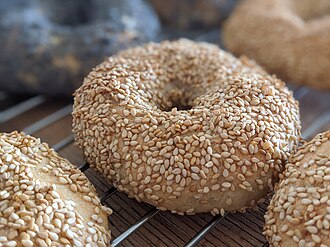
Photo: Wikipedia
A plain, enriched bagel is a dense, chewy bread ring with a smooth, golden-brown crust and a soft, slightly sweet interior. Its signature texture comes from boiling the dough before baking, creating a satisfying bite. At 264 kcal per 100g, it's a carbohydrate-rich food with a notable 10.56g of protein.
Calorie split: 16% protein · 79% carbs · 5% fat
↓ Full nutrition💚 Why it's loved
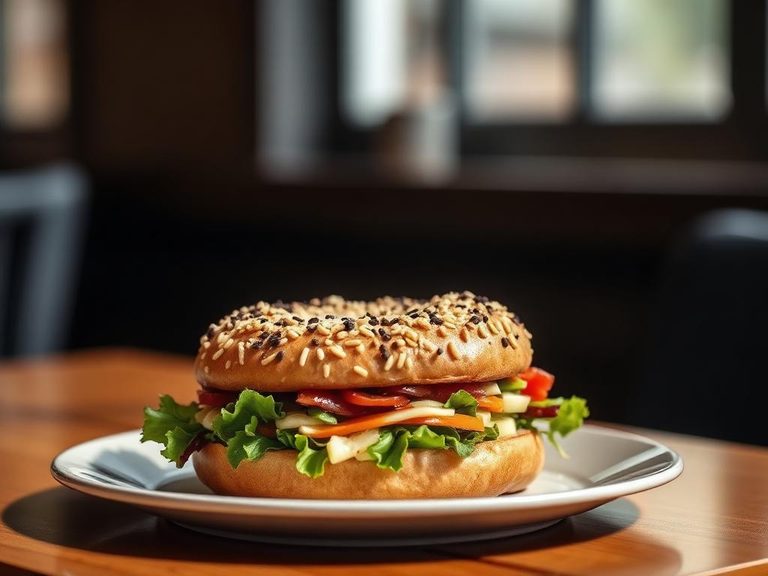
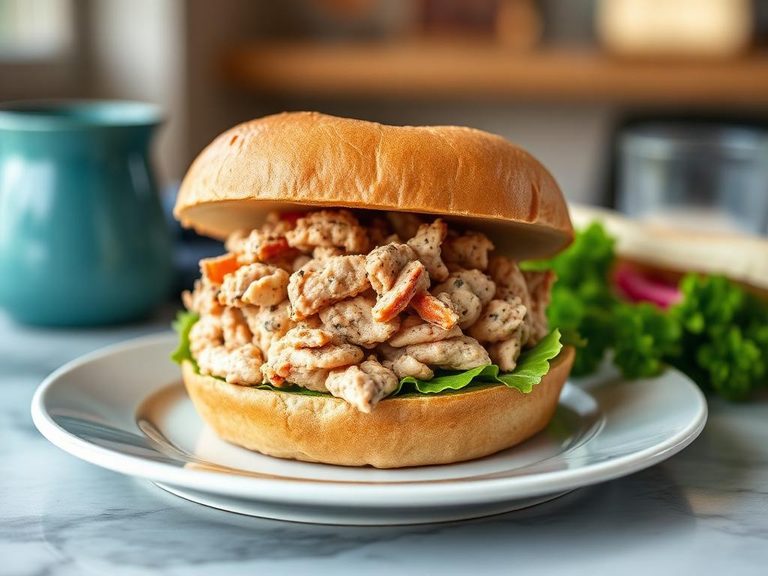
People adore bagels for their uniquely chewy-yet-soft texture and the comforting, toasty flavor that comes from a quick bake. They are a beloved cultural staple, serving as the foundation for everything from a simple schmear to a loaded breakfast sandwich.
⚠️ Watch-outs & how to enjoy it better
The dense carbohydrate content can lead to rapid blood-sugar spikes, especially when eaten plain. They are often high in sodium and may contain common allergens like wheat, sesame, or poppy seeds. To counteract, pair with protein and healthy fats (like cream cheese and smoked salmon), choose whole-grain versions, and practice portion control by enjoying half a bagel.
Key benefits
- Provides quick, dense energy from complex carbohydrates
- Enriched with B vitamins like thiamine and niacin
- Good source of plant-based protein (10.56g per 100g)
- Calcium propionate helps extend shelf life
- Versatile base for both sweet and savory toppings
🍽️ Popular dishes




🌍 Where it's eaten
💡 Did you know?
The hole in the center isn't just for looks; it was traditionally created to ensure the dense dough cooked evenly and quickly during the boiling and baking process.
Full nutrition (USDA data · scales with serving)
| Water | 33.8 g |
| Energy | 264 kcal |
| Energy | 1103 kj |
| Protein | 10.6 g |
| Total lipid (fat) | 1.3 g |
| Ash | 1.9 g |
| Carbohydrate, by difference | 52.4 g |
| Fiber, total dietary | 1.6 g |
| Total Sugars | 8.4 g |
| Sucrose | 0.00 g |
| Glucose | 2.3 g |
| Fructose | 2.9 g |
| Lactose | 0.00 g |
| Maltose | 3.2 g |
| Galactose | 0.00 g |
| Starch | 37.4 g |
| Calcium, Ca | 219 mg |
| Iron, Fe | 3.6 mg |
| Magnesium, Mg | 29.0 mg |
| Phosphorus, P | 99.0 mg |
| Potassium, K | 107 mg |
| Sodium, Na | 422 mg |
| Zinc, Zn | 0.83 mg |
| Copper, Cu | 0.13 mg |
| Manganese, Mn | 0.54 mg |
| Selenium, Se | 21.5 ug |
| Vitamin C, total ascorbic acid | 0.00 mg |
| Thiamin | 0.57 mg |
| Riboflavin | 0.34 mg |
| Niacin | 4.5 mg |
| Pantothenic acid | 0.41 mg |
| Vitamin B-6 | 0.07 mg |
| Folate, total | 106 ug |
| Folic acid | 82.0 ug |
| Folate, food | 24.0 ug |
| Folate, DFE | 163 ug |
| Choline, total | 14.6 mg |
| Vitamin B-12 | 0.00 ug |
| Vitamin B-12, added | 0.00 ug |
| Vitamin A, RAE | 0.00 ug |
| Retinol | 0.00 ug |
| Carotene, beta | 0.00 ug |
| Carotene, alpha | 0.00 ug |
| Cryptoxanthin, beta | 0.00 ug |
| Vitamin A, IU | 0.00 iu |
| Lycopene | 0.00 ug |
| Lutein + zeaxanthin | 0.00 ug |
| Vitamin E (alpha-tocopherol) | 7.5 mg |
| Vitamin E, added | 0.00 mg |
| Tocopherol, beta | 0.06 mg |
| Tocopherol, gamma | 0.03 mg |
| Tocopherol, delta | 0.03 mg |
| Tocotrienol, alpha | 0.00 mg |
| Tocotrienol, beta | 0.47 mg |
| Tocotrienol, gamma | 0.03 mg |
| Tocotrienol, delta | 0.00 mg |
| Vitamin D (D2 + D3), International Units | 0.00 iu |
| Vitamin D (D2 + D3) | 0.00 ug |
| Vitamin K (phylloquinone) | 0.20 ug |
| Vitamin K (Dihydrophylloquinone) | 0.20 ug |
| Vitamin K (Menaquinone-4) | 0.00 ug |
| Alcohol, ethyl | 0.00 g |
| Caffeine | 0.00 mg |
| Theobromine | 0.00 mg |
Fat & fatty acid profile (per 100g)
| Fatty acids, total saturated | 0.36 g |
| SFA 4:0 | 0.00 g |
| SFA 6:0 | 0.00 g |
| SFA 8:0 | 0.00 g |
| SFA 10:0 | 0.00 g |
| SFA 12:0 | 0.00 g |
| SFA 14:0 | 0.00 g |
| SFA 15:0 | 0.00 g |
| SFA 16:0 | 0.23 g |
| SFA 17:0 | 0.00 g |
| SFA 18:0 | 0.12 g |
| SFA 20:0 | 0.00 g |
| SFA 22:0 | 0.00 g |
| SFA 24:0 | 0.00 g |
| Fatty acids, total monounsaturated | 0.39 g |
| MUFA 14:1 | 0.00 g |
| MUFA 15:1 | 0.00 g |
| MUFA 16:1 | 0.01 g |
| MUFA 16:1 c | 0.01 g |
| MUFA 17:1 | 0.00 g |
| MUFA 18:1 | 0.19 g |
| MUFA 18:1 c | 0.17 g |
| MUFA 20:1 | 0.01 g |
| MUFA 22:1 | 0.00 g |
| MUFA 22:1 c | 0.00 g |
| MUFA 24:1 c | 0.00 g |
| Fatty acids, total polyunsaturated | 0.53 g |
| PUFA 18:2 | 0.50 g |
| PUFA 18:2 n-6 c,c | 0.50 g |
| PUFA 18:2 CLAs | 0.00 g |
| PUFA 18:3 | 0.02 g |
| PUFA 18:3 n-3 c,c,c (ALA) | 0.02 g |
| PUFA 18:3 n-6 c,c,c | 0.00 g |
| PUFA 18:3i | 0.00 g |
| PUFA 18:4 | 0.00 g |
| PUFA 20:2 n-6 c,c | 0.00 g |
| PUFA 20:3 | 0.00 g |
| PUFA 20:3 n-3 | 0.00 g |
| PUFA 20:3 n-6 | 0.00 g |
| PUFA 20:4 | 0.00 g |
| PUFA 20:5 n-3 (EPA) | 0.00 g |
| PUFA 22:4 | 0.00 g |
| PUFA 22:5 n-3 (DPA) | 0.00 g |
| PUFA 22:6 n-3 (DHA) | 0.00 g |
| Fatty acids, total trans | 0.02 g |
| Fatty acids, total trans-monoenoic | 0.02 g |
| TFA 16:1 t | 0.00 g |
| TFA 18:1 t | 0.02 g |
| TFA 22:1 t | 0.00 g |
| TFA 18:2 t not further defined | 0.00 g |
| Fatty acids, total trans-polyenoic | 0.00 g |
| Cholesterol | 0.00 mg |
Amino acid profile (per 100g)
Estimated from Bagels, cinnamon-raisin — USDA does not publish this profile for Bagels.
| Tryptophan | 0.11 g |
| Threonine | 0.28 g |
| Isoleucine | 0.37 g |
| Leucine | 0.67 g |
| Lysine | 0.24 g |
| Methionine | 0.18 g |
| Cystine | 0.21 g |
| Phenylalanine | 0.47 g |
| Tyrosine | 0.27 g |
| Valine | 0.42 g |
| Arginine | 0.38 g |
| Histidine | 0.22 g |
| Alanine | 0.33 g |
| Aspartic acid | 0.48 g |
| Glutamic acid | 3.2 g |
| Glycine | 0.34 g |
| Proline | 1.1 g |
| Serine | 0.48 g |
FAQ
Why is a bagel boiled before baking?
Boiling the dough in water (often with malt or honey) gelatinizes the starches on the surface, creating the signature shiny, crisp crust and dense, chewy interior.
Are bagels a healthy breakfast choice?
They can be part of a balanced diet. Opt for whole-grain varieties for more fiber, and always pair with protein (like eggs or yogurt) and healthy fats to slow digestion and provide sustained energy.
What does 'enriched' mean on the label?
It means refined flour has been fortified with nutrients lost during processing, typically adding back iron and B vitamins like folic acid, thiamine, and niacin.
Nutrient density (calculated · NRF9.3)
Nutrient Rich Foods index: beneficial nutrients (protein, fiber, vitamins, minerals) minus saturated fat, added sugar & sodium, per 100 kcal.
NRF9.3 index — Fulgoni, Keast & Drewnowski, 2009. Computed from USDA nutrients.
Weight-loss friendliness (composite index)
Energy density 2.64 kcal/g · 16% calories from protein · 1.6 g fiber · 8.4 g sugar per 100 g.
Composite of energy density (Rolls et al., 1999), protein & fiber satiety, minus sugar. A calculated heuristic — ranks satiety-per-calorie, not a clinical measure.
Dietary load (calculated from USDA values)
Potential renal acid load. Positive = acid-forming, negative = alkaline-forming.
Sodium-to-potassium ratio: 3.94 (lower is better — aim for ≤ 1)
Sodium:potassium per WHO potassium guidance. Computed from USDA nutrients.