

Bread, white wheat
Whole food · Baked Products
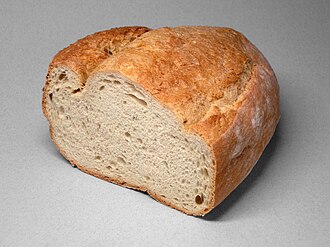
Photo: Wikipedia
White wheat bread is a soft, pillowy staple made from refined wheat flour, offering a mild, slightly sweet flavor and a tender crumb that toasts to a golden crunch. With 10.66g of protein per 100g, it provides a surprising protein boost for a carbohydrate-focused food, though its refined nature means it lacks the fiber of whole-grain varieties. Its neutral taste and airy texture make it a universal canvas for both sweet and savory toppings.
Calorie split: 18% protein · 74% carbs · 8% fat
↓ Full nutrition💚 Why it's loved
People love white wheat bread for its soft, non-abrasive texture and mild, slightly sweet flavor that complements everything from peanut butter to deli meats. Its cultural significance as a breakfast and lunch staple across many cuisines makes it a comforting, familiar food.
⚠️ Watch-outs & how to enjoy it better
White wheat bread can cause blood-sugar spikes due to its refined carbohydrates, and it may contain added sodium and common allergens like wheat gluten. To counteract this, pair it with protein or healthy fats (like avocado or cheese) to slow digestion, practice portion control, and consider soaking it in soups or stews to reduce its glycemic impact.
Key benefits
- Provides a quick source of energy from 43.91g of carbohydrates per 100g.
- Contains 10.66g of protein per 100g, supporting muscle maintenance.
- Offers 9.2g of fiber per 100g, aiding digestion and satiety.
- Low in fat (2.15g per 100g), making it a lighter option compared to enriched breads.
- Versatile base for sandwiches, toast, and various culinary applications.
🍽️ Popular dishes



🌍 Where it's eaten
💡 Did you know?
White bread was once considered a luxury food in ancient Rome, reserved for the elite, while the poor ate darker, coarser breads made from whole grains.
Full nutrition (USDA data · scales with serving)
| Water | 39.6 g |
| Energy | 238 kcal |
| Energy | 994 kj |
| Protein | 10.7 g |
| Total lipid (fat) | 2.1 g |
| Ash | 3.7 g |
| Carbohydrate, by difference | 43.9 g |
| Fiber, total dietary | 9.2 g |
| Total Sugars | 5.0 g |
| Sucrose | 0.00 g |
| Glucose | 1.5 g |
| Fructose | 2.7 g |
| Lactose | 0.00 g |
| Maltose | 0.80 g |
| Galactose | 0.00 g |
| Starch | 27.3 g |
| Calcium, Ca | 684 mg |
| Iron, Fe | 4.9 mg |
| Magnesium, Mg | 26.0 mg |
| Phosphorus, P | 103 mg |
| Potassium, K | 127 mg |
| Sodium, Na | 478 mg |
| Zinc, Zn | 0.95 mg |
| Copper, Cu | 0.15 mg |
| Manganese, Mn | 0.63 mg |
| Selenium, Se | 16.1 ug |
| Vitamin C, total ascorbic acid | 0.00 mg |
| Thiamin | 0.51 mg |
| Riboflavin | 0.26 mg |
| Niacin | 4.5 mg |
| Pantothenic acid | 0.46 mg |
| Vitamin B-6 | 0.08 mg |
| Folate, total | 127 ug |
| Folic acid | 49.0 ug |
| Folate, food | 78.0 ug |
| Folate, DFE | 162 ug |
| Choline, total | 8.1 mg |
| Betaine | 0.00 mg |
| Vitamin B-12 | 0.00 ug |
| Vitamin B-12, added | 0.00 ug |
| Vitamin A, RAE | 0.00 ug |
| Retinol | 0.00 ug |
| Carotene, beta | 2.0 ug |
| Carotene, alpha | 0.00 ug |
| Cryptoxanthin, beta | 0.00 ug |
| Vitamin A, IU | 4.0 iu |
| Lycopene | 0.00 ug |
| Lutein + zeaxanthin | 25.0 ug |
| Vitamin E (alpha-tocopherol) | 0.38 mg |
| Vitamin E, added | 0.00 mg |
| Vitamin D (D2 + D3), International Units | 0.00 iu |
| Vitamin D (D2 + D3) | 0.00 ug |
| Vitamin K (phylloquinone) | 7.7 ug |
| Alcohol, ethyl | 0.00 g |
| Caffeine | 0.00 mg |
| Theobromine | 0.00 mg |
Fat & fatty acid profile (per 100g)
| Fatty acids, total saturated | 0.63 g |
| SFA 4:0 | 0.00 g |
| SFA 6:0 | 0.00 g |
| SFA 8:0 | 0.01 g |
| SFA 10:0 | 0.00 g |
| SFA 12:0 | 0.01 g |
| SFA 14:0 | 0.01 g |
| SFA 15:0 | 0.00 g |
| SFA 16:0 | 0.32 g |
| SFA 17:0 | 0.00 g |
| SFA 18:0 | 0.25 g |
| SFA 20:0 | 0.01 g |
| SFA 22:0 | 0.01 g |
| SFA 24:0 | 0.00 g |
| Fatty acids, total monounsaturated | 0.39 g |
| MUFA 14:1 | 0.00 g |
| MUFA 15:1 | 0.00 g |
| MUFA 16:1 | 0.02 g |
| MUFA 16:1 c | 0.02 g |
| MUFA 17:1 | 0.00 g |
| MUFA 18:1 | 0.37 g |
| MUFA 18:1 c | 0.34 g |
| MUFA 20:1 | 0.01 g |
| MUFA 22:1 | 0.00 g |
| MUFA 22:1 c | 0.00 g |
| MUFA 24:1 c | 0.00 g |
| Fatty acids, total polyunsaturated | 0.97 g |
| PUFA 18:2 | 0.88 g |
| PUFA 18:2 n-6 c,c | 0.88 g |
| PUFA 18:2 CLAs | 0.00 g |
| PUFA 18:3 | 0.08 g |
| PUFA 18:3 n-3 c,c,c (ALA) | 0.08 g |
| PUFA 18:3 n-6 c,c,c | 0.00 g |
| PUFA 18:4 | 0.00 g |
| PUFA 20:2 n-6 c,c | 0.00 g |
| PUFA 20:3 | 0.00 g |
| PUFA 20:3 n-3 | 0.00 g |
| PUFA 20:3 n-6 | 0.00 g |
| PUFA 20:4 | 0.00 g |
| PUFA 20:5 n-3 (EPA) | 0.00 g |
| PUFA 22:4 | 0.01 g |
| PUFA 22:5 n-3 (DPA) | 0.00 g |
| PUFA 22:6 n-3 (DHA) | 0.00 g |
| Fatty acids, total trans | 0.03 g |
| Fatty acids, total trans-monoenoic | 0.03 g |
| TFA 16:1 t | 0.00 g |
| TFA 18:1 t | 0.03 g |
| TFA 22:1 t | 0.00 g |
| TFA 18:2 t not further defined | 0.00 g |
| Fatty acids, total trans-polyenoic | 0.00 g |
| Cholesterol | 0.00 mg |
Amino acid profile (per 100g)
Estimated from Bread, salvadoran sweet cheese (quesadilla salvadorena) — USDA does not publish this profile for Bread.
| Tryptophan | 0.07 g |
| Threonine | 0.21 g |
| Isoleucine | 0.30 g |
| Leucine | 0.65 g |
| Lysine | 0.50 g |
| Methionine | 0.28 g |
| Cystine | 0.06 g |
| Phenylalanine | 0.37 g |
| Tyrosine | 0.23 g |
| Valine | 0.43 g |
| Arginine | 0.25 g |
| Histidine | 0.15 g |
| Alanine | 0.36 g |
| Aspartic acid | 0.59 g |
| Glutamic acid | 1.3 g |
| Glycine | 0.20 g |
| Proline | 0.83 g |
| Serine | 0.45 g |
| Hydroxyproline | 0.00 g |
FAQ
Is white wheat bread healthier than whole wheat bread?
Whole wheat bread is generally considered healthier because it retains more fiber, vitamins, and minerals from the whole grain. White wheat bread is made from refined flour, which removes some of these nutrients, but it can still be part of a balanced diet when consumed in moderation.
Can white wheat bread be part of a weight-loss diet?
Yes, it can be part of a weight-loss diet if consumed in controlled portions and paired with protein or fiber-rich foods to increase satiety. However, its higher glycemic index may lead to quicker hunger compared to whole-grain options.
Does white wheat bread contain gluten?
Yes, white wheat bread contains gluten, which is a protein found in wheat. Individuals with celiac disease or gluten sensitivity should avoid it and opt for gluten-free alternatives.
Nutrient density (calculated · NRF9.3)
Nutrient Rich Foods index: beneficial nutrients (protein, fiber, vitamins, minerals) minus saturated fat, added sugar & sodium, per 100 kcal.
NRF9.3 index — Fulgoni, Keast & Drewnowski, 2009. Computed from USDA nutrients.
Weight-loss friendliness (composite index)
Energy density 2.38 kcal/g · 18% calories from protein · 9.2 g fiber · 5.0 g sugar per 100 g.
Composite of energy density (Rolls et al., 1999), protein & fiber satiety, minus sugar. A calculated heuristic — ranks satiety-per-calorie, not a clinical measure.
Dietary load (calculated from USDA values)
Potential renal acid load. Positive = acid-forming, negative = alkaline-forming.
Sodium-to-potassium ratio: 3.76 (lower is better — aim for ≤ 1)
Sodium:potassium per WHO potassium guidance. Computed from USDA nutrients.