

Bread, white, commercially prepared
Whole food · Baked Products
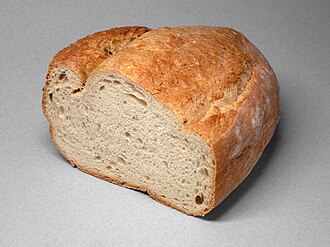
Photo: Wikipedia
A soft, pillowy loaf with a mild, slightly sweet flavor and a tender crumb, white bread is the quintessential everyday staple. Nutritionally, it's a concentrated source of quick-release carbohydrates, providing 270 kcal per 100g, with a modest 9.43g of protein and very little fat. Its low fiber content (2.3g) means it digests rapidly, making it a fast energy source.
Calorie split: 14% protein · 74% carbs · 12% fat
↓ Full nutrition💚 Why it's loved
People love it for its comforting, neutral taste and soft, squishy texture that complements almost any topping or filling. Its cultural ubiquity makes it a nostalgic and reliable staple, from a simple buttered slice to a vehicle for hearty sandwiches.
⚠️ Watch-outs & how to enjoy it better
Its high glycemic index can cause rapid blood-sugar spikes, making it less ideal for those managing diabetes or seeking sustained energy. It's also a common allergen (wheat/gluten) and can be high in sodium; to counteract, pair a slice with protein (like eggs or cheese) or healthy fats (avocado, nut butter) to slow digestion, and opt for whole-grain versions when possible.
Key benefits
- Quick and accessible energy source from carbohydrates
- Fortified with B vitamins and iron in many commercial varieties
- Versatile base for countless meals and snacks
- Long shelf life and convenient storage
- Low in fat and naturally cholesterol-free
🍽️ Popular dishes




🌍 Where it's eaten
💡 Did you know?
The soft, uniform texture of commercially prepared white bread is achieved through a process called 'enrichment,' where the dough is mechanically kneaded to develop gluten, then often treated with enzymes like amylase to break down starches for a softer crumb.
Full nutrition (USDA data · scales with serving)
| Water | 35.7 g |
| Energy (Atwater General Factors) | 267 kcal |
| Energy (Atwater Specific Factors) | 270 kcal |
| Energy | 270 kcal |
| Energy | 1130 kj |
| Nitrogen | 1.5 g |
| Protein | 9.4 g |
| Total lipid (fat) | 3.6 g |
| Total fat (NLEA) | 3.5 g |
| Ash | 2.1 g |
| Carbohydrate, by difference | 49.2 g |
| Carbohydrate, by summation | 44.8 g |
| Fiber, total dietary | 2.3 g |
| Sugars, Total | 5.3 g |
| Sucrose | 0.00 g |
| Glucose | 1.4 g |
| Fructose | 2.3 g |
| Lactose | 0.06 g |
| Maltose | 1.6 g |
| Galactose | 0.00 g |
| Starch | 37.2 g |
| Calcium, Ca | 211 mg |
| Iron, Fe | 3.4 mg |
| Magnesium, Mg | 26.9 mg |
| Phosphorus, P | 113 mg |
| Potassium, K | 117 mg |
| Sodium, Na | 477 mg |
| Zinc, Zn | 0.88 mg |
| Copper, Cu | 0.12 mg |
| Manganese, Mn | 0.63 mg |
| Selenium, Se | 23.2 ug |
| Thiamin | 0.51 mg |
| Riboflavin | 0.24 mg |
| Niacin | 4.8 mg |
| Pantothenic acid | 0.55 mg |
| Vitamin B-6 | 0.09 mg |
Fat & fatty acid profile (per 100g)
| Fatty acids, total saturated | 0.82 g |
| SFA 4:0 | 0.00 g |
| SFA 6:0 | 0.00 g |
| SFA 8:0 | 0.01 g |
| SFA 10:0 | 0.01 g |
| SFA 11:0 | 0.00 g |
| SFA 12:0 | 0.01 g |
| SFA 14:0 | 0.01 g |
| SFA 15:0 | 0.00 g |
| SFA 16:0 | 0.49 g |
| SFA 17:0 | 0.01 g |
| SFA 18:0 | 0.25 g |
| SFA 20:0 | 0.01 g |
| SFA 22:0 | 0.01 g |
| SFA 24:0 | 0.00 g |
| Fatty acids, total monounsaturated | 0.72 g |
| MUFA 14:1 c | 0.00 g |
| MUFA 15:1 | 0.00 g |
| MUFA 16:1 c | 0.02 g |
| MUFA 17:1 | 0.00 g |
| MUFA 17:1 c | 0.00 g |
| MUFA 18:1 c | 0.68 g |
| MUFA 20:1 | 0.01 g |
| MUFA 20:1 c | 0.01 g |
| MUFA 22:1 c | 0.00 g |
| MUFA 24:1 c | 0.00 g |
| Fatty acids, total polyunsaturated | 1.9 g |
| PUFA 18:2 c | 1.7 g |
| PUFA 18:2 n-6 c,c | 1.7 g |
| PUFA 18:2 CLAs | 0.00 g |
| PUFA 18:3 c | 0.20 g |
| PUFA 18:3 n-3 c,c,c (ALA) | 0.20 g |
| PUFA 18:3 n-6 c,c,c | 0.00 g |
| PUFA 18:4 | 0.00 g |
| PUFA 20:2 c | 0.00 g |
| PUFA 20:2 n-6 c,c | 0.00 g |
| PUFA 20:3 c | 0.00 g |
| PUFA 20:3 n-3 | 0.00 g |
| PUFA 20:3 n-6 | 0.00 g |
| PUFA 20:4 | 0.00 g |
| PUFA 20:4c | 0.00 g |
| PUFA 20:5c | 0.00 g |
| PUFA 20:5 n-3 (EPA) | 0.00 g |
| PUFA 22:2 | 0.00 g |
| PUFA 22:5 c | 0.00 g |
| PUFA 22:4 | 0.00 g |
| PUFA 22:5 n-3 (DPA) | 0.00 g |
| PUFA 22:6 c | 0.00 g |
| PUFA 22:6 n-3 (DHA) | 0.00 g |
| Fatty acids, total trans | 0.04 g |
| Fatty acids, total trans-monoenoic | 0.03 g |
| TFA 16:1 t | 0.00 g |
| TFA 18:1 t | 0.03 g |
| TFA 22:1 t | 0.00 g |
| Fatty acids, total trans-dienoic | 0.01 g |
| TFA 18:2 t not further defined | 0.01 g |
Amino acid profile (per 100g)
Estimated from Bread, salvadoran sweet cheese (quesadilla salvadorena) — USDA does not publish this profile for Bread.
| Tryptophan | 0.07 g |
| Threonine | 0.21 g |
| Isoleucine | 0.30 g |
| Leucine | 0.65 g |
| Lysine | 0.50 g |
| Methionine | 0.28 g |
| Cystine | 0.06 g |
| Phenylalanine | 0.37 g |
| Tyrosine | 0.23 g |
| Valine | 0.43 g |
| Arginine | 0.25 g |
| Histidine | 0.15 g |
| Alanine | 0.36 g |
| Aspartic acid | 0.59 g |
| Glutamic acid | 1.3 g |
| Glycine | 0.20 g |
| Proline | 0.83 g |
| Serine | 0.45 g |
| Hydroxyproline | 0.00 g |
FAQ
Is white bread healthier than whole wheat bread?
Generally, no. Whole wheat bread retains the bran and germ, providing more fiber, vitamins, and minerals. White bread is more refined and has a higher glycemic index, though it can be part of a balanced diet when consumed in moderation.
Why does commercial white bread have a long shelf life?
It often contains preservatives like calcium propionate and emulsifiers to prevent mold and maintain softness. The low fiber and fat content also contribute to its stability.
Can I use white bread for making breadcrumbs?
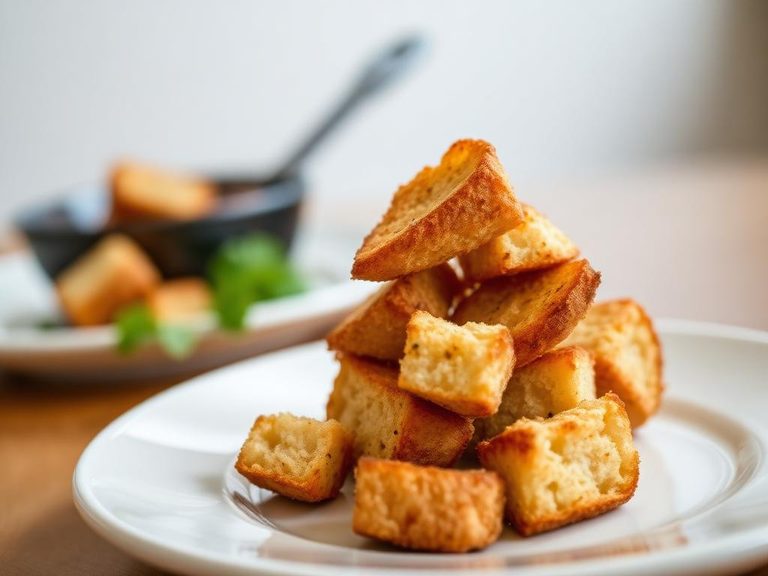
Yes, it's ideal for making fine, light breadcrumbs. Simply toast or dry the bread, then pulse in a food processor. It's perfect for coating fried foods or as a binder in meatballs.
Nutrient density (calculated · NRF9.3)
Nutrient Rich Foods index: beneficial nutrients (protein, fiber, vitamins, minerals) minus saturated fat, added sugar & sodium, per 100 kcal.
NRF9.3 index — Fulgoni, Keast & Drewnowski, 2009. Computed from USDA nutrients.
Weight-loss friendliness (composite index)
Energy density 2.70 kcal/g · 14% calories from protein · 2.3 g fiber · 0.0 g sugar per 100 g.
Composite of energy density (Rolls et al., 1999), protein & fiber satiety, minus sugar. A calculated heuristic — ranks satiety-per-calorie, not a clinical measure.
Dietary load (calculated from USDA values)
Potential renal acid load. Positive = acid-forming, negative = alkaline-forming.
Sodium-to-potassium ratio: 4.08 (lower is better — aim for ≤ 1)
Sodium:potassium per WHO potassium guidance. Computed from USDA nutrients.