

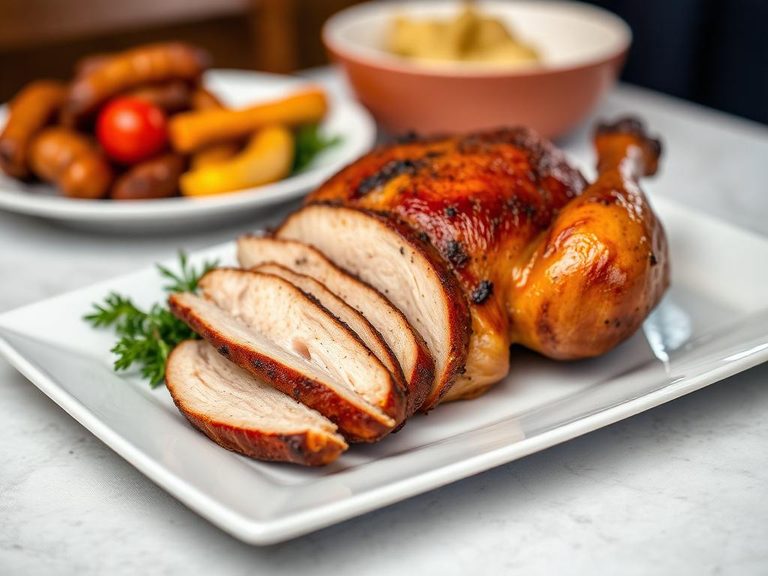
Turkey, skin from whole (light and dark), with added solution, raw
Whole food · Poultry Products

Photo: Wikipedia
This is the skin from a whole raw turkey, including both light and dark meat portions, that has been processed with an added solution to enhance moisture and flavor. The skin is rich, fatty, and gelatinous when raw, transforming into a crispy, savory delicacy when roasted or fried. Nutritionally, it is an extremely high-fat, low-carbohydrate food, providing a dense source of energy and fat-soluble vitamins.
Calorie split: 13% protein · 0% carbs · 87% fat
↓ Full nutrition💚 Why it's loved
People love turkey skin for its unparalleled ability to become shatteringly crisp and deeply flavorful when cooked, offering a savory, umami-rich contrast to the leaner meat. It's a prized treat at holiday meals and a symbol of indulgent, home-style cooking.
⚠️ Watch-outs & how to enjoy it better
The primary downside is its very high fat and calorie density, which can contribute to excessive calorie intake if consumed in large portions. The added solution often contains sodium, which can be a concern for those monitoring salt intake. To enjoy it mindfully, practice portion control, consider it a flavor accent rather than a main component, and pair it with fiber-rich vegetables to balance the meal.
Key benefits
- Excellent source of dietary fat for energy and satiety.
- Provides a good amount of protein per serving.
- Contains B vitamins like niacin and B6.
- Rich in minerals such as selenium and phosphorus.
- A key component for adding flavor and crispness to roasted poultry.
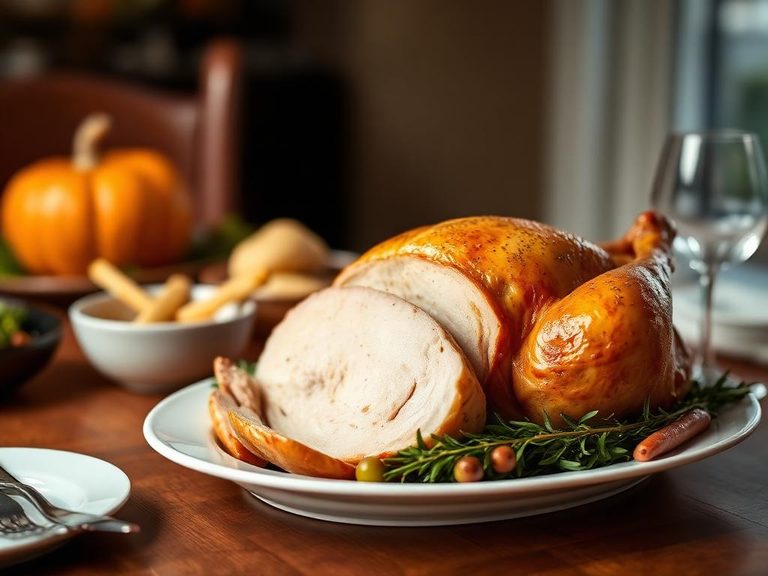
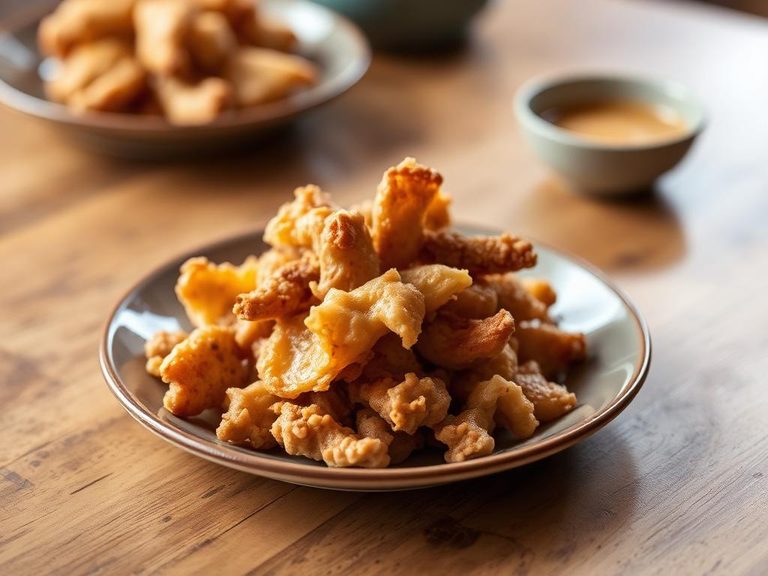
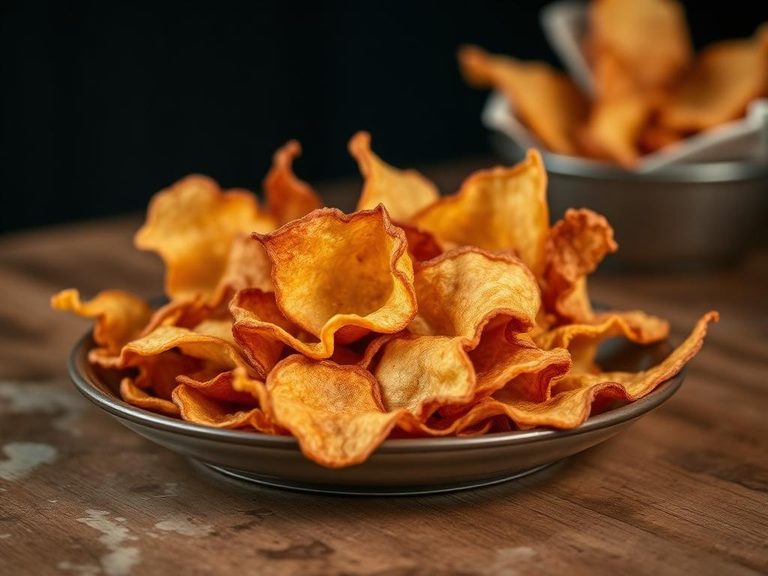
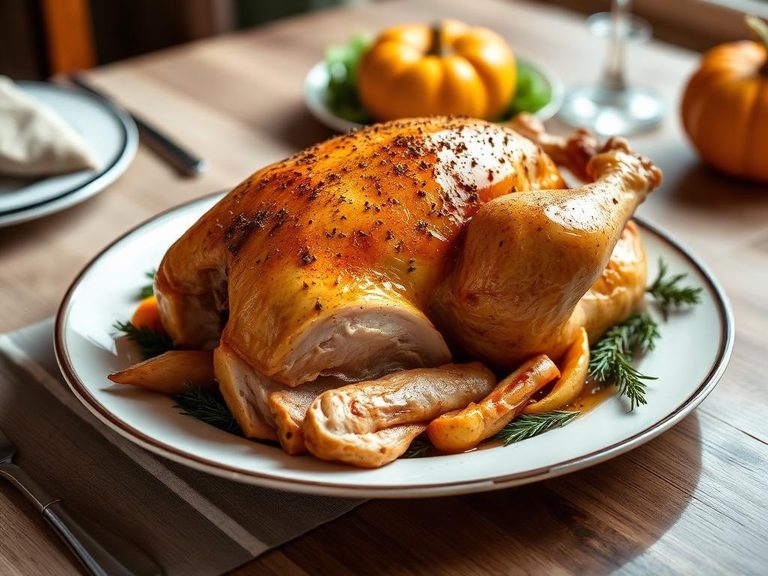
🍽️ Popular dishes
🌍 Where it's eaten
💡 Did you know?
The practice of adding a solution (often a salt-water brine with seasonings) to turkey is a modern industrial technique to increase the bird's weight and juiciness, but it can also make the skin more challenging to crisp up during cooking.
Full nutrition (USDA data · scales with serving)
| Water | 50.0 g |
| Energy | 381 kcal |
| Energy | 1595 kj |
| Protein | 12.3 g |
| Total lipid (fat) | 36.8 g |
| Ash | 0.69 g |
| Carbohydrate, by difference | 0.21 g |
| Fiber, total dietary | 0.00 g |
| Total Sugars | 0.10 g |
| Sucrose | 0.10 g |
| Glucose | 0.00 g |
| Fructose | 0.00 g |
| Lactose | 0.00 g |
| Maltose | 0.00 g |
| Galactose | 0.00 g |
| Starch | 0.06 g |
| Calcium, Ca | 13.0 mg |
| Iron, Fe | 0.57 mg |
| Magnesium, Mg | 9.0 mg |
| Phosphorus, P | 99.0 mg |
| Potassium, K | 107 mg |
| Sodium, Na | 138 mg |
| Zinc, Zn | 0.82 mg |
| Copper, Cu | 0.05 mg |
| Manganese, Mn | 0.01 mg |
| Selenium, Se | 10.1 ug |
| Vitamin C, total ascorbic acid | 0.00 mg |
| Thiamin | 0.02 mg |
| Riboflavin | 0.10 mg |
| Niacin | 3.3 mg |
| Pantothenic acid | 0.49 mg |
| Vitamin B-6 | 0.16 mg |
| Folate, total | 4.0 ug |
| Folate, food | 4.0 ug |
| Choline, total | 34.8 mg |
| Betaine | 2.1 mg |
| Vitamin B-12 | 0.88 ug |
| Vitamin B-12, added | 0.00 ug |
| Vitamin A, RAE | 85.0 ug |
| Retinol | 85.0 ug |
| Carotene, beta | 0.00 ug |
| Carotene, alpha | 0.00 ug |
| Cryptoxanthin, beta | 0.00 ug |
| Vitamin A, IU | 284 iu |
| Lycopene | 0.00 ug |
| Lutein + zeaxanthin | 0.00 ug |
| Vitamin E (alpha-tocopherol) | 0.09 mg |
| Vitamin E, added | 0.00 mg |
| Tocopherol, beta | 0.01 mg |
| Tocopherol, gamma | 0.01 mg |
| Tocopherol, delta | 0.01 mg |
| Tocotrienol, alpha | 0.01 mg |
| Tocotrienol, beta | 0.00 mg |
| Tocotrienol, gamma | 0.04 mg |
| Tocotrienol, delta | 0.00 mg |
| Vitamin D (D2 + D3), International Units | 46.0 iu |
| Vitamin D (D2 + D3) | 1.1 ug |
| Vitamin D3 (cholecalciferol) | 1.1 ug |
| Vitamin K (phylloquinone) | 0.00 ug |
| Alcohol, ethyl | 0.00 g |
| Caffeine | 0.00 mg |
| Theobromine | 0.00 mg |
Fat & fatty acid profile (per 100g)
| Fatty acids, total saturated | 10.4 g |
| SFA 4:0 | 0.00 g |
| SFA 6:0 | 0.00 g |
| SFA 8:0 | 0.00 g |
| SFA 10:0 | 0.02 g |
| SFA 12:0 | 0.14 g |
| SFA 14:0 | 0.41 g |
| SFA 15:0 | 0.06 g |
| SFA 16:0 | 7.2 g |
| SFA 17:0 | 0.10 g |
| SFA 18:0 | 2.4 g |
| SFA 20:0 | 0.04 g |
| SFA 22:0 | 0.02 g |
| SFA 24:0 | 0.01 g |
| Fatty acids, total monounsaturated | 13.9 g |
| MUFA 14:1 | 0.06 g |
| MUFA 15:1 | 0.00 g |
| MUFA 16:1 | 1.4 g |
| MUFA 16:1 c | 1.3 g |
| MUFA 17:1 | 0.06 g |
| MUFA 18:1 | 12.2 g |
| MUFA 18:1 c | 11.8 g |
| MUFA 20:1 | 0.18 g |
| MUFA 22:1 | 0.01 g |
| MUFA 22:1 c | 0.01 g |
| MUFA 24:1 c | 0.00 g |
| Fatty acids, total polyunsaturated | 10.9 g |
| PUFA 18:2 | 10.0 g |
| PUFA 18:2 n-6 c,c | 9.8 g |
| PUFA 18:2 CLAs | 0.08 g |
| PUFA 18:3 | 0.63 g |
| PUFA 18:3 n-3 c,c,c (ALA) | 0.61 g |
| PUFA 18:3 n-6 c,c,c | 0.02 g |
| PUFA 18:4 | 0.00 g |
| PUFA 20:2 n-6 c,c | 0.06 g |
| PUFA 20:3 | 0.04 g |
| PUFA 20:3 n-3 | 0.01 g |
| PUFA 20:3 n-6 | 0.04 g |
| PUFA 20:4 | 0.14 g |
| PUFA 20:5 n-3 (EPA) | 0.01 g |
| PUFA 22:4 | 0.03 g |
| PUFA 22:5 n-3 (DPA) | 0.02 g |
| PUFA 22:6 n-3 (DHA) | 0.01 g |
| Fatty acids, total trans | 0.56 g |
| Fatty acids, total trans-monoenoic | 0.43 g |
| TFA 16:1 t | 0.03 g |
| TFA 18:1 t | 0.41 g |
| TFA 22:1 t | 0.00 g |
| TFA 18:2 t not further defined | 0.13 g |
| Fatty acids, total trans-polyenoic | 0.13 g |
| Cholesterol | 94.0 mg |
Amino acid profile (per 100g)
| Tryptophan | 0.06 g |
| Threonine | 0.28 g |
| Isoleucine | 0.24 g |
| Leucine | 0.58 g |
| Lysine | 0.64 g |
| Methionine | 0.21 g |
| Cystine | 0.09 g |
| Phenylalanine | 0.31 g |
| Tyrosine | 0.22 g |
| Valine | 0.34 g |
| Arginine | 0.77 g |
| Histidine | 0.21 g |
| Alanine | 0.83 g |
| Aspartic acid | 0.74 g |
| Glutamic acid | 1.2 g |
| Glycine | 1.6 g |
| Proline | 1.1 g |
| Serine | 0.40 g |
| Hydroxyproline | 0.89 g |
FAQ
How do I get turkey skin crispy?
Pat the skin completely dry with paper towels before cooking. Roast at a high temperature (425°F/220°C) or start low and finish high. You can also separate the skin from the meat and rub fat (like butter or oil) directly on it.
Is turkey skin healthy?
It is a nutritious source of fat, protein, and certain vitamins, but its high calorie and saturated fat content means it should be eaten in moderation as part of a balanced diet.
What does 'with added solution' mean?
It means the turkey has been injected or marinated with a mixture, typically containing water, salt, and sometimes sugars or flavorings, to increase its weight and moisture.
Nutrient density (calculated · NRF9.3)
Nutrient Rich Foods index: beneficial nutrients (protein, fiber, vitamins, minerals) minus saturated fat, added sugar & sodium, per 100 kcal.
NRF9.3 index — Fulgoni, Keast & Drewnowski, 2009. Computed from USDA nutrients.
Weight-loss friendliness (composite index)
Energy density 3.81 kcal/g · 13% calories from protein · 0.0 g fiber · 0.1 g sugar per 100 g.
Composite of energy density (Rolls et al., 1999), protein & fiber satiety, minus sugar. A calculated heuristic — ranks satiety-per-calorie, not a clinical measure.
Dietary load (calculated from USDA values)
Potential renal acid load. Positive = acid-forming, negative = alkaline-forming.
Sodium-to-potassium ratio: 1.29 (lower is better — aim for ≤ 1)
Sodium:potassium per WHO potassium guidance. Computed from USDA nutrients.