

Crackers, standard snack-type, regular
Whole food · Baked Products
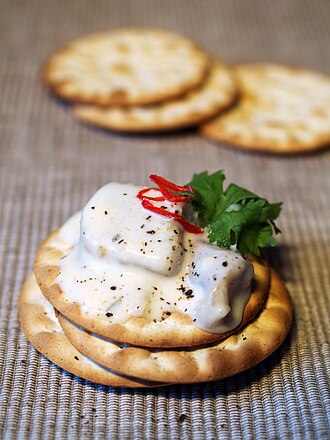
Photo: Wikipedia
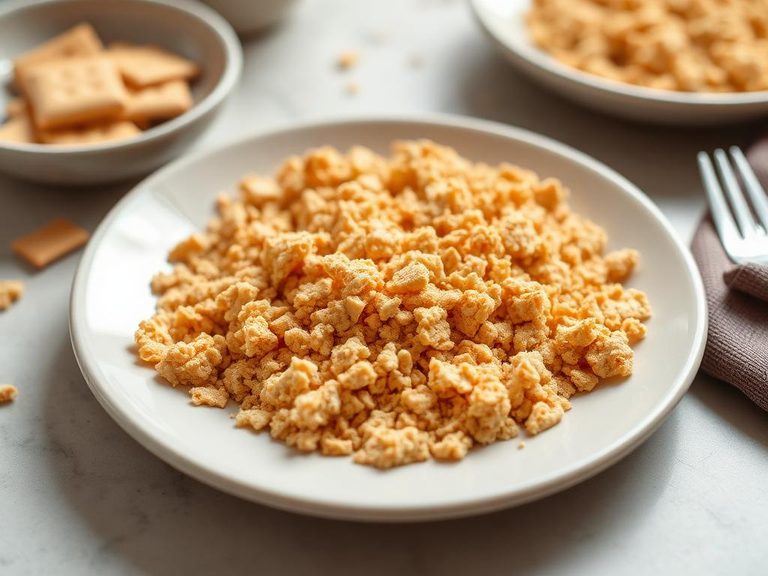
Standard snack crackers are crisp, salty, and savory wafers, typically made from refined wheat flour and baked to a satisfying crunch. Their neutral, buttery base makes them a perfect canvas for toppings. Nutritionally, they are a dense energy source, primarily from carbohydrates and fats.
Calorie split: 5% protein · 48% carbs · 47% fat
↓ Full nutrition💚 Why it's loved
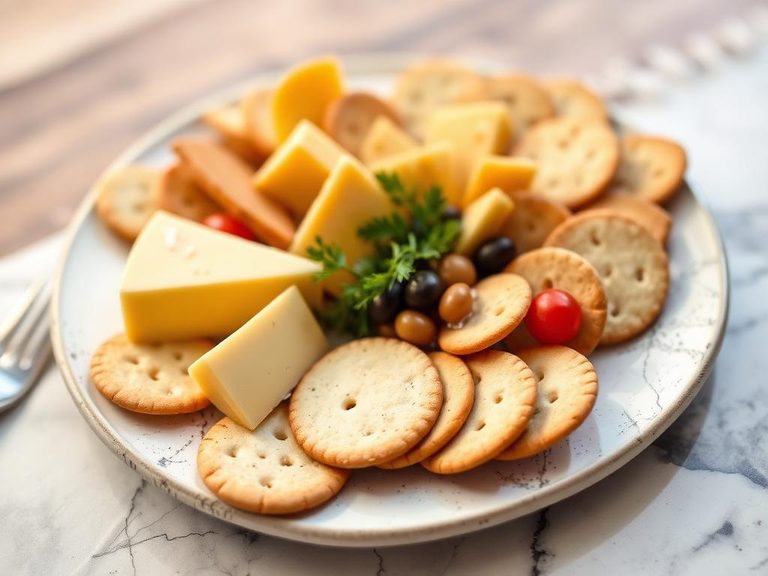
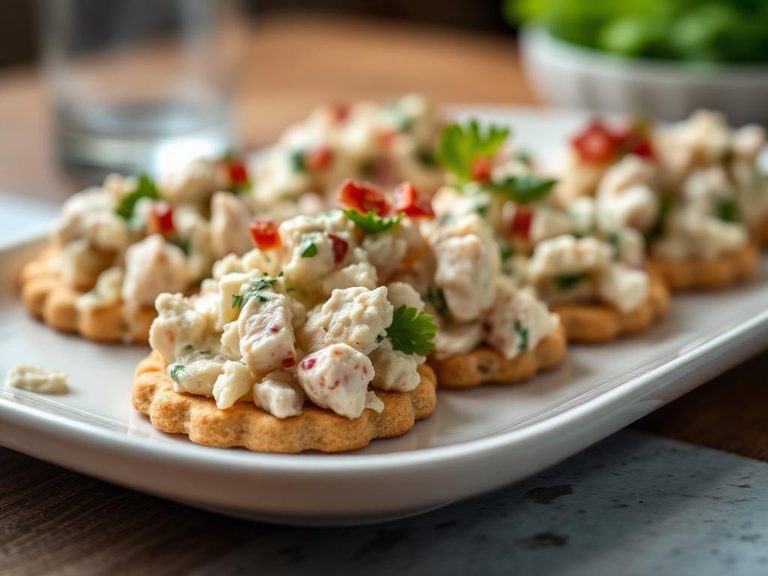
People love them for their addictive salty crunch and incredible versatility—they are the ultimate blank slate for cheese, dips, or spreads. They evoke a sense of casual comfort and are a staple at parties, picnics, and quick snacks.
⚠️ Watch-outs & how to enjoy it better
Their refined flour and low fiber content can lead to rapid blood sugar spikes, and they are often high in sodium. To counteract this, pair them with protein (like cheese or hummus) or healthy fats (like avocado) to slow digestion, and practice strict portion control by serving a single handful.
Key benefits
- Quick source of energy from carbohydrates.
- Convenient, shelf-stable, and portable snack.
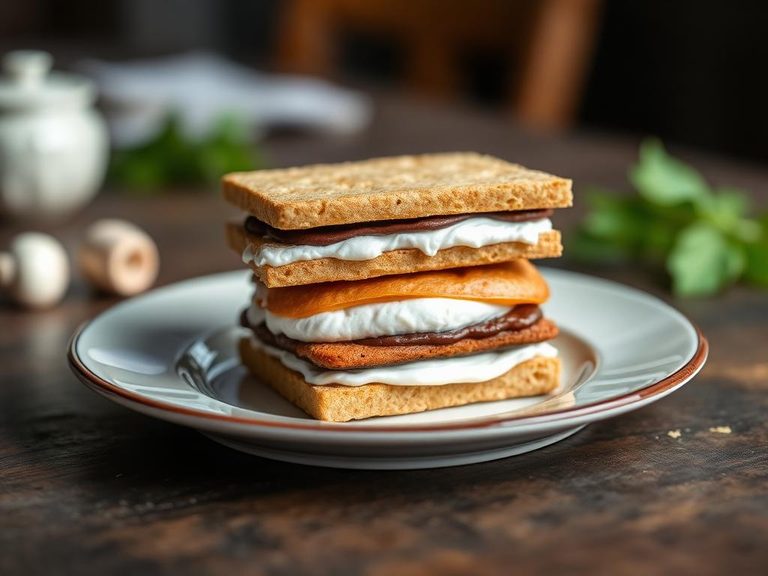
- Versatile base for both savory and sweet toppings.
- Often fortified with small amounts of iron and B vitamins.
- Provides a satisfying crunch that can aid in mindful eating.
🍽️ Popular dishes
🌍 Where it's eaten
💡 Did you know?
The word 'cracker' may derive from the sound they make when bitten, or from the practice of 'cracking' them to place on soup.
Full nutrition (USDA data · scales with serving)
| Water | 3.1 g |
| Energy | 510 kcal |
| Energy | 2132 kj |
| Protein | 6.6 g |
| Total lipid (fat) | 26.4 g |
| Ash | 2.5 g |
| Carbohydrate, by difference | 61.3 g |
| Fiber, total dietary | 2.3 g |
| Total Sugars | 8.2 g |
| Sucrose | 7.0 g |
| Glucose | 0.47 g |
| Fructose | 0.29 g |
| Lactose | 0.00 g |
| Maltose | 0.48 g |
| Galactose | 0.00 g |
| Starch | 49.7 g |
| Calcium, Ca | 120 mg |
| Iron, Fe | 4.0 mg |
| Magnesium, Mg | 18.0 mg |
| Phosphorus, P | 248 mg |
| Potassium, K | 118 mg |
| Sodium, Na | 726 mg |
| Zinc, Zn | 0.49 mg |
| Copper, Cu | 0.10 mg |
| Manganese, Mn | 0.49 mg |
| Selenium, Se | 6.7 ug |
| Vitamin C, total ascorbic acid | 0.00 mg |
| Thiamin | 0.42 mg |
| Riboflavin | 0.46 mg |
| Niacin | 4.4 mg |
| Pantothenic acid | 0.42 mg |
| Vitamin B-6 | 0.06 mg |
| Folate, total | 92.0 ug |
| Folic acid | 84.0 ug |
| Folate, food | 8.0 ug |
| Folate, DFE | 150 ug |
| Choline, total | 9.6 mg |
| Betaine | 48.0 mg |
| Vitamin B-12 | 0.00 ug |
| Vitamin B-12, added | 0.00 ug |
| Vitamin A, RAE | 0.00 ug |
| Retinol | 0.00 ug |
| Carotene, beta | 0.00 ug |
| Carotene, alpha | 0.00 ug |
| Cryptoxanthin, beta | 0.00 ug |
| Vitamin A, IU | 0.00 iu |
| Lycopene | 0.00 ug |
| Lutein + zeaxanthin | 12.0 ug |
| Vitamin E (alpha-tocopherol) | 3.0 mg |
| Vitamin E, added | 0.00 mg |
| Tocopherol, beta | 0.43 mg |
| Tocopherol, gamma | 14.4 mg |
| Tocopherol, delta | 5.2 mg |
| Tocotrienol, alpha | 0.08 mg |
| Tocotrienol, beta | 1.1 mg |
| Tocotrienol, gamma | 0.00 mg |
| Tocotrienol, delta | 0.00 mg |
| Vitamin D (D2 + D3), International Units | 0.00 iu |
| Vitamin D (D2 + D3) | 0.00 ug |
| Vitamin K (phylloquinone) | 69.3 ug |
| Vitamin K (Dihydrophylloquinone) | 4.5 ug |
| Vitamin K (Menaquinone-4) | 0.00 ug |
| Alcohol, ethyl | 0.00 g |
| Caffeine | 0.00 mg |
| Theobromine | 0.00 mg |
Fat & fatty acid profile (per 100g)
| Fatty acids, total saturated | 5.6 g |
| SFA 4:0 | 0.01 g |
| SFA 6:0 | 0.00 g |
| SFA 8:0 | 0.00 g |
| SFA 10:0 | 0.01 g |
| SFA 12:0 | 0.01 g |
| SFA 14:0 | 0.05 g |
| SFA 15:0 | 0.01 g |
| SFA 16:0 | 3.2 g |
| SFA 17:0 | 0.03 g |
| SFA 18:0 | 2.1 g |
| SFA 20:0 | 0.08 g |
| SFA 22:0 | 0.08 g |
| SFA 24:0 | 0.03 g |
| Fatty acids, total monounsaturated | 6.6 g |
| MUFA 15:1 | 0.00 g |
| MUFA 16:1 | 0.02 g |
| MUFA 16:1 c | 0.02 g |
| MUFA 17:1 | 0.01 g |
| MUFA 18:1 | 6.4 g |
| MUFA 18:1 c | 5.4 g |
| MUFA 20:1 | 0.11 g |
| MUFA 22:1 | 0.01 g |
| MUFA 22:1 c | 0.01 g |
| MUFA 24:1 c | 0.00 g |
| Fatty acids, total polyunsaturated | 13.1 g |
| PUFA 18:2 | 11.6 g |
| PUFA 18:2 n-6 c,c | 11.5 g |
| PUFA 18:2 CLAs | 0.02 g |
| PUFA 18:3 | 1.5 g |
| PUFA 18:3 n-3 c,c,c (ALA) | 1.5 g |
| PUFA 18:3 n-6 c,c,c | 0.06 g |
| PUFA 18:3i | 0.00 g |
| PUFA 18:4 | 0.00 g |
| PUFA 20:2 n-6 c,c | 0.01 g |
| PUFA 20:3 | 0.00 g |
| PUFA 20:3 n-3 | 0.00 g |
| PUFA 20:3 n-6 | 0.00 g |
| PUFA 20:4 | 0.01 g |
| PUFA 20:5 n-3 (EPA) | 0.00 g |
| PUFA 22:4 | 0.00 g |
| PUFA 22:5 n-3 (DPA) | 0.00 g |
| PUFA 22:6 n-3 (DHA) | 0.00 g |
| Fatty acids, total trans | 1.1 g |
| Fatty acids, total trans-monoenoic | 1.0 g |
| TFA 16:1 t | 0.00 g |
| TFA 18:1 t | 0.99 g |
| TFA 22:1 t | 0.01 g |
| TFA 18:2 t not further defined | 0.07 g |
| Fatty acids, total trans-polyenoic | 0.07 g |
| Cholesterol | 0.00 mg |
Amino acid profile (per 100g)
| Tryptophan | 0.08 g |
| Threonine | 0.19 g |
| Isoleucine | 0.25 g |
| Leucine | 0.47 g |
| Lysine | 0.10 g |
| Methionine | 0.11 g |
| Cystine | 0.17 g |
| Phenylalanine | 0.33 g |
| Tyrosine | 0.16 g |
| Valine | 0.29 g |
| Arginine | 0.25 g |
| Histidine | 0.14 g |
| Alanine | 0.23 g |
| Aspartic acid | 0.31 g |
| Glutamic acid | 2.3 g |
| Glycine | 0.25 g |
| Proline | 0.75 g |
| Serine | 0.32 g |
FAQ
Are standard snack crackers healthy?
They are generally considered a processed food, high in refined carbs and sodium, with limited nutritional benefits. They are best enjoyed occasionally as part of a balanced diet, not as a primary snack.
Why do crackers get soft in soup?
The dry, porous starch structure absorbs liquid through capillary action, causing the cracker to swell and lose its crisp texture.
What's the difference between snack crackers and saltines?
While similar, saltines are typically thinner, lighter, and have a more pronounced salt topping and perforations, while 'standard snack-type' crackers can be denser, more buttery, and come in various shapes.
Nutrient density (calculated · NRF9.3)
Nutrient Rich Foods index: beneficial nutrients (protein, fiber, vitamins, minerals) minus saturated fat, added sugar & sodium, per 100 kcal.
NRF9.3 index — Fulgoni, Keast & Drewnowski, 2009. Computed from USDA nutrients.
Weight-loss friendliness (composite index)
Energy density 5.10 kcal/g · 5% calories from protein · 2.3 g fiber · 8.2 g sugar per 100 g.
Composite of energy density (Rolls et al., 1999), protein & fiber satiety, minus sugar. A calculated heuristic — ranks satiety-per-calorie, not a clinical measure.
Dietary load (calculated from USDA values)
Potential renal acid load. Positive = acid-forming, negative = alkaline-forming.
Sodium-to-potassium ratio: 6.15 (lower is better — aim for ≤ 1)
Sodium:potassium per WHO potassium guidance. Computed from USDA nutrients.