

Restaurant, Latino, empanadas, beef, prepared
Whole food · Restaurant Foods

Photo: Wikipedia
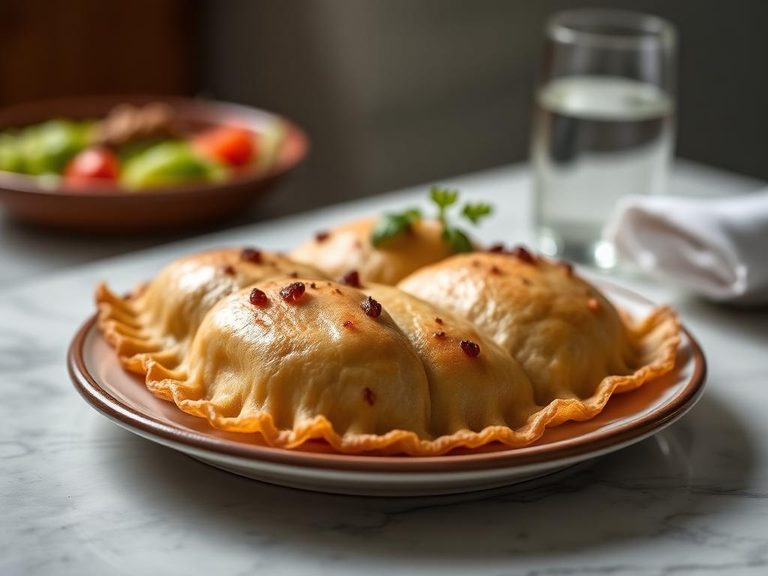
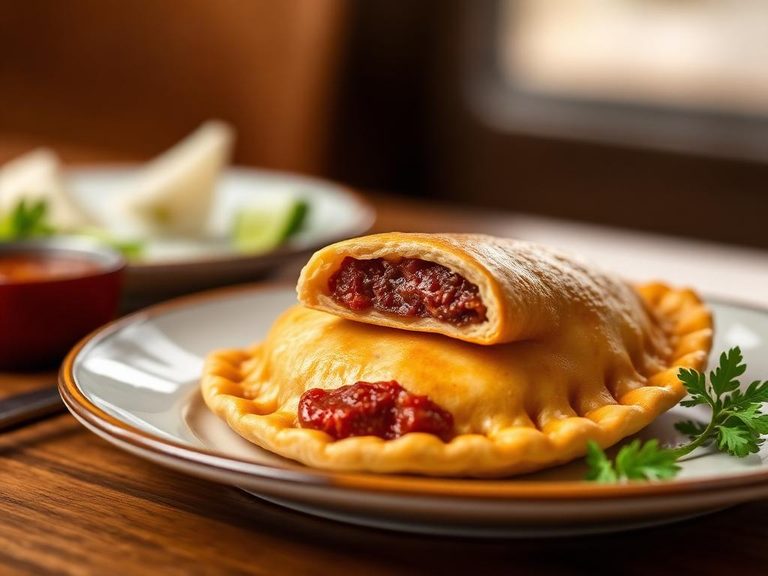
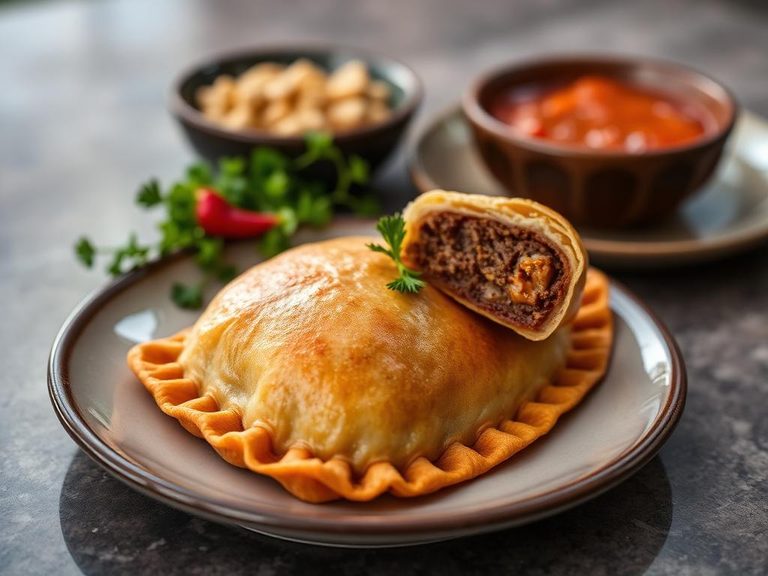
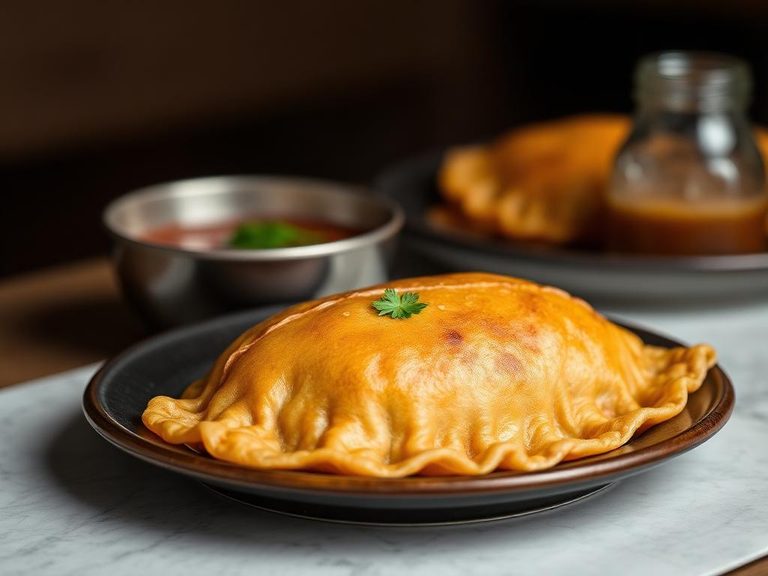
A golden, flaky pastry pocket encasing a savory, seasoned beef filling, these empanadas deliver a satisfying crunch followed by a rich, spiced meat interior. Nutritionally, they are a calorie-dense, energy-rich food with a notable balance of protein and fat, making them a substantial meal component.
Calorie split: 13% protein · 37% carbs · 49% fat
↓ Full nutrition💚 Why it's loved
People love empanadas for their handheld convenience and the perfect contrast between the crispy, buttery crust and the warm, savory beef filling. They are deeply tied to Latin American culture, representing comfort food, family gatherings, and festive celebrations.
⚠️ Watch-outs & how to enjoy it better
The high fat and calorie content can be a concern for those monitoring their weight or heart health, and the refined flour crust may cause blood-sugar spikes. To counteract this, pair an empanada with a large, fiber-rich salad or roasted vegetables to slow digestion, and practice portion control by enjoying just one as part of a balanced meal.
Key benefits
- Provides a good source of protein for muscle maintenance.
- Offers a significant amount of carbohydrates for energy.
- Contains dietary fat for satiety and nutrient absorption.
- Can be a convenient, portable meal or snack.
- Often features a flavorful, spiced filling.
🍽️ Popular dishes
🌍 Where it's eaten
💡 Did you know?
The word 'empanada' comes from the Spanish verb 'empanar', meaning 'to wrap in bread', and the first known recipe for them appears in a 1520 Spanish cookbook, 'Libre de Sent Soví'.
Full nutrition (USDA data · scales with serving)
| Water | 37.5 g |
| Energy | 335 kcal |
| Energy | 1403 kj |
| Protein | 11.3 g |
| Total lipid (fat) | 18.4 g |
| Ash | 1.6 g |
| Carbohydrate, by difference | 31.2 g |
| Fiber, total dietary | 2.0 g |
| Total Sugars | 1.8 g |
| Sucrose | 0.00 g |
| Glucose | 0.40 g |
| Fructose | 0.38 g |
| Lactose | 0.00 g |
| Maltose | 1.1 g |
| Galactose | 0.00 g |
| Starch | 26.1 g |
| Calcium, Ca | 20.0 mg |
| Iron, Fe | 2.7 mg |
| Magnesium, Mg | 21.0 mg |
| Phosphorus, P | 103 mg |
| Potassium, K | 190 mg |
| Sodium, Na | 440 mg |
| Zinc, Zn | 1.9 mg |
| Copper, Cu | 0.10 mg |
| Manganese, Mn | 0.27 mg |
| Selenium, Se | 24.8 ug |
| Vitamin C, total ascorbic acid | 0.70 mg |
| Thiamin | 0.28 mg |
| Riboflavin | 0.19 mg |
| Niacin | 4.7 mg |
| Pantothenic acid | 0.49 mg |
| Vitamin B-6 | 0.15 mg |
| Folate, total | 45.0 ug |
| Folic acid | 34.0 ug |
| Folate, food | 11.0 ug |
| Folate, DFE | 69.0 ug |
| Choline, total | 30.3 mg |
| Vitamin B-12 | 0.76 ug |
| Vitamin B-12, added | 0.00 ug |
| Vitamin A, RAE | 18.0 ug |
| Retinol | 10.0 ug |
| Carotene, beta | 73.0 ug |
| Carotene, alpha | 0.00 ug |
| Cryptoxanthin, beta | 33.0 ug |
| Vitamin A, IU | 183 iu |
| Lycopene | 417 ug |
| Lutein + zeaxanthin | 174 ug |
| Vitamin E (alpha-tocopherol) | 0.73 mg |
| Vitamin E, added | 0.00 mg |
| Tocopherol, beta | 0.07 mg |
| Tocopherol, gamma | 2.5 mg |
| Tocopherol, delta | 1.0 mg |
| Tocotrienol, alpha | 0.07 mg |
| Tocotrienol, beta | 0.00 mg |
| Tocotrienol, gamma | 0.07 mg |
| Tocotrienol, delta | 0.00 mg |
| Vitamin D (D2 + D3), International Units | 7.0 iu |
| Vitamin D (D2 + D3) | 0.20 ug |
| Vitamin K (phylloquinone) | 6.1 ug |
| Vitamin K (Dihydrophylloquinone) | 5.7 ug |
| Vitamin K (Menaquinone-4) | 2.6 ug |
| Alcohol, ethyl | 0.00 g |
| Caffeine | 0.00 mg |
| Theobromine | 0.00 mg |
Fat & fatty acid profile (per 100g)
| Fatty acids, total saturated | 5.2 g |
| SFA 4:0 | 0.00 g |
| SFA 6:0 | 0.00 g |
| SFA 8:0 | 0.00 g |
| SFA 10:0 | 0.02 g |
| SFA 12:0 | 0.01 g |
| SFA 14:0 | 0.19 g |
| SFA 15:0 | 0.02 g |
| SFA 16:0 | 3.1 g |
| SFA 17:0 | 0.07 g |
| SFA 18:0 | 1.7 g |
| SFA 20:0 | 0.04 g |
| SFA 22:0 | 0.02 g |
| SFA 24:0 | 0.01 g |
| Fatty acids, total monounsaturated | 7.1 g |
| MUFA 14:1 | 0.03 g |
| MUFA 15:1 | 0.00 g |
| MUFA 16:1 | 0.30 g |
| MUFA 16:1 c | 0.29 g |
| MUFA 17:1 | 0.00 g |
| MUFA 18:1 | 6.7 g |
| MUFA 18:1 c | 6.0 g |
| MUFA 20:1 | 0.08 g |
| MUFA 22:1 | 0.00 g |
| MUFA 22:1 c | 0.00 g |
| MUFA 24:1 c | 0.00 g |
| Fatty acids, total polyunsaturated | 4.3 g |
| PUFA 18:2 | 3.8 g |
| PUFA 18:2 n-6 c,c | 3.7 g |
| PUFA 18:2 CLAs | 0.04 g |
| PUFA 18:3 | 0.30 g |
| PUFA 18:3 n-3 c,c,c (ALA) | 0.30 g |
| PUFA 18:3 n-6 c,c,c | 0.00 g |
| PUFA 18:4 | 0.00 g |
| PUFA 20:2 n-6 c,c | 0.04 g |
| PUFA 20:3 | 0.02 g |
| PUFA 20:3 n-3 | 0.01 g |
| PUFA 20:3 n-6 | 0.01 g |
| PUFA 20:4 | 0.03 g |
| PUFA 20:5 n-3 (EPA) | 0.00 g |
| PUFA 22:4 | 0.01 g |
| PUFA 22:5 n-3 (DPA) | 0.01 g |
| PUFA 22:6 n-3 (DHA) | 0.00 g |
| Fatty acids, total trans | 0.83 g |
| Fatty acids, total trans-monoenoic | 0.69 g |
| TFA 16:1 t | 0.01 g |
| TFA 18:1 t | 0.67 g |
| TFA 22:1 t | 0.00 g |
| TFA 18:2 t not further defined | 0.14 g |
| Fatty acids, total trans-polyenoic | 0.14 g |
| Cholesterol | 26.0 mg |
Amino acid profile (per 100g)
| Tryptophan | 0.12 g |
| Threonine | 0.41 g |
| Isoleucine | 0.46 g |
| Leucine | 0.90 g |
| Lysine | 0.61 g |
| Methionine | 0.21 g |
| Cystine | 0.16 g |
| Phenylalanine | 0.50 g |
| Tyrosine | 0.31 g |
| Valine | 0.51 g |
| Arginine | 0.58 g |
| Histidine | 0.31 g |
| Alanine | 0.58 g |
| Aspartic acid | 0.82 g |
| Glutamic acid | 2.5 g |
| Glycine | 0.57 g |
| Proline | 0.85 g |
| Serine | 0.45 g |
FAQ
What is the difference between a beef empanada and a beef pasty?
While both are filled pastries, empanadas are typically associated with Latin American and Spanish cuisines, often featuring a flakier, sometimes sweeter dough, and fillings like spiced beef with onions and olives. Pasties, from Cornwall, England, are usually made with a sturdier, shortcrust pastry and a filling of beef, potato, swede, and onion, often eaten as a working man's lunch.
Can I make beef empanadas healthier?
Yes, you can use a whole-wheat or corn-based dough, leaner cuts of beef (like sirloin), and increase the vegetable content in the filling (e.g., add spinach, bell peppers, or mushrooms). Baking instead of frying also significantly reduces the fat content.
Why are some beef empanadas baked and others fried?
The cooking method often depends on regional tradition and desired texture. Fried empanadas (common in Argentina) have a crispier, more bubbly crust, while baked empanadas (common in Chile) have a smoother, more bread-like finish. Both methods are traditional, but frying adds more fat.
Nutrient density (calculated · NRF9.3)
Nutrient Rich Foods index: beneficial nutrients (protein, fiber, vitamins, minerals) minus saturated fat, added sugar & sodium, per 100 kcal.
NRF9.3 index — Fulgoni, Keast & Drewnowski, 2009. Computed from USDA nutrients.
Weight-loss friendliness (composite index)
Energy density 3.35 kcal/g · 14% calories from protein · 2.0 g fiber · 1.8 g sugar per 100 g.
Composite of energy density (Rolls et al., 1999), protein & fiber satiety, minus sugar. A calculated heuristic — ranks satiety-per-calorie, not a clinical measure.
Dietary load (calculated from USDA values)
Potential renal acid load. Positive = acid-forming, negative = alkaline-forming.
Sodium-to-potassium ratio: 2.32 (lower is better — aim for ≤ 1)
Sodium:potassium per WHO potassium guidance. Computed from USDA nutrients.