

Pork, cured, ham, slice, bone-in, separable lean and fat, heated, pan-broil
Whole food · Pork Products
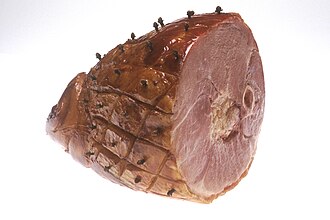
Photo: Wikipedia
This is a slice of bone-in, cured ham that has been pan-broiled to a sizzling finish, offering a satisfying contrast between its savory, salty lean meat and the rich, rendered fat cap. Nutritionally, it's a protein powerhouse with minimal carbohydrates, making it a substantial, low-carb centerpiece for a meal.
Calorie split: 56% protein · 2% carbs · 42% fat
↓ Full nutrition💚 Why it's loved
People cherish it for the deep, savory umami flavor from the curing process and the delightful textural contrast between the crispy, caramelized edges and the tender interior. It's a versatile staple that can anchor a hearty breakfast, a simple lunch, or a classic dinner.
⚠️ Watch-outs & how to enjoy it better
The primary concerns are its high sodium content from curing and the saturated fat in the separable fat portion. Those monitoring salt intake should opt for smaller portions or rinse the slice lightly before cooking. To balance the meal, pair it with fiber-rich vegetables like steamed broccoli or a fresh salad to add volume and nutrients without significant carbs.
Key benefits
- Excellent source of high-quality protein for muscle maintenance.
- Very low in carbohydrates and sugars.
- Provides essential minerals like zinc and selenium.
- Bone-in cut can enhance flavor during cooking.
- Pan-broiling adds crispness without extra oil.
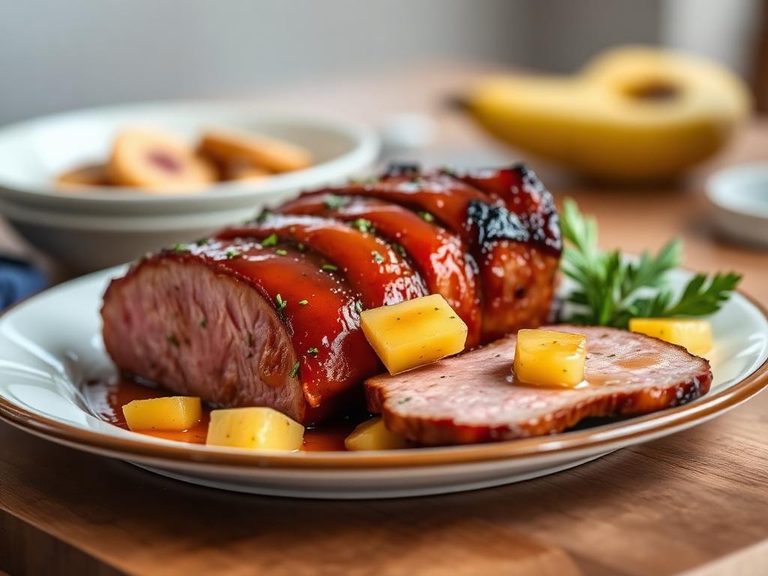
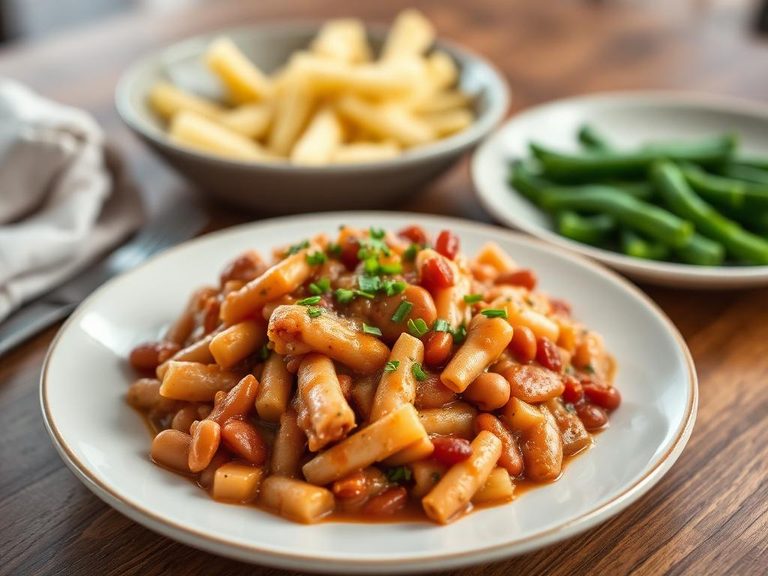
🍽️ Popular dishes




🌍 Where it's eaten
💡 Did you know?
The tradition of pan-broiling ham steaks became especially popular in mid-20th century America as a quick, protein-rich weeknight meal, often advertised by pork producers as a convenient 'ready-to-cook' option.
Full nutrition (USDA data · scales with serving)
| Water | 62.6 g |
| Energy | 181 kcal |
| Energy | 757 kj |
| Protein | 25.5 g |
| Total lipid (fat) | 8.5 g |
| Ash | 3.1 g |
| Carbohydrate, by difference | 0.70 g |
| Fiber, total dietary | 0.00 g |
| Total Sugars | 0.70 g |
| Sucrose | 0.57 g |
| Glucose | 0.13 g |
| Fructose | 0.00 g |
| Lactose | 0.00 g |
| Maltose | 0.00 g |
| Galactose | 0.00 g |
| Calcium, Ca | 14.0 mg |
| Iron, Fe | 1.3 mg |
| Magnesium, Mg | 25.0 mg |
| Phosphorus, P | 285 mg |
| Potassium, K | 405 mg |
| Sodium, Na | 852 mg |
| Zinc, Zn | 2.9 mg |
| Copper, Cu | 0.42 mg |
| Manganese, Mn | 0.02 mg |
| Selenium, Se | 24.4 ug |
| Vitamin C, total ascorbic acid | 0.00 mg |
| Thiamin | 0.55 mg |
| Riboflavin | 0.30 mg |
| Niacin | 7.3 mg |
| Pantothenic acid | 0.73 mg |
| Vitamin B-6 | 0.51 mg |
| Folate, total | 2.0 ug |
| Folic acid | 0.00 ug |
| Folate, food | 2.0 ug |
| Folate, DFE | 2.0 ug |
| Choline, total | 102 mg |
| Betaine | 6.7 mg |
| Vitamin B-12 | 0.63 ug |
| Vitamin B-12, added | 0.00 ug |
| Vitamin A, RAE | 1.0 ug |
| Retinol | 1.0 ug |
| Carotene, beta | 0.00 ug |
| Carotene, alpha | 0.00 ug |
| Cryptoxanthin, beta | 0.00 ug |
| Vitamin A, IU | 4.0 iu |
| Lycopene | 0.00 ug |
| Lutein + zeaxanthin | 0.00 ug |
| Vitamin E (alpha-tocopherol) | 0.30 mg |
| Vitamin E, added | 0.00 mg |
| Tocopherol, beta | 0.00 mg |
| Tocopherol, gamma | 0.04 mg |
| Tocopherol, delta | 0.00 mg |
| Tocotrienol, alpha | 0.00 mg |
| Tocotrienol, beta | 0.00 mg |
| Tocotrienol, gamma | 0.02 mg |
| Tocotrienol, delta | 0.00 mg |
| Vitamin D (D2 + D3), International Units | 40.0 iu |
| Vitamin D (D2 + D3) | 1.0 ug |
| Vitamin D3 (cholecalciferol) | 1.0 ug |
| Vitamin K (phylloquinone) | 0.00 ug |
| Vitamin K (Dihydrophylloquinone) | 0.00 ug |
| Vitamin K (Menaquinone-4) | 1.8 ug |
| Alcohol, ethyl | 0.00 g |
| Caffeine | 0.00 mg |
| Theobromine | 0.00 mg |
Fat & fatty acid profile (per 100g)
| Fatty acids, total saturated | 2.8 g |
| SFA 4:0 | 0.00 g |
| SFA 6:0 | 0.00 g |
| SFA 8:0 | 0.00 g |
| SFA 10:0 | 0.00 g |
| SFA 12:0 | 0.00 g |
| SFA 14:0 | 0.06 g |
| SFA 15:0 | 0.00 g |
| SFA 16:0 | 1.00 g |
| SFA 17:0 | 0.01 g |
| SFA 18:0 | 0.49 g |
| SFA 20:0 | 0.01 g |
| SFA 22:0 | 0.00 g |
| Fatty acids, total monounsaturated | 3.8 g |
| MUFA 14:1 | 0.00 g |
| MUFA 15:1 | 0.00 g |
| MUFA 16:1 | 0.20 g |
| MUFA 17:1 | 0.00 g |
| MUFA 18:1 | 1.9 g |
| MUFA 18:1 c | 3.2 g |
| MUFA 20:1 | 0.05 g |
| MUFA 22:1 | 0.00 g |
| Fatty acids, total polyunsaturated | 1.0 g |
| PUFA 18:2 | 0.49 g |
| PUFA 18:2 n-6 c,c | 0.88 g |
| PUFA 18:2 CLAs | 0.01 g |
| PUFA 18:3 | 0.02 g |
| PUFA 18:3 n-3 c,c,c (ALA) | 0.05 g |
| PUFA 18:3 n-6 c,c,c | 0.00 g |
| PUFA 18:4 | 0.00 g |
| PUFA 20:2 n-6 c,c | 0.04 g |
| PUFA 20:3 | 0.00 g |
| PUFA 20:4 | 0.08 g |
| PUFA 20:5 n-3 (EPA) | 0.00 g |
| PUFA 22:5 n-3 (DPA) | 0.00 g |
| PUFA 22:6 n-3 (DHA) | 0.00 g |
| Fatty acids, total trans | 0.06 g |
| Fatty acids, total trans-monoenoic | 0.04 g |
| TFA 18:1 t | 0.04 g |
| TFA 18:2 t,t | 0.02 g |
| Fatty acids, total trans-polyenoic | 0.02 g |
| Cholesterol | 73.0 mg |
Amino acid profile (per 100g)
| Tryptophan | 0.24 g |
| Threonine | 1.1 g |
| Isoleucine | 1.1 g |
| Leucine | 2.0 g |
| Lysine | 2.1 g |
| Methionine | 0.61 g |
| Cystine | 0.29 g |
| Phenylalanine | 1.0 g |
| Tyrosine | 0.82 g |
| Valine | 1.3 g |
| Arginine | 1.6 g |
| Histidine | 1.1 g |
| Alanine | 1.5 g |
| Aspartic acid | 2.2 g |
| Glutamic acid | 3.6 g |
| Glycine | 1.4 g |
| Proline | 1.1 g |
| Serine | 1.00 g |
| Hydroxyproline | 0.17 g |
FAQ
Is this the same as 'country ham'?
Not necessarily. 'Country ham' refers to a specific dry-curing and aging method, often resulting in a saltier, firmer product. This item is a generic cured ham slice; it could be city ham (wet-cured) or country ham, but the nutrition profile is typical for a standard cured ham.
Why is there 0g fiber and very low carbs?
Ham is animal muscle tissue, which contains no plant-based carbohydrates or fiber. The trace amounts of carbs (0.7g) and sugar come from minimal ingredients added during the curing process, like dextrose or corn syrup.
How do I pan-broil it properly?
Heat a skillet over medium heat (no oil needed if the ham is fatty). Place the slice in the pan and cook for 3-4 minutes per side, until heated through and the fat is rendered and edges are crispy. Avoid overcooking, which can make it tough and dry.
Nutrient density (calculated · NRF9.3)
Nutrient Rich Foods index: beneficial nutrients (protein, fiber, vitamins, minerals) minus saturated fat, added sugar & sodium, per 100 kcal.
NRF9.3 index — Fulgoni, Keast & Drewnowski, 2009. Computed from USDA nutrients.
Weight-loss friendliness (composite index)
Energy density 1.81 kcal/g · 56% calories from protein · 0.0 g fiber · 0.7 g sugar per 100 g.
Composite of energy density (Rolls et al., 1999), protein & fiber satiety, minus sugar. A calculated heuristic — ranks satiety-per-calorie, not a clinical measure.
Dietary load (calculated from USDA values)
Potential renal acid load. Positive = acid-forming, negative = alkaline-forming.
Sodium-to-potassium ratio: 2.10 (lower is better — aim for ≤ 1)
Sodium:potassium per WHO potassium guidance. Computed from USDA nutrients.