

Crackers, whole-wheat, reduced fat
Whole food · Baked Products

Photo: Wikipedia
Whole-wheat reduced-fat crackers are crisp, savory biscuits made from coarsely ground whole grain, offering a satisfying crunch with a nutty, slightly earthy flavor. They are typically lower in fat than traditional varieties while retaining a sturdy texture perfect for dipping or topping. Nutritionally, they are a significant source of dietary fiber and complex carbohydrates, providing sustained energy.
Calorie split: 11% protein · 73% carbs · 16% fat
↓ Full nutrition💚 Why it's loved
People love these crackers for their robust, wholesome flavor and satisfying crunch, which makes them a versatile base for both savory and creamy toppings. They are a staple in pantries for their convenience, long shelf life, and ability to complement everything from cheese and hummus to soups and salads.
⚠️ Watch-outs & how to enjoy it better
The high fiber content can cause digestive discomfort like bloating if consumed in large quantities without adequate water. Being a grain product, they may cause blood sugar spikes in sensitive individuals, and some brands can be high in sodium. To counteract this, pair them with protein or healthy fats (like cheese, nut butter, or avocado) to slow digestion, practice portion control, and choose low-sodium varieties.
Key benefits
- High in dietary fiber (10.9g per 100g) for digestive health.
- Good source of plant-based protein (11.34g per 100g).
- Low in sugar (1.22g per 100g) compared to many snacks.
- Reduced fat content makes them a lighter snack option.
- Provides complex carbohydrates for steady energy release.
🍽️ Popular dishes


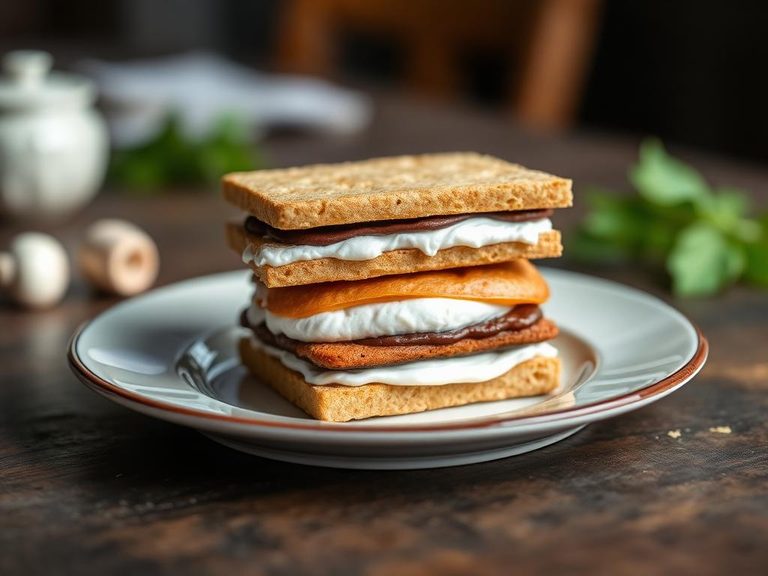
🌍 Where it's eaten
💡 Did you know?
The word 'cracker' is believed to have originated in the 19th century from the loud 'crack' sound made when breaking the hard biscuit.
Full nutrition (USDA data · scales with serving)
| Water | 2.6 g |
| Energy | 416 kcal |
| Energy | 1739 kj |
| Protein | 11.3 g |
| Total lipid (fat) | 7.6 g |
| Ash | 3.0 g |
| Carbohydrate, by difference | 75.5 g |
| Fiber, total dietary | 10.9 g |
| Total Sugars | 1.2 g |
| Sucrose | 0.90 g |
| Glucose | 0.32 g |
| Fructose | 0.00 g |
| Lactose | 0.00 g |
| Maltose | 0.00 g |
| Galactose | 0.00 g |
| Starch | 61.1 g |
| Calcium, Ca | 39.0 mg |
| Iron, Fe | 3.6 mg |
| Magnesium, Mg | 120 mg |
| Phosphorus, P | 364 mg |
| Potassium, K | 373 mg |
| Sodium, Na | 745 mg |
| Zinc, Zn | 3.0 mg |
| Copper, Cu | 0.45 mg |
| Manganese, Mn | 2.3 mg |
| Selenium, Se | 14.1 ug |
| Vitamin C, total ascorbic acid | 0.00 mg |
| Thiamin | 0.18 mg |
| Riboflavin | 0.02 mg |
| Niacin | 5.2 mg |
| Pantothenic acid | 0.90 mg |
| Vitamin B-6 | 0.20 mg |
| Folate, total | 30.0 ug |
| Folic acid | 0.00 ug |
| Folate, food | 30.0 ug |
| Folate, DFE | 30.0 ug |
| Choline, total | 29.5 mg |
| Vitamin B-12 | 0.00 ug |
| Vitamin B-12, added | 0.00 ug |
| Vitamin A, RAE | 0.00 ug |
| Retinol | 0.00 ug |
| Carotene, beta | 0.00 ug |
| Carotene, alpha | 0.00 ug |
| Cryptoxanthin, beta | 0.00 ug |
| Vitamin A, IU | 0.00 iu |
| Lycopene | 0.00 ug |
| Lutein + zeaxanthin | 194 ug |
| Vitamin E (alpha-tocopherol) | 1.1 mg |
| Vitamin E, added | 0.00 mg |
| Tocopherol, beta | 0.22 mg |
| Tocopherol, gamma | 4.5 mg |
| Tocopherol, delta | 0.94 mg |
| Tocotrienol, alpha | 0.34 mg |
| Tocotrienol, beta | 0.00 mg |
| Tocotrienol, gamma | 0.00 mg |
| Tocotrienol, delta | 0.00 mg |
| Vitamin D (D2 + D3), International Units | 0.00 iu |
| Vitamin D (D2 + D3) | 0.00 ug |
| Vitamin K (phylloquinone) | 12.5 ug |
| Vitamin K (Dihydrophylloquinone) | 0.00 ug |
| Vitamin K (Menaquinone-4) | 0.00 ug |
| Alcohol, ethyl | 0.00 g |
| Caffeine | 0.00 mg |
| Theobromine | 0.00 mg |
Fat & fatty acid profile (per 100g)
| Fatty acids, total saturated | 1.1 g |
| SFA 4:0 | 0.00 g |
| SFA 6:0 | 0.00 g |
| SFA 8:0 | 0.00 g |
| SFA 10:0 | 0.00 g |
| SFA 12:0 | 0.00 g |
| SFA 14:0 | 0.01 g |
| SFA 15:0 | 0.00 g |
| SFA 16:0 | 0.73 g |
| SFA 17:0 | 0.01 g |
| SFA 18:0 | 0.27 g |
| SFA 20:0 | 0.02 g |
| SFA 22:0 | 0.02 g |
| SFA 24:0 | 0.01 g |
| Fatty acids, total monounsaturated | 1.6 g |
| MUFA 14:1 | 0.00 g |
| MUFA 15:1 | 0.00 g |
| MUFA 16:1 | 0.01 g |
| MUFA 16:1 c | 0.01 g |
| MUFA 17:1 | 0.00 g |
| MUFA 18:1 | 1.6 g |
| MUFA 18:1 c | 1.5 g |
| MUFA 20:1 | 0.02 g |
| MUFA 22:1 | 0.00 g |
| MUFA 22:1 c | 0.00 g |
| MUFA 24:1 c | 0.00 g |
| Fatty acids, total polyunsaturated | 3.6 g |
| PUFA 18:2 | 3.2 g |
| PUFA 18:2 n-6 c,c | 3.1 g |
| PUFA 18:2 CLAs | 0.00 g |
| PUFA 18:3 | 0.40 g |
| PUFA 18:3 n-3 c,c,c (ALA) | 0.39 g |
| PUFA 18:3 n-6 c,c,c | 0.01 g |
| PUFA 18:4 | 0.00 g |
| PUFA 20:2 n-6 c,c | 0.00 g |
| PUFA 20:3 | 0.00 g |
| PUFA 20:3 n-3 | 0.00 g |
| PUFA 20:3 n-6 | 0.00 g |
| PUFA 20:4 | 0.00 g |
| PUFA 20:5 n-3 (EPA) | 0.00 g |
| PUFA 22:4 | 0.00 g |
| PUFA 22:5 n-3 (DPA) | 0.00 g |
| PUFA 22:6 n-3 (DHA) | 0.00 g |
| Fatty acids, total trans | 0.10 g |
| Fatty acids, total trans-monoenoic | 0.08 g |
| TFA 16:1 t | 0.00 g |
| TFA 18:1 t | 0.08 g |
| TFA 22:1 t | 0.00 g |
| TFA 18:2 t not further defined | 0.01 g |
| Fatty acids, total trans-polyenoic | 0.01 g |
| Cholesterol | 0.00 mg |
Amino acid profile (per 100g)
| Tryptophan | 0.16 g |
| Threonine | 0.34 g |
| Isoleucine | 0.39 g |
| Leucine | 0.78 g |
| Lysine | 0.31 g |
| Methionine | 0.19 g |
| Cystine | 0.24 g |
| Phenylalanine | 0.52 g |
| Tyrosine | 0.20 g |
| Valine | 0.51 g |
| Arginine | 0.53 g |
| Histidine | 0.27 g |
| Alanine | 0.45 g |
| Aspartic acid | 0.61 g |
| Glutamic acid | 3.4 g |
| Glycine | 0.48 g |
| Proline | 1.1 g |
| Serine | 0.52 g |
FAQ
Are whole-wheat reduced-fat crackers gluten-free?
No, they are made from whole wheat, which contains gluten. Individuals with celiac disease or gluten sensitivity should avoid them or seek certified gluten-free alternatives made from other grains.
How do they compare nutritionally to regular white-flour crackers?
They generally offer more fiber, protein, and micronutrients (like B vitamins and minerals) due to the whole grain, and often have less fat. However, they can be denser in calories per cracker.
What's the best way to store them to maintain freshness?
Store them in a cool, dry place in an airtight container or resealable bag. Once opened, they can stay fresh for several weeks. Avoid refrigeration, as it can introduce moisture and make them stale faster.
Nutrient density (calculated · NRF9.3)
Nutrient Rich Foods index: beneficial nutrients (protein, fiber, vitamins, minerals) minus saturated fat, added sugar & sodium, per 100 kcal.
NRF9.3 index — Fulgoni, Keast & Drewnowski, 2009. Computed from USDA nutrients.
Weight-loss friendliness (composite index)
Energy density 4.16 kcal/g · 11% calories from protein · 10.9 g fiber · 1.2 g sugar per 100 g.
Composite of energy density (Rolls et al., 1999), protein & fiber satiety, minus sugar. A calculated heuristic — ranks satiety-per-calorie, not a clinical measure.
Dietary load (calculated from USDA values)
Potential renal acid load. Positive = acid-forming, negative = alkaline-forming.
Sodium-to-potassium ratio: 2.00 (lower is better — aim for ≤ 1)
Sodium:potassium per WHO potassium guidance. Computed from USDA nutrients.