

Tomato juice, canned, with salt added
Whole food · Vegetables and Vegetable Products
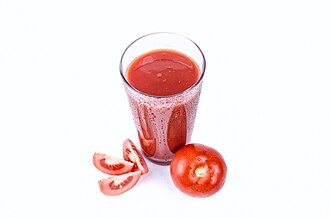
Photo: Wikipedia
This is a smooth, savory liquid made from concentrated tomato solids and water, with a bright, umami-rich flavor and a thin, drinkable texture. Nutritionally, it's a low-calorie, low-fat source of carbohydrates and a small amount of fiber. Its standout feature is being a concentrated source of the antioxidant lycopene, which becomes more bioavailable through the canning process.
Calorie split: 17% protein · 70% carbs · 13% fat
↓ Full nutrition💚 Why it's loved
People love it for its robust, savory-tart flavor that serves as a versatile base for cocktails like the Bloody Mary or a quick, nutritious drink on its own. It's a staple in many cultures, valued for its ability to add depth to soups, stews, and sauces.
⚠️ Watch-outs & how to enjoy it better
The primary caution is the added salt, which can contribute to high sodium intake, especially for those with hypertension. The natural sugars, while not excessive, can cause a mild blood sugar rise if consumed in large quantities without other foods. To counteract this, opt for low-sodium versions when possible, and pair it with a source of protein or healthy fat (like a hard-boiled egg or avocado) to blunt any glycemic response.
Key benefits
- Excellent source of lycopene, a powerful antioxidant linked to heart and skin health.
- Very low in calories and fat, making it a light, hydrating option.
- Provides a small amount of dietary fiber and natural sugars for energy.
- Convenient, shelf-stable, and ready to drink with no preparation needed.
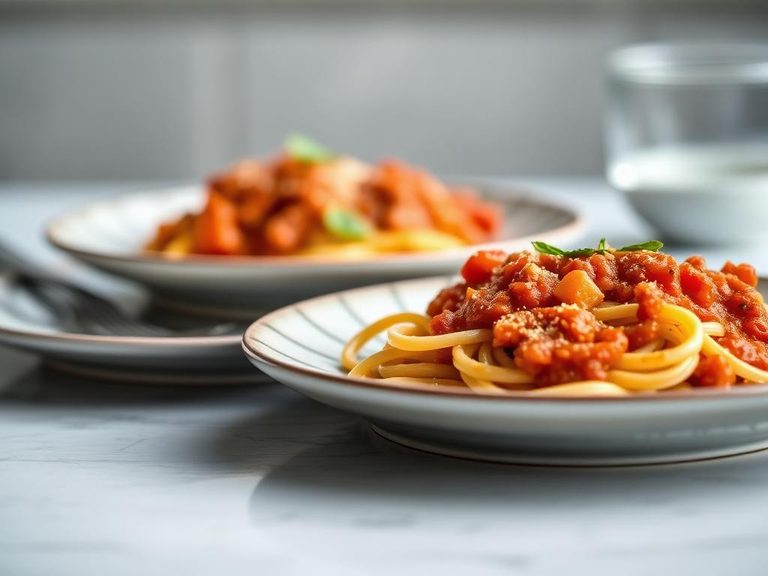
🍽️ Popular dishes


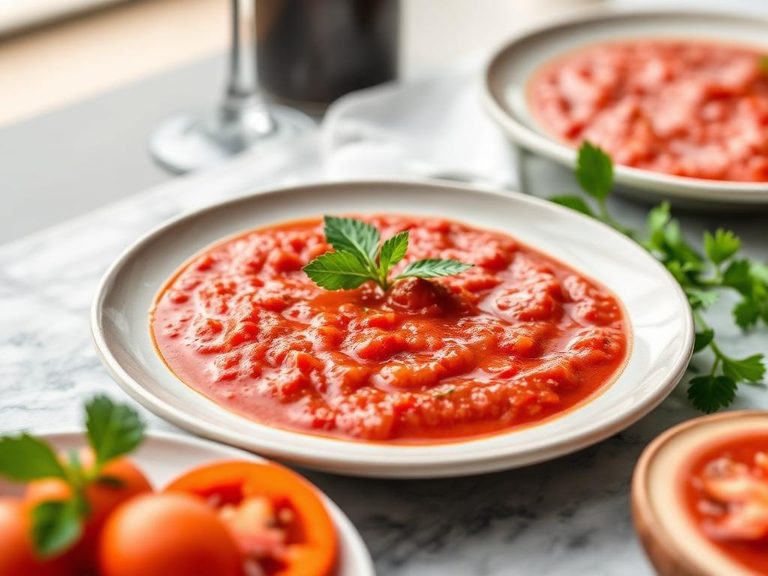
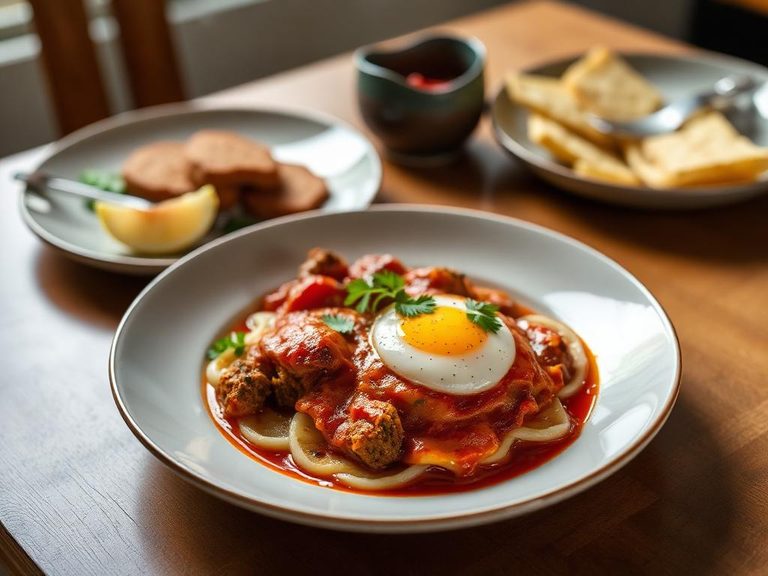
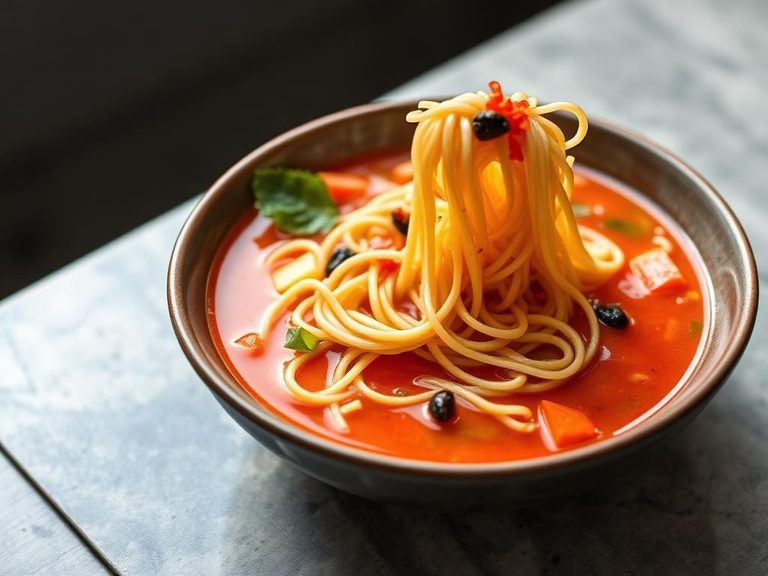
🌍 Where it's eaten
💡 Did you know?
The canning process significantly increases the bioavailability of lycopene in tomatoes, meaning your body can absorb and use more of this beneficial antioxidant from canned tomato juice than from many fresh tomato products.
Full nutrition (USDA data · scales with serving)
| Water | 94.2 g |
| Energy | 17.0 kcal |
| Energy | 72.0 kj |
| Protein | 0.85 g |
| Total lipid (fat) | 0.29 g |
| Ash | 1.1 g |
| Carbohydrate, by difference | 3.5 g |
| Fiber, total dietary | 0.40 g |
| Total Sugars | 2.6 g |
| Sucrose | 0.00 g |
| Glucose | 1.3 g |
| Fructose | 1.3 g |
| Lactose | 0.00 g |
| Maltose | 0.00 g |
| Galactose | 0.00 g |
| Calcium, Ca | 10.0 mg |
| Iron, Fe | 0.39 mg |
| Magnesium, Mg | 11.0 mg |
| Phosphorus, P | 19.0 mg |
| Potassium, K | 217 mg |
| Sodium, Na | 253 mg |
| Zinc, Zn | 0.11 mg |
| Copper, Cu | 0.04 mg |
| Manganese, Mn | 0.07 mg |
| Selenium, Se | 0.50 ug |
| Fluoride, F | 6.9 ug |
| Vitamin C, total ascorbic acid | 70.1 mg |
| Thiamin | 0.10 mg |
| Riboflavin | 0.08 mg |
| Niacin | 0.67 mg |
| Vitamin B-6 | 0.07 mg |
| Folate, total | 20.0 ug |
| Folic acid | 0.00 ug |
| Folate, food | 20.0 ug |
| Folate, DFE | 20.0 ug |
| Choline, total | 6.8 mg |
| Vitamin B-12 | 0.00 ug |
| Vitamin B-12, added | 0.00 ug |
| Vitamin A, RAE | 23.0 ug |
| Retinol | 0.00 ug |
| Carotene, beta | 270 ug |
| Carotene, alpha | 0.00 ug |
| Cryptoxanthin, beta | 0.00 ug |
| Vitamin A, IU | 450 iu |
| Lycopene | 9037 ug |
| Lutein + zeaxanthin | 60.0 ug |
| Vitamin E (alpha-tocopherol) | 0.32 mg |
| Vitamin E, added | 0.00 mg |
| Tocopherol, beta | 0.01 mg |
| Tocopherol, gamma | 0.02 mg |
| Tocopherol, delta | 0.00 mg |
| Vitamin D (D2 + D3), International Units | 0.00 iu |
| Vitamin D (D2 + D3) | 0.00 ug |
| Vitamin K (phylloquinone) | 2.3 ug |
| Alcohol, ethyl | 0.00 g |
| Caffeine | 0.00 mg |
| Theobromine | 0.00 mg |
Fat & fatty acid profile (per 100g)
| Fatty acids, total saturated | 0.02 g |
| SFA 4:0 | 0.00 g |
| SFA 6:0 | 0.00 g |
| SFA 8:0 | 0.00 g |
| SFA 10:0 | 0.00 g |
| SFA 12:0 | 0.00 g |
| SFA 14:0 | 0.00 g |
| SFA 15:0 | 0.00 g |
| SFA 16:0 | 0.01 g |
| SFA 17:0 | 0.00 g |
| SFA 18:0 | 0.00 g |
| SFA 20:0 | 0.00 g |
| SFA 22:0 | 0.00 g |
| SFA 24:0 | 0.00 g |
| Fatty acids, total monounsaturated | 0.01 g |
| MUFA 14:1 | 0.00 g |
| MUFA 15:1 | 0.00 g |
| MUFA 16:1 | 0.00 g |
| MUFA 16:1 c | 0.00 g |
| MUFA 17:1 | 0.00 g |
| MUFA 18:1 | 0.01 g |
| MUFA 18:1 c | 0.01 g |
| MUFA 20:1 | 0.00 g |
| MUFA 22:1 | 0.00 g |
| MUFA 22:1 c | 0.00 g |
| MUFA 24:1 c | 0.00 g |
| Fatty acids, total polyunsaturated | 0.03 g |
| PUFA 18:2 | 0.02 g |
| PUFA 18:2 n-6 c,c | 0.02 g |
| PUFA 18:2 CLAs | 0.00 g |
| PUFA 18:3 | 0.01 g |
| PUFA 18:3 n-3 c,c,c (ALA) | 0.01 g |
| PUFA 18:3 n-6 c,c,c | 0.00 g |
| PUFA 18:3i | 0.00 g |
| PUFA 18:4 | 0.00 g |
| PUFA 20:2 n-6 c,c | 0.00 g |
| PUFA 20:3 | 0.00 g |
| PUFA 20:3 n-3 | 0.00 g |
| PUFA 20:3 n-6 | 0.00 g |
| PUFA 20:4 | 0.00 g |
| PUFA 20:5 n-3 (EPA) | 0.00 g |
| PUFA 22:4 | 0.00 g |
| PUFA 22:5 n-3 (DPA) | 0.00 g |
| PUFA 22:6 n-3 (DHA) | 0.00 g |
| Fatty acids, total trans | 0.00 g |
| Fatty acids, total trans-monoenoic | 0.00 g |
| TFA 16:1 t | 0.00 g |
| TFA 18:1 t | 0.00 g |
| TFA 22:1 t | 0.00 g |
| TFA 18:2 t not further defined | 0.00 g |
| Fatty acids, total trans-polyenoic | 0.00 g |
| Cholesterol | 0.00 mg |
Amino acid profile (per 100g)
Estimated from Tomatoes, red, ripe, canned, packed in tomato juice — USDA does not publish this profile for Tomato juice.
| Tryptophan | 0.01 g |
| Threonine | 0.04 g |
| Isoleucine | 0.02 g |
| Leucine | 0.03 g |
| Lysine | 0.03 g |
| Methionine | 0.01 g |
| Cystine | 0.01 g |
| Phenylalanine | 0.03 g |
| Tyrosine | 0.02 g |
| Valine | 0.02 g |
| Arginine | 0.02 g |
| Histidine | 0.01 g |
| Alanine | 0.03 g |
| Aspartic acid | 0.15 g |
| Glutamic acid | 0.45 g |
| Glycine | 0.02 g |
| Proline | 0.01 g |
| Serine | 0.02 g |
FAQ
Is tomato juice high in sugar?
It contains natural sugars from the tomatoes (about 2.6g per 100g), but no added sugars. The amount is moderate and generally not a concern for most people when consumed in standard serving sizes.
Can I use it as a substitute for tomato sauce in cooking?
Yes, but it's much thinner. You can use it as a base for sauces, soups, and stews, but you'll likely need to reduce it by simmering to thicken it or combine it with tomato paste for a richer consistency.
Why does it sometimes separate in the can?
This is natural separation of the tomato solids from the liquid. It's perfectly safe to consume. Simply shake the can well before pouring to recombine everything.
Nutrient density (calculated · NRF9.3)
Nutrient Rich Foods index: beneficial nutrients (protein, fiber, vitamins, minerals) minus saturated fat, added sugar & sodium, per 100 kcal.
NRF9.3 index — Fulgoni, Keast & Drewnowski, 2009. Computed from USDA nutrients.
Weight-loss friendliness (composite index)
Energy density 0.17 kcal/g · 20% calories from protein · 0.4 g fiber · 2.6 g sugar per 100 g.
Composite of energy density (Rolls et al., 1999), protein & fiber satiety, minus sugar. A calculated heuristic — ranks satiety-per-calorie, not a clinical measure.
Dietary load (calculated from USDA values)
Potential renal acid load. Positive = acid-forming, negative = alkaline-forming.
Sodium-to-potassium ratio: 1.17 (lower is better — aim for ≤ 1)
Sodium:potassium per WHO potassium guidance. Computed from USDA nutrients.