

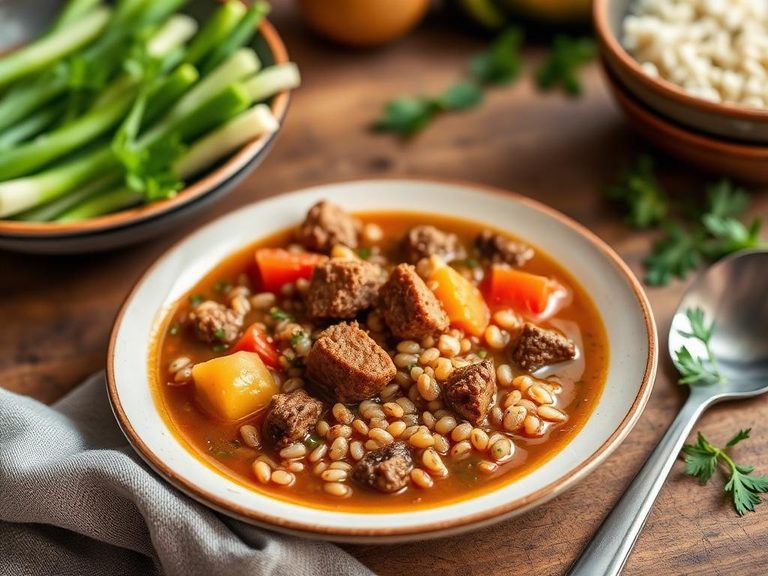
Soup, beef barley, ready to serve
Whole food · Soups, Sauces, and Gravies
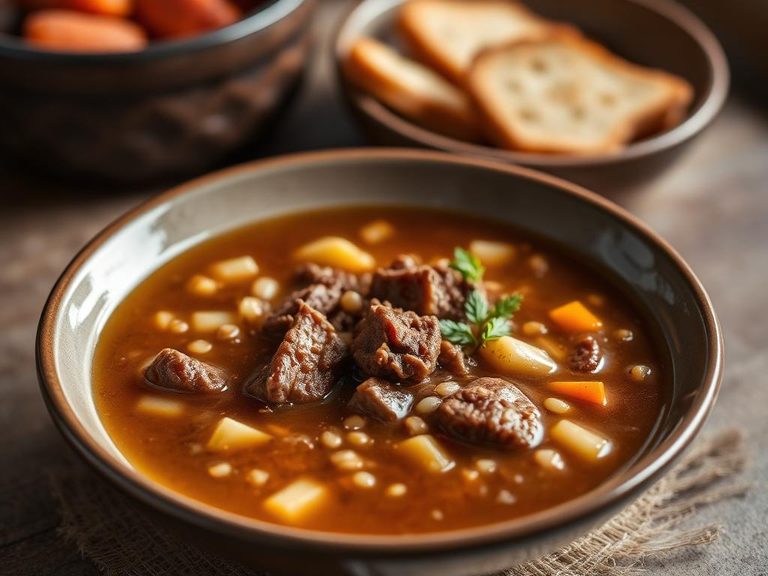
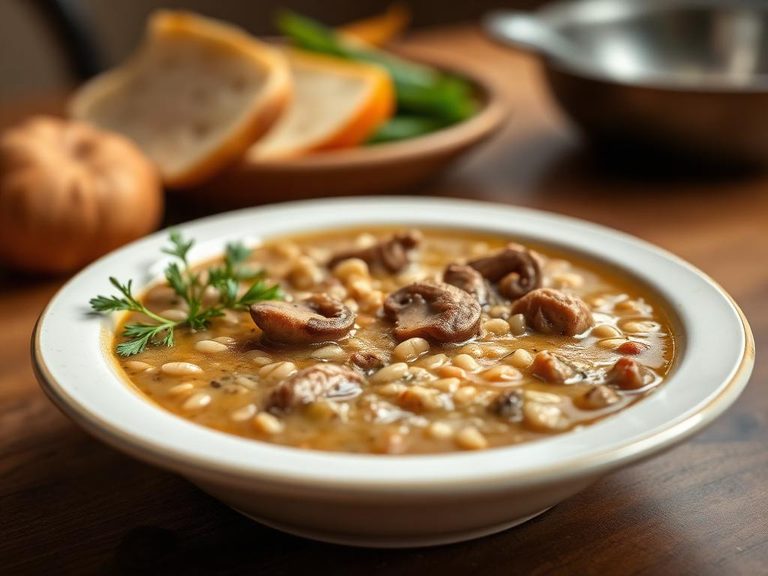
This is a classic, ready-to-eat soup featuring tender beef and chewy barley in a savory, often tomato-tinged broth. It offers a comforting, hearty texture with a mild, meaty flavor. Nutritionally, it's a low-calorie, high-fiber option that provides a modest protein boost.
Calorie split: 22% protein · 62% carbs · 17% fat
↓ Full nutrition💚 Why it's loved
People love it for its deep, savory umami flavor and the satisfying chew of the barley, making it a quintessential comfort food. It's cherished for its simplicity and ability to feel like a complete, warming meal.
⚠️ Watch-outs & how to enjoy it better
The main downside is often high sodium content in commercial versions, which can be a concern for those monitoring blood pressure. To counteract this, look for low-sodium varieties or pair it with a fresh, low-salt side salad. The barley is a source of gluten, so it must be avoided by those with celiac disease or gluten sensitivity.
Key benefits
- Low-calorie density (52 kcal/100g)
- Good source of dietary fiber (0.9g/100g)
- Provides complete protein (2.81g/100g)
- Contains complex carbohydrates from barley
- Convenient, ready-to-serve format
🍽️ Popular dishes
🌍 Where it's eaten
💡 Did you know?
Barley is one of the first cultivated grains, dating back to 10,000 BC, and its use in soups like this connects modern kitchens to ancient culinary traditions.
Full nutrition (USDA data · scales with serving)
| Water | 87.3 g |
| Energy | 52.0 kcal |
| Energy | 216 kj |
| Protein | 2.8 g |
| Total lipid (fat) | 0.96 g |
| Ash | 0.94 g |
| Carbohydrate, by difference | 7.9 g |
| Fiber, total dietary | 0.90 g |
| Total Sugars | 1.2 g |
| Sucrose | 0.70 g |
| Glucose | 0.22 g |
| Fructose | 0.30 g |
| Lactose | 0.00 g |
| Maltose | 0.00 g |
| Galactose | 0.00 g |
| Starch | 4.0 g |
| Calcium, Ca | 11.0 mg |
| Iron, Fe | 0.45 mg |
| Magnesium, Mg | 9.0 mg |
| Phosphorus, P | 50.0 mg |
| Potassium, K | 121 mg |
| Sodium, Na | 297 mg |
| Zinc, Zn | 0.50 mg |
| Copper, Cu | 0.06 mg |
| Manganese, Mn | 0.09 mg |
| Selenium, Se | 2.2 ug |
| Vitamin C, total ascorbic acid | 0.50 mg |
| Thiamin | 0.03 mg |
| Riboflavin | 0.09 mg |
| Niacin | 0.93 mg |
| Pantothenic acid | 0.18 mg |
| Vitamin B-6 | 0.08 mg |
| Folate, total | 11.0 ug |
| Folic acid | 0.00 ug |
| Folate, food | 11.0 ug |
| Folate, DFE | 11.0 ug |
| Choline, total | 9.0 mg |
| Vitamin B-12 | 0.15 ug |
| Vitamin B-12, added | 0.00 ug |
| Vitamin A, RAE | 14.0 ug |
| Retinol | 0.00 ug |
| Carotene, beta | 139 ug |
| Carotene, alpha | 58.0 ug |
| Cryptoxanthin, beta | 0.00 ug |
| Vitamin A, IU | 279 iu |
| Lycopene | 357 ug |
| Lutein + zeaxanthin | 56.0 ug |
| Vitamin E (alpha-tocopherol) | 0.12 mg |
| Vitamin E, added | 0.00 mg |
| Tocopherol, beta | 0.00 mg |
| Tocopherol, gamma | 0.12 mg |
| Tocopherol, delta | 0.03 mg |
| Tocotrienol, alpha | 0.00 mg |
| Tocotrienol, beta | 0.00 mg |
| Tocotrienol, gamma | 0.00 mg |
| Tocotrienol, delta | 0.00 mg |
| Vitamin D (D2 + D3), International Units | 0.00 iu |
| Vitamin D (D2 + D3) | 0.00 ug |
| Vitamin K (phylloquinone) | 0.40 ug |
| Alcohol, ethyl | 0.00 g |
| Caffeine | 0.00 mg |
| Theobromine | 0.00 mg |
Fat & fatty acid profile (per 100g)
| Fatty acids, total saturated | 0.33 g |
| SFA 4:0 | 0.00 g |
| SFA 6:0 | 0.00 g |
| SFA 8:0 | 0.00 g |
| SFA 10:0 | 0.01 g |
| SFA 12:0 | 0.00 g |
| SFA 14:0 | 0.02 g |
| SFA 15:0 | 0.01 g |
| SFA 16:0 | 0.20 g |
| SFA 17:0 | 0.01 g |
| SFA 18:0 | 0.09 g |
| SFA 20:0 | 0.00 g |
| SFA 22:0 | 0.00 g |
| SFA 24:0 | 0.00 g |
| Fatty acids, total monounsaturated | 0.35 g |
| MUFA 14:1 | 0.01 g |
| MUFA 15:1 | 0.00 g |
| MUFA 16:1 | 0.02 g |
| MUFA 16:1 c | 0.02 g |
| MUFA 17:1 | 0.01 g |
| MUFA 18:1 | 0.31 g |
| MUFA 18:1 c | 0.28 g |
| MUFA 20:1 | 0.00 g |
| MUFA 22:1 | 0.00 g |
| MUFA 22:1 c | 0.00 g |
| MUFA 24:1 c | 0.00 g |
| Fatty acids, total polyunsaturated | 0.23 g |
| PUFA 18:2 | 0.20 g |
| PUFA 18:2 n-6 c,c | 0.19 g |
| PUFA 18:2 CLAs | 0.00 g |
| PUFA 18:3 | 0.02 g |
| PUFA 18:3 n-3 c,c,c (ALA) | 0.02 g |
| PUFA 18:3 n-6 c,c,c | 0.00 g |
| PUFA 18:3i | 0.00 g |
| PUFA 18:4 | 0.00 g |
| PUFA 20:2 n-6 c,c | 0.00 g |
| PUFA 20:3 | 0.00 g |
| PUFA 20:3 n-3 | 0.00 g |
| PUFA 20:3 n-6 | 0.00 g |
| PUFA 20:4 | 0.00 g |
| PUFA 20:5 n-3 (EPA) | 0.00 g |
| PUFA 22:4 | 0.00 g |
| PUFA 22:5 n-3 (DPA) | 0.00 g |
| PUFA 22:6 n-3 (DHA) | 0.00 g |
| Fatty acids, total trans | 0.03 g |
| Fatty acids, total trans-monoenoic | 0.03 g |
| TFA 16:1 t | 0.00 g |
| TFA 18:1 t | 0.03 g |
| TFA 22:1 t | 0.00 g |
| TFA 18:2 t not further defined | 0.01 g |
| Fatty acids, total trans-polyenoic | 0.01 g |
| Cholesterol | 4.0 mg |
Amino acid profile (per 100g)
Estimated from Soup, bean with pork, canned, condensed — USDA does not publish this profile for Soup.
| Tryptophan | 0.06 g |
| Threonine | 0.24 g |
| Isoleucine | 0.29 g |
| Leucine | 0.48 g |
| Lysine | 0.40 g |
| Methionine | 0.07 g |
| Cystine | 0.07 g |
| Phenylalanine | 0.33 g |
| Tyrosine | 0.18 g |
| Valine | 0.32 g |
| Arginine | 0.31 g |
| Histidine | 0.15 g |
| Alanine | 0.29 g |
| Aspartic acid | 0.66 g |
| Glutamic acid | 1.1 g |
| Glycine | 0.28 g |
| Proline | 0.27 g |
| Serine | 0.29 g |
FAQ
Is beef barley soup healthy?
It can be a healthy choice, offering fiber, protein, and nutrients at a low calorie count. However, watch for high sodium in canned versions and check labels for added sugars.
What gives beef barley soup its texture?
The signature texture comes from the barley grains, which absorb liquid and become plump and chewy, contrasting with the tender pieces of beef.
Can I freeze beef barley soup?
Yes, it freezes well. However, the barley may soften slightly upon thawing. For best results, store in airtight containers and consume within 3 months.
Nutrient density (calculated · NRF9.3)
Nutrient Rich Foods index: beneficial nutrients (protein, fiber, vitamins, minerals) minus saturated fat, added sugar & sodium, per 100 kcal.
NRF9.3 index — Fulgoni, Keast & Drewnowski, 2009. Computed from USDA nutrients.
Weight-loss friendliness (composite index)
Energy density 0.52 kcal/g · 22% calories from protein · 0.9 g fiber · 1.2 g sugar per 100 g.
Composite of energy density (Rolls et al., 1999), protein & fiber satiety, minus sugar. A calculated heuristic — ranks satiety-per-calorie, not a clinical measure.
Dietary load (calculated from USDA values)
Potential renal acid load. Positive = acid-forming, negative = alkaline-forming.
Sodium-to-potassium ratio: 2.45 (lower is better — aim for ≤ 1)
Sodium:potassium per WHO potassium guidance. Computed from USDA nutrients.