

Snacks, bagel chips, plain
Whole food · Snacks
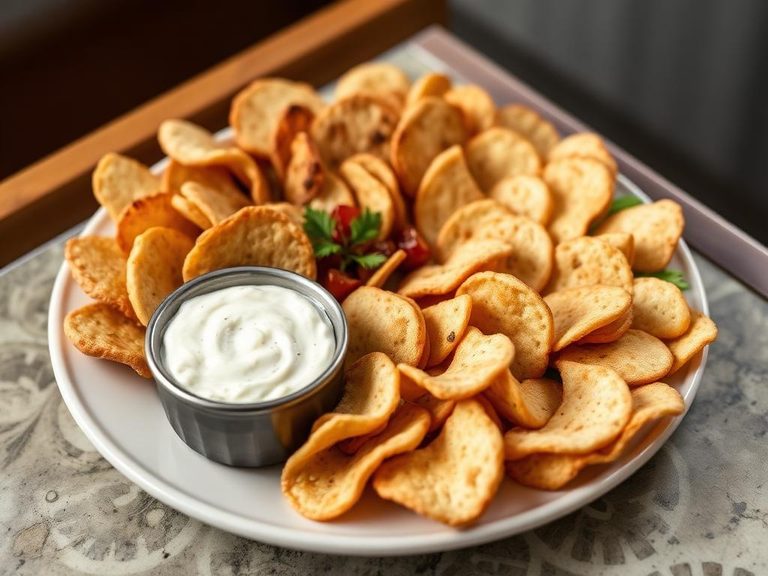
Bagel chips are thin, crunchy slices of bagel that have been baked or fried until golden and crisp. They offer a satisfying, savory crunch with a toasty, wheat-forward flavor and a texture that's denser and more robust than a typical potato chip. Nutritionally, they are a calorie-dense snack, packing significant carbohydrates and a moderate amount of protein per serving.
Calorie split: 11% protein · 59% carbs · 30% fat
↓ Full nutrition💚 Why it's loved
People love bagel chips for their intense crunch and savory, toasty flavor that feels more substantial than a regular chip. They are a versatile snack, perfect on their own or as a sturdy companion for creamy dips like hummus or spinach artichoke.
⚠️ Watch-outs & how to enjoy it better
Bagel chips can be high in calories and refined carbohydrates, which may lead to blood sugar spikes, especially for those with insulin sensitivity. They are also a common vehicle for added salt. To enjoy mindfully, practice portion control by measuring a single serving, and pair them with a protein-rich dip like Greek yogurt-based tzatziki or a healthy fat like guacamole to help slow digestion and increase satiety.
Key benefits
- Provides a quick source of energy from carbohydrates
- Offers a satisfying, crunchy texture for snack cravings
- Contains some dietary fiber from the wheat base
- Can be a vehicle for dips and spreads
- Often lower in fat than many fried snack chips
🍽️ Popular dishes

🌍 Where it's eaten
💡 Did you know?
The modern bagel chip is largely credited to a New York entrepreneur in the 1980s who figured out how to thinly slice day-old bagels and re-bake them into a crunchy snack to reduce bakery waste.
Full nutrition (USDA data · scales with serving)
| Water | 5.0 g |
| Energy | 451 kcal |
| Energy | 1887 kj |
| Protein | 12.3 g |
| Total lipid (fat) | 15.1 g |
| Ash | 1.1 g |
| Carbohydrate, by difference | 66.4 g |
| Fiber, total dietary | 4.1 g |
| Total Sugars | 6.0 g |
| Sucrose | 0.00 g |
| Glucose | 0.47 g |
| Fructose | 0.73 g |
| Lactose | 0.00 g |
| Maltose | 4.8 g |
| Galactose | 0.00 g |
| Starch | 49.0 g |
| Calcium, Ca | 24.0 mg |
| Iron, Fe | 5.0 mg |
| Magnesium, Mg | 39.0 mg |
| Phosphorus, P | 131 mg |
| Potassium, K | 140 mg |
| Sodium, Na | 233 mg |
| Zinc, Zn | 1.0 mg |
| Copper, Cu | 0.17 mg |
| Manganese, Mn | 0.67 mg |
| Selenium, Se | 36.2 ug |
| Fluoride, F | 0.00 ug |
| Vitamin C, total ascorbic acid | 0.00 mg |
| Thiamin | 0.52 mg |
| Riboflavin | 0.34 mg |
| Niacin | 7.7 mg |
| Pantothenic acid | 0.47 mg |
| Vitamin B-6 | 0.12 mg |
| Folate, total | 142 ug |
| Folic acid | 112 ug |
| Folate, food | 30.0 ug |
| Folate, DFE | 220 ug |
| Choline, total | 17.8 mg |
| Betaine | 53.0 mg |
| Vitamin B-12 | 0.00 ug |
| Vitamin B-12, added | 0.00 ug |
| Vitamin A, RAE | 0.00 ug |
| Retinol | 0.00 ug |
| Carotene, beta | 0.00 ug |
| Carotene, alpha | 0.00 ug |
| Cryptoxanthin, beta | 0.00 ug |
| Vitamin A, IU | 0.00 iu |
| Lycopene | 0.00 ug |
| Lutein + zeaxanthin | 14.0 ug |
| Vitamin E (alpha-tocopherol) | 0.81 mg |
| Vitamin E, added | 0.00 mg |
| Tocopherol, beta | 0.05 mg |
| Tocopherol, gamma | 0.29 mg |
| Tocopherol, delta | 0.01 mg |
| Tocotrienol, alpha | 0.02 mg |
| Tocotrienol, beta | 0.06 mg |
| Tocotrienol, gamma | 0.00 mg |
| Tocotrienol, delta | 0.00 mg |
| Vitamin D (D2 + D3), International Units | 0.00 iu |
| Vitamin D (D2 + D3) | 0.00 ug |
| Vitamin K (phylloquinone) | 5.2 ug |
| Vitamin K (Dihydrophylloquinone) | 0.00 ug |
| Vitamin K (Menaquinone-4) | 0.00 ug |
| Alcohol, ethyl | 0.00 g |
| Caffeine | 0.00 mg |
| Theobromine | 0.00 mg |
Fat & fatty acid profile (per 100g)
| Fatty acids, total saturated | 6.8 g |
| SFA 4:0 | 0.00 g |
| SFA 6:0 | 0.00 g |
| SFA 8:0 | 0.01 g |
| SFA 10:0 | 0.01 g |
| SFA 12:0 | 0.06 g |
| SFA 14:0 | 0.16 g |
| SFA 15:0 | 0.01 g |
| SFA 16:0 | 5.9 g |
| SFA 17:0 | 0.01 g |
| SFA 18:0 | 0.61 g |
| SFA 20:0 | 0.05 g |
| SFA 22:0 | 0.01 g |
| SFA 24:0 | 0.01 g |
| Fatty acids, total monounsaturated | 6.0 g |
| MUFA 14:1 | 0.00 g |
| MUFA 15:1 | 0.00 g |
| MUFA 16:1 | 0.03 g |
| MUFA 16:1 c | 0.03 g |
| MUFA 17:1 | 0.00 g |
| MUFA 18:1 | 6.0 g |
| MUFA 18:1 c | 6.0 g |
| MUFA 20:1 | 0.03 g |
| MUFA 22:1 | 0.00 g |
| MUFA 22:1 c | 0.00 g |
| MUFA 24:1 c | 0.01 g |
| Fatty acids, total polyunsaturated | 2.1 g |
| PUFA 18:2 | 2.0 g |
| PUFA 18:2 n-6 c,c | 2.0 g |
| PUFA 18:2 CLAs | 0.00 g |
| PUFA 18:3 | 0.06 g |
| PUFA 18:3 n-3 c,c,c (ALA) | 0.06 g |
| PUFA 18:3 n-6 c,c,c | 0.00 g |
| PUFA 18:4 | 0.00 g |
| PUFA 20:2 n-6 c,c | 0.00 g |
| PUFA 20:3 | 0.00 g |
| PUFA 20:3 n-3 | 0.00 g |
| PUFA 20:3 n-6 | 0.00 g |
| PUFA 20:4 | 0.00 g |
| PUFA 20:5 n-3 (EPA) | 0.00 g |
| PUFA 22:4 | 0.00 g |
| PUFA 22:5 n-3 (DPA) | 0.00 g |
| PUFA 22:6 n-3 (DHA) | 0.00 g |
| Fatty acids, total trans | 0.06 g |
| Fatty acids, total trans-monoenoic | 0.02 g |
| TFA 16:1 t | 0.00 g |
| TFA 18:1 t | 0.02 g |
| TFA 22:1 t | 0.00 g |
| TFA 18:2 t not further defined | 0.04 g |
| Fatty acids, total trans-polyenoic | 0.04 g |
| Cholesterol | 0.00 mg |
| Phytosterols | 18.0 mg |
Amino acid profile (per 100g)
| Tryptophan | 0.14 g |
| Threonine | 0.36 g |
| Isoleucine | 0.51 g |
| Leucine | 0.92 g |
| Lysine | 0.19 g |
| Methionine | 0.18 g |
| Cystine | 0.29 g |
| Phenylalanine | 0.68 g |
| Tyrosine | 0.31 g |
| Valine | 0.57 g |
| Arginine | 0.45 g |
| Histidine | 0.27 g |
| Alanine | 0.41 g |
| Aspartic acid | 0.53 g |
| Glutamic acid | 4.8 g |
| Glycine | 0.49 g |
| Proline | 1.6 g |
| Serine | 0.61 g |
FAQ
Are bagel chips healthier than potato chips?
It depends. Bagel chips are often baked, not fried, so they can be lower in total fat. However, they are very calorie-dense and made primarily from refined flour, offering little nutritional advantage. Portion control is key with both.
Why are my homemade bagel chips not crispy?
The slices are likely too thick or not baked long enough. For maximum crunch, slice bagels as thinly as possible (a mandoline helps), toss lightly with oil, and bake at a low temperature (around 300°F/150°C) for 20-30 minutes, flipping halfway, until completely dry and golden.
What is the best way to store bagel chips?
To maintain their crunch, store them in an airtight container at room temperature. If they absorb moisture and soften, you can re-crisp them by spreading them on a baking sheet and warming in a 300°F (150°C) oven for 5-10 minutes.
Nutrient density (calculated · NRF9.3)
Nutrient Rich Foods index: beneficial nutrients (protein, fiber, vitamins, minerals) minus saturated fat, added sugar & sodium, per 100 kcal.
NRF9.3 index — Fulgoni, Keast & Drewnowski, 2009. Computed from USDA nutrients.
Weight-loss friendliness (composite index)
Energy density 4.51 kcal/g · 11% calories from protein · 4.1 g fiber · 6.0 g sugar per 100 g.
Composite of energy density (Rolls et al., 1999), protein & fiber satiety, minus sugar. A calculated heuristic — ranks satiety-per-calorie, not a clinical measure.
Dietary load (calculated from USDA values)
Potential renal acid load. Positive = acid-forming, negative = alkaline-forming.
Sodium-to-potassium ratio: 1.66 (lower is better — aim for ≤ 1)
Sodium:potassium per WHO potassium guidance. Computed from USDA nutrients.