

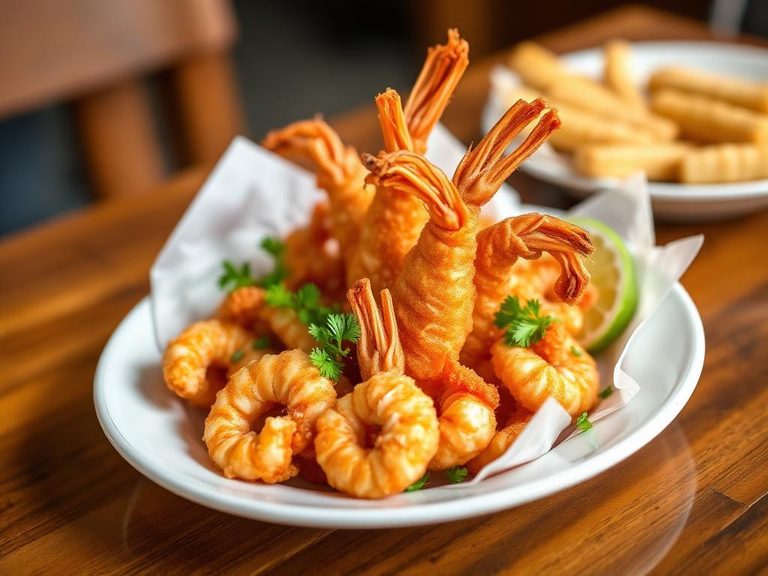
Restaurant, family style, shrimp, breaded and fried
Whole food · Restaurant Foods

Photo: Wikipedia
This is a classic comfort food featuring plump shrimp coated in a seasoned breadcrumb or batter crust and deep-fried to a golden, crunchy perfection. The exterior provides a satisfying shatter, giving way to tender, sweet, and juicy shrimp inside. Nutritionally, it's a protein-rich dish, but the frying process adds significant calories and fat.
Calorie split: 16% protein · 29% carbs · 55% fat
↓ Full nutrition💚 Why it's loved
People adore the irresistible contrast between the crispy, savory coating and the sweet, succulent shrimp inside. It's a versatile crowd-pleaser, perfect as an appetizer, main course, or in sandwiches and salads, and is deeply embedded in casual dining and seafood culture.
⚠️ Watch-outs & how to enjoy it better
The deep-frying method significantly increases the calorie and fat content, which can be a concern for heart health or weight management. Those watching their blood sugar should be mindful, as the refined flour coating can cause a rapid spike. To counteract, pair it with a large, non-starchy vegetable salad or steamed greens to add fiber and volume, practice strict portion control, and consider air-frying or baking a homemade version to reduce oil absorption.
Key benefits
- Excellent source of high-quality protein for muscle maintenance.
- Provides selenium, an antioxidant important for thyroid function.
- Contains vitamin B12, crucial for nerve function and red blood cell formation.
- Offers a quick source of energy from its carbohydrate-rich coating.
🍽️ Popular dishes
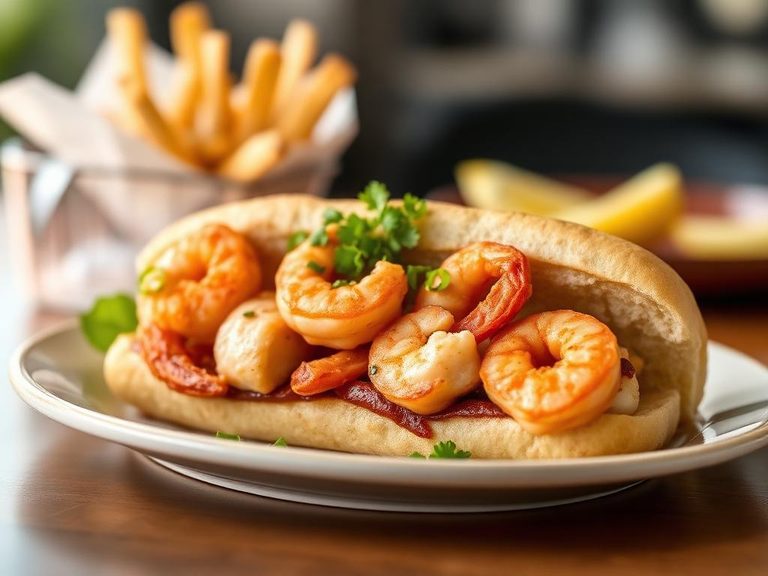
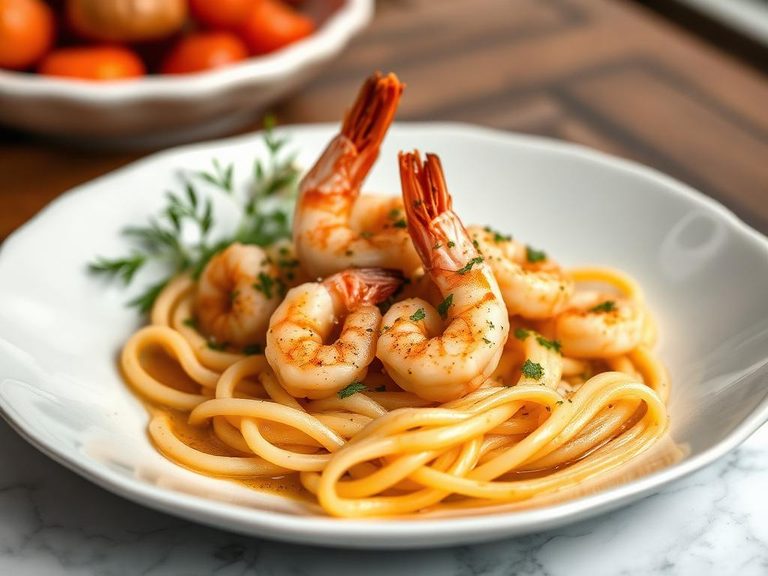
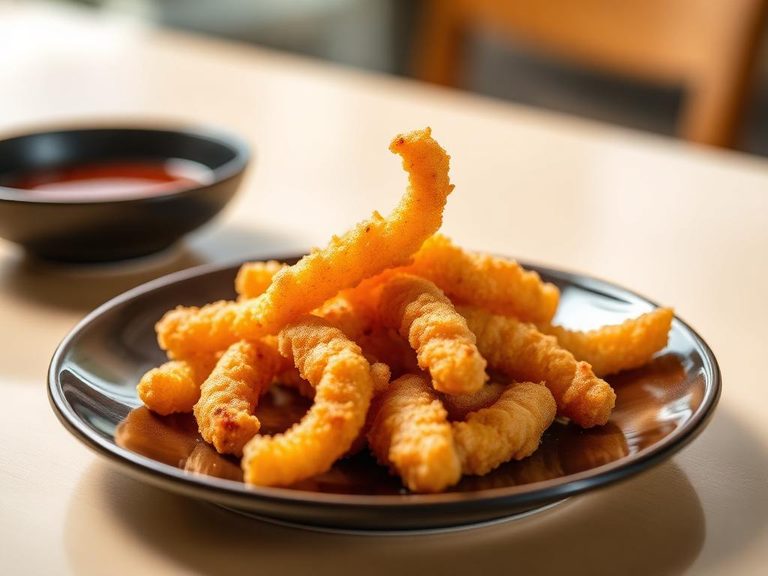
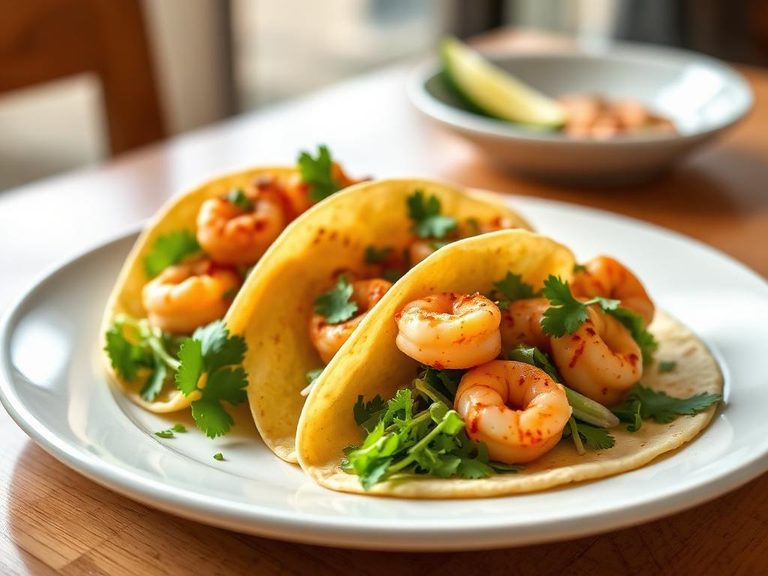
🌍 Where it's eaten
💡 Did you know?
The technique of breading and frying seafood, known as 'pané,' was popularized in France, but the modern breaded shrimp dish as we know it was largely perfected and popularized in the United States during the 20th century.
Full nutrition (USDA data · scales with serving)
| Water | 43.0 g |
| Energy | 308 kcal |
| Energy | 1288 kj |
| Protein | 12.7 g |
| Total lipid (fat) | 18.7 g |
| Ash | 3.3 g |
| Carbohydrate, by difference | 22.3 g |
| Fiber, total dietary | 1.5 g |
| Total Sugars | 0.91 g |
| Sucrose | 0.35 g |
| Glucose | 0.14 g |
| Fructose | 0.14 g |
| Lactose | 0.00 g |
| Maltose | 0.29 g |
| Galactose | 0.00 g |
| Starch | 20.0 g |
| Calcium, Ca | 42.0 mg |
| Iron, Fe | 1.2 mg |
| Magnesium, Mg | 21.0 mg |
| Phosphorus, P | 301 mg |
| Potassium, K | 108 mg |
| Sodium, Na | 1125 mg |
| Zinc, Zn | 0.79 mg |
| Copper, Cu | 0.14 mg |
| Manganese, Mn | 0.30 mg |
| Selenium, Se | 22.6 ug |
| Vitamin C, total ascorbic acid | 0.00 mg |
| Thiamin | 0.11 mg |
| Riboflavin | 0.13 mg |
| Niacin | 1.2 mg |
| Pantothenic acid | 0.35 mg |
| Vitamin B-6 | 0.07 mg |
| Folate, total | 43.0 ug |
| Folic acid | 28.0 ug |
| Folate, food | 15.0 ug |
| Folate, DFE | 62.0 ug |
| Choline, total | 50.1 mg |
| Vitamin B-12 | 0.44 ug |
| Vitamin B-12, added | 0.00 ug |
| Vitamin A, RAE | 3.0 ug |
| Retinol | 3.0 ug |
| Carotene, beta | 0.00 ug |
| Carotene, alpha | 0.00 ug |
| Cryptoxanthin, beta | 0.00 ug |
| Vitamin A, IU | 11.0 iu |
| Lycopene | 0.00 ug |
| Lutein + zeaxanthin | 10.0 ug |
| Vitamin E (alpha-tocopherol) | 2.1 mg |
| Vitamin E, added | 0.00 mg |
| Tocopherol, beta | 0.22 mg |
| Tocopherol, gamma | 7.2 mg |
| Tocopherol, delta | 3.1 mg |
| Tocotrienol, alpha | 0.00 mg |
| Tocotrienol, beta | 0.05 mg |
| Tocotrienol, gamma | 0.00 mg |
| Tocotrienol, delta | 0.25 mg |
| Vitamin D (D2 + D3), International Units | 1.0 iu |
| Vitamin D (D2 + D3) | 0.00 ug |
| Vitamin K (phylloquinone) | 32.2 ug |
| Vitamin K (Dihydrophylloquinone) | 0.00 ug |
| Vitamin K (Menaquinone-4) | 0.00 ug |
| Alcohol, ethyl | 0.00 g |
| Caffeine | 0.00 mg |
| Theobromine | 0.00 mg |
Fat & fatty acid profile (per 100g)
| Fatty acids, total saturated | 3.4 g |
| SFA 4:0 | 0.00 g |
| SFA 6:0 | 0.00 g |
| SFA 8:0 | 0.01 g |
| SFA 10:0 | 0.01 g |
| SFA 12:0 | 0.00 g |
| SFA 14:0 | 0.02 g |
| SFA 15:0 | 0.01 g |
| SFA 16:0 | 2.0 g |
| SFA 17:0 | 0.02 g |
| SFA 18:0 | 1.2 g |
| SFA 20:0 | 0.06 g |
| SFA 22:0 | 0.06 g |
| SFA 24:0 | 0.02 g |
| Fatty acids, total monounsaturated | 4.3 g |
| MUFA 14:1 | 0.00 g |
| MUFA 15:1 | 0.00 g |
| MUFA 16:1 | 0.03 g |
| MUFA 16:1 c | 0.03 g |
| MUFA 17:1 | 0.01 g |
| MUFA 18:1 | 4.1 g |
| MUFA 18:1 c | 4.1 g |
| MUFA 20:1 | 0.11 g |
| MUFA 22:1 | 0.00 g |
| MUFA 22:1 c | 0.00 g |
| MUFA 24:1 c | 0.00 g |
| Fatty acids, total polyunsaturated | 9.3 g |
| PUFA 18:2 | 8.2 g |
| PUFA 18:2 n-6 c,c | 8.1 g |
| PUFA 18:2 CLAs | 0.02 g |
| PUFA 18:3 | 1.00 g |
| PUFA 18:3 n-3 c,c,c (ALA) | 0.91 g |
| PUFA 18:3 n-6 c,c,c | 0.08 g |
| PUFA 18:3i | 0.00 g |
| PUFA 18:4 | 0.00 g |
| PUFA 20:2 n-6 c,c | 0.01 g |
| PUFA 20:3 | 0.00 g |
| PUFA 20:3 n-3 | 0.00 g |
| PUFA 20:3 n-6 | 0.00 g |
| PUFA 20:4 | 0.03 g |
| PUFA 20:5 n-3 (EPA) | 0.04 g |
| PUFA 22:4 | 0.00 g |
| PUFA 22:5 n-3 (DPA) | 0.00 g |
| PUFA 22:6 n-3 (DHA) | 0.04 g |
| Fatty acids, total trans | 0.14 g |
| Fatty acids, total trans-monoenoic | 0.06 g |
| TFA 16:1 t | 0.00 g |
| TFA 18:1 t | 0.06 g |
| TFA 22:1 t | 0.00 g |
| TFA 18:2 t not further defined | 0.08 g |
| Fatty acids, total trans-polyenoic | 0.08 g |
| Cholesterol | 87.0 mg |
Amino acid profile (per 100g)
| Tryptophan | 0.14 g |
| Threonine | 0.45 g |
| Isoleucine | 0.55 g |
| Leucine | 0.99 g |
| Lysine | 0.86 g |
| Methionine | 0.31 g |
| Cystine | 0.17 g |
| Phenylalanine | 0.56 g |
| Tyrosine | 0.39 g |
| Valine | 0.67 g |
| Arginine | 0.92 g |
| Histidine | 0.26 g |
| Alanine | 0.66 g |
| Aspartic acid | 1.2 g |
| Glutamic acid | 2.6 g |
| Glycine | 0.58 g |
| Proline | 0.69 g |
| Serine | 0.51 g |
FAQ
Is breaded fried shrimp a good source of omega-3s?
While shrimp itself contains some omega-3 fatty acids, the deep-frying process and breading dilute its nutritional density. For a significant omega-3 boost, consider baked or grilled shrimp instead.
How can I make it healthier at home?
Use whole-grain breadcrumbs or panko for more fiber, bake or air-fry instead of deep-frying, and season the coating with herbs and spices to boost flavor without adding sodium or fat.
Is this dish high in cholesterol?
Shrimp does contain dietary cholesterol, but for most people, dietary cholesterol has a smaller impact on blood cholesterol than saturated and trans fats. The bigger concern is the saturated fat from the frying oil.
Nutrient density (calculated · NRF9.3)
Nutrient Rich Foods index: beneficial nutrients (protein, fiber, vitamins, minerals) minus saturated fat, added sugar & sodium, per 100 kcal.
NRF9.3 index — Fulgoni, Keast & Drewnowski, 2009. Computed from USDA nutrients.
Weight-loss friendliness (composite index)
Energy density 3.08 kcal/g · 16% calories from protein · 1.5 g fiber · 0.9 g sugar per 100 g.
Composite of energy density (Rolls et al., 1999), protein & fiber satiety, minus sugar. A calculated heuristic — ranks satiety-per-calorie, not a clinical measure.
Dietary load (calculated from USDA values)
Potential renal acid load. Positive = acid-forming, negative = alkaline-forming.
Sodium-to-potassium ratio: 10.42 (lower is better — aim for ≤ 1)
Sodium:potassium per WHO potassium guidance. Computed from USDA nutrients.