

Pork, cured, ham with natural juices, whole, boneless, separable lean and fat, heated, roasted
Whole food · Pork Products
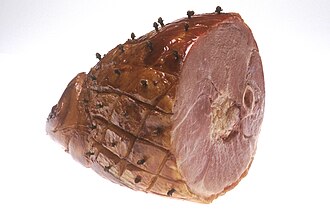
Photo: Wikipedia
This is a lean, roasted cut of cured ham, offering a tender, juicy texture with a savory, salty-sweet flavor profile from the curing process. Nutritionally, it's a powerhouse of high-quality protein with minimal fat and almost no carbohydrates, making it a very lean meat option.
Calorie split: 72% protein · 3% carbs · 25% fat
↓ Full nutrition💚 Why it's loved
People love it for its deep, savory umami flavor and satisfying, tender bite that's both hearty and lean. It's incredibly versatile, serving as a centerpiece for a holiday meal or a quick, protein-packed addition to salads, sandwiches, and pasta dishes.
⚠️ Watch-outs & how to enjoy it better
The primary concern is its high sodium content from the curing salt, which can be an issue for those monitoring blood pressure or fluid retention. To counteract this, pair it with potassium-rich foods like leafy greens or roasted potatoes, and be mindful of portion sizes, especially if adding other salty sides or sauces.
Key benefits
- Excellent source of complete protein for muscle maintenance.
- Very low in fat, especially saturated fat.
- Virtually carbohydrate-free.
- Provides essential minerals like phosphorus and selenium.
- Convenient, pre-cooked protein source.
🍽️ Popular dishes



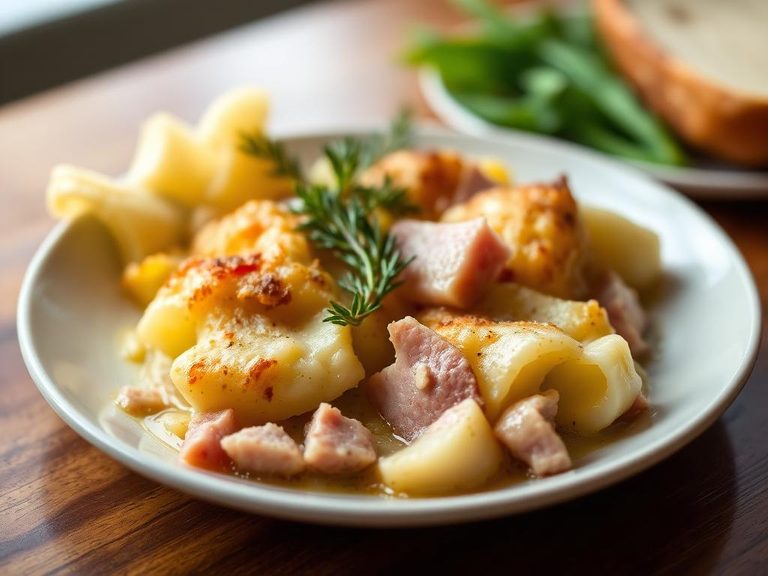

🌍 Where it's eaten
💡 Did you know?
The tradition of curing ham with salt and smoking it dates back to ancient times as a preservation method, long before refrigeration existed.
Full nutrition (USDA data · scales with serving)
| Water | 71.6 g |
| Energy | 114 kcal |
| Energy | 476 kj |
| Protein | 20.5 g |
| Total lipid (fat) | 3.1 g |
| Ash | 3.9 g |
| Carbohydrate, by difference | 0.84 g |
| Fiber, total dietary | 0.00 g |
| Total Sugars | 0.81 g |
| Sucrose | 0.37 g |
| Glucose | 0.44 g |
| Fructose | 0.00 g |
| Lactose | 0.00 g |
| Maltose | 0.00 g |
| Galactose | 0.00 g |
| Calcium, Ca | 6.0 mg |
| Iron, Fe | 0.84 mg |
| Magnesium, Mg | 22.0 mg |
| Phosphorus, P | 318 mg |
| Potassium, K | 367 mg |
| Sodium, Na | 1179 mg |
| Zinc, Zn | 2.0 mg |
| Copper, Cu | 0.27 mg |
| Manganese, Mn | 0.03 mg |
| Selenium, Se | 32.7 ug |
| Vitamin C, total ascorbic acid | 0.00 mg |
| Thiamin | 0.62 mg |
| Riboflavin | 0.21 mg |
| Niacin | 6.8 mg |
| Pantothenic acid | 0.89 mg |
| Vitamin B-6 | 0.46 mg |
| Folate, total | 2.0 ug |
| Folic acid | 0.00 ug |
| Folate, food | 2.0 ug |
| Folate, DFE | 2.0 ug |
| Choline, total | 79.6 mg |
| Betaine | 7.8 mg |
| Vitamin B-12 | 0.42 ug |
| Vitamin B-12, added | 0.00 ug |
| Vitamin A, RAE | 13.0 ug |
| Retinol | 13.0 ug |
| Carotene, beta | 0.00 ug |
| Carotene, alpha | 0.00 ug |
| Cryptoxanthin, beta | 0.00 ug |
| Vitamin A, IU | 44.0 iu |
| Lycopene | 0.00 ug |
| Lutein + zeaxanthin | 0.00 ug |
| Vitamin E (alpha-tocopherol) | 0.27 mg |
| Vitamin E, added | 0.00 mg |
| Tocopherol, beta | 0.01 mg |
| Tocopherol, gamma | 0.03 mg |
| Tocopherol, delta | 0.00 mg |
| Tocotrienol, alpha | 0.03 mg |
| Tocotrienol, beta | 0.00 mg |
| Tocotrienol, gamma | 0.00 mg |
| Tocotrienol, delta | 0.00 mg |
| Vitamin D (D2 + D3), International Units | 30.0 iu |
| Vitamin D (D2 + D3) | 0.80 ug |
| Vitamin D3 (cholecalciferol) | 0.80 ug |
| Vitamin K (phylloquinone) | 0.00 ug |
| Vitamin K (Dihydrophylloquinone) | 0.00 ug |
| Vitamin K (Menaquinone-4) | 2.4 ug |
| Alcohol, ethyl | 0.00 g |
| Caffeine | 0.00 mg |
| Theobromine | 0.00 mg |
Fat & fatty acid profile (per 100g)
| Fatty acids, total saturated | 1.1 g |
| SFA 4:0 | 0.00 g |
| SFA 6:0 | 0.00 g |
| SFA 8:0 | 0.00 g |
| SFA 10:0 | 0.00 g |
| SFA 12:0 | 0.00 g |
| SFA 14:0 | 0.04 g |
| SFA 15:0 | 0.00 g |
| SFA 16:0 | 0.69 g |
| SFA 17:0 | 0.01 g |
| SFA 18:0 | 0.34 g |
| SFA 20:0 | 0.01 g |
| SFA 22:0 | 0.01 g |
| Fatty acids, total monounsaturated | 1.5 g |
| MUFA 14:1 | 0.00 g |
| MUFA 15:1 | 0.00 g |
| MUFA 16:1 | 0.09 g |
| MUFA 17:1 | 0.00 g |
| MUFA 18:1 | 1.4 g |
| MUFA 18:1 c | 1.3 g |
| MUFA 20:1 | 0.02 g |
| MUFA 22:1 | 0.00 g |
| Fatty acids, total polyunsaturated | 0.45 g |
| PUFA 18:2 | 0.37 g |
| PUFA 18:2 n-6 c,c | 0.36 g |
| PUFA 18:2 CLAs | 0.00 g |
| PUFA 18:3 | 0.02 g |
| PUFA 18:3 n-3 c,c,c (ALA) | 0.02 g |
| PUFA 18:3 n-6 c,c,c | 0.00 g |
| PUFA 18:4 | 0.00 g |
| PUFA 20:2 n-6 c,c | 0.01 g |
| PUFA 20:3 | 0.00 g |
| PUFA 20:4 | 0.05 g |
| PUFA 20:5 n-3 (EPA) | 0.00 g |
| PUFA 22:5 n-3 (DPA) | 0.00 g |
| PUFA 22:6 n-3 (DHA) | 0.00 g |
| Fatty acids, total trans | 0.00 g |
| Fatty acids, total trans-monoenoic | 0.00 g |
| TFA 18:1 t | 0.01 g |
| TFA 18:2 t,t | 0.01 g |
| Fatty acids, total trans-polyenoic | 0.00 g |
| Cholesterol | 56.0 mg |
Amino acid profile (per 100g)
| Tryptophan | 0.19 g |
| Threonine | 0.92 g |
| Isoleucine | 0.93 g |
| Leucine | 1.6 g |
| Lysine | 1.7 g |
| Methionine | 0.49 g |
| Cystine | 0.23 g |
| Phenylalanine | 0.82 g |
| Tyrosine | 0.67 g |
| Valine | 1.0 g |
| Arginine | 1.3 g |
| Histidine | 0.90 g |
| Alanine | 1.2 g |
| Aspartic acid | 1.8 g |
| Glutamic acid | 2.9 g |
| Glycine | 1.1 g |
| Proline | 0.88 g |
| Serine | 0.80 g |
| Hydroxyproline | 0.13 g |
FAQ
Is this the same as 'city ham' or 'country ham'?
This description aligns most closely with a 'city ham,' which is wet-cured (injected with brine) and typically fully cooked, resulting in a milder, moister product. 'Country ham' is dry-cured, aged, and often much saltier and firmer.
How should I store leftover cooked ham?
Wrap tightly in plastic wrap or store in an airtight container in the refrigerator for 3-5 days. For longer storage, freeze slices or chunks for up to 1-2 months.
Can I eat this ham cold?
Yes, since it's fully cooked and heated (roasted), it's safe and common to eat it cold in sandwiches or salads. However, gently warming it can enhance its flavor and juiciness.
Nutrient density (calculated · NRF9.3)
Nutrient Rich Foods index: beneficial nutrients (protein, fiber, vitamins, minerals) minus saturated fat, added sugar & sodium, per 100 kcal.
NRF9.3 index — Fulgoni, Keast & Drewnowski, 2009. Computed from USDA nutrients.
Weight-loss friendliness (composite index)
Energy density 1.14 kcal/g · 72% calories from protein · 0.0 g fiber · 0.8 g sugar per 100 g.
Composite of energy density (Rolls et al., 1999), protein & fiber satiety, minus sugar. A calculated heuristic — ranks satiety-per-calorie, not a clinical measure.
Dietary load (calculated from USDA values)
Potential renal acid load. Positive = acid-forming, negative = alkaline-forming.
Sodium-to-potassium ratio: 3.21 (lower is better — aim for ≤ 1)
Sodium:potassium per WHO potassium guidance. Computed from USDA nutrients.