

Pork, cured, ham with natural juices, slice, boneless, separable lean and fat, heated, pan-broil
Whole food · Pork Products
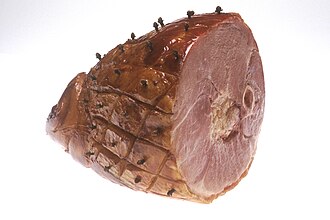
Photo: Wikipedia
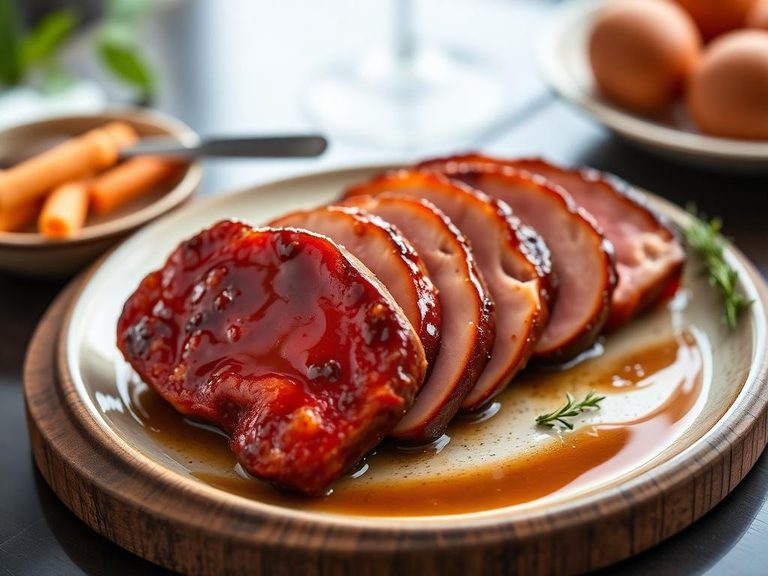
This is a lean, boneless ham slice that's been pan-broiled until slightly caramelized, offering a savory, salty, and subtly smoky flavor with a tender, meaty texture. It's a high-protein, low-carb option that packs a significant nutritional punch in a small serving. The cooking method concentrates its natural juices, enhancing its rich, umami-forward taste.
Calorie split: 71% protein · 4% carbs · 26% fat
↓ Full nutrition💚 Why it's loved
People love it for its deeply savory, salty flavor that pairs well with almost anything, from eggs to salads. Its convenience and ability to be heated in minutes make it a staple for quick, satisfying meals across many cultures.
⚠️ Watch-outs & how to enjoy it better
The primary concern is its high sodium content, which can be problematic for those managing blood pressure. To counteract this, pair it with potassium-rich foods like spinach or avocado, and be mindful of portion sizes. Also, cured meats like this can contain nitrates, so balancing with antioxidant-rich vegetables is a good strategy.
Key benefits
- Excellent source of high-quality protein for muscle maintenance.
- Very low in carbohydrates and sugars, suitable for low-carb diets.
- Provides essential B vitamins, particularly B1 (thiamine) and B6.
- Low in fat, making it a lean protein choice.
- Quick to prepare, ideal for fast meals.
🍽️ Popular dishes


🌍 Where it's eaten
💡 Did you know?
Pan-broiling is a dry-heat cooking method that uses high heat and minimal fat, which helps create a flavorful, slightly crispy exterior while keeping the inside moist and tender.
Full nutrition (USDA data · scales with serving)
| Water | 70.9 g |
| Energy | 118 kcal |
| Energy | 494 kj |
| Protein | 20.9 g |
| Total lipid (fat) | 3.4 g |
| Ash | 3.8 g |
| Carbohydrate, by difference | 1.0 g |
| Fiber, total dietary | 0.00 g |
| Total Sugars | 1.0 g |
| Sucrose | 0.31 g |
| Glucose | 0.72 g |
| Fructose | 0.01 g |
| Lactose | 0.00 g |
| Maltose | 0.00 g |
| Galactose | 0.00 g |
| Calcium, Ca | 6.0 mg |
| Iron, Fe | 0.93 mg |
| Magnesium, Mg | 22.0 mg |
| Phosphorus, P | 321 mg |
| Potassium, K | 363 mg |
| Sodium, Na | 1160 mg |
| Zinc, Zn | 2.1 mg |
| Copper, Cu | 0.27 mg |
| Manganese, Mn | 0.03 mg |
| Selenium, Se | 36.9 ug |
| Vitamin C, total ascorbic acid | 0.00 mg |
| Thiamin | 0.51 mg |
| Riboflavin | 0.22 mg |
| Niacin | 7.4 mg |
| Pantothenic acid | 0.84 mg |
| Vitamin B-6 | 0.50 mg |
| Folate, total | 1.0 ug |
| Folic acid | 0.00 ug |
| Folate, food | 1.0 ug |
| Folate, DFE | 1.0 ug |
| Choline, total | 81.9 mg |
| Betaine | 6.2 mg |
| Vitamin B-12 | 0.42 ug |
| Vitamin B-12, added | 0.00 ug |
| Vitamin A, RAE | 13.0 ug |
| Retinol | 13.0 ug |
| Carotene, beta | 0.00 ug |
| Carotene, alpha | 0.00 ug |
| Cryptoxanthin, beta | 0.00 ug |
| Vitamin A, IU | 44.0 iu |
| Lycopene | 0.00 ug |
| Lutein + zeaxanthin | 0.00 ug |
| Vitamin E (alpha-tocopherol) | 0.22 mg |
| Vitamin E, added | 0.00 mg |
| Tocopherol, beta | 0.01 mg |
| Tocopherol, gamma | 0.03 mg |
| Tocopherol, delta | 0.00 mg |
| Tocotrienol, alpha | 0.02 mg |
| Tocotrienol, beta | 0.00 mg |
| Tocotrienol, gamma | 0.00 mg |
| Tocotrienol, delta | 0.00 mg |
| Vitamin D (D2 + D3), International Units | 37.0 iu |
| Vitamin D (D2 + D3) | 0.90 ug |
| Vitamin D3 (cholecalciferol) | 0.90 ug |
| Vitamin K (phylloquinone) | 0.00 ug |
| Vitamin K (Dihydrophylloquinone) | 0.00 ug |
| Vitamin K (Menaquinone-4) | 3.2 ug |
| Alcohol, ethyl | 0.00 g |
| Caffeine | 0.00 mg |
| Theobromine | 0.00 mg |
Fat & fatty acid profile (per 100g)
| Fatty acids, total saturated | 1.1 g |
| SFA 4:0 | 0.00 g |
| SFA 6:0 | 0.00 g |
| SFA 8:0 | 0.00 g |
| SFA 10:0 | 0.00 g |
| SFA 12:0 | 0.00 g |
| SFA 14:0 | 0.04 g |
| SFA 15:0 | 0.00 g |
| SFA 16:0 | 0.67 g |
| SFA 17:0 | 0.01 g |
| SFA 18:0 | 0.33 g |
| SFA 20:0 | 0.01 g |
| SFA 22:0 | 0.01 g |
| Fatty acids, total monounsaturated | 1.4 g |
| MUFA 14:1 | 0.00 g |
| MUFA 15:1 | 0.00 g |
| MUFA 16:1 | 0.09 g |
| MUFA 17:1 | 0.00 g |
| MUFA 18:1 | 1.3 g |
| MUFA 18:1 c | 1.3 g |
| MUFA 20:1 | 0.02 g |
| MUFA 22:1 | 0.00 g |
| Fatty acids, total polyunsaturated | 0.45 g |
| PUFA 18:2 | 0.37 g |
| PUFA 18:2 n-6 c,c | 0.36 g |
| PUFA 18:2 CLAs | 0.00 g |
| PUFA 18:3 | 0.02 g |
| PUFA 18:3 n-3 c,c,c (ALA) | 0.02 g |
| PUFA 18:3 n-6 c,c,c | 0.00 g |
| PUFA 18:4 | 0.00 g |
| PUFA 20:2 n-6 c,c | 0.01 g |
| PUFA 20:3 | 0.00 g |
| PUFA 20:4 | 0.06 g |
| PUFA 20:5 n-3 (EPA) | 0.00 g |
| PUFA 22:5 n-3 (DPA) | 0.00 g |
| PUFA 22:6 n-3 (DHA) | 0.00 g |
| Fatty acids, total trans | 0.00 g |
| Fatty acids, total trans-monoenoic | 0.00 g |
| TFA 18:1 t | 0.01 g |
| TFA 18:2 t,t | 0.01 g |
| Fatty acids, total trans-polyenoic | 0.00 g |
| Cholesterol | 58.0 mg |
Amino acid profile (per 100g)
| Tryptophan | 0.20 g |
| Threonine | 0.93 g |
| Isoleucine | 0.94 g |
| Leucine | 1.7 g |
| Lysine | 1.8 g |
| Methionine | 0.50 g |
| Cystine | 0.23 g |
| Phenylalanine | 0.83 g |
| Tyrosine | 0.68 g |
| Valine | 1.1 g |
| Arginine | 1.3 g |
| Histidine | 0.91 g |
| Alanine | 1.2 g |
| Aspartic acid | 1.8 g |
| Glutamic acid | 3.0 g |
| Glycine | 1.1 g |
| Proline | 0.90 g |
| Serine | 0.82 g |
| Hydroxyproline | 0.14 g |
FAQ
Is this ham slice pre-cooked?
Yes, cured ham is typically fully cooked during the curing process. Heating it, such as by pan-broiling, is primarily to enhance flavor and texture.
How does pan-broiling differ from pan-frying?
Pan-broiling uses high heat with little to no added fat, while pan-frying typically involves more oil or butter. Pan-broiling gives a drier, more caramelized exterior.
Can I freeze leftover ham slices?
Yes, ham slices can be frozen for up to 1-2 months. Wrap them tightly in plastic wrap or foil to prevent freezer burn.
Nutrient density (calculated · NRF9.3)
Nutrient Rich Foods index: beneficial nutrients (protein, fiber, vitamins, minerals) minus saturated fat, added sugar & sodium, per 100 kcal.
NRF9.3 index — Fulgoni, Keast & Drewnowski, 2009. Computed from USDA nutrients.
Weight-loss friendliness (composite index)
Energy density 1.18 kcal/g · 71% calories from protein · 0.0 g fiber · 1.0 g sugar per 100 g.
Composite of energy density (Rolls et al., 1999), protein & fiber satiety, minus sugar. A calculated heuristic — ranks satiety-per-calorie, not a clinical measure.
Dietary load (calculated from USDA values)
Potential renal acid load. Positive = acid-forming, negative = alkaline-forming.
Sodium-to-potassium ratio: 3.20 (lower is better — aim for ≤ 1)
Sodium:potassium per WHO potassium guidance. Computed from USDA nutrients.