

Chicken, broilers or fryers, wing, meat and skin, cooked, roasted
Whole food · Poultry Products
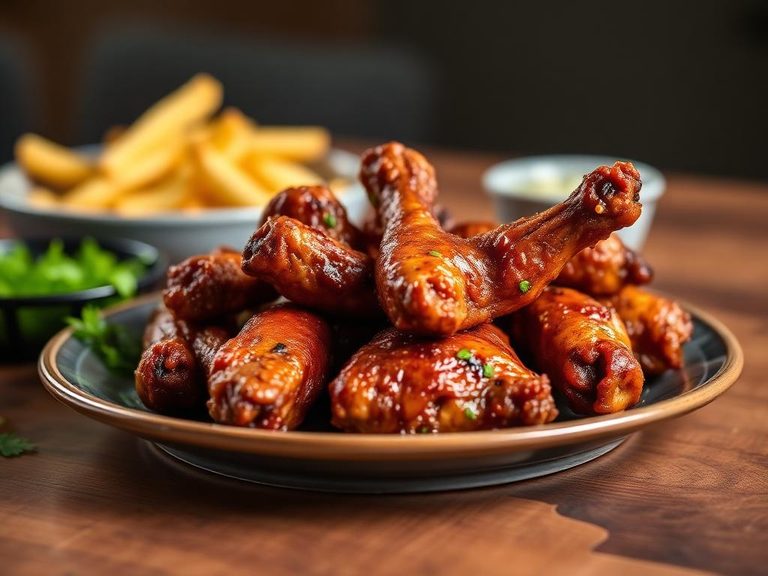
A roasted chicken wing, skin-on, delivers a satisfying, savory bite with a crisp, rendered skin and tender, juicy meat beneath. Its flavor is deeply umami-rich, enhanced by the Maillard browning from high-heat cooking. Nutritionally, it's a powerhouse of protein and fat, with virtually no carbohydrates.
Calorie split: 39% protein · 0% carbs · 61% fat
↓ Full nutrition💚 Why it's loved
People adore the perfect contrast between the shatteringly crisp skin and the succulent meat, a textural delight. Its rich, savory flavor makes it a universally beloved comfort food and a staple for social gatherings from game days to family dinners.
⚠️ Watch-outs & how to enjoy it better
The high fat and calorie density can be a concern for those monitoring energy intake. The skin, while delicious, is high in saturated fat. To enjoy mindfully, practice portion control, pair with a large portion of non-starchy vegetables for balance, and consider removing the skin to reduce fat content if desired.
Key benefits
- Excellent source of complete protein for muscle maintenance and repair.
- Provides essential fats for hormone production and nutrient absorption.
- Rich in B vitamins, particularly niacin (B3) and B6, for energy metabolism.
- Contains minerals like selenium and phosphorus.
🍽️ Popular dishes
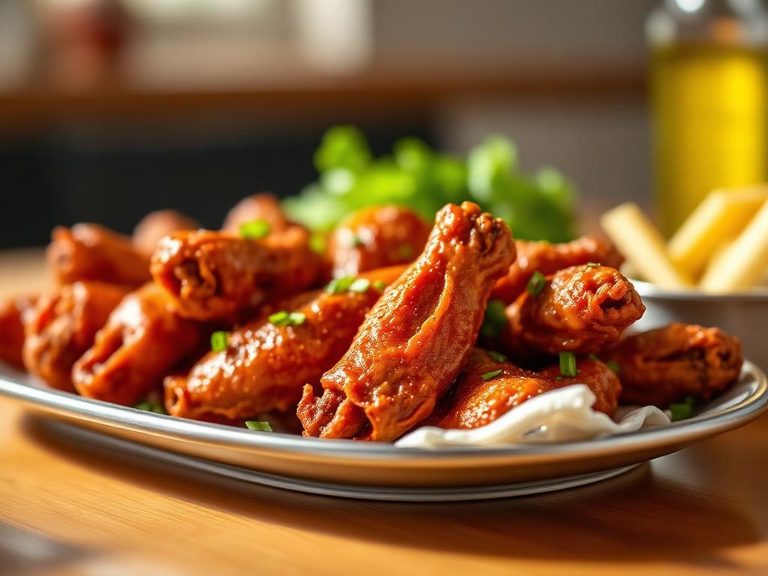
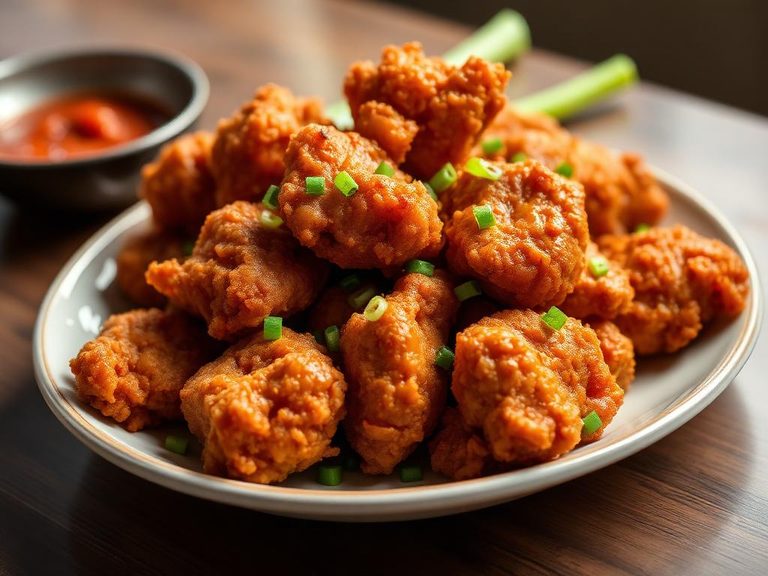
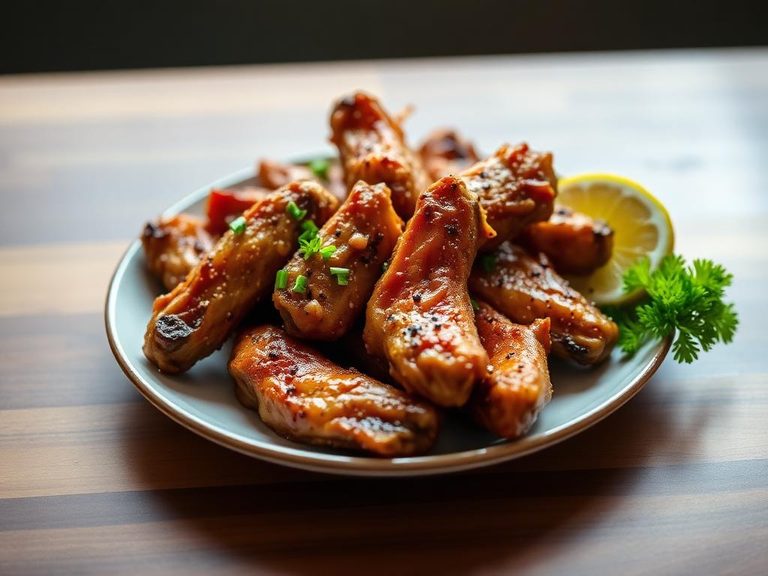
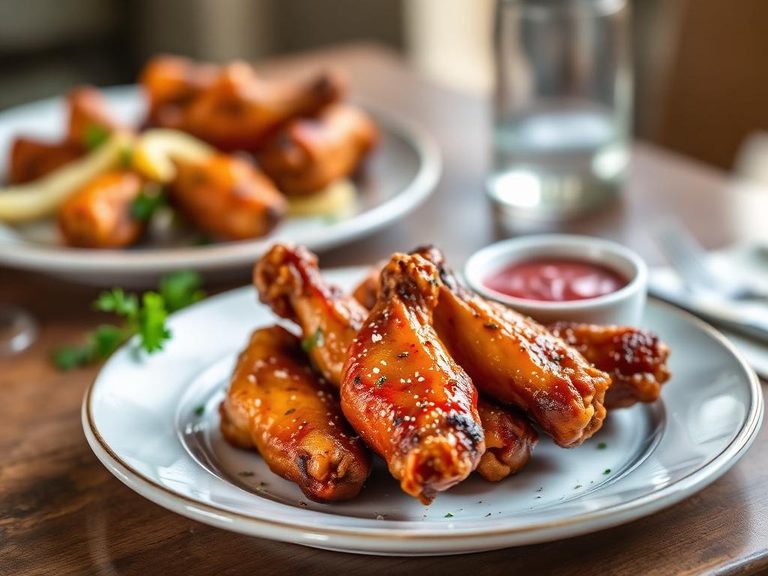
🌍 Where it's eaten
💡 Did you know?
The world record for the most chicken wings eaten in 12 minutes is 501 (bones excluded), set by Joey Chestnut in 2023.
Full nutrition (USDA data · scales with serving)
| Water | 59.4 g |
| Energy | 254 kcal |
| Energy | 1062 kj |
| Protein | 23.8 g |
| Total lipid (fat) | 16.9 g |
| Ash | 0.88 g |
| Carbohydrate, by difference | 0.00 g |
| Fiber, total dietary | 0.00 g |
| Total Sugars | 0.00 g |
| Calcium, Ca | 18.0 mg |
| Iron, Fe | 0.84 mg |
| Magnesium, Mg | 19.0 mg |
| Phosphorus, P | 147 mg |
| Potassium, K | 212 mg |
| Sodium, Na | 98.0 mg |
| Zinc, Zn | 1.6 mg |
| Copper, Cu | 0.04 mg |
| Manganese, Mn | 0.01 mg |
| Selenium, Se | 25.5 ug |
| Vitamin C, total ascorbic acid | 0.00 mg |
| Thiamin | 0.07 mg |
| Riboflavin | 0.15 mg |
| Niacin | 6.3 mg |
| Pantothenic acid | 0.86 mg |
| Vitamin B-6 | 0.56 mg |
| Folate, total | 9.0 ug |
| Folic acid | 0.00 ug |
| Folate, food | 9.0 ug |
| Folate, DFE | 9.0 ug |
| Choline, total | 111 mg |
| Betaine | 12.2 mg |
| Vitamin B-12 | 0.35 ug |
| Vitamin B-12, added | 0.00 ug |
| Vitamin A, RAE | 12.0 ug |
| Retinol | 12.0 ug |
| Carotene, beta | 0.00 ug |
| Carotene, alpha | 0.00 ug |
| Cryptoxanthin, beta | 0.00 ug |
| Vitamin A, IU | 39.0 iu |
| Lycopene | 0.00 ug |
| Lutein + zeaxanthin | 0.00 ug |
| Vitamin E (alpha-tocopherol) | 0.69 mg |
| Vitamin E, added | 0.00 mg |
| Tocopherol, beta | 0.00 mg |
| Tocopherol, gamma | 0.20 mg |
| Tocopherol, delta | 0.04 mg |
| Tocotrienol, alpha | 0.05 mg |
| Tocotrienol, beta | 0.00 mg |
| Tocotrienol, gamma | 0.14 mg |
| Tocotrienol, delta | 0.00 mg |
| Vitamin D (D2 + D3), International Units | 7.0 iu |
| Vitamin D (D2 + D3) | 0.20 ug |
| Vitamin D3 (cholecalciferol) | 0.20 ug |
| Vitamin K (phylloquinone) | 0.30 ug |
| Vitamin K (Dihydrophylloquinone) | 0.00 ug |
| Alcohol, ethyl | 0.00 g |
| Caffeine | 0.00 mg |
| Theobromine | 0.00 mg |
Fat & fatty acid profile (per 100g)
| Fatty acids, total saturated | 5.0 g |
| SFA 4:0 | 0.00 g |
| SFA 6:0 | 0.00 g |
| SFA 8:0 | 0.00 g |
| SFA 10:0 | 0.01 g |
| SFA 12:0 | 0.01 g |
| SFA 14:0 | 0.10 g |
| SFA 15:0 | 0.01 g |
| SFA 16:0 | 3.9 g |
| SFA 17:0 | 0.02 g |
| SFA 18:0 | 0.93 g |
| SFA 20:0 | 0.01 g |
| SFA 22:0 | 0.01 g |
| SFA 24:0 | 0.00 g |
| Fatty acids, total monounsaturated | 7.7 g |
| MUFA 14:1 | 0.04 g |
| MUFA 15:1 | 0.00 g |
| MUFA 16:1 | 1.1 g |
| MUFA 16:1 c | 1.1 g |
| MUFA 17:1 | 0.01 g |
| MUFA 18:1 | 6.4 g |
| MUFA 18:1 c | 6.4 g |
| MUFA 20:1 | 0.10 g |
| MUFA 22:1 | 0.00 g |
| MUFA 22:1 c | 0.00 g |
| MUFA 24:1 c | 0.00 g |
| Fatty acids, total polyunsaturated | 3.6 g |
| PUFA 18:2 | 3.2 g |
| PUFA 18:2 n-6 c,c | 3.2 g |
| PUFA 18:2 CLAs | 0.02 g |
| PUFA 18:3 | 0.17 g |
| PUFA 18:3 n-3 c,c,c (ALA) | 0.16 g |
| PUFA 18:3 n-6 c,c,c | 0.00 g |
| PUFA 18:3i | 0.00 g |
| PUFA 18:4 | 0.00 g |
| PUFA 20:2 n-6 c,c | 0.02 g |
| PUFA 20:3 | 0.04 g |
| PUFA 20:3 n-3 | 0.00 g |
| PUFA 20:3 n-6 | 0.04 g |
| PUFA 20:4 | 0.10 g |
| PUFA 20:5 n-3 (EPA) | 0.00 g |
| PUFA 22:4 | 0.03 g |
| PUFA 22:5 n-3 (DPA) | 0.01 g |
| PUFA 22:6 n-3 (DHA) | 0.01 g |
| Fatty acids, total trans | 0.08 g |
| Fatty acids, total trans-monoenoic | 0.06 g |
| TFA 16:1 t | 0.01 g |
| TFA 18:1 t | 0.06 g |
| TFA 22:1 t | 0.00 g |
| TFA 18:2 t not further defined | 0.02 g |
| Fatty acids, total trans-polyenoic | 0.02 g |
| Cholesterol | 141 mg |
Amino acid profile (per 100g)
| Tryptophan | 0.30 g |
| Threonine | 1.1 g |
| Isoleucine | 1.2 g |
| Leucine | 2.0 g |
| Lysine | 2.3 g |
| Methionine | 0.62 g |
| Cystine | 0.25 g |
| Phenylalanine | 0.96 g |
| Tyrosine | 0.86 g |
| Valine | 1.2 g |
| Arginine | 1.6 g |
| Histidine | 0.89 g |
| Alanine | 1.4 g |
| Aspartic acid | 2.2 g |
| Glutamic acid | 3.5 g |
| Glycine | 1.1 g |
| Proline | 0.76 g |
| Serine | 0.91 g |
FAQ
Why are chicken wings often deep-fried instead of baked?
Deep-frying at a high temperature quickly renders the subcutaneous fat and creates an exceptionally crisp, blistered skin through rapid dehydration and Maillard reaction, which is difficult to replicate perfectly in a home oven without careful technique.
Is the skin the main source of flavor and fat?
Yes, the skin contains most of the fat and is a major flavor carrier. It crisps up and browns, creating complex flavors. Removing it significantly reduces the fat and calorie content of the wing.
How can I make baked wings as crispy as fried?
Pat the wings completely dry, toss with a small amount of baking powder (not baking soda), and bake on a wire rack over a sheet pan at a high temperature (around 425°F / 220°C). This helps draw out moisture and crisp the skin.
Nutrient density (calculated · NRF9.3)
Nutrient Rich Foods index: beneficial nutrients (protein, fiber, vitamins, minerals) minus saturated fat, added sugar & sodium, per 100 kcal.
NRF9.3 index — Fulgoni, Keast & Drewnowski, 2009. Computed from USDA nutrients.
Weight-loss friendliness (composite index)
Energy density 2.54 kcal/g · 37% calories from protein · 0.0 g fiber · 0.0 g sugar per 100 g.
Composite of energy density (Rolls et al., 1999), protein & fiber satiety, minus sugar. A calculated heuristic — ranks satiety-per-calorie, not a clinical measure.
Dietary load (calculated from USDA values)
Potential renal acid load. Positive = acid-forming, negative = alkaline-forming.
Sodium-to-potassium ratio: 0.46 (lower is better — aim for ≤ 1)
Sodium:potassium per WHO potassium guidance. Computed from USDA nutrients.