

Bread, paratha, whole wheat, commercially prepared, frozen
Whole food · Baked Products

Photo: Wikipedia
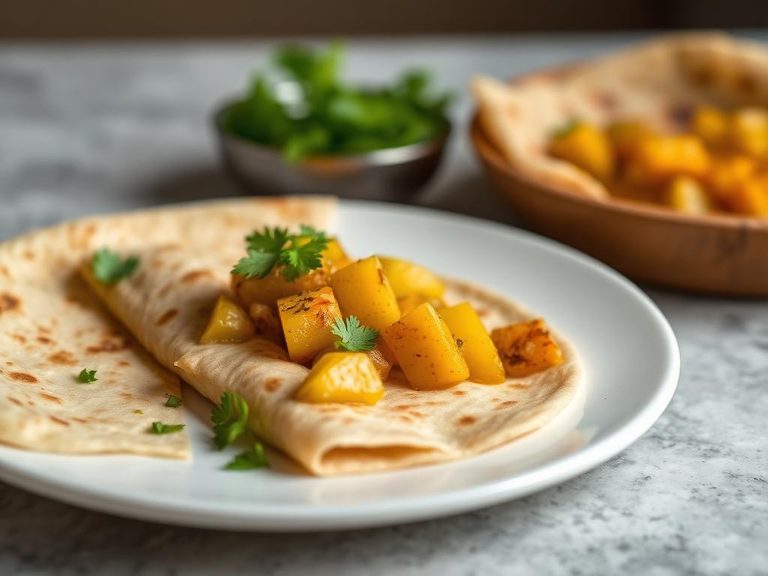
This is a commercially prepared, frozen whole wheat paratha, a layered Indian flatbread designed for quick cooking. It offers a satisfyingly flaky, chewy texture with a nutty, wholesome wheat flavor. Nutritionally, it's a dense source of energy and fiber, with a significant portion of its calories coming from fat.
Calorie split: 8% protein · 56% carbs · 36% fat
↓ Full nutrition💚 Why it's loved
People love it for its authentic, buttery layers and comforting, hearty taste that serves as the perfect vehicle for curries, dals, and pickles. It's a beloved staple that brings the taste of homemade Indian bread to the table in minutes.
⚠️ Watch-outs & how to enjoy it better
The high fat content (13.2g per 100g) and calorie density require mindful portion control, especially for those monitoring fat intake. To balance, pair it with protein-rich dishes like dal or yogurt and load up on non-starchy vegetable sides to create a more balanced meal.
Key benefits
- Excellent source of dietary fiber (9.6g per 100g)
- Provides a good balance of complex carbohydrates and plant-based protein
- Convenient frozen format preserves freshness for quick preparation
- Whole wheat base offers more nutrients than refined flour alternatives
- High satiety factor due to fiber and fat content
🍽️ Popular dishes


🌍 Where it's eaten
💡 Did you know?
The name 'paratha' comes from the Sanskrit words 'parat' meaning 'layers' and 'atta' meaning 'flour', perfectly describing its signature laminated, flaky structure.
Full nutrition (USDA data · scales with serving)
| Water | 33.5 g |
| Energy | 326 kcal |
| Energy | 1362 kj |
| Protein | 6.4 g |
| Total lipid (fat) | 13.2 g |
| Ash | 1.6 g |
| Carbohydrate, by difference | 45.4 g |
| Fiber, total dietary | 9.6 g |
| Total Sugars | 4.2 g |
| Sucrose | 1.8 g |
| Glucose | 0.35 g |
| Fructose | 0.35 g |
| Lactose | 0.00 g |
| Maltose | 1.7 g |
| Galactose | 0.00 g |
| Starch | 31.5 g |
| Calcium, Ca | 25.0 mg |
| Iron, Fe | 1.6 mg |
| Magnesium, Mg | 37.0 mg |
| Phosphorus, P | 120 mg |
| Potassium, K | 139 mg |
| Sodium, Na | 452 mg |
| Zinc, Zn | 0.82 mg |
| Copper, Cu | 0.15 mg |
| Manganese, Mn | 1.1 mg |
| Selenium, Se | 7.1 ug |
| Vitamin C, total ascorbic acid | 0.00 mg |
| Thiamin | 0.11 mg |
| Riboflavin | 0.08 mg |
| Niacin | 1.8 mg |
| Pantothenic acid | 0.47 mg |
| Vitamin B-6 | 0.08 mg |
| Folate, total | 10.0 ug |
| Folic acid | 0.00 ug |
| Folate, food | 10.0 ug |
| Folate, DFE | 10.0 ug |
| Choline, total | 6.3 mg |
| Vitamin B-12 | 0.00 ug |
| Vitamin B-12, added | 0.00 ug |
| Vitamin A, RAE | 2.0 ug |
| Retinol | 2.0 ug |
| Carotene, beta | 0.00 ug |
| Carotene, alpha | 0.00 ug |
| Cryptoxanthin, beta | 0.00 ug |
| Vitamin A, IU | 6.0 iu |
| Lycopene | 0.00 ug |
| Lutein + zeaxanthin | 12.0 ug |
| Vitamin E (alpha-tocopherol) | 1.4 mg |
| Vitamin E, added | 0.00 mg |
| Tocopherol, beta | 0.09 mg |
| Tocopherol, gamma | 0.20 mg |
| Tocopherol, delta | 0.07 mg |
| Tocotrienol, alpha | 1.1 mg |
| Tocotrienol, beta | 0.41 mg |
| Tocotrienol, gamma | 3.4 mg |
| Tocotrienol, delta | 1.1 mg |
| Vitamin D (D2 + D3), International Units | 0.00 iu |
| Vitamin D (D2 + D3) | 0.00 ug |
| Vitamin K (phylloquinone) | 3.4 ug |
| Alcohol, ethyl | 0.00 g |
| Caffeine | 0.00 mg |
| Theobromine | 0.00 mg |
Fat & fatty acid profile (per 100g)
| Fatty acids, total saturated | 5.8 g |
| SFA 4:0 | 0.00 g |
| SFA 6:0 | 0.00 g |
| SFA 8:0 | 0.00 g |
| SFA 10:0 | 0.02 g |
| SFA 12:0 | 0.05 g |
| SFA 14:0 | 0.11 g |
| SFA 15:0 | 0.01 g |
| SFA 16:0 | 4.9 g |
| SFA 17:0 | 0.01 g |
| SFA 18:0 | 0.64 g |
| SFA 20:0 | 0.05 g |
| SFA 22:0 | 0.01 g |
| SFA 24:0 | 0.01 g |
| Fatty acids, total monounsaturated | 3.8 g |
| MUFA 14:1 | 0.00 g |
| MUFA 15:1 | 0.00 g |
| MUFA 16:1 | 0.02 g |
| MUFA 16:1 c | 0.02 g |
| MUFA 17:1 | 0.00 g |
| MUFA 18:1 | 3.8 g |
| MUFA 18:1 c | 3.8 g |
| MUFA 20:1 | 0.03 g |
| MUFA 22:1 | 0.00 g |
| MUFA 22:1 c | 0.00 g |
| MUFA 24:1 c | 0.00 g |
| Fatty acids, total polyunsaturated | 2.5 g |
| PUFA 18:2 | 2.4 g |
| PUFA 18:2 n-6 c,c | 2.4 g |
| PUFA 18:2 CLAs | 0.00 g |
| PUFA 18:3 | 0.07 g |
| PUFA 18:3 n-3 c,c,c (ALA) | 0.06 g |
| PUFA 18:3 n-6 c,c,c | 0.01 g |
| PUFA 18:3i | 0.00 g |
| PUFA 18:4 | 0.00 g |
| PUFA 20:2 n-6 c,c | 0.00 g |
| PUFA 20:3 | 0.00 g |
| PUFA 20:3 n-3 | 0.00 g |
| PUFA 20:3 n-6 | 0.00 g |
| PUFA 20:4 | 0.00 g |
| PUFA 20:5 n-3 (EPA) | 0.00 g |
| PUFA 22:4 | 0.00 g |
| PUFA 22:5 n-3 (DPA) | 0.00 g |
| PUFA 22:6 n-3 (DHA) | 0.00 g |
| Fatty acids, total trans | 0.03 g |
| Fatty acids, total trans-monoenoic | 0.02 g |
| TFA 16:1 t | 0.00 g |
| TFA 18:1 t | 0.02 g |
| TFA 22:1 t | 0.00 g |
| TFA 18:2 t not further defined | 0.02 g |
| Fatty acids, total trans-polyenoic | 0.02 g |
| Cholesterol | 1.0 mg |
Amino acid profile (per 100g)
Estimated from Bread, salvadoran sweet cheese (quesadilla salvadorena) — USDA does not publish this profile for Bread.
| Tryptophan | 0.07 g |
| Threonine | 0.21 g |
| Isoleucine | 0.30 g |
| Leucine | 0.65 g |
| Lysine | 0.50 g |
| Methionine | 0.28 g |
| Cystine | 0.06 g |
| Phenylalanine | 0.37 g |
| Tyrosine | 0.23 g |
| Valine | 0.43 g |
| Arginine | 0.25 g |
| Histidine | 0.15 g |
| Alanine | 0.36 g |
| Aspartic acid | 0.59 g |
| Glutamic acid | 1.3 g |
| Glycine | 0.20 g |
| Proline | 0.83 g |
| Serine | 0.45 g |
| Hydroxyproline | 0.00 g |
FAQ
How is this different from a regular tortilla?
Unlike a tortilla, a paratha is made from whole wheat dough that is layered with fat (like ghee or oil), folded, and rolled, creating a flaky, multi-layered texture when cooked. It's also typically thicker and more substantial.
What's the best way to cook it from frozen?
For best results, cook directly from frozen on a hot tawa (griddle) or skillet over medium heat. Flip when bubbles form, and press gently with a spatula. Apply a little oil or ghee to both sides until golden brown spots appear.
Is it a good source of protein?
At 6.36g per 100g, it provides a moderate amount of plant-based protein, but it is not a complete protein source. It's best enjoyed alongside protein-rich foods like lentils, beans, or dairy to form a complete meal.
Nutrient density (calculated · NRF9.3)
Nutrient Rich Foods index: beneficial nutrients (protein, fiber, vitamins, minerals) minus saturated fat, added sugar & sodium, per 100 kcal.
NRF9.3 index — Fulgoni, Keast & Drewnowski, 2009. Computed from USDA nutrients.
Weight-loss friendliness (composite index)
Energy density 3.26 kcal/g · 8% calories from protein · 9.6 g fiber · 4.2 g sugar per 100 g.
Composite of energy density (Rolls et al., 1999), protein & fiber satiety, minus sugar. A calculated heuristic — ranks satiety-per-calorie, not a clinical measure.
Dietary load (calculated from USDA values)
Potential renal acid load. Positive = acid-forming, negative = alkaline-forming.
Sodium-to-potassium ratio: 3.25 (lower is better — aim for ≤ 1)
Sodium:potassium per WHO potassium guidance. Computed from USDA nutrients.