

Peanut butter, smooth style, with salt (Includes foods for USDA's Food Distribution Program)
Whole food · Legumes and Legume Products
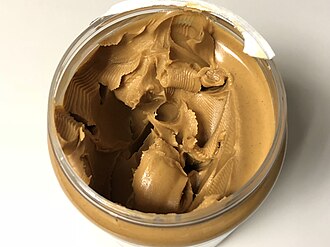
Photo: Wikipedia
This is the classic, creamy, salted peanut butter found in institutional and household pantries—a smooth, rich paste with a deep roasted peanut flavor and a velvety, spreadable texture. Nutritionally, it's a calorie-dense powerhouse, delivering over 51 grams of fat and 22 grams of protein per 100 grams, making it a significant source of energy and plant-based protein.
Calorie split: 14% protein · 14% carbs · 72% fat
↓ Full nutrition💚 Why it's loved
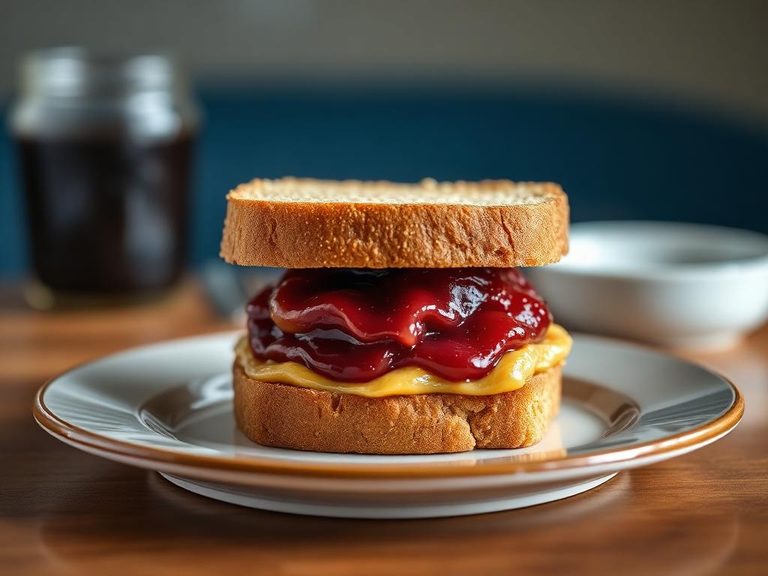
People adore it for its deeply satisfying, savory-sweet umami flavor and incredibly versatile, creamy texture that transforms everything from toast to smoothies. It's a beloved comfort food staple, central to childhood snacks and iconic dishes like PB&J sandwiches across North America.
⚠️ Watch-outs & how to enjoy it better
Its high calorie density and fat content require mindful portion control for those managing weight. The added salt (sodium) can be a concern for blood pressure, and it is a major allergen. To counteract, pair it with fiber-rich foods like apple slices or celery to slow absorption, measure out a tablespoon instead of eating from the jar, and opt for low-sodium or no-salt-added versions when possible.
Key benefits
- Excellent source of plant-based protein (22g per 100g)
- High in heart-healthy monounsaturated fats
- Good source of dietary fiber (5g per 100g)
- Provides essential minerals like magnesium and potassium
- Contains antioxidants like p-coumaric acid
🍽️ Popular dishes
🌍 Where it's eaten
💡 Did you know?
It takes approximately 540 peanuts to make one 12-ounce jar of peanut butter.
Full nutrition (USDA data · scales with serving)
| Water | 1.2 g |
| Energy | 598 kcal |
| Energy | 2501 kj |
| Protein | 22.2 g |
| Total lipid (fat) | 51.4 g |
| Ash | 2.9 g |
| Carbohydrate, by difference | 22.3 g |
| Fiber, total dietary | 5.0 g |
| Total Sugars | 10.5 g |
| Sucrose | 10.3 g |
| Glucose | 0.13 g |
| Fructose | 0.12 g |
| Lactose | 0.00 g |
| Maltose | 0.00 g |
| Galactose | 0.00 g |
| Starch | 3.6 g |
| Calcium, Ca | 49.0 mg |
| Iron, Fe | 1.7 mg |
| Magnesium, Mg | 168 mg |
| Phosphorus, P | 335 mg |
| Potassium, K | 558 mg |
| Sodium, Na | 426 mg |
| Zinc, Zn | 2.5 mg |
| Copper, Cu | 0.42 mg |
| Manganese, Mn | 1.7 mg |
| Selenium, Se | 4.1 ug |
| Vitamin C, total ascorbic acid | 0.00 mg |
| Thiamin | 0.15 mg |
| Riboflavin | 0.19 mg |
| Niacin | 13.1 mg |
| Pantothenic acid | 1.1 mg |
| Vitamin B-6 | 0.44 mg |
| Folate, total | 87.0 ug |
| Folic acid | 0.00 ug |
| Folate, food | 87.0 ug |
| Folate, DFE | 87.0 ug |
| Choline, total | 63.0 mg |
| Betaine | 0.80 mg |
| Vitamin B-12 | 0.00 ug |
| Vitamin B-12, added | 0.00 ug |
| Vitamin A, RAE | 0.00 ug |
| Retinol | 0.00 ug |
| Carotene, beta | 0.00 ug |
| Carotene, alpha | 0.00 ug |
| Cryptoxanthin, beta | 0.00 ug |
| Vitamin A, IU | 0.00 iu |
| Lycopene | 0.00 ug |
| Lutein + zeaxanthin | 0.00 ug |
| Vitamin E (alpha-tocopherol) | 9.1 mg |
| Vitamin E, added | 0.00 mg |
| Tocopherol, beta | 0.52 mg |
| Tocopherol, gamma | 7.6 mg |
| Tocopherol, delta | 0.74 mg |
| Tocotrienol, alpha | 0.00 mg |
| Tocotrienol, beta | 0.00 mg |
| Tocotrienol, gamma | 0.00 mg |
| Tocotrienol, delta | 0.00 mg |
| Vitamin D (D2 + D3), International Units | 0.00 iu |
| Vitamin D (D2 + D3) | 0.00 ug |
| Vitamin K (phylloquinone) | 0.30 ug |
| Alcohol, ethyl | 0.00 g |
| Caffeine | 0.00 mg |
| Theobromine | 0.00 mg |
Fat & fatty acid profile (per 100g)
| Fatty acids, total saturated | 10.3 g |
| SFA 4:0 | 0.00 g |
| SFA 6:0 | 0.00 g |
| SFA 8:0 | 0.00 g |
| SFA 10:0 | 0.00 g |
| SFA 12:0 | 0.00 g |
| SFA 14:0 | 0.02 g |
| SFA 15:0 | 0.01 g |
| SFA 16:0 | 4.7 g |
| SFA 17:0 | 0.05 g |
| SFA 18:0 | 2.2 g |
| SFA 20:0 | 0.72 g |
| SFA 22:0 | 1.7 g |
| SFA 24:0 | 0.73 g |
| Fatty acids, total monounsaturated | 25.9 g |
| MUFA 14:1 | 0.00 g |
| MUFA 15:1 | 0.00 g |
| MUFA 16:1 | 0.03 g |
| MUFA 16:1 c | 0.03 g |
| MUFA 17:1 | 0.03 g |
| MUFA 18:1 | 24.8 g |
| MUFA 18:1 c | 24.8 g |
| MUFA 20:1 | 0.58 g |
| MUFA 22:1 | 0.05 g |
| MUFA 22:1 c | 0.04 g |
| MUFA 24:1 c | 0.00 g |
| Fatty acids, total polyunsaturated | 12.5 g |
| PUFA 18:2 | 12.3 g |
| PUFA 18:2 n-6 c,c | 12.2 g |
| PUFA 18:2 CLAs | 0.01 g |
| PUFA 18:3 | 0.03 g |
| PUFA 18:3 n-3 c,c,c (ALA) | 0.03 g |
| PUFA 18:3 n-6 c,c,c | 0.00 g |
| PUFA 18:3i | 0.00 g |
| PUFA 18:4 | 0.00 g |
| PUFA 20:2 n-6 c,c | 0.01 g |
| PUFA 20:3 | 0.01 g |
| PUFA 20:3 n-3 | 0.01 g |
| PUFA 20:3 n-6 | 0.00 g |
| PUFA 20:4 | 0.02 g |
| PUFA 20:5 n-3 (EPA) | 0.00 g |
| PUFA 22:4 | 0.00 g |
| PUFA 22:5 n-3 (DPA) | 0.00 g |
| PUFA 22:6 n-3 (DHA) | 0.00 g |
| Fatty acids, total trans | 0.07 g |
| Fatty acids, total trans-monoenoic | 0.05 g |
| TFA 16:1 t | 0.00 g |
| TFA 18:1 t | 0.04 g |
| TFA 22:1 t | 0.00 g |
| TFA 18:2 t not further defined | 0.03 g |
| Fatty acids, total trans-polyenoic | 0.03 g |
| Cholesterol | 0.00 mg |
Amino acid profile (per 100g)
| Tryptophan | 0.23 g |
| Threonine | 0.53 g |
| Isoleucine | 0.62 g |
| Leucine | 1.5 g |
| Lysine | 0.68 g |
| Methionine | 0.27 g |
| Cystine | 0.23 g |
| Phenylalanine | 1.2 g |
| Tyrosine | 0.83 g |
| Valine | 0.78 g |
| Arginine | 2.8 g |
| Histidine | 0.56 g |
| Alanine | 0.92 g |
| Aspartic acid | 3.1 g |
| Glutamic acid | 5.1 g |
| Glycine | 1.4 g |
| Proline | 1.4 g |
| Serine | 1.5 g |
FAQ
Is the oil separation at the top normal?
Yes, it's completely natural. The heavier peanut solids sink, leaving the lighter peanut oil on top. Simply stir it back in before use.
What's the difference between 'smooth' and 'crunchy' style?
Smooth style is ground to a fine, uniform paste. Crunchy (or 'chunky') style includes small pieces of roasted peanuts for added texture.
Why is it included in USDA's Food Distribution Program?
It's a cost-effective, nutrient-dense, shelf-stable source of protein, healthy fats, and calories, making it ideal for providing reliable nutrition in food assistance programs.
Nutrient density (calculated · NRF9.3)
Nutrient Rich Foods index: beneficial nutrients (protein, fiber, vitamins, minerals) minus saturated fat, added sugar & sodium, per 100 kcal.
NRF9.3 index — Fulgoni, Keast & Drewnowski, 2009. Computed from USDA nutrients.
Weight-loss friendliness (composite index)
Energy density 5.98 kcal/g · 15% calories from protein · 5.0 g fiber · 10.5 g sugar per 100 g.
Composite of energy density (Rolls et al., 1999), protein & fiber satiety, minus sugar. A calculated heuristic — ranks satiety-per-calorie, not a clinical measure.
Dietary load (calculated from USDA values)
Potential renal acid load. Positive = acid-forming, negative = alkaline-forming.
Sodium-to-potassium ratio: 0.76 (lower is better — aim for ≤ 1)
Sodium:potassium per WHO potassium guidance. Computed from USDA nutrients.