Restaurant, Italian, lasagna with meat
Whole food · Restaurant Foods

Photo: Wikipedia
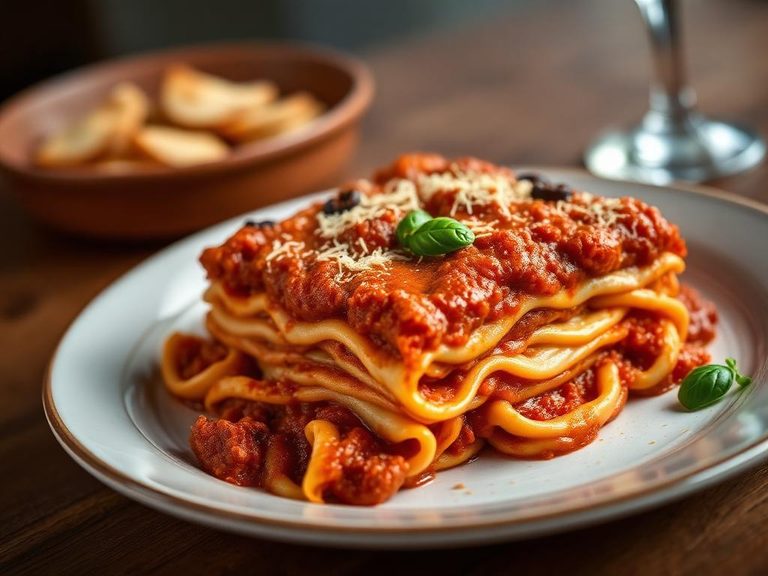
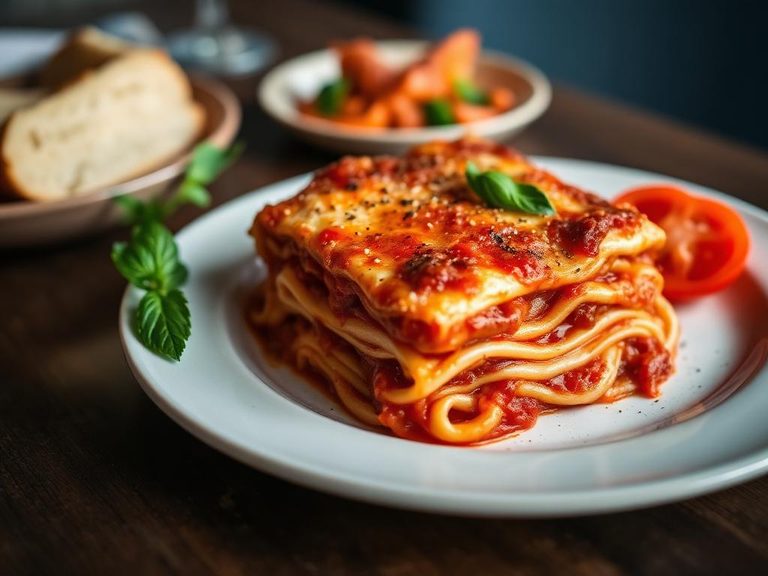
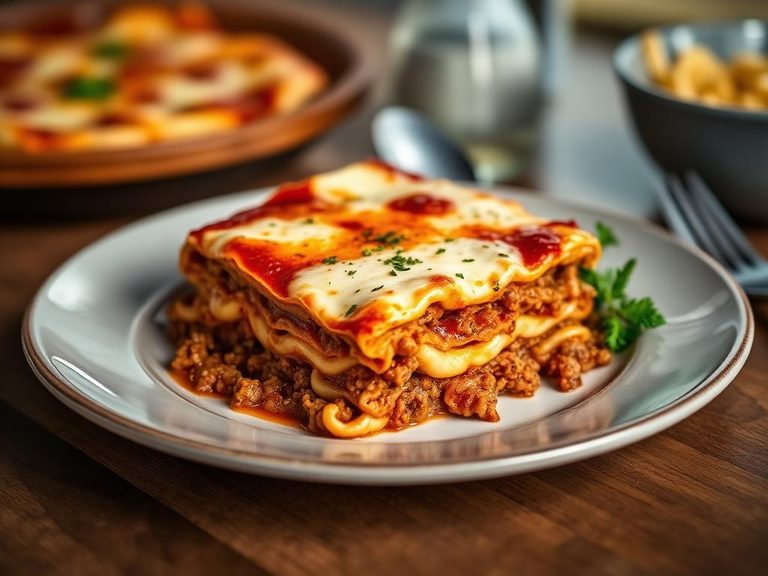
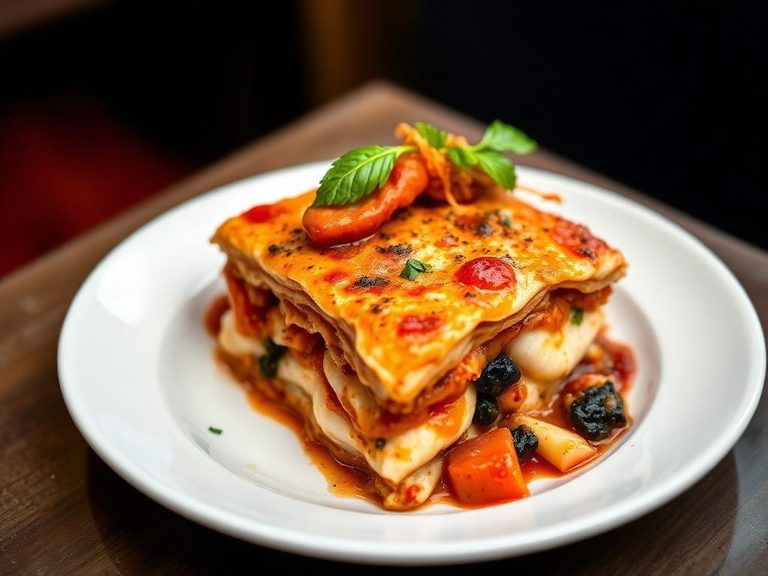
This is a hearty, layered pasta dish featuring sheets of egg pasta alternating with a rich meat ragù (typically beef or pork), creamy béchamel or ricotta, and a blanket of melted cheese. The texture is a comforting blend of soft, yielding pasta, savory, saucy meat, and a golden, slightly crispy top. Per 100g, it provides a balanced mix of protein and fat for satiety, with a moderate carbohydrate content.
💚 Why it's loved
People adore lasagna for its comforting, layered complexity—the way the savory meat, creamy sauce, and melted cheese meld into a cohesive, rich bite. It's a universal crowd-pleaser, often associated with family gatherings, holidays, and the comforting tradition of Italian-American and Italian home cooking.
⚠️ Watch-outs & how to enjoy it better
Its high calorie, fat, and sodium density can be a concern for those managing weight, heart health, or blood pressure. The refined pasta and cheese can cause blood sugar spikes for some. To counteract, pair a smaller portion with a large, vinegar-dressed green salad to add fiber and slow digestion, and ensure the meat component is lean.
Key benefits
- Good source of protein (10.83g per 100g) for muscle maintenance.
- Provides iron and B-vitamins from the meat component.
- Contains calcium from the cheese and béchamel layers.
- Offers a balanced macronutrient profile for a complete meal.
- The fat content (10.69g) aids in the absorption of fat-soluble vitamins.
🍽️ Popular dishes
🌍 Where it's eaten
💡 Did you know?
The word 'lasagna' likely derives from the Greek 'laganon,' which referred to a sheet of pasta dough, but the modern layered dish as we know it is a distinctly Italian innovation, with early recipes appearing in 14th-century Italian cookbooks.
Full nutrition (scales with serving)
| Water | 64.9 g |
| Energy | 185 kcal |
| Energy | 774 kj |
| Protein | 10.8 g |
| Total lipid (fat) | 10.7 g |
| Ash | 2.3 g |
| Carbohydrate, by difference | 11.4 g |
| Fiber, total dietary | 1.5 g |
| Total Sugars | 3.1 g |
| Sucrose | 0.00 g |
| Glucose | 1.2 g |
| Fructose | 1.2 g |
| Lactose | 0.61 g |
| Maltose | 0.00 g |
| Galactose | 0.18 g |
| Starch | 6.1 g |
| Calcium, Ca | 197 mg |
| Iron, Fe | 0.79 mg |
| Magnesium, Mg | 22.0 mg |
| Phosphorus, P | 178 mg |
| Potassium, K | 255 mg |
| Sodium, Na | 466 mg |
| Zinc, Zn | 1.3 mg |
| Copper, Cu | 0.07 mg |
| Manganese, Mn | 0.14 mg |
| Selenium, Se | 18.0 ug |
| Vitamin C, total ascorbic acid | 0.70 mg |
| Thiamin | 0.14 mg |
| Riboflavin | 0.24 mg |
| Niacin | 1.8 mg |
| Pantothenic acid | 0.49 mg |
| Vitamin B-6 | 0.12 mg |
| Folate, total | 26.0 ug |
| Folic acid | 17.0 ug |
| Folate, food | 8.0 ug |
| Folate, DFE | 38.0 ug |
| Choline, total | 33.5 mg |
| Betaine | 594 mg |
| Vitamin B-12 | 0.66 ug |
| Vitamin B-12, added | 0.00 ug |
| Vitamin A, RAE | 81.0 ug |
| Retinol | 64.0 ug |
| Carotene, beta | 197 ug |
| Carotene, alpha | 9.0 ug |
| Cryptoxanthin, beta | 0.00 ug |
| Vitamin A, IU | 550 iu |
| Lycopene | 2517 ug |
| Lutein + zeaxanthin | 97.0 ug |
| Vitamin E (alpha-tocopherol) | 0.91 mg |
| Vitamin E, added | 0.00 mg |
| Tocopherol, beta | 0.00 mg |
| Tocopherol, gamma | 0.14 mg |
| Tocopherol, delta | 0.01 mg |
| Tocotrienol, alpha | 0.01 mg |
| Tocotrienol, beta | 0.05 mg |
| Tocotrienol, gamma | 0.04 mg |
| Tocotrienol, delta | 0.00 mg |
| Vitamin D (D2 + D3), International Units | 1.0 iu |
| Vitamin D (D2 + D3) | 0.00 ug |
| Vitamin K (phylloquinone) | 6.8 ug |
| Vitamin K (Dihydrophylloquinone) | 0.30 ug |
| Vitamin K (Menaquinone-4) | 3.2 ug |
| Alcohol, ethyl | 0.00 g |
| Caffeine | 0.00 mg |
| Theobromine | 0.00 mg |
Fat & fatty acid profile (per 100g)
| Fatty acids, total saturated | 4.9 g |
| SFA 4:0 | 0.12 g |
| SFA 6:0 | 0.10 g |
| SFA 8:0 | 0.07 g |
| SFA 10:0 | 0.17 g |
| SFA 12:0 | 0.19 g |
| SFA 14:0 | 0.66 g |
| SFA 15:0 | 0.07 g |
| SFA 16:0 | 2.4 g |
| SFA 17:0 | 0.06 g |
| SFA 18:0 | 1.0 g |
| SFA 20:0 | 0.02 g |
| SFA 22:0 | 0.01 g |
| SFA 24:0 | 0.01 g |
| Fatty acids, total monounsaturated | 3.3 g |
| MUFA 14:1 | 0.07 g |
| MUFA 15:1 | 0.00 g |
| MUFA 16:1 | 0.18 g |
| MUFA 16:1 c | 0.16 g |
| MUFA 17:1 | 0.03 g |
| MUFA 18:1 | 3.0 g |
| MUFA 18:1 c | 2.8 g |
| MUFA 20:1 | 0.03 g |
| MUFA 22:1 | 0.00 g |
| MUFA 22:1 c | 0.00 g |
| MUFA 24:1 c | 0.00 g |
| Fatty acids, total polyunsaturated | 0.79 g |
| PUFA 18:2 | 0.67 g |
| PUFA 18:2 n-6 c,c | 0.57 g |
| PUFA 18:2 CLAs | 0.04 g |
| PUFA 18:3 | 0.06 g |
| PUFA 18:3 n-3 c,c,c (ALA) | 0.06 g |
| PUFA 18:3 n-6 c,c,c | 0.00 g |
| PUFA 18:3i | 0.00 g |
| PUFA 18:4 | 0.00 g |
| PUFA 20:2 n-6 c,c | 0.01 g |
| PUFA 20:3 | 0.01 g |
| PUFA 20:3 n-3 | 0.00 g |
| PUFA 20:3 n-6 | 0.01 g |
| PUFA 20:4 | 0.02 g |
| PUFA 20:5 n-3 (EPA) | 0.00 g |
| PUFA 22:4 | 0.00 g |
| PUFA 22:5 n-3 (DPA) | 0.01 g |
| PUFA 22:6 n-3 (DHA) | 0.00 g |
| Fatty acids, total trans | 0.31 g |
| Fatty acids, total trans-monoenoic | 0.25 g |
| TFA 16:1 t | 0.03 g |
| TFA 18:1 t | 0.23 g |
| TFA 22:1 t | 0.00 g |
| TFA 18:2 t not further defined | 0.06 g |
| Fatty acids, total trans-polyenoic | 0.06 g |
| Cholesterol | 36.0 mg |
Amino acid profile (per 100g)
| Tryptophan | 0.13 g |
| Threonine | 0.38 g |
| Isoleucine | 0.42 g |
| Leucine | 0.86 g |
| Lysine | 0.82 g |
| Methionine | 0.25 g |
| Cystine | 0.11 g |
| Phenylalanine | 0.49 g |
| Tyrosine | 0.36 g |
| Valine | 0.46 g |
| Arginine | 0.47 g |
| Histidine | 0.28 g |
| Alanine | 0.41 g |
| Aspartic acid | 0.77 g |
| Glutamic acid | 2.1 g |
| Glycine | 0.35 g |
| Proline | 1.1 g |
| Serine | 0.50 g |
| Hydroxyproline | 0.07 g |
FAQ
Is lasagna always made with meat?
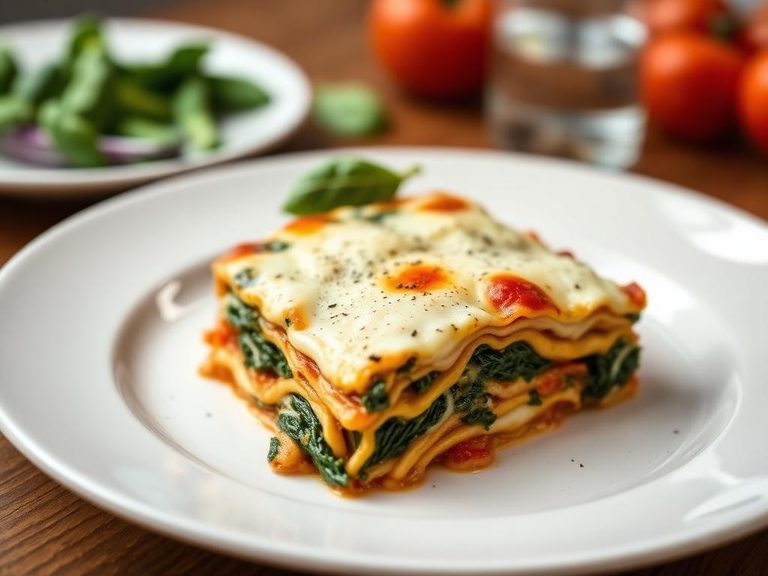
No. While 'lasagna with meat' (like Lasagna alla Bolognese) is iconic, there are many popular vegetarian versions, such as Lasagna al Forno with spinach and ricotta, or 'Lasagna Bianca' with a creamy white sauce and vegetables.
What's the difference between béchamel and ricotta in lasagna?
Béchamel is a classic French-Italian white sauce made from butter, flour, and milk, creating a smooth, rich layer. Ricotta is a fresh, grainy Italian cheese that provides a lighter, slightly sweet, and creamy texture. Many American-style lasagnas use ricotta, while traditional Bolognese versions use béchamel.
Can lasagna be made ahead of time?
Absolutely. Lasagna is an ideal make-ahead dish. Assembling it a day in advance allows the flavors to meld and the pasta to absorb the sauces, resulting in a more cohesive and flavorful dish when baked.