

Restaurant, Chinese, beef and vegetables
Whole food · Restaurant Foods

Photo: Wikipedia
A classic stir-fry of tender beef slices and crisp-tender vegetables, often in a savory, slightly glossy sauce. The texture is a delightful contrast between the soft, yielding beef and the fresh crunch of greens like broccoli or bell peppers. With only 105 calories per 100g, it's a protein-rich, relatively light dish that packs a flavorful punch.
Calorie split: 27% protein · 28% carbs · 45% fat
↓ Full nutrition💚 Why it's loved
People love it for the perfect harmony of savory, umami-rich sauce with the satisfying textures of meat and vegetables. It's a versatile, comforting staple that represents the art of balancing flavors and textures in Chinese home cooking and restaurants.
⚠️ Watch-outs & how to enjoy it better
The dish can be high in sodium from soy sauce and oyster sauce, and the stir-frying oil adds fat. Those watching sodium or fat intake should opt for light sauce on the side and pair it with plain steamed rice or noodles to balance the meal. Choosing leaner cuts of beef and loading up on extra vegetables can also improve its nutritional profile.
Key benefits
- High-quality protein from beef for muscle maintenance.
- Low-calorie density makes it suitable for weight management.
- Provides dietary fiber from the vegetable components.
- Contains essential minerals like iron and zinc from the beef.
🍽️ Popular dishes

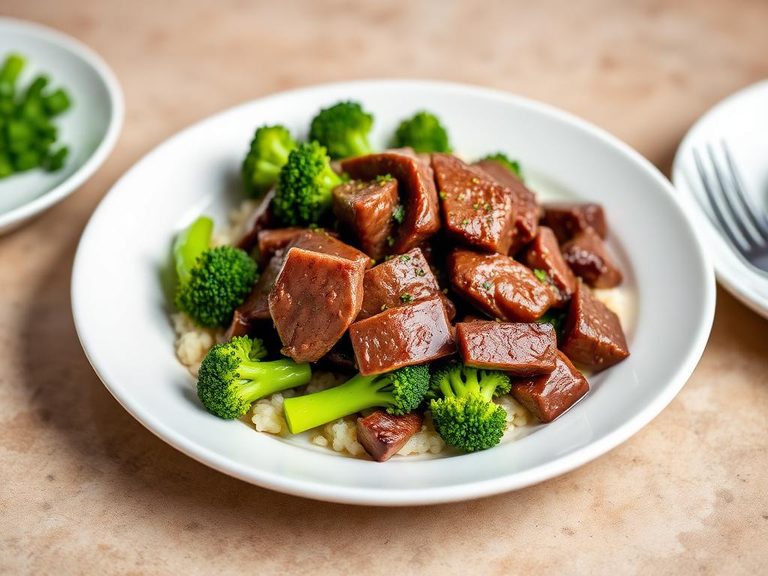

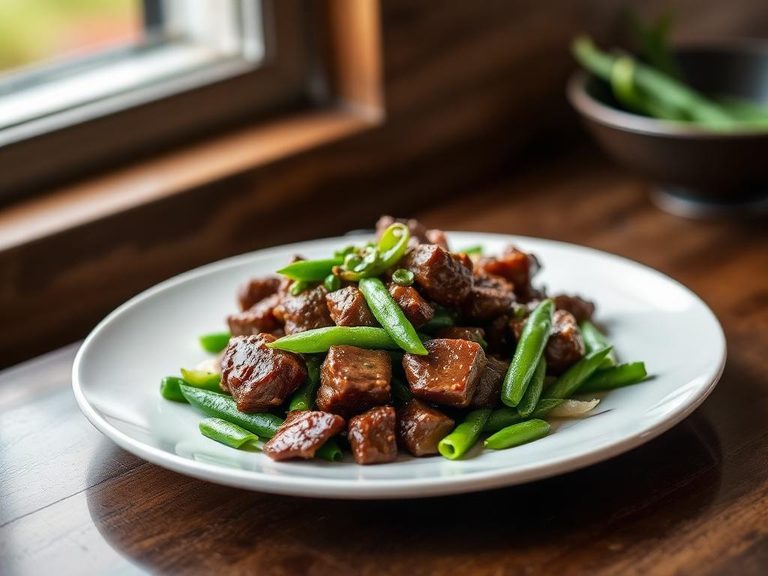

🌍 Where it's eaten
💡 Did you know?
The technique of 'velveting' beef—marinating it in a cornstarch and egg white mixture before stir-frying—is a classic Chinese method that gives the meat its signature silky, tender texture.
Full nutrition (USDA data · scales with serving)
| Water | 78.8 g |
| Energy | 105 kcal |
| Energy | 440 kj |
| Protein | 7.1 g |
| Total lipid (fat) | 5.3 g |
| Ash | 1.5 g |
| Carbohydrate, by difference | 7.3 g |
| Fiber, total dietary | 1.5 g |
| Total Sugars | 2.4 g |
| Sucrose | 1.2 g |
| Glucose | 0.69 g |
| Fructose | 0.55 g |
| Lactose | 0.00 g |
| Maltose | 0.00 g |
| Galactose | 0.00 g |
| Starch | 1.8 g |
| Calcium, Ca | 22.0 mg |
| Iron, Fe | 1.1 mg |
| Magnesium, Mg | 15.0 mg |
| Phosphorus, P | 76.0 mg |
| Potassium, K | 204 mg |
| Sodium, Na | 409 mg |
| Zinc, Zn | 1.5 mg |
| Copper, Cu | 0.05 mg |
| Manganese, Mn | 0.15 mg |
| Selenium, Se | 6.7 ug |
| Vitamin C, total ascorbic acid | 11.6 mg |
| Thiamin | 0.03 mg |
| Riboflavin | 0.06 mg |
| Niacin | 1.3 mg |
| Pantothenic acid | 0.44 mg |
| Vitamin B-6 | 0.16 mg |
| Folate, total | 45.0 ug |
| Folic acid | 0.00 ug |
| Folate, food | 45.0 ug |
| Folate, DFE | 45.0 ug |
| Choline, total | 34.5 mg |
| Betaine | 3.1 mg |
| Vitamin B-12 | 0.48 ug |
| Vitamin B-12, added | 0.00 ug |
| Vitamin A, RAE | 63.0 ug |
| Retinol | 0.00 ug |
| Carotene, beta | 595 ug |
| Carotene, alpha | 323 ug |
| Cryptoxanthin, beta | 1.0 ug |
| Vitamin A, IU | 1262 iu |
| Lycopene | 4.0 ug |
| Lutein + zeaxanthin | 268 ug |
| Vitamin E (alpha-tocopherol) | 0.82 mg |
| Vitamin E, added | 0.00 mg |
| Tocopherol, beta | 0.04 mg |
| Tocopherol, gamma | 1.8 mg |
| Tocopherol, delta | 0.65 mg |
| Tocotrienol, alpha | 0.00 mg |
| Tocotrienol, beta | 0.00 mg |
| Tocotrienol, gamma | 0.01 mg |
| Tocotrienol, delta | 0.00 mg |
| Vitamin D (D2 + D3), International Units | 3.0 iu |
| Vitamin D (D2 + D3) | 0.10 ug |
| Vitamin K (phylloquinone) | 51.3 ug |
| Vitamin K (Menaquinone-4) | 2.0 ug |
| Alcohol, ethyl | 0.00 g |
| Caffeine | 0.00 mg |
| Theobromine | 0.00 mg |
Fat & fatty acid profile (per 100g)
| Fatty acids, total saturated | 0.98 g |
| SFA 4:0 | 0.00 g |
| SFA 6:0 | 0.01 g |
| SFA 8:0 | 0.00 g |
| SFA 10:0 | 0.00 g |
| SFA 12:0 | 0.00 g |
| SFA 14:0 | 0.03 g |
| SFA 15:0 | 0.01 g |
| SFA 16:0 | 0.63 g |
| SFA 17:0 | 0.01 g |
| SFA 18:0 | 0.25 g |
| SFA 20:0 | 0.01 g |
| SFA 22:0 | 0.01 g |
| SFA 24:0 | 0.00 g |
| Fatty acids, total monounsaturated | 1.2 g |
| MUFA 14:1 | 0.01 g |
| MUFA 15:1 | 0.00 g |
| MUFA 16:1 | 0.05 g |
| MUFA 16:1 c | 0.05 g |
| MUFA 17:1 | 0.01 g |
| MUFA 18:1 | 1.1 g |
| MUFA 18:1 c | 1.1 g |
| MUFA 20:1 | 0.02 g |
| MUFA 22:1 | 0.00 g |
| MUFA 22:1 c | 0.00 g |
| MUFA 24:1 c | 0.00 g |
| Fatty acids, total polyunsaturated | 2.1 g |
| PUFA 18:2 | 1.8 g |
| PUFA 18:2 n-6 c,c | 1.8 g |
| PUFA 18:2 CLAs | 0.01 g |
| PUFA 18:3 | 0.26 g |
| PUFA 18:3 n-3 c,c,c (ALA) | 0.26 g |
| PUFA 18:3 n-6 c,c,c | 0.00 g |
| PUFA 18:4 | 0.00 g |
| PUFA 20:2 n-6 c,c | 0.00 g |
| PUFA 20:3 | 0.00 g |
| PUFA 20:3 n-3 | 0.00 g |
| PUFA 20:3 n-6 | 0.00 g |
| PUFA 20:4 | 0.01 g |
| PUFA 20:5 n-3 (EPA) | 0.00 g |
| PUFA 22:4 | 0.00 g |
| PUFA 22:5 n-3 (DPA) | 0.01 g |
| PUFA 22:6 n-3 (DHA) | 0.00 g |
| Fatty acids, total trans | 0.06 g |
| Fatty acids, total trans-monoenoic | 0.04 g |
| TFA 16:1 t | 0.00 g |
| TFA 18:1 t | 0.03 g |
| TFA 22:1 t | 0.00 g |
| TFA 18:2 t not further defined | 0.02 g |
| Fatty acids, total trans-polyenoic | 0.02 g |
| Cholesterol | 14.0 mg |
Amino acid profile (per 100g)
| Tryptophan | 0.08 g |
| Threonine | 0.31 g |
| Isoleucine | 0.31 g |
| Leucine | 0.53 g |
| Lysine | 0.55 g |
| Methionine | 0.16 g |
| Cystine | 0.07 g |
| Phenylalanine | 0.32 g |
| Tyrosine | 0.27 g |
| Valine | 0.33 g |
| Arginine | 0.52 g |
| Histidine | 0.21 g |
| Alanine | 0.38 g |
| Aspartic acid | 0.67 g |
| Glutamic acid | 1.3 g |
| Glycine | 0.28 g |
| Proline | 0.26 g |
| Serine | 0.29 g |
FAQ
Is this dish considered healthy?
It can be a healthy choice due to its protein and vegetable content, but its overall healthiness depends on the cooking method, cut of beef, and sauce quantity. Opting for lean beef, a lighter sauce, and a high vegetable-to-meat ratio improves its nutritional value.
What vegetables are typically used?
Common choices include broccoli, bell peppers, snow peas, carrots, celery, bok choy, and onions. The selection often depends on regional preference and seasonal availability.
How can I reduce the sodium content?
You can request the sauce on the side, use low-sodium soy sauce if cooking at home, or balance the dish by serving it with unsalted steamed rice and plenty of plain vegetables.
Nutrient density (calculated · NRF9.3)
Nutrient Rich Foods index: beneficial nutrients (protein, fiber, vitamins, minerals) minus saturated fat, added sugar & sodium, per 100 kcal.
NRF9.3 index — Fulgoni, Keast & Drewnowski, 2009. Computed from USDA nutrients.
Weight-loss friendliness (composite index)
Energy density 1.05 kcal/g · 27% calories from protein · 1.5 g fiber · 2.4 g sugar per 100 g.
Composite of energy density (Rolls et al., 1999), protein & fiber satiety, minus sugar. A calculated heuristic — ranks satiety-per-calorie, not a clinical measure.
Dietary load (calculated from USDA values)
Potential renal acid load. Positive = acid-forming, negative = alkaline-forming.
Sodium-to-potassium ratio: 2.00 (lower is better — aim for ≤ 1)
Sodium:potassium per WHO potassium guidance. Computed from USDA nutrients.