

Turkey, whole, meat and skin, with added solution, roasted
Whole food · Poultry Products
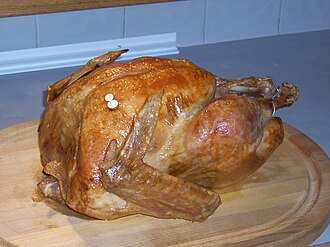
Photo: Wikipedia
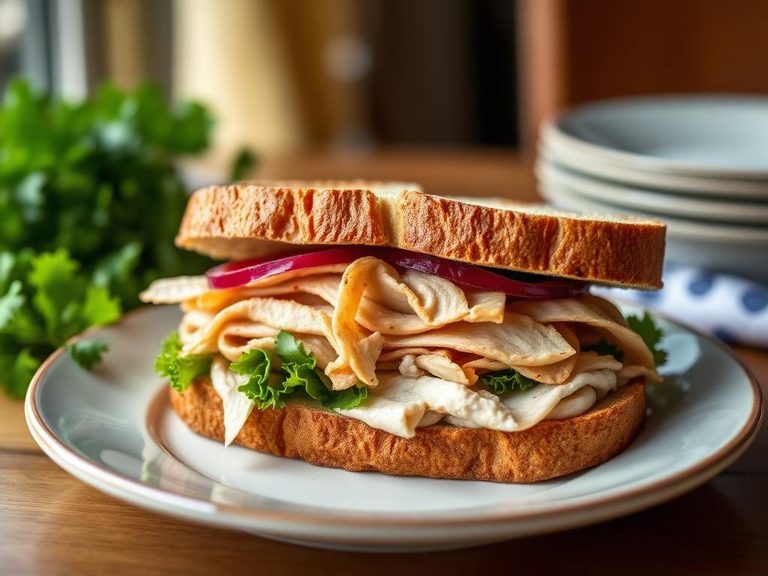
This is a whole roasted turkey, meat and skin together, that has been cooked with an added solution (like broth or brine) for moisture and flavor. The result is tender, juicy meat with a rich, savory taste and a slightly crispy, fatty skin. It's a lean protein powerhouse, delivering over 26 grams of protein per 100 grams with zero carbohydrates.
Calorie split: 59% protein · 0% carbs · 41% fat
↓ Full nutrition💚 Why it's loved
People love it for its rich, savory flavor that's milder than beef but more substantial than chicken, and its incredible versatility as the centerpiece of festive meals. Its ability to feed a crowd and be repurposed into countless leftovers is a major part of its cultural appeal.
⚠️ Watch-outs & how to enjoy it better
The skin is high in saturated fat and calories, and the added solution can significantly increase sodium content. To counteract this, simply remove the skin before eating and balance the meal with fresh, low-sodium vegetables or a salad to add fiber and volume.
Key benefits
- Excellent source of high-quality, complete protein
- Very low in carbohydrates and sugars
- Provides essential minerals like selenium and phosphorus
- Naturally gluten-free and sugar-free
🍽️ Popular dishes


🌍 Where it's eaten
💡 Did you know?
The tradition of eating turkey on Thanksgiving became a national icon in the U.S. largely due to a magazine editor's campaign in the 19th century and Sarah Josepha Hale's persistent lobbying.
Full nutrition (USDA data · scales with serving)
| Water | 65.0 g |
| Energy | 176 kcal |
| Energy | 738 kj |
| Protein | 26.1 g |
| Total lipid (fat) | 8.0 g |
| Ash | 1.4 g |
| Carbohydrate, by difference | 0.00 g |
| Fiber, total dietary | 0.00 g |
| Total Sugars | 0.00 g |
| Calcium, Ca | 15.0 mg |
| Iron, Fe | 0.81 mg |
| Magnesium, Mg | 27.0 mg |
| Phosphorus, P | 236 mg |
| Potassium, K | 242 mg |
| Sodium, Na | 224 mg |
| Zinc, Zn | 2.2 mg |
| Copper, Cu | 0.09 mg |
| Manganese, Mn | 0.01 mg |
| Selenium, Se | 29.6 ug |
| Vitamin C, total ascorbic acid | 0.00 mg |
| Thiamin | 0.04 mg |
| Riboflavin | 0.26 mg |
| Niacin | 9.4 mg |
| Pantothenic acid | 0.94 mg |
| Vitamin B-6 | 0.55 mg |
| Folate, total | 8.0 ug |
| Folic acid | 0.00 ug |
| Folate, food | 8.0 ug |
| Folate, DFE | 8.0 ug |
| Choline, total | 77.7 mg |
| Betaine | 4.2 mg |
| Vitamin B-12 | 1.7 ug |
| Vitamin B-12, added | 0.00 ug |
| Vitamin A, RAE | 13.0 ug |
| Retinol | 13.0 ug |
| Carotene, beta | 0.00 ug |
| Carotene, alpha | 0.00 ug |
| Cryptoxanthin, beta | 0.00 ug |
| Vitamin A, IU | 43.0 iu |
| Lycopene | 0.00 ug |
| Lutein + zeaxanthin | 0.00 ug |
| Vitamin E (alpha-tocopherol) | 0.07 mg |
| Vitamin E, added | 0.00 mg |
| Tocopherol, beta | 0.00 mg |
| Tocopherol, gamma | 0.04 mg |
| Tocopherol, delta | 0.02 mg |
| Tocotrienol, alpha | 0.00 mg |
| Tocotrienol, beta | 0.00 mg |
| Tocotrienol, gamma | 0.05 mg |
| Tocotrienol, delta | 0.00 mg |
| Vitamin D (D2 + D3), International Units | 15.0 iu |
| Vitamin D (D2 + D3) | 0.40 ug |
| Vitamin D3 (cholecalciferol) | 0.40 ug |
| Vitamin K (phylloquinone) | 0.00 ug |
| Alcohol, ethyl | 0.00 g |
| Caffeine | 0.00 mg |
| Theobromine | 0.00 mg |
Fat & fatty acid profile (per 100g)
| Fatty acids, total saturated | 2.3 g |
| SFA 4:0 | 0.00 g |
| SFA 6:0 | 0.00 g |
| SFA 8:0 | 0.00 g |
| SFA 10:0 | 0.01 g |
| SFA 12:0 | 0.03 g |
| SFA 14:0 | 0.08 g |
| SFA 15:0 | 0.01 g |
| SFA 16:0 | 1.5 g |
| SFA 17:0 | 0.02 g |
| SFA 18:0 | 0.59 g |
| SFA 20:0 | 0.01 g |
| SFA 22:0 | 0.00 g |
| SFA 24:0 | 0.00 g |
| Fatty acids, total monounsaturated | 2.9 g |
| MUFA 14:1 | 0.01 g |
| MUFA 15:1 | 0.00 g |
| MUFA 16:1 | 0.27 g |
| MUFA 16:1 c | 0.27 g |
| MUFA 17:1 | 0.01 g |
| MUFA 18:1 | 2.5 g |
| MUFA 18:1 c | 2.4 g |
| MUFA 20:1 | 0.04 g |
| MUFA 22:1 | 0.00 g |
| MUFA 22:1 c | 0.00 g |
| MUFA 24:1 c | 0.00 g |
| Fatty acids, total polyunsaturated | 2.3 g |
| PUFA 18:2 | 2.0 g |
| PUFA 18:2 n-6 c,c | 2.0 g |
| PUFA 18:2 CLAs | 0.01 g |
| PUFA 18:3 | 0.12 g |
| PUFA 18:3 n-3 c,c,c (ALA) | 0.11 g |
| PUFA 18:3 n-6 c,c,c | 0.00 g |
| PUFA 18:4 | 0.00 g |
| PUFA 20:2 n-6 c,c | 0.01 g |
| PUFA 20:3 | 0.01 g |
| PUFA 20:3 n-3 | 0.00 g |
| PUFA 20:3 n-6 | 0.01 g |
| PUFA 20:4 | 0.08 g |
| PUFA 20:5 n-3 (EPA) | 0.01 g |
| PUFA 22:4 | 0.02 g |
| PUFA 22:5 n-3 (DPA) | 0.01 g |
| PUFA 22:6 n-3 (DHA) | 0.01 g |
| Fatty acids, total trans | 0.11 g |
| Fatty acids, total trans-monoenoic | 0.09 g |
| TFA 16:1 t | 0.01 g |
| TFA 18:1 t | 0.08 g |
| TFA 22:1 t | 0.00 g |
| TFA 18:2 t not further defined | 0.02 g |
| Fatty acids, total trans-polyenoic | 0.02 g |
| Cholesterol | 91.0 mg |
Amino acid profile (per 100g)
| Tryptophan | 0.26 g |
| Threonine | 0.91 g |
| Isoleucine | 0.72 g |
| Leucine | 1.7 g |
| Lysine | 2.1 g |
| Methionine | 0.66 g |
| Cystine | 0.24 g |
| Phenylalanine | 0.82 g |
| Tyrosine | 0.74 g |
| Valine | 0.82 g |
| Arginine | 1.5 g |
| Histidine | 0.68 g |
| Alanine | 1.4 g |
| Aspartic acid | 2.0 g |
| Glutamic acid | 3.4 g |
| Glycine | 1.3 g |
| Proline | 1.5 g |
| Serine | 1.0 g |
FAQ
What does 'with added solution' mean?
It means the turkey was injected or soaked in a mixture (often water, salt, broth, or spices) before cooking to enhance moisture, tenderness, and flavor during roasting.
Is roasted turkey with skin a good choice for a low-carb diet?
Yes, the meat itself is an excellent low-carb protein source. However, the skin adds significant fat and calories, so for strict low-carb or keto diets, portion control of the skin is advised.
How does the nutrition compare to roasted chicken?
Roasted turkey (meat & skin) is very similar to roasted chicken in calories and protein, but turkey meat is often slightly leaner. The main difference is cultural use and typical portion size.
Nutrient density (calculated · NRF9.3)
Nutrient Rich Foods index: beneficial nutrients (protein, fiber, vitamins, minerals) minus saturated fat, added sugar & sodium, per 100 kcal.
NRF9.3 index — Fulgoni, Keast & Drewnowski, 2009. Computed from USDA nutrients.
Weight-loss friendliness (composite index)
Energy density 1.76 kcal/g · 59% calories from protein · 0.0 g fiber · 0.0 g sugar per 100 g.
Composite of energy density (Rolls et al., 1999), protein & fiber satiety, minus sugar. A calculated heuristic — ranks satiety-per-calorie, not a clinical measure.
Dietary load (calculated from USDA values)
Potential renal acid load. Positive = acid-forming, negative = alkaline-forming.
Sodium-to-potassium ratio: 0.93 (lower is better — aim for ≤ 1)
Sodium:potassium per WHO potassium guidance. Computed from USDA nutrients.