

Sausage, breakfast sausage, beef, pre-cooked, unprepared
Whole food · Sausages and Luncheon Meats
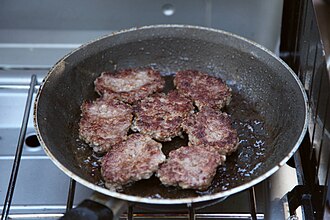
Photo: Wikipedia
This is a savory, pre-cooked ground beef sausage, typically seasoned with salt, pepper, and spices like sage or paprika, forming the classic breakfast patty or link. Its texture is firm yet juicy with a satisfyingly coarse grind, delivering a rich, meaty flavor with a smoky, savory depth. Nutritionally, it is a high-fat, high-protein energy source, providing substantial calories primarily from fat (28.7g per 100g) with a modest protein boost (13.3g).
Calorie split: 16% protein · 4% carbs · 79% fat
↓ Full nutrition💚 Why it's loved
People love it for its robust, savory flavor and the satisfying, juicy texture that makes it a cornerstone of a hearty breakfast. Its versatility allows it to be crumbled into scrambles, layered in sandwiches, or served alongside eggs, making it a beloved comfort food across many cultures.
⚠️ Watch-outs & how to enjoy it better
The high fat and sodium content can be a concern for those managing heart health or blood pressure, and it may cause digestive discomfort if consumed in large quantities. To counteract this, pair it with high-fiber vegetables (like spinach or peppers) to slow digestion, practice strict portion control (e.g., one small patty), and choose lower-sodium varieties or rinse if possible.
Key benefits
- High in protein for muscle maintenance and satiety.
- Provides a quick, dense energy source due to high fat content.
- Convenient pre-cooked format reduces preparation time.
- Rich in B vitamins (especially B12) from beef.
- Offers a strong savory flavor base for many dishes.
🍽️ Popular dishes

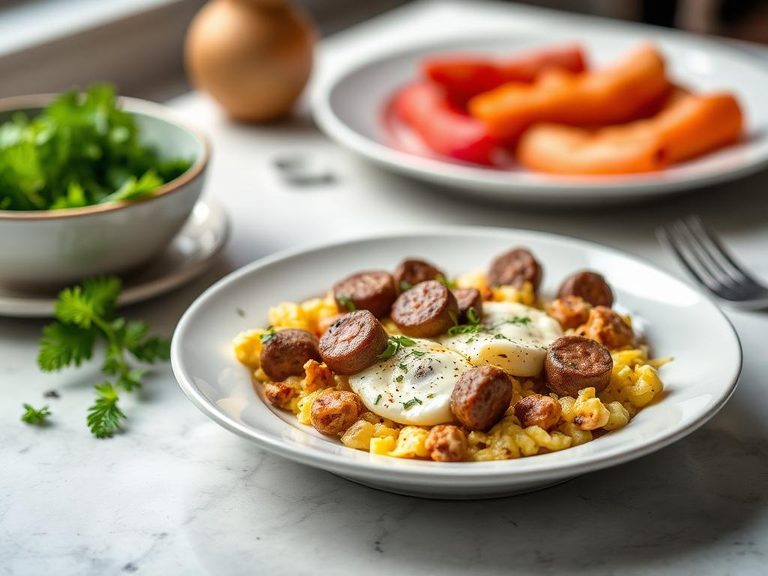


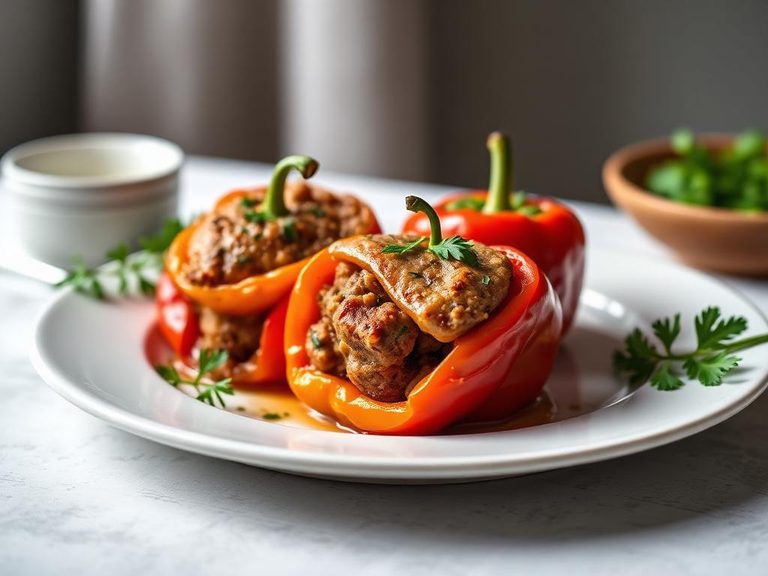
🌍 Where it's eaten
💡 Did you know?
The term 'breakfast sausage' in the U.S. often refers to pork, but beef versions became popular in the 20th century as a leaner alternative, though they can still be quite fatty depending on the cut.
Full nutrition (USDA data · scales with serving)
| Water | 51.7 g |
| Energy (Atwater General Factors) | 325 kcal |
| Energy (Atwater Specific Factors) | 329 kcal |
| Energy | 328 kcal |
| Energy | 1370 kj |
| Nitrogen | 2.1 g |
| Protein | 13.3 g |
| Total lipid (fat) | 28.7 g |
| Total fat (NLEA) | 27.1 g |
| Ash | 3.0 g |
| Carbohydrate, by difference | 3.4 g |
| Sugars, Total | 1.0 g |
| Sucrose | 0.00 g |
| Glucose | 1.0 g |
| Fructose | 0.00 g |
| Lactose | 0.00 g |
| Maltose | 0.00 g |
| Galactose | 0.00 g |
| Calcium, Ca | 35.0 mg |
| Iron, Fe | 1.6 mg |
| Magnesium, Mg | 19.7 mg |
| Phosphorus, P | 124 mg |
| Potassium, K | 263 mg |
| Sodium, Na | 866 mg |
| Zinc, Zn | 2.1 mg |
| Copper, Cu | 0.07 mg |
| Manganese, Mn | 0.17 mg |
| Selenium, Se | 11.6 ug |
| Vitamin C, total ascorbic acid | 19.2 mg |
| Thiamin | 0.05 mg |
| Riboflavin | 0.13 mg |
| Niacin | 2.4 mg |
| Pantothenic acid | 0.32 mg |
| Vitamin B-6 | 0.15 mg |
| Choline, total | 38.3 mg |
| Choline, free | 2.3 mg |
| Choline, from phosphocholine | 27.7 mg |
| Choline, from phosphotidyl choline | 0.40 mg |
| Choline, from glycerophosphocholine | 1.9 mg |
| Choline, from sphingomyelin | 6.0 mg |
| Betaine | 2.8 mg |
| Vitamin B-12 | 1.1 ug |
| Vitamin A, RAE | 18.0 ug |
| Retinol | 18.0 ug |
| Vitamin E (alpha-tocopherol) | 0.33 mg |
| Tocopherol, beta | 0.00 mg |
| Tocopherol, gamma | 0.14 mg |
| Tocopherol, delta | 0.00 mg |
| Tocotrienol, alpha | 0.00 mg |
| Tocotrienol, beta | 0.00 mg |
| Tocotrienol, gamma | 0.00 mg |
| Tocotrienol, delta | 0.00 mg |
Fat & fatty acid profile (per 100g)
| Fatty acids, total saturated | 11.3 g |
| SFA 4:0 | 0.00 g |
| SFA 6:0 | 0.00 g |
| SFA 8:0 | 0.00 g |
| SFA 10:0 | 0.00 g |
| SFA 11:0 | 0.00 g |
| SFA 12:0 | 0.02 g |
| SFA 14:0 | 0.78 g |
| SFA 15:0 | 0.10 g |
| SFA 16:0 | 6.7 g |
| SFA 17:0 | 0.26 g |
| SFA 18:0 | 3.5 g |
| SFA 20:0 | 0.03 g |
| SFA 22:0 | 0.00 g |
| SFA 24:0 | 0.00 g |
| Fatty acids, total monounsaturated | 12.7 g |
| MUFA 14:1 c | 0.25 g |
| MUFA 15:1 | 0.00 g |
| MUFA 16:1 c | 1.1 g |
| MUFA 17:1 | 0.20 g |
| MUFA 17:1 c | 0.20 g |
| MUFA 18:1 c | 11.0 g |
| MUFA 20:1 c | 0.11 g |
| MUFA 22:1 c | 0.02 g |
| MUFA 22:1 n-9 | 0.02 g |
| MUFA 24:1 c | 0.00 g |
| Fatty acids, total polyunsaturated | 1.9 g |
| PUFA 18:2 c | 1.7 g |
| PUFA 18:2 n-6 c,c | 1.6 g |
| PUFA 18:2 CLAs | 0.13 g |
| PUFA 18:3 c | 0.09 g |
| PUFA 18:3 n-3 c,c,c (ALA) | 0.09 g |
| PUFA 18:3 n-6 c,c,c | 0.00 g |
| PUFA 18:4 | 0.00 g |
| PUFA 20:2 c | 0.03 g |
| PUFA 20:2 n-6 c,c | 0.03 g |
| PUFA 20:3 c | 0.03 g |
| PUFA 20:3 n-3 | 0.00 g |
| PUFA 20:3 n-6 | 0.03 g |
| PUFA 20:3 n-9 | 0.00 g |
| PUFA 20:4 | 0.05 g |
| PUFA 20:4c | 0.05 g |
| PUFA 20:5c | 0.00 g |
| PUFA 20:5 n-3 (EPA) | 0.00 g |
| PUFA 22:2 | 0.00 g |
| PUFA 22:5 c | 0.01 g |
| PUFA 22:4 | 0.01 g |
| PUFA 22:5 n-3 (DPA) | 0.01 g |
| PUFA 22:6 c | 0.00 g |
| PUFA 22:6 n-3 (DHA) | 0.00 g |
| Fatty acids, total trans | 1.2 g |
| Fatty acids, total trans-monoenoic | 1.1 g |
| TFA 16:1 t | 0.06 g |
| TFA 18:1 t | 1.0 g |
| TFA 22:1 t | 0.00 g |
| Fatty acids, total trans-dienoic | 0.09 g |
| TFA 18:2 t not further defined | 0.09 g |
| Fatty acids, total trans-polyenoic | 0.00 g |
| TFA 18:3 t | 0.00 g |
| Cholesterol | 61.0 mg |
Amino acid profile (per 100g)
| Tryptophan | 0.12 g |
| Threonine | 0.50 g |
| Isoleucine | 0.46 g |
| Leucine | 0.93 g |
| Lysine | 0.95 g |
| Methionine | 0.26 g |
| Phenylalanine | 0.60 g |
| Tyrosine | 0.39 g |
| Valine | 0.53 g |
| Arginine | 0.83 g |
| Histidine | 0.35 g |
| Alanine | 0.77 g |
| Aspartic acid | 1.2 g |
| Glutamic acid | 1.9 g |
| Glycine | 0.94 g |
| Proline | 0.84 g |
| Serine | 0.55 g |
| Hydroxyproline | 0.29 g |
| Cysteine | 0.17 g |
FAQ
Is beef breakfast sausage healthier than pork sausage?
Beef sausage can be slightly lower in saturated fat than pork, but it depends on the cut and preparation. Both are high in fat and sodium, so moderation is key.
How can I reduce the fat content when cooking beef breakfast sausage?
Cook it on a rack to allow fat to drain away, or bake it in the oven. You can also mix it with leaner ground beef or turkey to reduce overall fat.
What are common spices in beef breakfast sausage?
Common spices include sage, black pepper, salt, paprika, and sometimes red pepper flakes or garlic powder for extra flavor.
Nutrient density (calculated · NRF9.3)
Nutrient Rich Foods index: beneficial nutrients (protein, fiber, vitamins, minerals) minus saturated fat, added sugar & sodium, per 100 kcal.
NRF9.3 index — Fulgoni, Keast & Drewnowski, 2009. Computed from USDA nutrients.
Weight-loss friendliness (composite index)
Energy density 3.28 kcal/g · 16% calories from protein · 0.0 g fiber · 0.0 g sugar per 100 g.
Composite of energy density (Rolls et al., 1999), protein & fiber satiety, minus sugar. A calculated heuristic — ranks satiety-per-calorie, not a clinical measure.
Dietary load (calculated from USDA values)
Potential renal acid load. Positive = acid-forming, negative = alkaline-forming.
Sodium-to-potassium ratio: 3.29 (lower is better — aim for ≤ 1)
Sodium:potassium per WHO potassium guidance. Computed from USDA nutrients.