

Restaurant, family style, fried mozzarella sticks
Whole food · Restaurant Foods

Photo: Wikipedia
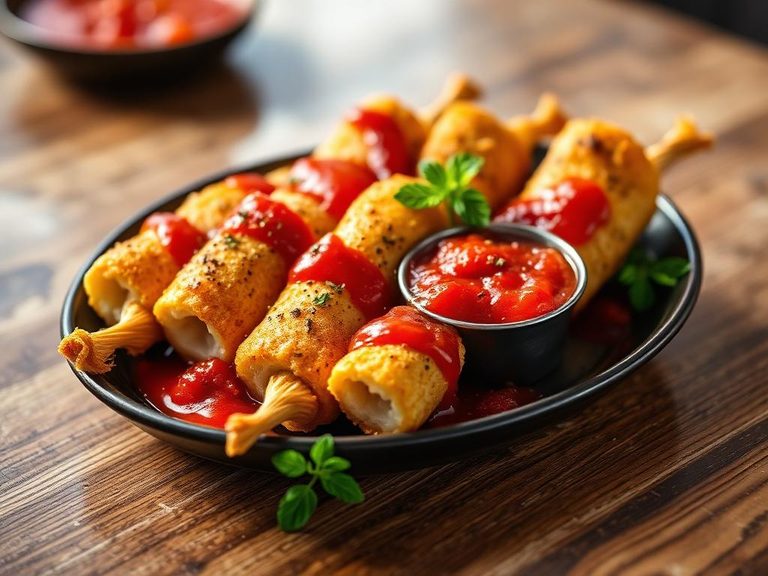
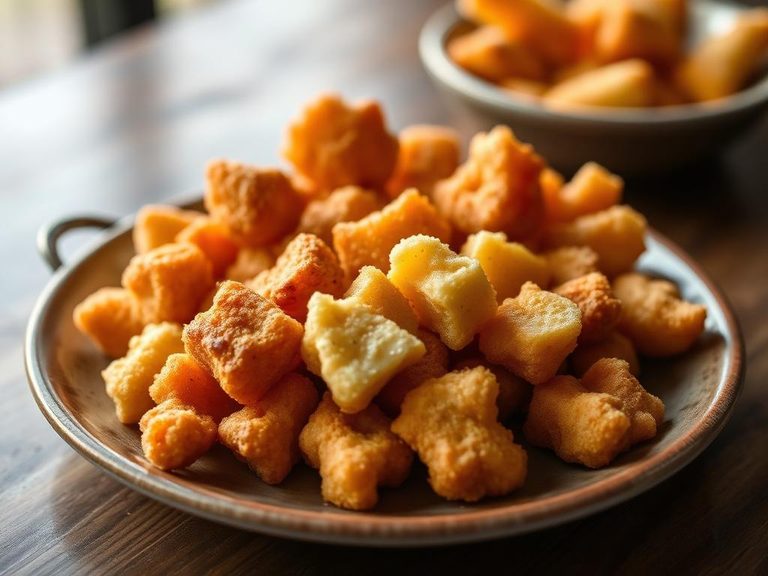
Golden-fried sticks of mozzarella cheese, coated in a crispy breadcrumb crust that gives way to a molten, stretchy interior. Each bite delivers a satisfying crunch followed by a rich, creamy cheese pull. At 325 kcal per 100g, it's a calorie-dense appetizer with a solid protein punch from the cheese.
Calorie split: 18% protein · 31% carbs · 51% fat
↓ Full nutrition💚 Why it's loved
People adore the irresistible contrast of the crunchy exterior and the gooey, stretchy cheese inside, making it a universally popular shareable appetizer. It's a nostalgic comfort food that pairs perfectly with marinara sauce for dipping.
⚠️ Watch-outs & how to enjoy it better
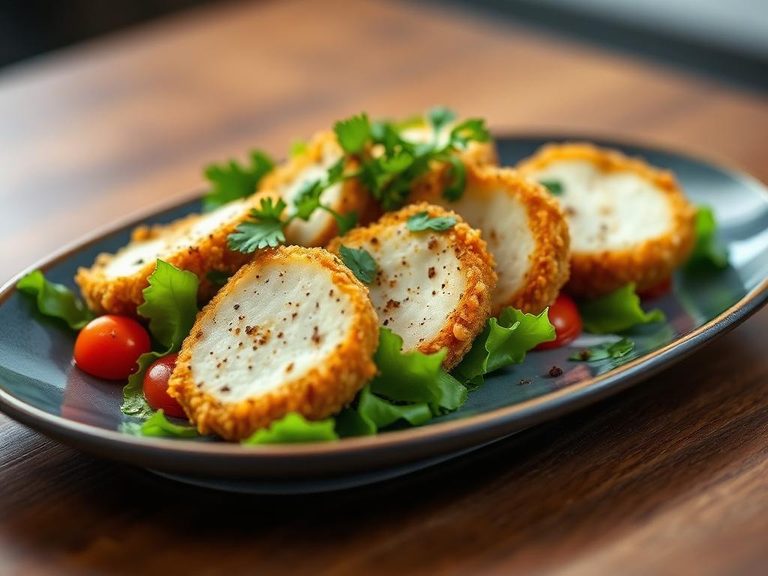
The high fat and calorie content can be a concern for those managing weight or heart health, and the fried preparation can cause blood sugar spikes. To mitigate this, pair with a side salad or vegetables to add fiber and slow digestion, and practice portion control by sticking to a single serving.
Key benefits
- Good source of calcium from mozzarella cheese
- Provides 14.75g protein per 100g for muscle support
- Quick energy from carbohydrates in the breading
- Satisfying texture combination of crispy and creamy
🍽️ Popular dishes


🌍 Where it's eaten
💡 Did you know?
The mozzarella cheese used in these sticks is traditionally made from water buffalo milk in Italy, though most versions today use cow's milk for a milder flavor and better melting properties.
Full nutrition (USDA data · scales with serving)
| Water | 38.4 g |
| Energy | 325 kcal |
| Energy | 1358 kj |
| Protein | 14.8 g |
| Total lipid (fat) | 18.3 g |
| Ash | 3.3 g |
| Carbohydrate, by difference | 25.1 g |
| Fiber, total dietary | 2.0 g |
| Total Sugars | 2.4 g |
| Sucrose | 0.04 g |
| Glucose | 0.64 g |
| Fructose | 0.07 g |
| Lactose | 0.74 g |
| Maltose | 0.58 g |
| Galactose | 0.30 g |
| Starch | 20.5 g |
| Calcium, Ca | 334 mg |
| Iron, Fe | 0.62 mg |
| Magnesium, Mg | 21.0 mg |
| Phosphorus, P | 318 mg |
| Potassium, K | 108 mg |
| Sodium, Na | 861 mg |
| Zinc, Zn | 2.1 mg |
| Copper, Cu | 0.07 mg |
| Manganese, Mn | 0.29 mg |
| Selenium, Se | 18.9 ug |
| Vitamin C, total ascorbic acid | 0.00 mg |
| Thiamin | 0.10 mg |
| Riboflavin | 0.26 mg |
| Niacin | 0.78 mg |
| Pantothenic acid | 0.41 mg |
| Vitamin B-6 | 0.07 mg |
| Folate, total | 26.0 ug |
| Folic acid | 14.0 ug |
| Folate, food | 12.0 ug |
| Folate, DFE | 36.0 ug |
| Choline, total | 9.9 mg |
| Vitamin B-12 | 0.96 ug |
| Vitamin B-12, added | 0.00 ug |
| Vitamin A, RAE | 99.0 ug |
| Retinol | 97.0 ug |
| Carotene, beta | 25.0 ug |
| Carotene, alpha | 0.00 ug |
| Cryptoxanthin, beta | 2.0 ug |
| Vitamin A, IU | 366 iu |
| Lycopene | 0.00 ug |
| Lutein + zeaxanthin | 43.0 ug |
| Vitamin E (alpha-tocopherol) | 0.77 mg |
| Vitamin E, added | 0.00 mg |
| Tocopherol, beta | 0.11 mg |
| Tocopherol, gamma | 4.2 mg |
| Tocopherol, delta | 1.6 mg |
| Tocotrienol, alpha | 0.02 mg |
| Tocotrienol, beta | 0.14 mg |
| Tocotrienol, gamma | 0.03 mg |
| Tocotrienol, delta | 0.00 mg |
| Vitamin D (D2 + D3), International Units | 7.0 iu |
| Vitamin D (D2 + D3) | 0.20 ug |
| Vitamin K (phylloquinone) | 22.9 ug |
| Vitamin K (Dihydrophylloquinone) | 0.00 ug |
| Vitamin K (Menaquinone-4) | 2.3 ug |
| Alcohol, ethyl | 0.00 g |
| Caffeine | 0.00 mg |
| Theobromine | 0.00 mg |
Fat & fatty acid profile (per 100g)
| Fatty acids, total saturated | 6.8 g |
| SFA 4:0 | 0.18 g |
| SFA 6:0 | 0.15 g |
| SFA 8:0 | 0.10 g |
| SFA 10:0 | 0.23 g |
| SFA 12:0 | 0.27 g |
| SFA 14:0 | 0.87 g |
| SFA 15:0 | 0.09 g |
| SFA 16:0 | 3.4 g |
| SFA 17:0 | 0.06 g |
| SFA 18:0 | 1.4 g |
| SFA 20:0 | 0.04 g |
| SFA 22:0 | 0.03 g |
| SFA 24:0 | 0.01 g |
| Fatty acids, total monounsaturated | 4.3 g |
| MUFA 14:1 | 0.09 g |
| MUFA 15:1 | 0.00 g |
| MUFA 16:1 | 0.16 g |
| MUFA 16:1 c | 0.13 g |
| MUFA 17:1 | 0.02 g |
| MUFA 18:1 | 4.0 g |
| MUFA 18:1 c | 3.8 g |
| MUFA 20:1 | 0.08 g |
| MUFA 22:1 | 0.00 g |
| MUFA 22:1 c | 0.00 g |
| MUFA 24:1 c | 0.00 g |
| Fatty acids, total polyunsaturated | 5.0 g |
| PUFA 18:2 | 4.3 g |
| PUFA 18:2 n-6 c,c | 4.2 g |
| PUFA 18:2 CLAs | 0.06 g |
| PUFA 18:3 | 0.57 g |
| PUFA 18:3 n-3 c,c,c (ALA) | 0.54 g |
| PUFA 18:3 n-6 c,c,c | 0.04 g |
| PUFA 18:3i | 0.00 g |
| PUFA 18:4 | 0.00 g |
| PUFA 20:2 n-6 c,c | 0.01 g |
| PUFA 20:3 | 0.01 g |
| PUFA 20:3 n-3 | 0.00 g |
| PUFA 20:3 n-6 | 0.01 g |
| PUFA 20:4 | 0.02 g |
| PUFA 20:5 n-3 (EPA) | 0.00 g |
| PUFA 22:4 | 0.01 g |
| PUFA 22:5 n-3 (DPA) | 0.01 g |
| PUFA 22:6 n-3 (DHA) | 0.00 g |
| Fatty acids, total trans | 0.36 g |
| Fatty acids, total trans-monoenoic | 0.25 g |
| TFA 16:1 t | 0.03 g |
| TFA 18:1 t | 0.22 g |
| TFA 22:1 t | 0.00 g |
| TFA 18:2 t not further defined | 0.10 g |
| Fatty acids, total trans-polyenoic | 0.11 g |
| Cholesterol | 36.0 mg |
Amino acid profile (per 100g)
| Tryptophan | 0.18 g |
| Threonine | 0.43 g |
| Isoleucine | 0.79 g |
| Leucine | 1.5 g |
| Lysine | 1.2 g |
| Methionine | 0.43 g |
| Cystine | 0.18 g |
| Phenylalanine | 0.85 g |
| Tyrosine | 0.63 g |
| Valine | 1.0 g |
| Arginine | 0.64 g |
| Histidine | 0.47 g |
| Alanine | 0.49 g |
| Aspartic acid | 1.1 g |
| Glutamic acid | 3.9 g |
| Glycine | 0.37 g |
| Proline | 2.2 g |
| Serine | 0.69 g |
| Hydroxyproline | 0.00 g |
FAQ
What is the nutritional breakdown per 100g of fried mozzarella sticks?
Per 100g, fried mozzarella sticks contain 325 kcal, 14.75g protein, 25.14g carbs, 18.33g fat, 2g fiber, and 2.36g sugar.
Are fried mozzarella sticks a good source of protein?
Yes, they provide 14.75g of protein per 100g, which is a decent amount for an appetizer, primarily from the mozzarella cheese.
How can I make fried mozzarella sticks healthier?
You can bake them instead of frying, use whole-grain breadcrumbs for more fiber, and pair them with a side of vegetables or a salad to balance the meal.
Nutrient density (calculated · NRF9.3)
Nutrient Rich Foods index: beneficial nutrients (protein, fiber, vitamins, minerals) minus saturated fat, added sugar & sodium, per 100 kcal.
NRF9.3 index — Fulgoni, Keast & Drewnowski, 2009. Computed from USDA nutrients.
Weight-loss friendliness (composite index)
Energy density 3.25 kcal/g · 18% calories from protein · 2.0 g fiber · 2.4 g sugar per 100 g.
Composite of energy density (Rolls et al., 1999), protein & fiber satiety, minus sugar. A calculated heuristic — ranks satiety-per-calorie, not a clinical measure.
Dietary load (calculated from USDA values)
Potential renal acid load. Positive = acid-forming, negative = alkaline-forming.
Sodium-to-potassium ratio: 7.97 (lower is better — aim for ≤ 1)
Sodium:potassium per WHO potassium guidance. Computed from USDA nutrients.