Restaurant, Chinese, sweet and sour pork
Whole food · Restaurant Foods
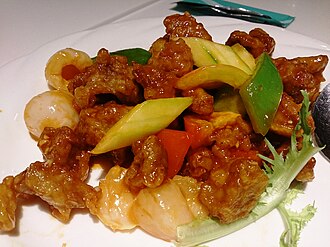
Photo: Wikipedia
A Cantonese classic featuring bite-sized pork pieces, deep-fried to a golden crunch, then tossed in a vibrant, glossy sauce of vinegar, sugar, and ketchup. The texture is a delightful contrast of crispy batter and tender meat, coated in a tangy-sweet glaze. At 260 kcal per 100g, it's a calorie-dense dish with a notable fat content from frying, balanced by a moderate protein and carbohydrate profile.
💚 Why it's loved
People adore the addictive sweet-and-sour flavor profile, which perfectly balances tangy and sweet notes. The crispy texture of the pork, combined with the glossy sauce, makes it a universally appealing and comforting dish in many Chinese restaurants worldwide.
⚠️ Watch-outs & how to enjoy it better
The deep-frying process significantly increases the fat and calorie content, making it a less ideal choice for those monitoring their fat intake. The high sugar and refined carbohydrate content can cause rapid blood-sugar spikes, and the dish is often high in sodium from the sauce. To counteract this, pair it with a large portion of steamed vegetables or brown rice to increase fiber and slow digestion, and practice portion control by sharing the dish.
Key benefits
- Provides a quick source of energy from carbohydrates and fats.
- Offers a good amount of protein (8.88g per 100g) for muscle maintenance.
- The vinegar in the sauce can aid digestion and add a refreshing tang.
- A popular comfort food that can boost mood and satisfaction.
🍽️ Popular dishes


🌍 Where it's eaten
💡 Did you know?
The iconic red color of the sauce in many Westernized versions comes from ketchup or food coloring, but traditional Cantonese recipes often use a natural red from fermented bean curd or a mix of vinegar and sugar.
Full nutrition (scales with serving)
| Water | 50.8 g |
| Energy | 260 kcal |
| Energy | 1090 kj |
| Nitrogen | 1.4 g |
| Protein | 8.9 g |
| Total lipid (fat) | 13.6 g |
| Total fat (NLEA) | 13.3 g |
| Ash | 1.3 g |
| Carbohydrate, by difference | 25.5 g |
| Carbohydrate, by summation | 23.0 g |
| Fiber, total dietary | 1.0 g |
| Sugars, Total | 10.3 g |
| Sucrose | 4.5 g |
| Glucose | 3.0 g |
| Fructose | 2.9 g |
| Lactose | 0.00 g |
| Maltose | 0.00 g |
| Galactose | 0.00 g |
| Starch | 11.7 g |
| Calcium, Ca | 46.0 mg |
| Iron, Fe | 3.1 mg |
| Magnesium, Mg | 13.0 mg |
| Phosphorus, P | 133 mg |
| Potassium, K | 152 mg |
| Sodium, Na | 304 mg |
| Zinc, Zn | 1.1 mg |
| Copper, Cu | 0.06 mg |
| Manganese, Mn | 0.17 mg |
| Selenium, Se | 9.7 ug |
| Vitamin C, total ascorbic acid | 2.3 mg |
| Thiamin | 0.23 mg |
| Riboflavin | 0.10 mg |
| Niacin | 2.1 mg |
| Pantothenic acid | 0.44 mg |
| Vitamin B-6 | 0.17 mg |
| Choline, total | 32.4 mg |
| Choline, free | 3.5 mg |
| Choline, from phosphocholine | 0.80 mg |
| Choline, from phosphotidyl choline | 16.2 mg |
| Choline, from glycerophosphocholine | 7.3 mg |
| Choline, from sphingomyelin | 4.6 mg |
| Betaine | 7.4 mg |
| Vitamin B-12 | 0.19 ug |
| Vitamin A, RAE | 29.0 ug |
| Retinol | 2.0 ug |
| Carotene, beta | 259 ug |
| Carotene, alpha | 139 ug |
| Cryptoxanthin, beta | 0.00 ug |
| Lycopene | 199 ug |
| Lutein + zeaxanthin | 22.0 ug |
| Vitamin E (alpha-tocopherol) | 0.89 mg |
| Tocopherol, beta | 0.06 mg |
| Tocopherol, gamma | 3.3 mg |
| Tocopherol, delta | 1.3 mg |
| Tocotrienol, alpha | 0.00 mg |
| Tocotrienol, beta | 0.00 mg |
| Tocotrienol, gamma | 0.01 mg |
| Tocotrienol, delta | 0.00 mg |
| Vitamin K (phylloquinone) | 27.8 ug |
| Vitamin K (Menaquinone-4) | 2.0 ug |
| Fatty acids, total saturated | 2.7 g |
| SFA 4:0 | 0.00 g |
| SFA 6:0 | 0.00 g |
| SFA 8:0 | 0.01 g |
| SFA 10:0 | 0.01 g |
| SFA 11:0 | 0.00 g |
| SFA 12:0 | 0.00 g |
| SFA 14:0 | 0.04 g |
| SFA 15:0 | 0.00 g |
| SFA 16:0 | 1.8 g |
| SFA 17:0 | 0.02 g |
| SFA 18:0 | 0.72 g |
| SFA 20:0 | 0.04 g |
| SFA 22:0 | 0.04 g |
| SFA 24:0 | 0.01 g |
| Fatty acids, total monounsaturated | 3.5 g |
| MUFA 14:1 c | 0.00 g |
| MUFA 15:1 | 0.00 g |
| MUFA 16:1 c | 0.07 g |
| MUFA 17:1 | 0.01 g |
| MUFA 17:1 c | 0.01 g |
| MUFA 18:1 c | 3.3 g |
| MUFA 20:1 | 0.07 g |
| MUFA 20:1 c | 0.07 g |
| MUFA 22:1 c | 0.00 g |
| MUFA 24:1 c | 0.00 g |
| Fatty acids, total polyunsaturated | 7.0 g |
| PUFA 18:2 c | 6.2 g |
| PUFA 18:2 n-6 c,c | 6.2 g |
| PUFA 18:2 CLAs | 0.01 g |
| PUFA 18:3 c | 0.79 g |
| PUFA 18:3 n-3 c,c,c (ALA) | 0.79 g |
| PUFA 18:3 n-6 c,c,c | 0.00 g |
| PUFA 18:4 | 0.00 g |
| PUFA 20:2 c | 0.01 g |
| PUFA 20:2 n-6 c,c | 0.01 g |
| PUFA 20:3 c | 0.01 g |
| PUFA 20:3 n-3 | 0.00 g |
| PUFA 20:3 n-6 | 0.00 g |
| PUFA 20:4 | 0.03 g |
| PUFA 20:4c | 0.03 g |
| PUFA 20:5c | 0.00 g |
| PUFA 20:5 n-3 (EPA) | 0.00 g |
| PUFA 22:2 | 0.00 g |
| PUFA 22:5 c | 0.00 g |
| PUFA 22:4 | 0.01 g |
| PUFA 22:5 n-3 (DPA) | 0.00 g |
| PUFA 22:6 c | 0.00 g |
| PUFA 22:6 n-3 (DHA) | 0.00 g |
| Fatty acids, total trans | 0.09 g |
| Fatty acids, total trans-monoenoic | 0.03 g |
| TFA 16:1 t | 0.00 g |
| TFA 18:1 t | 0.03 g |
| TFA 22:1 t | 0.00 g |
| Fatty acids, total trans-dienoic | 0.05 g |
| TFA 18:2 t not further defined | 0.05 g |
| Cholesterol | 24.0 mg |
| Tryptophan | 0.10 g |
| Threonine | 0.37 g |
| Isoleucine | 0.38 g |
| Leucine | 0.71 g |
| Lysine | 0.66 g |
| Methionine | 0.21 g |
| Cystine | 0.11 g |
| Phenylalanine | 0.34 g |
| Tyrosine | 0.25 g |
| Valine | 0.41 g |
| Arginine | 0.54 g |
| Histidine | 0.29 g |
| Alanine | 0.47 g |
| Aspartic acid | 0.77 g |
| Glutamic acid | 1.9 g |
| Glycine | 0.40 g |
| Proline | 0.45 g |
| Serine | 0.38 g |
FAQ
Is sweet and sour pork a healthy choice?
It's a treat, not a health food. While it provides protein, the deep-frying and sugary sauce make it high in calories, fat, and sugar. Enjoy it in moderation and balance it with lighter, vegetable-rich dishes.
What makes the pork crispy?
The pork is typically coated in a batter (often with cornstarch or flour) and deep-fried until golden and crispy before being tossed in the sauce. The batter creates a protective layer that keeps the meat tender inside.
Can I make a healthier version at home?
Yes! You can bake or air-fry the pork instead of deep-frying, use less sugar in the sauce, and add more vegetables like bell peppers and pineapple. Using leaner cuts of pork and whole-grain batter can also improve its nutritional profile.