

Nuts, mixed nuts, oil roasted, with peanuts, without salt added
Whole food · Nut and Seed Products
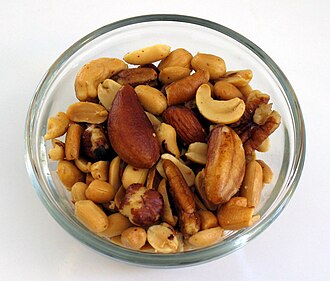
Photo: Wikipedia
This is a classic, savory snack mix of oil-roasted peanuts and other nuts, offering a satisfying crunch and a deep, toasty, nutty flavor. Nutritionally, it's a calorie-dense powerhouse, delivering a substantial 54 grams of healthy fats and over 20 grams of protein per 100g, making it a very satiating energy source.
Calorie split: 12% protein · 13% carbs · 75% fat
↓ Full nutrition💚 Why it's loved
People adore the addictive combination of savory, roasted flavors and the satisfying textural contrast between different nuts. It's the ultimate versatile snack, perfect for trail mixes, cheese boards, or as a standalone handful to curb hunger.
⚠️ Watch-outs & how to enjoy it better
The high calorie density can lead to overconsumption, and the oil-roasting process adds significant fat. Those with peanut or tree nut allergies must avoid it entirely. To enjoy mindfully, pre-portion a single serving (about a handful) into a small bowl to avoid eating straight from the large bag.
Key benefits
- Excellent source of plant-based protein for muscle maintenance.
- Rich in heart-healthy monounsaturated and polyunsaturated fats.
- Provides dietary fiber for digestive health and satiety.
- Good source of minerals like magnesium, phosphorus, and zinc.
- Convenient, shelf-stable, no-cook energy boost.
🍽️ Popular dishes
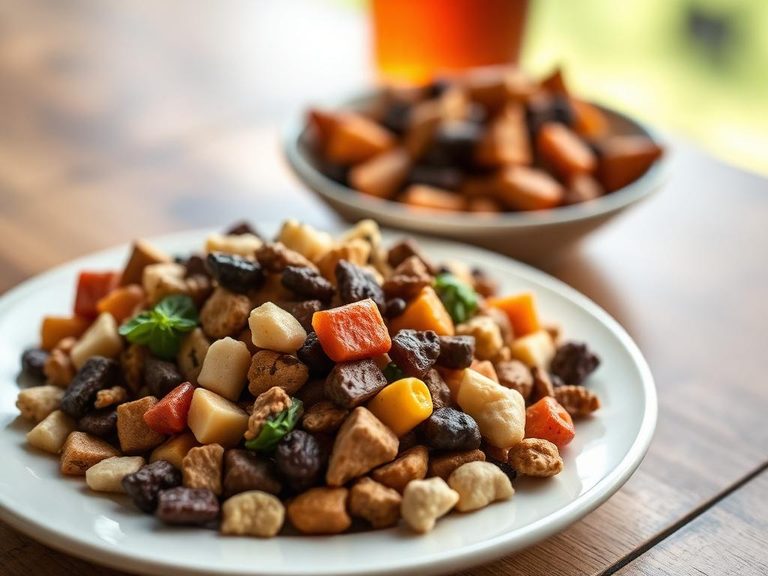
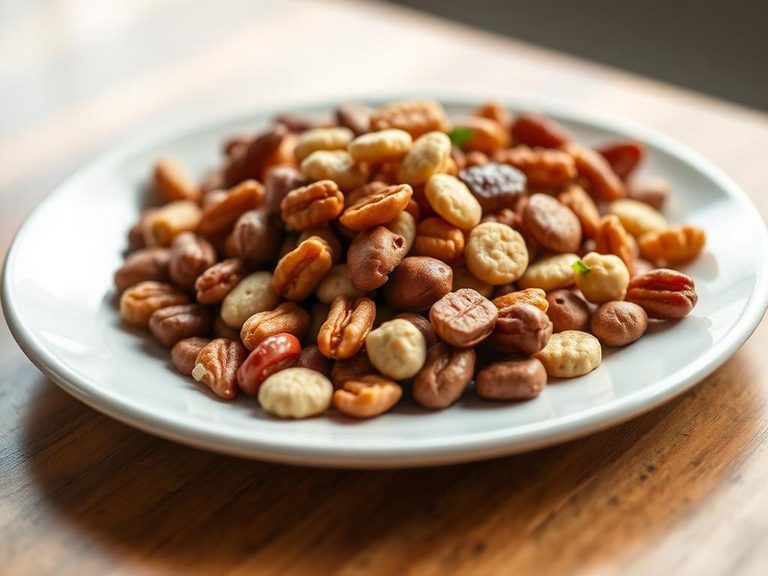
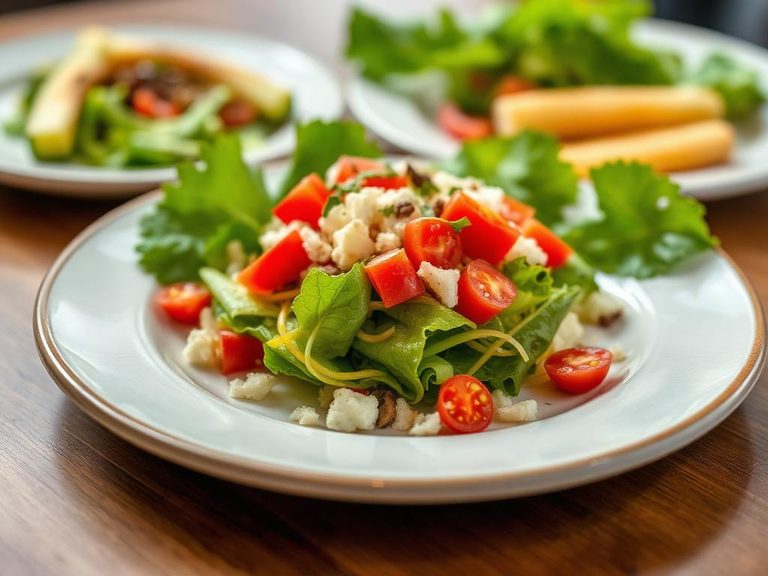
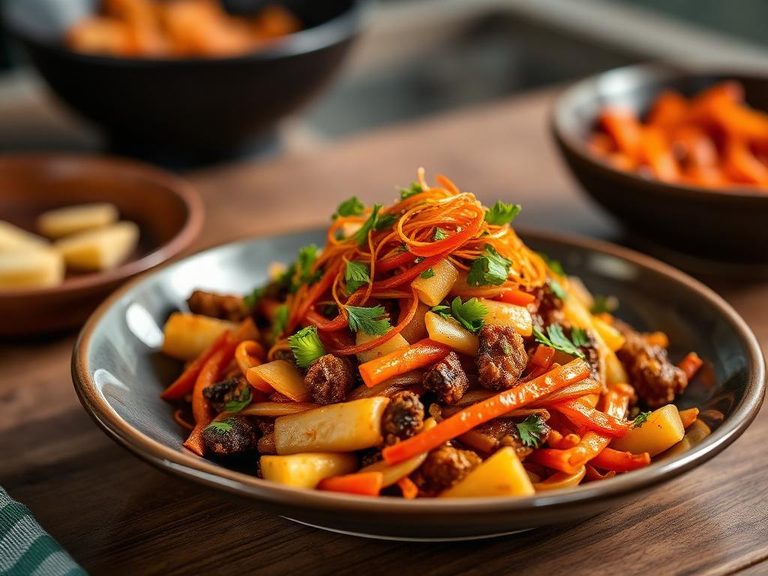

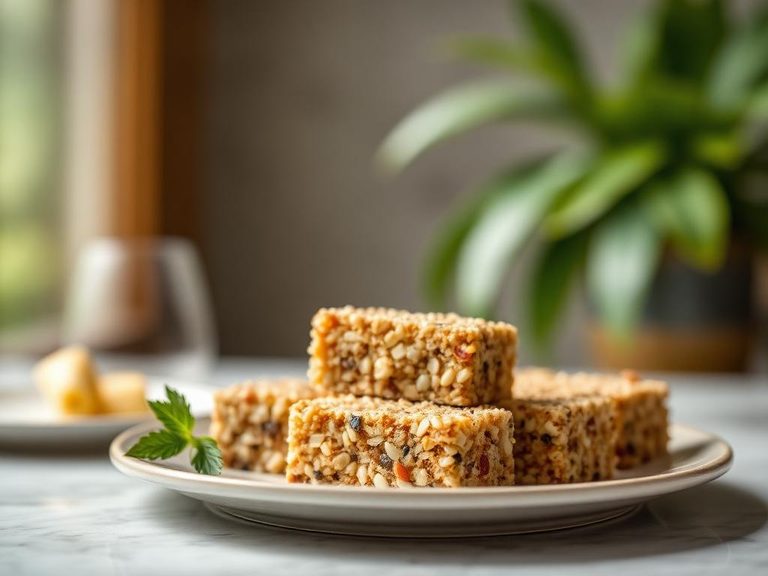
🌍 Where it's eaten
💡 Did you know?
The U.S. produces about 75% of the world's peanuts, and a single acre of peanut plants can produce enough peanut butter to make 30,000 peanut butter sandwiches.
Full nutrition (USDA data · scales with serving)
| Water | 2.1 g |
| Energy | 607 kcal |
| Energy | 2539 kj |
| Protein | 20.0 g |
| Total lipid (fat) | 54.0 g |
| Ash | 2.9 g |
| Carbohydrate, by difference | 21.1 g |
| Fiber, total dietary | 7.0 g |
| Total Sugars | 4.2 g |
| Sucrose | 4.2 g |
| Glucose | 0.00 g |
| Fructose | 0.00 g |
| Lactose | 0.00 g |
| Maltose | 0.00 g |
| Galactose | 0.00 g |
| Starch | 4.2 g |
| Calcium, Ca | 117 mg |
| Iron, Fe | 2.6 mg |
| Magnesium, Mg | 229 mg |
| Phosphorus, P | 456 mg |
| Potassium, K | 632 mg |
| Sodium, Na | 5.0 mg |
| Zinc, Zn | 3.4 mg |
| Copper, Cu | 0.91 mg |
| Manganese, Mn | 2.0 mg |
| Selenium, Se | 33.9 ug |
| Vitamin C, total ascorbic acid | 0.50 mg |
| Thiamin | 0.19 mg |
| Riboflavin | 0.20 mg |
| Niacin | 7.7 mg |
| Pantothenic acid | 1.1 mg |
| Vitamin B-6 | 0.35 mg |
| Folate, total | 83.0 ug |
| Folic acid | 0.00 ug |
| Folate, food | 83.0 ug |
| Folate, DFE | 83.0 ug |
| Choline, total | 52.0 mg |
| Vitamin B-12 | 0.00 ug |
| Vitamin A, RAE | 0.00 ug |
| Retinol | 0.00 ug |
| Carotene, beta | 2.0 ug |
| Carotene, alpha | 0.00 ug |
| Cryptoxanthin, beta | 0.00 ug |
| Vitamin A, IU | 3.0 iu |
| Lycopene | 0.00 ug |
| Lutein + zeaxanthin | 8.0 ug |
| Vitamin E (alpha-tocopherol) | 7.8 mg |
| Tocopherol, beta | 0.22 mg |
| Tocopherol, gamma | 6.4 mg |
| Tocopherol, delta | 0.32 mg |
| Tocotrienol, alpha | 0.04 mg |
| Tocotrienol, beta | 0.00 mg |
| Tocotrienol, gamma | 0.03 mg |
| Tocotrienol, delta | 0.00 mg |
| Vitamin D (D2 + D3), International Units | 0.00 iu |
| Vitamin D (D2 + D3) | 0.00 ug |
| Vitamin K (phylloquinone) | 5.7 ug |
| Alcohol, ethyl | 0.00 g |
Fat & fatty acid profile (per 100g)
| Fatty acids, total saturated | 8.7 g |
| SFA 4:0 | 0.00 g |
| SFA 6:0 | 0.00 g |
| SFA 8:0 | 0.00 g |
| SFA 10:0 | 0.00 g |
| SFA 12:0 | 0.00 g |
| SFA 14:0 | 0.04 g |
| SFA 15:0 | 0.01 g |
| SFA 16:0 | 5.2 g |
| SFA 17:0 | 0.05 g |
| SFA 18:0 | 2.0 g |
| SFA 20:0 | 0.36 g |
| SFA 22:0 | 0.64 g |
| SFA 24:0 | 0.38 g |
| Fatty acids, total monounsaturated | 28.5 g |
| MUFA 14:1 | 0.00 g |
| MUFA 15:1 | 0.00 g |
| MUFA 16:1 | 0.13 g |
| MUFA 16:1 c | 0.13 g |
| MUFA 17:1 | 0.04 g |
| MUFA 18:1 | 27.9 g |
| MUFA 18:1 c | 27.9 g |
| MUFA 20:1 | 0.38 g |
| MUFA 22:1 | 0.03 g |
| MUFA 22:1 c | 0.03 g |
| MUFA 24:1 c | 0.01 g |
| Fatty acids, total polyunsaturated | 14.6 g |
| PUFA 18:2 | 14.5 g |
| PUFA 18:2 n-6 c,c | 14.5 g |
| PUFA 18:2 CLAs | 0.01 g |
| PUFA 18:3 | 0.08 g |
| PUFA 18:3 n-3 c,c,c (ALA) | 0.08 g |
| PUFA 18:3 n-6 c,c,c | 0.00 g |
| PUFA 18:4 | 0.00 g |
| PUFA 20:2 n-6 c,c | 0.01 g |
| PUFA 20:3 | 0.00 g |
| PUFA 20:3 n-3 | 0.00 g |
| PUFA 20:3 n-6 | 0.00 g |
| PUFA 20:4 | 0.01 g |
| PUFA 20:5 n-3 (EPA) | 0.01 g |
| PUFA 22:4 | 0.01 g |
| PUFA 22:5 n-3 (DPA) | 0.00 g |
| PUFA 22:6 n-3 (DHA) | 0.00 g |
| Fatty acids, total trans | 0.06 g |
| Fatty acids, total trans-monoenoic | 0.02 g |
| TFA 16:1 t | 0.00 g |
| TFA 18:1 t | 0.02 g |
| TFA 22:1 t | 0.00 g |
| TFA 18:2 t not further defined | 0.03 g |
| Fatty acids, total trans-polyenoic | 0.03 g |
| Cholesterol | 0.00 mg |
Amino acid profile (per 100g)
| Tryptophan | 0.22 g |
| Threonine | 0.70 g |
| Isoleucine | 0.83 g |
| Leucine | 1.7 g |
| Lysine | 0.78 g |
| Methionine | 0.28 g |
| Cystine | 0.29 g |
| Phenylalanine | 1.2 g |
| Tyrosine | 0.79 g |
| Valine | 1.0 g |
| Arginine | 3.0 g |
| Histidine | 0.57 g |
| Alanine | 0.98 g |
| Aspartic acid | 2.9 g |
| Glutamic acid | 5.6 g |
| Glycine | 1.4 g |
| Proline | 0.96 g |
| Serine | 1.2 g |
FAQ
Is this a healthy snack?
It can be part of a healthy diet due to its protein, healthy fats, and minerals. However, it's very calorie-dense, so mindful portion control is key to avoid excess calorie intake.
Why is it 'without salt added'?
This means no extra salt was sprinkled on during or after roasting. The nuts may still contain their naturally occurring sodium, but the total sodium content is significantly lower than salted versions.
How should I store it?
Store in an airtight container in a cool, dark place like a pantry for up to 3 months, or in the refrigerator for up to 6 months to prevent the oils from going rancid and maintain freshness.
Nutrient density (calculated · NRF9.3)
Nutrient Rich Foods index: beneficial nutrients (protein, fiber, vitamins, minerals) minus saturated fat, added sugar & sodium, per 100 kcal.
NRF9.3 index — Fulgoni, Keast & Drewnowski, 2009. Computed from USDA nutrients.
Weight-loss friendliness (composite index)
Energy density 6.07 kcal/g · 13% calories from protein · 7.0 g fiber · 4.2 g sugar per 100 g.
Composite of energy density (Rolls et al., 1999), protein & fiber satiety, minus sugar. A calculated heuristic — ranks satiety-per-calorie, not a clinical measure.
Dietary load (calculated from USDA values)
Potential renal acid load. Positive = acid-forming, negative = alkaline-forming.
Sodium-to-potassium ratio: 0.01 (lower is better — aim for ≤ 1)
Sodium:potassium per WHO potassium guidance. Computed from USDA nutrients.