

Nuts, almonds, whole, raw
Whole food · Nut and Seed Products
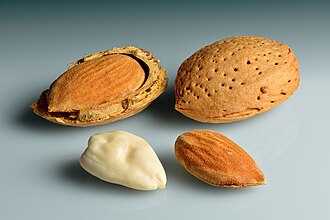
Photo: Wikipedia
Whole raw almonds are the unroasted, unblanched seeds of the almond tree, prized for their firm, satisfying crunch and subtly sweet, nutty flavor. Nutritionally, they are a powerhouse, delivering a remarkable amount of healthy monounsaturated fats and plant-based protein in a compact, fiber-rich package.
Calorie split: 14% protein · 13% carbs · 73% fat
↓ Full nutrition💚 Why it's loved
People adore almonds for their versatile, mild sweetness that pairs beautifully with both sweet and savory dishes, from salads to chocolates. Their satisfying crunch and long shelf life make them the ultimate convenient, nutrient-dense snack.
⚠️ Watch-outs & how to enjoy it better
As a common tree nut, almonds are a major allergen and must be strictly avoided by those with allergies. Their high fat and calorie density means portion control is essential for weight management, and their phytic acid content can slightly reduce mineral absorption; soaking or sprouting can help mitigate this.
Key benefits
- Excellent source of heart-healthy monounsaturated fats
- High in plant-based protein for satiety and muscle support
- Rich in fiber to aid digestion and promote fullness
- Provides key minerals like magnesium and vitamin E
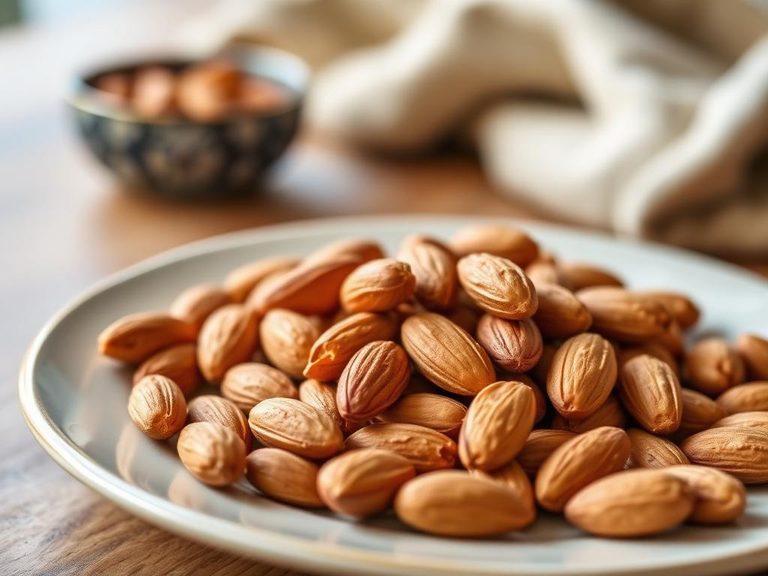
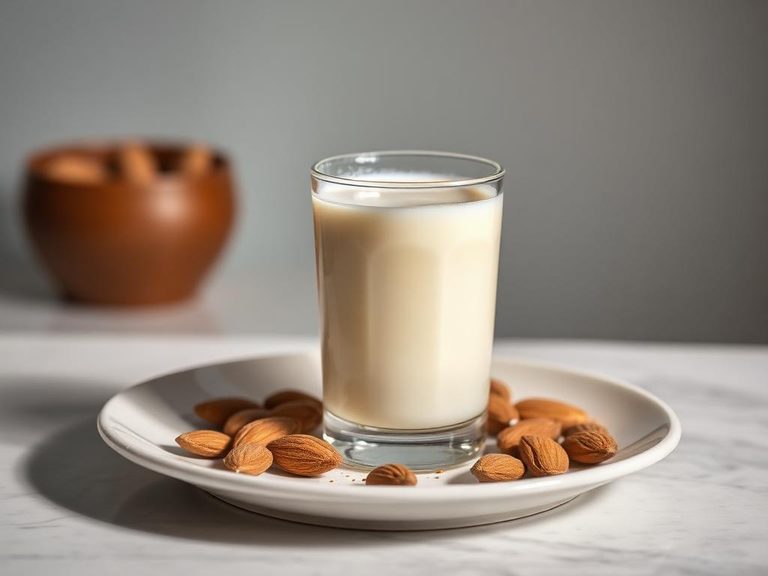
🍽️ Popular dishes




🌍 Where it's eaten
💡 Did you know?
The almond is not a true nut but a drupe seed, closely related to peaches and plums, and its cultivation dates back over 4,000 years to the Levant region.
Full nutrition (USDA data · scales with serving)
| Water | 4.3 g |
| Energy (Atwater General Factors) | 626 kcal |
| Energy (Atwater Specific Factors) | 584 kcal |
| Nitrogen | 4.1 g |
| Protein | 21.5 g |
| Total lipid (fat) | 51.1 g |
| Ash | 3.2 g |
| Carbohydrate, by difference | 20.0 g |
| Fiber, total dietary | 10.8 g |
| Calcium, Ca | 254 mg |
| Iron, Fe | 3.7 mg |
| Magnesium, Mg | 258 mg |
| Phosphorus, P | 503 mg |
| Potassium, K | 733 mg |
| Sodium, Na | 0.00 mg |
| Zinc, Zn | 2.9 mg |
| Copper, Cu | 0.91 mg |
| Manganese, Mn | 2.1 mg |
| Molybdenum, Mo | 45.3 ug |
| Thiamin | 0.16 mg |
| Niacin | 3.8 mg |
| Vitamin B-6 | 0.10 mg |
| Biotin | 57.0 ug |
| Vitamin K (phylloquinone) | 0.00 ug |
| Vitamin K (Dihydrophylloquinone) | 0.00 ug |
| Vitamin K (Menaquinone-4) | 0.00 ug |
Fat & fatty acid profile (per 100g)
| Fatty acids, total saturated | 3.8 g |
| Fatty acids, total monounsaturated | 31.3 g |
| Fatty acids, total polyunsaturated | 11.2 g |
Amino acid profile (per 100g)
| Tryptophan | 0.21 g |
| Threonine | 0.61 g |
| Isoleucine | 0.77 g |
| Leucine | 1.5 g |
| Lysine | 0.62 g |
| Methionine | 0.15 g |
| Phenylalanine | 1.2 g |
| Tyrosine | 0.63 g |
| Valine | 0.92 g |
| Arginine | 2.5 g |
| Histidine | 0.55 g |
| Alanine | 0.98 g |
| Aspartic acid | 2.4 g |
| Glutamic acid | 4.2 g |
| Glycine | 1.4 g |
| Proline | 1.3 g |
| Serine | 0.99 g |
| Hydroxyproline | 0.00 g |
| Cysteine | 0.50 g |
FAQ
Are raw almonds safe to eat?
In the United States, commercially sold 'raw' almonds are actually pasteurized for food safety, though they are not roasted. They retain their raw nutritional profile and texture.
What's the difference between raw and roasted almonds?
Roasting enhances flavor and crunch through browning reactions but can slightly reduce heat-sensitive nutrients. Raw almonds have a milder taste and firmer texture.
How should I store almonds?
To prevent their oils from going rancid, store almonds in an airtight container in a cool, dark place for up to 6 months, or refrigerate/freeze them for up to a year.
Nutrient density (calculated · NRF9.3)
Nutrient Rich Foods index: beneficial nutrients (protein, fiber, vitamins, minerals) minus saturated fat, added sugar & sodium, per 100 kcal.
NRF9.3 index — Fulgoni, Keast & Drewnowski, 2009. Computed from USDA nutrients.
Weight-loss friendliness (composite index)
Energy density 6.26 kcal/g · 14% calories from protein · 10.8 g fiber · 0.0 g sugar per 100 g.
Composite of energy density (Rolls et al., 1999), protein & fiber satiety, minus sugar. A calculated heuristic — ranks satiety-per-calorie, not a clinical measure.
Dietary load (calculated from USDA values)
Potential renal acid load. Positive = acid-forming, negative = alkaline-forming.
Sodium-to-potassium ratio: 0.00 (lower is better — aim for ≤ 1)
Sodium:potassium per WHO potassium guidance. Computed from USDA nutrients.