

Fast foods, submarine sandwich, ham on white bread with lettuce and tomato
Whole food · Fast Foods

Photo: Wikipedia
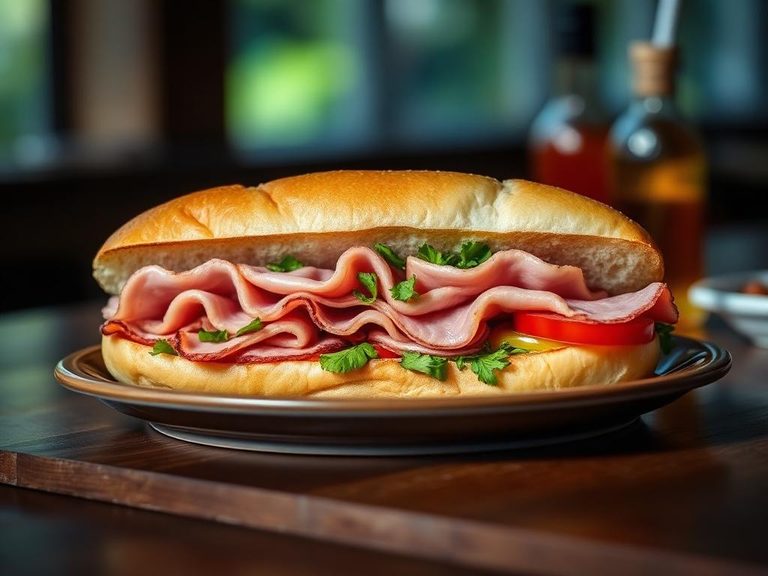
A classic submarine sandwich, often called a 'sub' or 'hoagie', features soft white bread filled with savory ham, crisp lettuce, and juicy tomato. At just 151 kcal per 100g, it's a surprisingly light yet satisfying option, with a notable protein boost from the ham. The texture is a delightful contrast between the pillowy bread and the fresh, crunchy vegetables.
Calorie split: 24% protein · 61% carbs · 15% fat
↓ Full nutrition💚 Why it's loved
People love this sandwich for its perfect balance of salty, savory ham and the fresh, clean taste of lettuce and tomato, all held together by soft bread. It's a universally recognized, portable meal that feels both comforting and light, fitting seamlessly into a busy lunch routine.
⚠️ Watch-outs & how to enjoy it better
The white bread and processed ham can lead to a rapid blood-sugar spike and are often high in sodium, which may concern those monitoring blood pressure or blood sugar. To counteract this, pair it with a side of avocado or a handful of nuts to add healthy fats and slow digestion, or choose a whole-grain bread option if available.
Key benefits
- Good source of lean protein from ham
- Low in fat per 100g serving
- Provides quick energy from carbohydrates
- Contains dietary fiber from lettuce and tomato
- Refreshing and hydrating due to high water content in vegetables
🍽️ Popular dishes


🌍 Where it's eaten
💡 Did you know?
The term 'submarine sandwich' is believed to have originated during World War II, when American sailors likened the long, cylindrical shape of the sandwich to the submarines they served on.
Full nutrition (USDA data · scales with serving)
| Water | 63.3 g |
| Energy | 151 kcal |
| Energy | 631 kj |
| Protein | 9.1 g |
| Total lipid (fat) | 2.5 g |
| Ash | 2.2 g |
| Carbohydrate, by difference | 22.9 g |
| Fiber, total dietary | 1.3 g |
| Total Sugars | 3.5 g |
| Sucrose | 0.00 g |
| Glucose | 1.5 g |
| Fructose | 1.3 g |
| Lactose | 0.00 g |
| Maltose | 0.69 g |
| Galactose | 0.00 g |
| Starch | 17.3 g |
| Calcium, Ca | 169 mg |
| Iron, Fe | 1.8 mg |
| Magnesium, Mg | 20.0 mg |
| Phosphorus, P | 116 mg |
| Potassium, K | 367 mg |
| Sodium, Na | 396 mg |
| Zinc, Zn | 0.88 mg |
| Copper, Cu | 0.08 mg |
| Manganese, Mn | 0.30 mg |
| Selenium, Se | 17.3 ug |
| Vitamin C, total ascorbic acid | 0.90 mg |
| Thiamin | 0.38 mg |
| Riboflavin | 0.24 mg |
| Niacin | 4.2 mg |
| Pantothenic acid | 0.43 mg |
| Vitamin B-6 | 0.17 mg |
| Folate, total | 72.0 ug |
| Folic acid | 54.0 ug |
| Folate, food | 17.0 ug |
| Folate, DFE | 109 ug |
| Choline, total | 33.2 mg |
| Vitamin B-12 | 0.12 ug |
| Vitamin B-12, added | 0.00 ug |
| Vitamin A, RAE | 2.0 ug |
| Retinol | 0.00 ug |
| Carotene, beta | 25.0 ug |
| Carotene, alpha | 0.00 ug |
| Cryptoxanthin, beta | 0.00 ug |
| Vitamin A, IU | 41.0 iu |
| Lycopene | 167 ug |
| Lutein + zeaxanthin | 76.0 ug |
| Vitamin E (alpha-tocopherol) | 0.29 mg |
| Vitamin E, added | 0.00 mg |
| Tocopherol, beta | 0.08 mg |
| Tocopherol, gamma | 0.46 mg |
| Tocopherol, delta | 0.13 mg |
| Tocotrienol, alpha | 0.02 mg |
| Tocotrienol, beta | 0.36 mg |
| Tocotrienol, gamma | 0.00 mg |
| Tocotrienol, delta | 0.00 mg |
| Vitamin D (D2 + D3), International Units | 9.0 iu |
| Vitamin D (D2 + D3) | 0.20 ug |
| Vitamin K (phylloquinone) | 4.7 ug |
| Alcohol, ethyl | 0.00 g |
| Caffeine | 0.00 mg |
| Theobromine | 0.00 mg |
Fat & fatty acid profile (per 100g)
| Fatty acids, total saturated | 0.63 g |
| SFA 4:0 | 0.00 g |
| SFA 6:0 | 0.00 g |
| SFA 8:0 | 0.00 g |
| SFA 10:0 | 0.00 g |
| SFA 12:0 | 0.00 g |
| SFA 14:0 | 0.01 g |
| SFA 15:0 | 0.00 g |
| SFA 16:0 | 0.43 g |
| SFA 17:0 | 0.00 g |
| SFA 18:0 | 0.16 g |
| SFA 20:0 | 0.01 g |
| SFA 22:0 | 0.01 g |
| SFA 24:0 | 0.00 g |
| Fatty acids, total monounsaturated | 0.76 g |
| MUFA 14:1 | 0.00 g |
| MUFA 15:1 | 0.00 g |
| MUFA 16:1 | 0.04 g |
| MUFA 16:1 c | 0.04 g |
| MUFA 17:1 | 0.00 g |
| MUFA 18:1 | 0.71 g |
| MUFA 18:1 c | 0.70 g |
| MUFA 20:1 | 0.01 g |
| MUFA 22:1 | 0.00 g |
| MUFA 22:1 c | 0.00 g |
| MUFA 24:1 c | 0.00 g |
| Fatty acids, total polyunsaturated | 0.83 g |
| PUFA 18:2 | 0.73 g |
| PUFA 18:2 n-6 c,c | 0.73 g |
| PUFA 18:2 CLAs | 0.00 g |
| PUFA 18:3 | 0.07 g |
| PUFA 18:3 n-3 c,c,c (ALA) | 0.06 g |
| PUFA 18:3 n-6 c,c,c | 0.00 g |
| PUFA 18:3i | 0.00 g |
| PUFA 18:4 | 0.00 g |
| PUFA 20:2 n-6 c,c | 0.01 g |
| PUFA 20:3 | 0.01 g |
| PUFA 20:3 n-3 | 0.00 g |
| PUFA 20:3 n-6 | 0.00 g |
| PUFA 20:4 | 0.01 g |
| PUFA 20:5 n-3 (EPA) | 0.00 g |
| PUFA 22:4 | 0.01 g |
| PUFA 22:5 n-3 (DPA) | 0.00 g |
| PUFA 22:6 n-3 (DHA) | 0.00 g |
| Fatty acids, total trans | 0.01 g |
| Fatty acids, total trans-monoenoic | 0.01 g |
| TFA 16:1 t | 0.00 g |
| TFA 18:1 t | 0.01 g |
| TFA 22:1 t | 0.00 g |
| TFA 18:2 t not further defined | 0.01 g |
| Fatty acids, total trans-polyenoic | 0.01 g |
| Cholesterol | 12.0 mg |
Amino acid profile (per 100g)
Estimated from Fast foods, english muffin, with egg, cheese, and sausage — USDA does not publish this profile for Fast foods.
| Tryptophan | 0.16 g |
| Threonine | 0.52 g |
| Isoleucine | 0.54 g |
| Leucine | 0.98 g |
| Lysine | 0.75 g |
| Methionine | 0.29 g |
| Cystine | 0.20 g |
| Phenylalanine | 0.59 g |
| Tyrosine | 0.41 g |
| Valine | 0.65 g |
| Arginine | 0.65 g |
| Histidine | 0.33 g |
| Alanine | 0.60 g |
| Aspartic acid | 1.1 g |
| Glutamic acid | 2.5 g |
| Glycine | 0.54 g |
| Proline | 0.90 g |
| Serine | 0.70 g |
FAQ
Is this sandwich a good source of protein?
Yes, with 9.12g of protein per 100g, it provides a solid protein boost, mainly from the ham, which supports muscle maintenance and satiety.
How does the fiber content affect digestion?
The 1.3g of fiber per 100g, primarily from the lettuce and tomato, aids in digestion and helps promote a feeling of fullness, though it's not a high-fiber meal on its own.
Is this a low-fat option?
At 2.53g of fat per 100g, it is relatively low in fat, making it a lighter choice compared to many other fast-food sandwiches that may include cheese, mayo, or higher-fat meats.
Nutrient density (calculated · NRF9.3)
Nutrient Rich Foods index: beneficial nutrients (protein, fiber, vitamins, minerals) minus saturated fat, added sugar & sodium, per 100 kcal.
NRF9.3 index — Fulgoni, Keast & Drewnowski, 2009. Computed from USDA nutrients.
Weight-loss friendliness (composite index)
Energy density 1.51 kcal/g · 24% calories from protein · 1.3 g fiber · 3.5 g sugar per 100 g.
Composite of energy density (Rolls et al., 1999), protein & fiber satiety, minus sugar. A calculated heuristic — ranks satiety-per-calorie, not a clinical measure.
Dietary load (calculated from USDA values)
Potential renal acid load. Positive = acid-forming, negative = alkaline-forming.
Sodium-to-potassium ratio: 1.08 (lower is better — aim for ≤ 1)
Sodium:potassium per WHO potassium guidance. Computed from USDA nutrients.