

Fast foods, hamburger; single, regular patty; plain
Whole food · Fast Foods
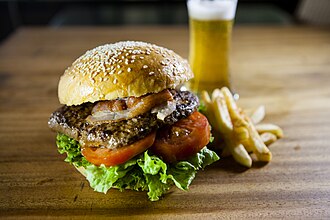
Photo: Wikipedia
A plain hamburger is the fundamental building block of American fast food: a single, unadorned beef patty nestled in a soft bun. Its appeal lies in the pure, savory flavor of the grilled beef and the simple contrast of textures between the tender patty and the pillowy bread. Nutritionally, it offers a concentrated source of protein and energy, with a moderate fat content that defines its classic taste.
Calorie split: 22% protein · 42% carbs · 36% fat
↓ Full nutrition💚 Why it's loved
People love the plain hamburger for its straightforward, satisfying umami flavor and the comforting ritual of a quick, hot meal. It's a cultural icon of convenience, representing a no-fuss, customizable canvas that can be dressed up or enjoyed in its purest form.
⚠️ Watch-outs & how to enjoy it better
The plain patty can be high in saturated fat and sodium, which may be a concern for heart health or blood pressure. To counteract, choose leaner beef blends (e.g., 90/10), limit added salt during cooking, and pair it with a large side salad or steamed vegetables to add fiber and volume without excess calories.
Key benefits
- Provides a complete protein source for muscle maintenance.
- Offers a quick, calorie-dense energy source.
- Contains essential nutrients like iron, zinc, and B12 from beef.
- Serves as a simple, familiar base for customization.
🍽️ Popular dishes




🌍 Where it's eaten
💡 Did you know?
The term 'hamburger' is named after Hamburg, Germany, where a similar minced beef preparation called 'Hamburg steak' was popular before immigrants brought the concept to the United States.
Full nutrition (USDA data · scales with serving)
| Water | 38.5 g |
| Energy | 297 kcal |
| Energy | 1245 kj |
| Protein | 16.5 g |
| Total lipid (fat) | 12.0 g |
| Ash | 1.5 g |
| Carbohydrate, by difference | 31.5 g |
| Fiber, total dietary | 1.7 g |
| Total Sugars | 4.9 g |
| Sucrose | 0.00 g |
| Glucose | 2.0 g |
| Fructose | 2.3 g |
| Lactose | 0.00 g |
| Maltose | 0.57 g |
| Galactose | 0.00 g |
| Starch | 22.9 g |
| Calcium, Ca | 62.0 mg |
| Iron, Fe | 3.1 mg |
| Magnesium, Mg | 27.0 mg |
| Phosphorus, P | 134 mg |
| Potassium, K | 197 mg |
| Sodium, Na | 331 mg |
| Zinc, Zn | 2.5 mg |
| Copper, Cu | 0.12 mg |
| Manganese, Mn | 0.36 mg |
| Selenium, Se | 20.3 ug |
| Vitamin C, total ascorbic acid | 0.00 mg |
| Thiamin | 0.32 mg |
| Riboflavin | 0.36 mg |
| Niacin | 5.6 mg |
| Pantothenic acid | 0.53 mg |
| Vitamin B-6 | 0.21 mg |
| Folate, total | 80.0 ug |
| Folic acid | 29.0 ug |
| Folate, food | 51.0 ug |
| Folate, DFE | 100 ug |
| Choline, total | 34.4 mg |
| Vitamin B-12 | 0.89 ug |
| Vitamin B-12, added | 0.00 ug |
| Vitamin A, RAE | 9.0 ug |
| Retinol | 8.0 ug |
| Carotene, beta | 15.0 ug |
| Carotene, alpha | 0.00 ug |
| Cryptoxanthin, beta | 1.0 ug |
| Vitamin A, IU | 51.0 iu |
| Lycopene | 5.0 ug |
| Lutein + zeaxanthin | 38.0 ug |
| Vitamin E (alpha-tocopherol) | 0.38 mg |
| Vitamin E, added | 0.00 mg |
| Tocopherol, beta | 0.08 mg |
| Tocopherol, gamma | 0.91 mg |
| Tocopherol, delta | 0.19 mg |
| Tocotrienol, alpha | 0.03 mg |
| Tocotrienol, beta | 0.61 mg |
| Tocotrienol, gamma | 0.00 mg |
| Tocotrienol, delta | 0.00 mg |
| Vitamin D (D2 + D3), International Units | 2.0 iu |
| Vitamin D (D2 + D3) | 0.10 ug |
| Vitamin K (phylloquinone) | 4.9 ug |
| Alcohol, ethyl | 0.00 g |
| Caffeine | 0.00 mg |
| Theobromine | 0.00 mg |
Fat & fatty acid profile (per 100g)
| Fatty acids, total saturated | 4.5 g |
| SFA 4:0 | 0.00 g |
| SFA 6:0 | 0.00 g |
| SFA 8:0 | 0.00 g |
| SFA 10:0 | 0.01 g |
| SFA 12:0 | 0.01 g |
| SFA 14:0 | 0.28 g |
| SFA 15:0 | 0.05 g |
| SFA 16:0 | 2.4 g |
| SFA 17:0 | 0.12 g |
| SFA 18:0 | 1.6 g |
| SFA 20:0 | 0.02 g |
| SFA 22:0 | 0.01 g |
| SFA 24:0 | 0.01 g |
| Fatty acids, total monounsaturated | 4.8 g |
| MUFA 14:1 | 0.08 g |
| MUFA 15:1 | 0.00 g |
| MUFA 16:1 | 0.32 g |
| MUFA 16:1 c | 0.28 g |
| MUFA 17:1 | 0.08 g |
| MUFA 18:1 | 4.3 g |
| MUFA 18:1 c | 3.9 g |
| MUFA 20:1 | 0.04 g |
| MUFA 22:1 | 0.00 g |
| MUFA 22:1 c | 0.00 g |
| MUFA 24:1 c | 0.00 g |
| Fatty acids, total polyunsaturated | 1.7 g |
| PUFA 18:2 | 1.5 g |
| PUFA 18:2 n-6 c,c | 1.4 g |
| PUFA 18:2 CLAs | 0.05 g |
| PUFA 18:3 | 0.13 g |
| PUFA 18:3 n-3 c,c,c (ALA) | 0.12 g |
| PUFA 18:3 n-6 c,c,c | 0.00 g |
| PUFA 18:3i | 0.00 g |
| PUFA 18:4 | 0.00 g |
| PUFA 20:2 n-6 c,c | 0.00 g |
| PUFA 20:3 | 0.01 g |
| PUFA 20:3 n-3 | 0.00 g |
| PUFA 20:3 n-6 | 0.01 g |
| PUFA 20:4 | 0.02 g |
| PUFA 20:5 n-3 (EPA) | 0.01 g |
| PUFA 22:4 | 0.00 g |
| PUFA 22:5 n-3 (DPA) | 0.01 g |
| PUFA 22:6 n-3 (DHA) | 0.00 g |
| Fatty acids, total trans | 0.51 g |
| Fatty acids, total trans-monoenoic | 0.45 g |
| TFA 16:1 t | 0.03 g |
| TFA 18:1 t | 0.42 g |
| TFA 22:1 t | 0.00 g |
| TFA 18:2 t not further defined | 0.06 g |
| Fatty acids, total trans-polyenoic | 0.06 g |
| Cholesterol | 33.0 mg |
Amino acid profile (per 100g)
| Tryptophan | 0.14 g |
| Threonine | 0.46 g |
| Isoleucine | 0.64 g |
| Leucine | 1.1 g |
| Lysine | 0.79 g |
| Methionine | 0.31 g |
| Phenylalanine | 0.67 g |
| Tyrosine | 0.37 g |
| Valine | 0.73 g |
| Arginine | 0.85 g |
| Histidine | 0.40 g |
| Alanine | 0.79 g |
| Aspartic acid | 1.1 g |
| Glutamic acid | 3.6 g |
| Glycine | 0.89 g |
| Proline | 1.7 g |
| Serine | 0.63 g |
| Hydroxyproline | 0.24 g |
FAQ
Is a plain hamburger a good source of protein?
Yes. A typical 118g plain hamburger patty provides about 16-20g of high-quality, complete protein, which is essential for building and repairing tissues.
How does the nutrition of a plain hamburger compare to a cheeseburger?
Adding a single slice of American cheese increases the calories by about 50-70, adds 4-5g of fat (mostly saturated), and boosts sodium and calcium content significantly.
Can I make a healthier plain hamburger at home?
Absolutely. Use lean ground beef (90% lean or higher), turkey, or plant-based patties. Grill or broil instead of frying, use a whole-wheat bun, and skip high-sugar condiments.
Nutrient density (calculated · NRF9.3)
Nutrient Rich Foods index: beneficial nutrients (protein, fiber, vitamins, minerals) minus saturated fat, added sugar & sodium, per 100 kcal.
NRF9.3 index — Fulgoni, Keast & Drewnowski, 2009. Computed from USDA nutrients.
Weight-loss friendliness (composite index)
Energy density 2.97 kcal/g · 22% calories from protein · 1.7 g fiber · 4.9 g sugar per 100 g.
Composite of energy density (Rolls et al., 1999), protein & fiber satiety, minus sugar. A calculated heuristic — ranks satiety-per-calorie, not a clinical measure.
Dietary load (calculated from USDA values)
Potential renal acid load. Positive = acid-forming, negative = alkaline-forming.
Sodium-to-potassium ratio: 1.68 (lower is better — aim for ≤ 1)
Sodium:potassium per WHO potassium guidance. Computed from USDA nutrients.