

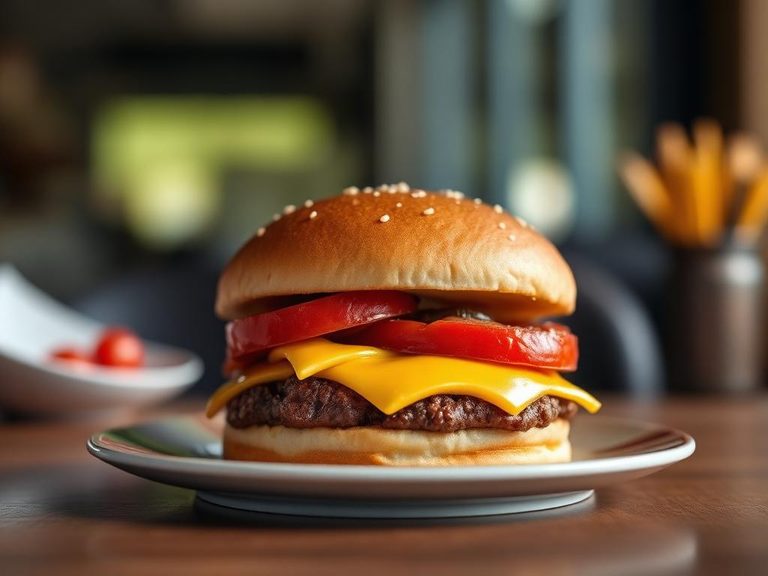
Fast foods, cheeseburger; single, regular patty; plain
Whole food · Fast Foods
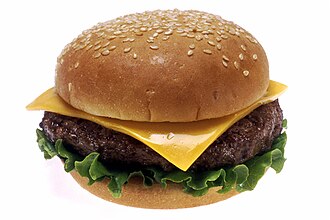
Photo: Wikipedia
A plain cheeseburger is a foundational fast-food staple: a single, regular beef patty topped with a slice of American cheese, served on a soft, toasted bun without any condiments or vegetables. Its appeal lies in the simple, savory interplay of juicy, seasoned beef and melted, salty cheese against the mild, slightly sweet bread. Nutritionally, it provides a solid hit of protein (16.51g) and calories (308 kcal) for its size, making it a dense source of energy.
Calorie split: 21% protein · 36% carbs · 43% fat
↓ Full nutrition💚 Why it's loved
People love it for its uncomplicated, satisfying flavor—the pure, savory umami of beef and cheese without distraction. It’s a versatile canvas, a cultural icon of American fast food, and a reliable comfort food that delivers on its promise of simple, hearty satisfaction.
⚠️ Watch-outs & how to enjoy it better
It can be high in sodium and saturated fat, which may concern those monitoring heart health or blood pressure. The refined white bun can cause a rapid blood-sugar spike. To counteract this, pair it with a side salad or non-starchy vegetables for fiber, and consider removing the top bun to reduce refined carbohydrate intake. Those with dairy or gluten allergies must obviously avoid it.
Key benefits
- Excellent source of complete protein for muscle maintenance.
- Provides a quick, dense source of calories and energy.
- Contains essential nutrients like iron, zinc, and B12 from beef.
- Simple ingredient list can be easier for those with multiple food sensitivities.
- The cheese adds calcium and additional protein.
🍽️ Popular dishes

🌍 Where it's eaten
💡 Did you know?
The term 'cheeseburger' was trademarked in 1935 by Louis Ballt of the Humpty Dumpty Drive-In in Denver, Colorado, though the concept of putting cheese on a hamburger existed earlier.
Full nutrition (USDA data · scales with serving)
| Water | 38.6 g |
| Energy | 308 kcal |
| Energy | 1290 kj |
| Protein | 16.5 g |
| Total lipid (fat) | 14.7 g |
| Ash | 2.1 g |
| Carbohydrate, by difference | 28.0 g |
| Fiber, total dietary | 2.0 g |
| Total Sugars | 4.9 g |
| Sucrose | 0.00 g |
| Glucose | 1.8 g |
| Fructose | 1.9 g |
| Lactose | 0.72 g |
| Maltose | 0.46 g |
| Galactose | 0.00 g |
| Starch | 19.9 g |
| Calcium, Ca | 119 mg |
| Iron, Fe | 2.7 mg |
| Magnesium, Mg | 26.0 mg |
| Phosphorus, P | 161 mg |
| Potassium, K | 196 mg |
| Sodium, Na | 515 mg |
| Zinc, Zn | 2.5 mg |
| Copper, Cu | 0.11 mg |
| Manganese, Mn | 0.32 mg |
| Selenium, Se | 19.6 ug |
| Vitamin C, total ascorbic acid | 0.00 mg |
| Thiamin | 0.29 mg |
| Riboflavin | 0.36 mg |
| Niacin | 5.2 mg |
| Pantothenic acid | 0.55 mg |
| Vitamin B-6 | 0.23 mg |
| Folate, total | 70.0 ug |
| Folic acid | 28.0 ug |
| Folate, food | 42.0 ug |
| Folate, DFE | 89.0 ug |
| Choline, total | 28.9 mg |
| Vitamin B-12 | 0.76 ug |
| Vitamin B-12, added | 0.00 ug |
| Vitamin A, RAE | 50.0 ug |
| Retinol | 45.0 ug |
| Carotene, beta | 61.0 ug |
| Carotene, alpha | 0.00 ug |
| Cryptoxanthin, beta | 2.0 ug |
| Vitamin A, IU | 254 iu |
| Lycopene | 0.00 ug |
| Lutein + zeaxanthin | 37.0 ug |
| Vitamin E (alpha-tocopherol) | 0.52 mg |
| Vitamin E, added | 0.00 mg |
| Tocopherol, beta | 0.08 mg |
| Tocopherol, gamma | 0.90 mg |
| Tocopherol, delta | 0.22 mg |
| Tocotrienol, alpha | 0.04 mg |
| Tocotrienol, beta | 0.50 mg |
| Tocotrienol, gamma | 0.00 mg |
| Tocotrienol, delta | 0.00 mg |
| Vitamin D (D2 + D3), International Units | 2.0 iu |
| Vitamin D (D2 + D3) | 0.10 ug |
| Vitamin K (phylloquinone) | 4.2 ug |
| Alcohol, ethyl | 0.00 g |
| Caffeine | 0.00 mg |
| Theobromine | 0.00 mg |
Fat & fatty acid profile (per 100g)
| Fatty acids, total saturated | 6.5 g |
| SFA 4:0 | 0.08 g |
| SFA 6:0 | 0.06 g |
| SFA 8:0 | 0.04 g |
| SFA 10:0 | 0.11 g |
| SFA 12:0 | 0.13 g |
| SFA 14:0 | 0.65 g |
| SFA 15:0 | 0.09 g |
| SFA 16:0 | 3.3 g |
| SFA 17:0 | 0.13 g |
| SFA 18:0 | 1.8 g |
| SFA 20:0 | 0.02 g |
| SFA 22:0 | 0.01 g |
| SFA 24:0 | 0.01 g |
| Fatty acids, total monounsaturated | 5.4 g |
| MUFA 14:1 | 0.11 g |
| MUFA 15:1 | 0.00 g |
| MUFA 16:1 | 0.36 g |
| MUFA 16:1 c | 0.32 g |
| MUFA 17:1 | 0.07 g |
| MUFA 18:1 | 4.8 g |
| MUFA 18:1 c | 4.4 g |
| MUFA 20:1 | 0.04 g |
| MUFA 22:1 | 0.00 g |
| MUFA 22:1 c | 0.00 g |
| MUFA 24:1 c | 0.00 g |
| Fatty acids, total polyunsaturated | 1.7 g |
| PUFA 18:2 | 1.5 g |
| PUFA 18:2 n-6 c,c | 1.3 g |
| PUFA 18:2 CLAs | 0.06 g |
| PUFA 18:3 | 0.13 g |
| PUFA 18:3 n-3 c,c,c (ALA) | 0.13 g |
| PUFA 18:3 n-6 c,c,c | 0.01 g |
| PUFA 18:3i | 0.00 g |
| PUFA 18:4 | 0.00 g |
| PUFA 20:2 n-6 c,c | 0.00 g |
| PUFA 20:3 | 0.01 g |
| PUFA 20:3 n-3 | 0.00 g |
| PUFA 20:3 n-6 | 0.01 g |
| PUFA 20:4 | 0.03 g |
| PUFA 20:5 n-3 (EPA) | 0.01 g |
| PUFA 22:4 | 0.01 g |
| PUFA 22:5 n-3 (DPA) | 0.01 g |
| PUFA 22:6 n-3 (DHA) | 0.00 g |
| Fatty acids, total trans | 0.57 g |
| Fatty acids, total trans-monoenoic | 0.49 g |
| TFA 16:1 t | 0.04 g |
| TFA 18:1 t | 0.45 g |
| TFA 22:1 t | 0.00 g |
| TFA 18:2 t not further defined | 0.08 g |
| Fatty acids, total trans-polyenoic | 0.08 g |
| Cholesterol | 43.0 mg |
Amino acid profile (per 100g)
| Tryptophan | 0.15 g |
| Threonine | 0.57 g |
| Isoleucine | 0.76 g |
| Leucine | 1.3 g |
| Lysine | 0.78 g |
| Methionine | 0.38 g |
| Phenylalanine | 0.76 g |
| Tyrosine | 0.46 g |
| Valine | 0.88 g |
| Arginine | 0.89 g |
| Histidine | 0.45 g |
| Alanine | 0.87 g |
| Aspartic acid | 1.2 g |
| Glutamic acid | 4.0 g |
| Glycine | 0.91 g |
| Proline | 1.9 g |
| Serine | 0.72 g |
| Hydroxyproline | 0.29 g |
FAQ
Is a plain cheeseburger a good source of protein?
Yes, a single, regular patty cheeseburger provides about 16.5 grams of complete protein, which is roughly 30% of the daily value for an average adult. The protein comes from both the beef patty and the cheese.
How does the nutrition change if I add condiments?
Adding ketchup, mustard, mayo, or special sauces significantly increases sugar, sodium, and/or fat content. A plain version is the most controlled option for managing calorie and macronutrient intake.
Is the cheese primarily for flavor or nutrition?
It's primarily for flavor and texture, adding a salty, creamy, umami-rich layer. Nutritionally, it does contribute meaningful amounts of calcium, protein, and fat to the meal.
Nutrient density (calculated · NRF9.3)
Nutrient Rich Foods index: beneficial nutrients (protein, fiber, vitamins, minerals) minus saturated fat, added sugar & sodium, per 100 kcal.
NRF9.3 index — Fulgoni, Keast & Drewnowski, 2009. Computed from USDA nutrients.
Weight-loss friendliness (composite index)
Energy density 3.08 kcal/g · 21% calories from protein · 2.0 g fiber · 4.9 g sugar per 100 g.
Composite of energy density (Rolls et al., 1999), protein & fiber satiety, minus sugar. A calculated heuristic — ranks satiety-per-calorie, not a clinical measure.
Dietary load (calculated from USDA values)
Potential renal acid load. Positive = acid-forming, negative = alkaline-forming.
Sodium-to-potassium ratio: 2.63 (lower is better — aim for ≤ 1)
Sodium:potassium per WHO potassium guidance. Computed from USDA nutrients.