

Fast foods, biscuit, with crispy chicken fillet
Whole food · Fast Foods
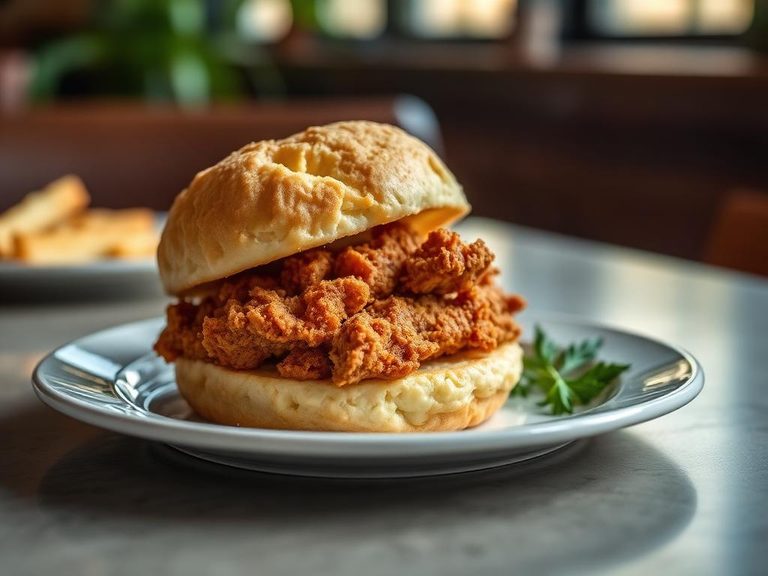
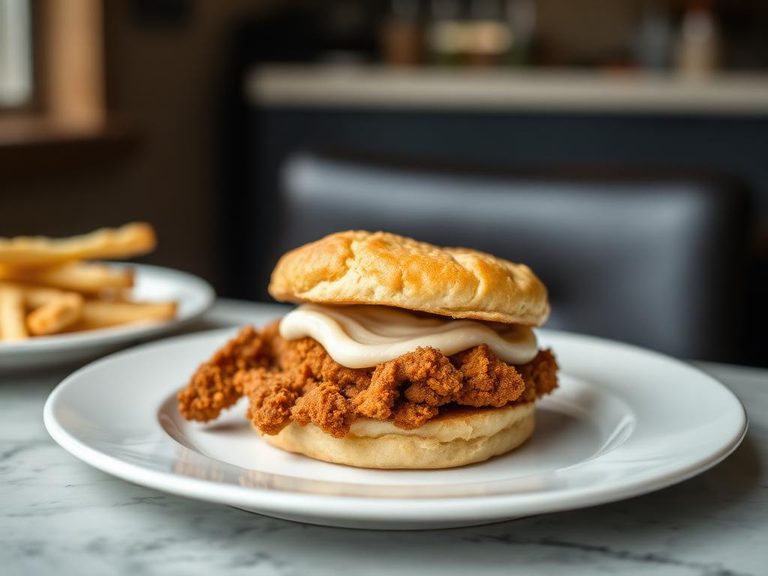
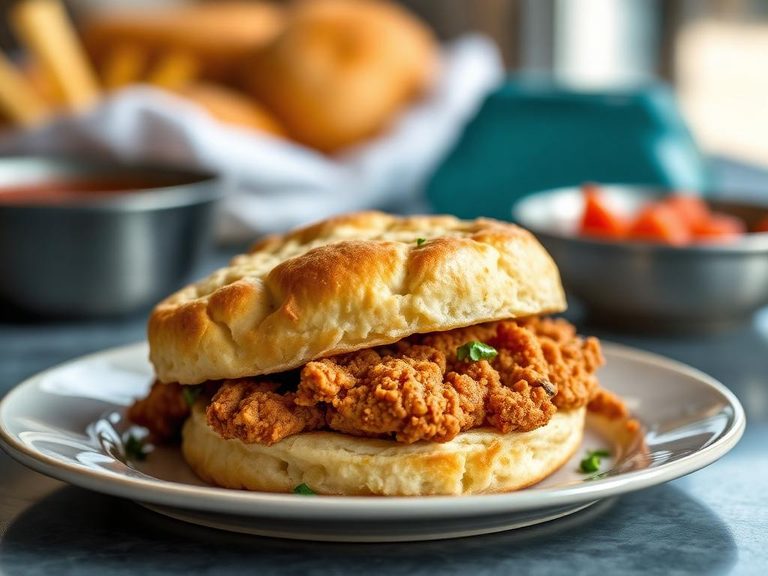
A golden-brown, flaky biscuit sandwiching a crispy, breaded chicken fillet, offering a satisfying crunch and savory, salty flavor. It's a classic fast-food staple, balancing a tender, juicy interior with a crunchy exterior, delivering a quick and hearty meal. Nutritionally, it provides a solid protein boost alongside a significant amount of carbohydrates and fats for energy.
Calorie split: 16% protein · 40% carbs · 44% fat
↓ Full nutrition💚 Why it's loved
People love it for the irresistible contrast between the buttery, flaky biscuit and the hot, crispy chicken, creating a comforting and indulgent experience. It's a beloved, nostalgic staple in American fast-food culture, representing a quick, hearty, and satisfying meal any time of day.
⚠️ Watch-outs & how to enjoy it better
The high sodium and fat content can contribute to water retention and is not ideal for those monitoring heart health or blood pressure. The refined carbohydrates in the biscuit can cause a rapid blood-sugar spike. To counteract, pair it with a side of fibrous vegetables or a simple salad, and be mindful of portion size by enjoying it as an occasional treat rather than a daily meal.
Key benefits
- Provides a complete protein source from the chicken fillet
- Offers a quick and convenient source of energy
- Satisfies cravings for a savory, crunchy, and salty flavor profile
- Contains some dietary fiber, though minimal
🍽️ Popular dishes

🌍 Where it's eaten
💡 Did you know?
The chicken biscuit is a cornerstone of the 'Southern breakfast' tradition, but its explosion as a nationwide fast-food phenomenon is largely credited to the marketing genius of chains like Chick-fil-A in the 1980s.
Full nutrition (USDA data · scales with serving)
| Water | 39.4 g |
| Energy | 300 kcal |
| Energy | 1255 kj |
| Protein | 11.9 g |
| Total lipid (fat) | 14.9 g |
| Ash | 3.2 g |
| Carbohydrate, by difference | 30.6 g |
| Fiber, total dietary | 1.4 g |
| Total Sugars | 2.6 g |
| Sucrose | 1.8 g |
| Glucose | 0.00 g |
| Fructose | 0.00 g |
| Lactose | 0.66 g |
| Maltose | 0.12 g |
| Galactose | 0.00 g |
| Starch | 25.3 g |
| Calcium, Ca | 44.0 mg |
| Iron, Fe | 1.8 mg |
| Magnesium, Mg | 18.0 mg |
| Phosphorus, P | 355 mg |
| Potassium, K | 206 mg |
| Sodium, Na | 868 mg |
| Zinc, Zn | 0.49 mg |
| Copper, Cu | 0.06 mg |
| Manganese, Mn | 0.24 mg |
| Selenium, Se | 10.1 ug |
| Vitamin C, total ascorbic acid | 0.70 mg |
| Thiamin | 0.25 mg |
| Riboflavin | 0.26 mg |
| Niacin | 4.8 mg |
| Vitamin B-6 | 0.21 mg |
| Folate, total | 64.0 ug |
| Folic acid | 36.0 ug |
| Folate, food | 27.0 ug |
| Folate, DFE | 89.0 ug |
| Choline, total | 22.3 mg |
| Vitamin B-12 | 0.15 ug |
| Vitamin B-12, added | 0.00 ug |
| Vitamin A, RAE | 10.0 ug |
| Retinol | 10.0 ug |
| Carotene, beta | 1.0 ug |
| Carotene, alpha | 0.00 ug |
| Cryptoxanthin, beta | 0.00 ug |
| Vitamin A, IU | 35.0 iu |
| Lycopene | 0.00 ug |
| Lutein + zeaxanthin | 42.0 ug |
| Vitamin E (alpha-tocopherol) | 1.9 mg |
| Vitamin E, added | 0.00 mg |
| Tocopherol, beta | 0.13 mg |
| Tocopherol, gamma | 2.0 mg |
| Tocopherol, delta | 0.31 mg |
| Tocotrienol, alpha | 0.65 mg |
| Tocotrienol, beta | 0.27 mg |
| Tocotrienol, gamma | 0.96 mg |
| Tocotrienol, delta | 0.00 mg |
| Vitamin D (D2 + D3), International Units | 4.0 iu |
| Vitamin D (D2 + D3) | 0.10 ug |
| Vitamin K (phylloquinone) | 6.6 ug |
| Vitamin K (Dihydrophylloquinone) | 0.00 ug |
| Vitamin K (Menaquinone-4) | 2.9 ug |
| Alcohol, ethyl | 0.00 g |
| Caffeine | 0.00 mg |
| Theobromine | 0.00 mg |
Fat & fatty acid profile (per 100g)
| Fatty acids, total saturated | 5.7 g |
| SFA 4:0 | 0.01 g |
| SFA 6:0 | 0.00 g |
| SFA 8:0 | 0.06 g |
| SFA 10:0 | 0.05 g |
| SFA 12:0 | 0.66 g |
| SFA 14:0 | 0.29 g |
| SFA 15:0 | 0.01 g |
| SFA 16:0 | 3.8 g |
| SFA 17:0 | 0.01 g |
| SFA 18:0 | 0.70 g |
| SFA 20:0 | 0.06 g |
| SFA 22:0 | 0.03 g |
| SFA 24:0 | 0.02 g |
| Fatty acids, total monounsaturated | 5.5 g |
| MUFA 14:1 | 0.00 g |
| MUFA 15:1 | 0.00 g |
| MUFA 16:1 | 0.04 g |
| MUFA 16:1 c | 0.04 g |
| MUFA 17:1 | 0.01 g |
| MUFA 18:1 | 5.3 g |
| MUFA 18:1 c | 5.3 g |
| MUFA 20:1 | 0.07 g |
| MUFA 22:1 | 0.01 g |
| MUFA 22:1 c | 0.00 g |
| MUFA 24:1 c | 0.01 g |
| Fatty acids, total polyunsaturated | 3.3 g |
| PUFA 18:2 | 3.0 g |
| PUFA 18:2 n-6 c,c | 3.0 g |
| PUFA 18:2 CLAs | 0.01 g |
| PUFA 18:3 | 0.21 g |
| PUFA 18:3 n-3 c,c,c (ALA) | 0.20 g |
| PUFA 18:3 n-6 c,c,c | 0.01 g |
| PUFA 18:3i | 0.00 g |
| PUFA 18:4 | 0.00 g |
| PUFA 20:2 n-6 c,c | 0.01 g |
| PUFA 20:3 | 0.01 g |
| PUFA 20:3 n-3 | 0.00 g |
| PUFA 20:3 n-6 | 0.01 g |
| PUFA 20:4 | 0.03 g |
| PUFA 20:5 n-3 (EPA) | 0.00 g |
| PUFA 22:4 | 0.01 g |
| PUFA 22:5 n-3 (DPA) | 0.00 g |
| PUFA 22:6 n-3 (DHA) | 0.00 g |
| Fatty acids, total trans | 0.07 g |
| Fatty acids, total trans-monoenoic | 0.04 g |
| TFA 16:1 t | 0.00 g |
| TFA 18:1 t | 0.04 g |
| TFA 22:1 t | 0.00 g |
| TFA 18:2 t not further defined | 0.03 g |
| Fatty acids, total trans-polyenoic | 0.03 g |
| Cholesterol | 24.0 mg |
Amino acid profile (per 100g)
Estimated from Fast foods, miniature cinnamon rolls — USDA does not publish this profile for Fast foods.
| Tryptophan | 0.05 g |
| Threonine | 0.22 g |
| Isoleucine | 0.28 g |
| Leucine | 0.51 g |
| Lysine | 0.18 g |
| Methionine | 0.11 g |
| Cystine | 0.16 g |
| Phenylalanine | 0.33 g |
| Tyrosine | 0.21 g |
| Valine | 0.33 g |
| Arginine | 0.26 g |
| Histidine | 0.16 g |
| Alanine | 0.25 g |
| Aspartic acid | 0.36 g |
| Glutamic acid | 2.2 g |
| Glycine | 0.25 g |
| Proline | 0.71 g |
| Serine | 0.37 g |
FAQ
Is a chicken biscuit a good source of protein?
Yes, it provides a substantial amount of protein from the chicken fillet, making it a satisfying option that can help with satiety.
Why is it so high in sodium?
The sodium comes from multiple sources: the seasoning in the chicken breading, the salt in the biscuit dough, and any added condiments. This is typical of many processed fast foods.
Can I make a healthier version at home?
Absolutely. You can bake the chicken instead of frying it, use a whole-wheat biscuit recipe, and add fresh herbs or spices for flavor instead of relying on salt.
Nutrient density (calculated · NRF9.3)
Nutrient Rich Foods index: beneficial nutrients (protein, fiber, vitamins, minerals) minus saturated fat, added sugar & sodium, per 100 kcal.
NRF9.3 index — Fulgoni, Keast & Drewnowski, 2009. Computed from USDA nutrients.
Weight-loss friendliness (composite index)
Energy density 3.00 kcal/g · 16% calories from protein · 1.4 g fiber · 2.6 g sugar per 100 g.
Composite of energy density (Rolls et al., 1999), protein & fiber satiety, minus sugar. A calculated heuristic — ranks satiety-per-calorie, not a clinical measure.
Dietary load (calculated from USDA values)
Potential renal acid load. Positive = acid-forming, negative = alkaline-forming.
Sodium-to-potassium ratio: 4.21 (lower is better — aim for ≤ 1)
Sodium:potassium per WHO potassium guidance. Computed from USDA nutrients.