

Chicken, broilers or fryers, dark meat, drumstick, meat and skin, cooked, braised
Whole food · Poultry Products
This is a classic, hearty cut of chicken, prized for its rich, savory flavor and satisfyingly tender, juicy texture. The dark meat, with its skin intact, offers a succulent bite that's more robust than white meat. Nutritionally, it's a powerhouse of protein and healthy fats, providing a substantial and filling meal.
Calorie split: 48% protein · 0% carbs · 52% fat
↓ Full nutrition💚 Why it's loved
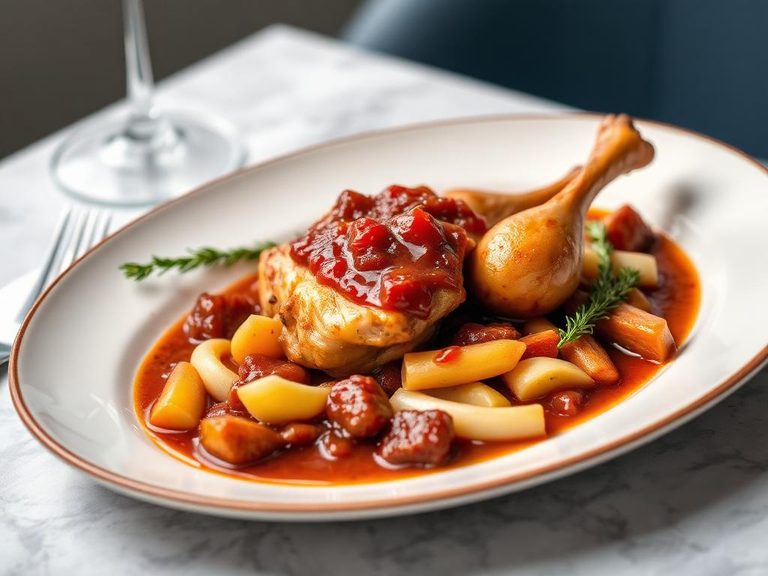
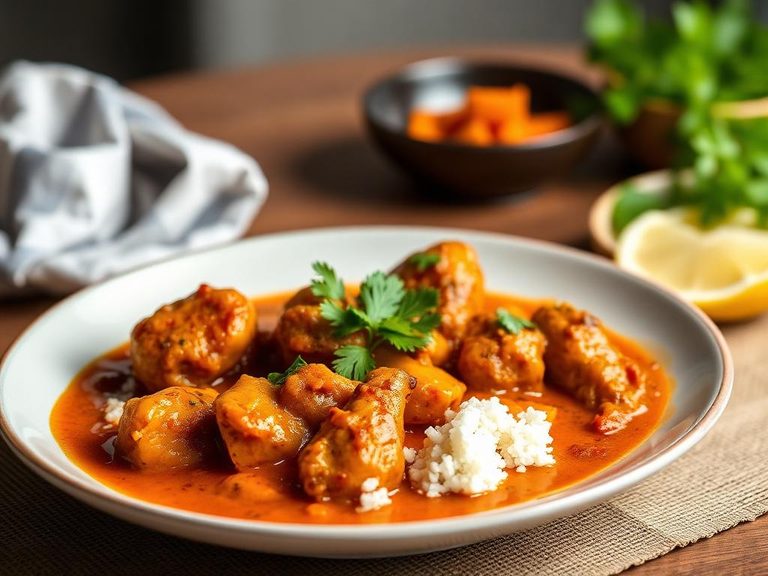
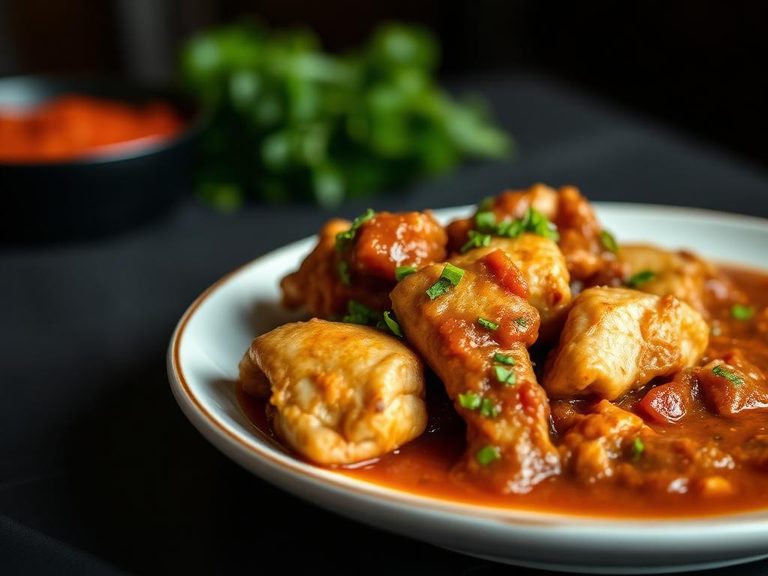
People adore the braised drumstick for its deep, savory flavor and fall-off-the-bone tenderness, a result of slow-cooking that breaks down connective tissue. It's a versatile comfort food, equally at home in a rustic stew, a spicy curry, or a simple roasted dinner, making it a beloved staple across countless cuisines.
⚠️ Watch-outs & how to enjoy it better
The skin significantly increases the saturated fat and calorie content, which may be a concern for those managing heart health or weight. For individuals watching sodium intake, common braising liquids like soy sauce or broth can add a lot. A practical tip is to remove the skin after cooking to reduce fat intake, or to braise with low-sodium broth and herbs for flavor.
Key benefits
- Excellent source of high-quality protein for muscle maintenance
- Rich in iron and zinc from the dark meat
- Provides healthy monounsaturated fats
- A good source of B vitamins, especially niacin
- The skin adds flavor and helps retain moisture during cooking
🍽️ Popular dishes


🌍 Where it's eaten
💡 Did you know?
Braising is a two-step cooking method (sear then simmer) that's perfect for drumsticks because it first creates a flavorful crust via the Maillard reaction, then uses moist heat to melt the collagen in the dark meat into gelatin, making it exceptionally tender.
Full nutrition (USDA data · scales with serving)
| Water | 66.3 g |
| Energy | 187 kcal |
| Energy | 784 kj |
| Protein | 22.7 g |
| Total lipid (fat) | 10.7 g |
| Ash | 0.93 g |
| Carbohydrate, by difference | 0.00 g |
| Fiber, total dietary | 0.00 g |
| Total Sugars | 0.00 g |
| Calcium, Ca | 12.0 mg |
| Iron, Fe | 0.94 mg |
| Magnesium, Mg | 21.0 mg |
| Phosphorus, P | 177 mg |
| Potassium, K | 229 mg |
| Sodium, Na | 111 mg |
| Zinc, Zn | 2.3 mg |
| Copper, Cu | 0.06 mg |
| Manganese, Mn | 0.02 mg |
| Selenium, Se | 26.4 ug |
| Vitamin C, total ascorbic acid | 0.00 mg |
| Thiamin | 0.08 mg |
| Riboflavin | 0.16 mg |
| Niacin | 4.8 mg |
| Pantothenic acid | 1.1 mg |
| Vitamin B-6 | 0.35 mg |
| Folate, total | 4.0 ug |
| Folic acid | 0.00 ug |
| Folate, food | 4.0 ug |
| Folate, DFE | 4.0 ug |
| Choline, total | 68.3 mg |
| Betaine | 11.3 mg |
| Vitamin B-12 | 0.41 ug |
| Vitamin B-12, added | 0.00 ug |
| Vitamin A, RAE | 12.0 ug |
| Retinol | 12.0 ug |
| Carotene, beta | 0.00 ug |
| Carotene, alpha | 0.00 ug |
| Cryptoxanthin, beta | 0.00 ug |
| Vitamin A, IU | 42.0 iu |
| Lycopene | 0.00 ug |
| Lutein + zeaxanthin | 13.0 ug |
| Vitamin E (alpha-tocopherol) | 0.17 mg |
| Vitamin E, added | 0.00 mg |
| Tocopherol, beta | 0.00 mg |
| Tocopherol, gamma | 0.09 mg |
| Tocopherol, delta | 0.00 mg |
| Tocotrienol, alpha | 0.01 mg |
| Tocotrienol, beta | 0.00 mg |
| Tocotrienol, gamma | 0.06 mg |
| Tocotrienol, delta | 0.00 mg |
| Vitamin D (D2 + D3), International Units | 2.0 iu |
| Vitamin D (D2 + D3) | 0.10 ug |
| Vitamin D3 (cholecalciferol) | 0.10 ug |
| Vitamin K (phylloquinone) | 0.30 ug |
| Alcohol, ethyl | 0.00 g |
| Caffeine | 0.00 mg |
| Theobromine | 0.00 mg |
Fat & fatty acid profile (per 100g)
| Fatty acids, total saturated | 2.9 g |
| SFA 4:0 | 0.00 g |
| SFA 6:0 | 0.00 g |
| SFA 8:0 | 0.00 g |
| SFA 10:0 | 0.00 g |
| SFA 12:0 | 0.01 g |
| SFA 14:0 | 0.06 g |
| SFA 15:0 | 0.01 g |
| SFA 16:0 | 2.3 g |
| SFA 17:0 | 0.01 g |
| SFA 18:0 | 0.58 g |
| SFA 20:0 | 0.01 g |
| SFA 22:0 | 0.01 g |
| SFA 24:0 | 0.00 g |
| Fatty acids, total monounsaturated | 4.5 g |
| MUFA 14:1 | 0.02 g |
| MUFA 15:1 | 0.00 g |
| MUFA 16:1 | 0.68 g |
| MUFA 16:1 c | 0.67 g |
| MUFA 17:1 | 0.01 g |
| MUFA 18:1 | 3.7 g |
| MUFA 18:1 c | 3.7 g |
| MUFA 20:1 | 0.05 g |
| MUFA 22:1 | 0.00 g |
| MUFA 22:1 c | 0.00 g |
| MUFA 24:1 c | 0.00 g |
| Fatty acids, total polyunsaturated | 2.2 g |
| PUFA 18:2 | 2.0 g |
| PUFA 18:2 n-6 c,c | 1.9 g |
| PUFA 18:2 CLAs | 0.01 g |
| PUFA 18:3 | 0.10 g |
| PUFA 18:3 n-3 c,c,c (ALA) | 0.09 g |
| PUFA 18:3 n-6 c,c,c | 0.01 g |
| PUFA 18:4 | 0.00 g |
| PUFA 20:2 n-6 c,c | 0.01 g |
| PUFA 20:3 | 0.03 g |
| PUFA 20:3 n-3 | 0.00 g |
| PUFA 20:3 n-6 | 0.03 g |
| PUFA 20:4 | 0.09 g |
| PUFA 20:5 n-3 (EPA) | 0.01 g |
| PUFA 22:4 | 0.02 g |
| PUFA 22:5 n-3 (DPA) | 0.01 g |
| PUFA 22:6 n-3 (DHA) | 0.01 g |
| Fatty acids, total trans | 0.06 g |
| Fatty acids, total trans-monoenoic | 0.04 g |
| TFA 16:1 t | 0.01 g |
| TFA 18:1 t | 0.03 g |
| TFA 22:1 t | 0.00 g |
| TFA 18:2 t not further defined | 0.02 g |
| Fatty acids, total trans-polyenoic | 0.02 g |
| Cholesterol | 132 mg |
Amino acid profile (per 100g)
| Tryptophan | 0.24 g |
| Threonine | 1.0 g |
| Isoleucine | 1.0 g |
| Leucine | 1.9 g |
| Lysine | 2.1 g |
| Methionine | 0.63 g |
| Cystine | 0.26 g |
| Phenylalanine | 0.89 g |
| Tyrosine | 0.83 g |
| Valine | 1.1 g |
| Arginine | 1.6 g |
| Histidine | 0.66 g |
| Alanine | 1.4 g |
| Aspartic acid | 2.2 g |
| Glutamic acid | 3.6 g |
| Glycine | 1.2 g |
| Proline | 0.98 g |
| Serine | 0.94 g |
FAQ
Is braised chicken drumstick healthy?
It's a nutritious source of protein, iron, and B vitamins. Its healthiness depends on preparation; keeping the skin adds flavor but also fat and calories. Using low-sodium liquids and pairing it with vegetables creates a balanced meal.
How do I know when it's fully cooked?
The most reliable method is using a meat thermometer. Insert it into the thickest part of the drumstick, avoiding the bone; it should read 165°F (74°C). The meat should also be opaque and pull away easily from the bone.
Can I use boneless, skinless chicken thighs for braising instead?
Yes, boneless, skinless thighs are a great substitute. They are also dark meat and will braise well, though the cooking time will be shorter. They will be slightly less rich in flavor without the bone and skin.
Nutrient density (calculated · NRF9.3)
Nutrient Rich Foods index: beneficial nutrients (protein, fiber, vitamins, minerals) minus saturated fat, added sugar & sodium, per 100 kcal.
NRF9.3 index — Fulgoni, Keast & Drewnowski, 2009. Computed from USDA nutrients.
Weight-loss friendliness (composite index)
Energy density 1.87 kcal/g · 49% calories from protein · 0.0 g fiber · 0.0 g sugar per 100 g.
Composite of energy density (Rolls et al., 1999), protein & fiber satiety, minus sugar. A calculated heuristic — ranks satiety-per-calorie, not a clinical measure.
Dietary load (calculated from USDA values)
Potential renal acid load. Positive = acid-forming, negative = alkaline-forming.
Sodium-to-potassium ratio: 0.48 (lower is better — aim for ≤ 1)
Sodium:potassium per WHO potassium guidance. Computed from USDA nutrients.