Spaghetti, with meatballs in tomato sauce, canned
Whole food · Meals, Entrees, and Side Dishes

Photo: Wikipedia
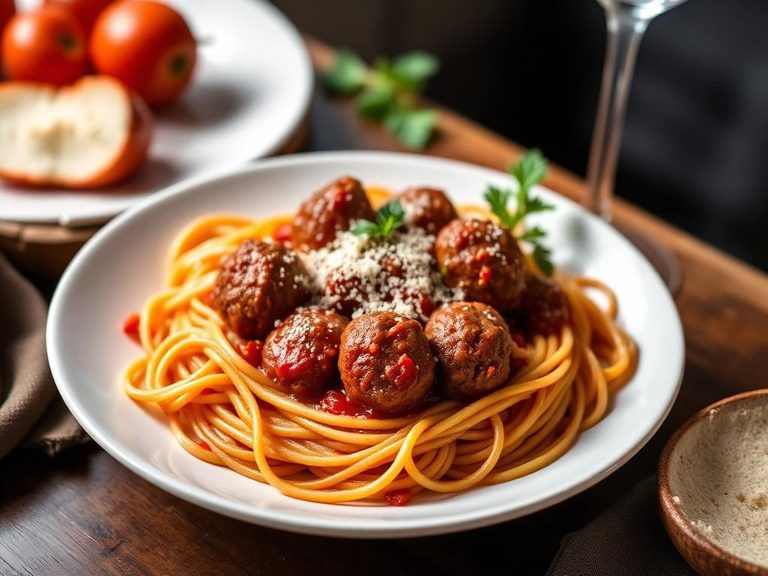
This is a classic canned convenience meal featuring soft wheat pasta, savory ground meatballs, and a tangy tomato sauce. The texture is uniformly soft, with the sauce providing a sweet and acidic balance to the savory meat. Nutritionally, it's a moderate source of protein and carbohydrates, with a notable 2.7g of fiber per 100g serving.
💚 Why it's loved
People love it for its comforting, familiar taste of savory meat and tangy tomato, evoking a sense of nostalgia and home-style cooking. It's also prized for its ultimate convenience as a ready-to-eat meal that requires only heating.
⚠️ Watch-outs & how to enjoy it better
The primary downside is often high sodium content from the canning process, which can contribute to water retention and is a concern for those managing blood pressure. The soft, processed texture may also lead to rapid consumption and less mindful eating. To counteract this, pair it with a fresh, crunchy side salad to add volume and slow down eating, and consider rinsing a portion of the sauce if sodium is a major concern.
Key benefits
- Provides a convenient, shelf-stable source of complete protein.
- Offers dietary fiber from both the pasta and tomato sauce.
- Contains lycopene, an antioxidant from cooked tomatoes.
- Serves as a quick, calorie-controlled meal option (100 kcal per 100g).
🍽️ Popular dishes
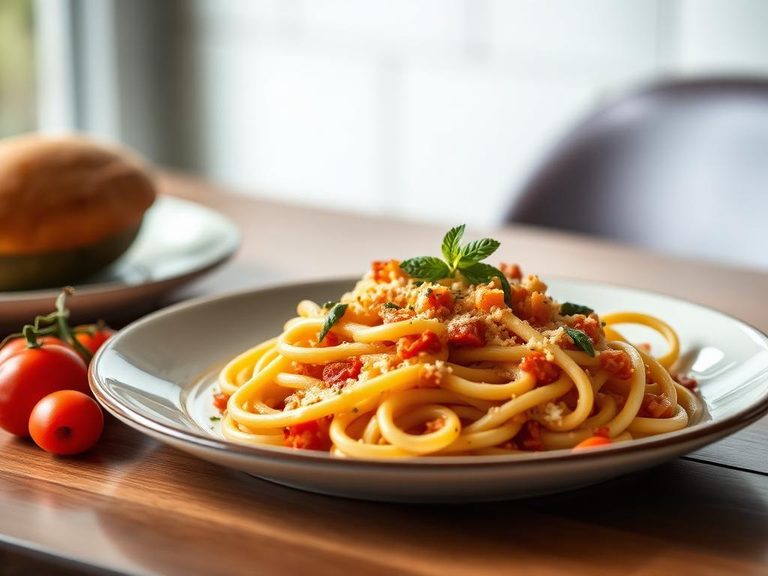
🌍 Where it's eaten
💡 Did you know?
The iconic pairing of spaghetti and meatballs is largely an Italian-American invention; in Italy, meatballs (polpette) are typically served as a separate main course, not on top of pasta.
Full nutrition (scales with serving)
| Water | 78.8 g |
| Energy | 100 kcal |
| Energy | 420 kj |
| Protein | 4.4 g |
| Total lipid (fat) | 4.1 g |
| Ash | 1.3 g |
| Carbohydrate, by difference | 11.4 g |
| Fiber, total dietary | 2.7 g |
| Total Sugars | 2.9 g |
| Sucrose | 0.34 g |
| Glucose | 1.3 g |
| Fructose | 1.3 g |
| Lactose | 0.00 g |
| Maltose | 0.00 g |
| Galactose | 0.00 g |
| Starch | 7.4 g |
| Calcium, Ca | 29.0 mg |
| Iron, Fe | 1.0 mg |
| Magnesium, Mg | 13.0 mg |
| Phosphorus, P | 57.0 mg |
| Potassium, K | 217 mg |
| Sodium, Na | 280 mg |
| Zinc, Zn | 0.51 mg |
| Copper, Cu | 0.05 mg |
| Manganese, Mn | 0.14 mg |
| Selenium, Se | 9.0 ug |
| Vitamin C, total ascorbic acid | 1.9 mg |
| Thiamin | 0.08 mg |
| Riboflavin | 0.07 mg |
| Niacin | 2.0 mg |
| Pantothenic acid | 0.29 mg |
| Vitamin B-6 | 0.07 mg |
| Folate, total | 20.0 ug |
| Folic acid | 13.0 ug |
| Folate, food | 8.0 ug |
| Folate, DFE | 29.0 ug |
| Choline, total | 10.5 mg |
| Betaine | 6.3 mg |
| Vitamin B-12 | 0.19 ug |
| Vitamin B-12, added | 0.00 ug |
| Vitamin A, RAE | 17.0 ug |
| Retinol | 5.0 ug |
| Carotene, beta | 141 ug |
| Carotene, alpha | 15.0 ug |
| Cryptoxanthin, beta | 0.00 ug |
| Vitamin A, IU | 264 iu |
| Lycopene | 3453 ug |
| Lutein + zeaxanthin | 78.0 ug |
| Vitamin E (alpha-tocopherol) | 0.50 mg |
| Vitamin E, added | 0.00 mg |
| Tocopherol, beta | 0.03 mg |
| Tocopherol, gamma | 0.10 mg |
| Tocopherol, delta | 0.00 mg |
| Tocotrienol, alpha | 0.02 mg |
| Tocotrienol, beta | 0.17 mg |
| Tocotrienol, gamma | 0.00 mg |
| Tocotrienol, delta | 0.00 mg |
| Vitamin D (D2 + D3), International Units | 8.0 iu |
| Vitamin D (D2 + D3) | 0.20 ug |
| Vitamin K (phylloquinone) | 1.8 ug |
| Vitamin K (Dihydrophylloquinone) | 0.80 ug |
| Vitamin K (Menaquinone-4) | 0.90 ug |
| Alcohol, ethyl | 0.00 g |
| Caffeine | 0.00 mg |
| Theobromine | 0.00 mg |
Fat & fatty acid profile (per 100g)
| Fatty acids, total saturated | 1.5 g |
| SFA 4:0 | 0.00 g |
| SFA 6:0 | 0.00 g |
| SFA 8:0 | 0.00 g |
| SFA 10:0 | 0.01 g |
| SFA 12:0 | 0.01 g |
| SFA 14:0 | 0.08 g |
| SFA 15:0 | 0.01 g |
| SFA 16:0 | 0.84 g |
| SFA 17:0 | 0.02 g |
| SFA 18:0 | 0.48 g |
| SFA 20:0 | 0.01 g |
| SFA 22:0 | 0.00 g |
| SFA 24:0 | 0.00 g |
| Fatty acids, total monounsaturated | 1.6 g |
| MUFA 14:1 | 0.01 g |
| MUFA 15:1 | 0.00 g |
| MUFA 16:1 | 0.10 g |
| MUFA 16:1 c | 0.10 g |
| MUFA 17:1 | 0.01 g |
| MUFA 18:1 | 1.5 g |
| MUFA 18:1 c | 1.4 g |
| MUFA 20:1 | 0.02 g |
| MUFA 22:1 | 0.00 g |
| MUFA 22:1 c | 0.00 g |
| MUFA 24:1 c | 0.00 g |
| Fatty acids, total polyunsaturated | 0.56 g |
| PUFA 18:2 | 0.51 g |
| PUFA 18:2 n-6 c,c | 0.48 g |
| PUFA 18:2 CLAs | 0.01 g |
| PUFA 18:3 | 0.02 g |
| PUFA 18:3 n-3 c,c,c (ALA) | 0.02 g |
| PUFA 18:3 n-6 c,c,c | 0.00 g |
| PUFA 18:4 | 0.00 g |
| PUFA 20:2 n-6 c,c | 0.01 g |
| PUFA 20:3 | 0.01 g |
| PUFA 20:3 n-3 | 0.00 g |
| PUFA 20:3 n-6 | 0.01 g |
| PUFA 20:4 | 0.01 g |
| PUFA 20:5 n-3 (EPA) | 0.00 g |
| PUFA 22:4 | 0.00 g |
| PUFA 22:5 n-3 (DPA) | 0.00 g |
| PUFA 22:6 n-3 (DHA) | 0.00 g |
| Fatty acids, total trans | 0.11 g |
| Fatty acids, total trans-monoenoic | 0.10 g |
| TFA 16:1 t | 0.01 g |
| TFA 18:1 t | 0.09 g |
| TFA 22:1 t | 0.00 g |
| TFA 18:2 t not further defined | 0.01 g |
| Fatty acids, total trans-polyenoic | 0.01 g |
| Cholesterol | 7.0 mg |
Amino acid profile (per 100g)
| Tryptophan | 0.03 g |
| Threonine | 0.12 g |
| Isoleucine | 0.12 g |
| Leucine | 0.27 g |
| Lysine | 0.13 g |
| Methionine | 0.07 g |
| Cystine | 0.05 g |
| Phenylalanine | 0.16 g |
| Tyrosine | 0.11 g |
| Valine | 0.15 g |
| Arginine | 0.19 g |
| Histidine | 0.08 g |
| Alanine | 0.18 g |
| Aspartic acid | 0.32 g |
| Glutamic acid | 1.0 g |
| Glycine | 0.19 g |
| Proline | 0.36 g |
| Serine | 0.17 g |
| Hydroxyproline | 0.06 g |
FAQ
Is canned spaghetti with meatballs healthy?
It can be part of a balanced diet. It provides protein and fiber, but be mindful of the sodium and added sugar content. Pairing it with vegetables and choosing lower-sodium versions can improve its nutritional profile.
How long does canned spaghetti with meatballs last?
Unopened, it can last for 2-5 years past the 'best by' date if stored in a cool, dry place. Once opened, transfer leftovers to a separate container and refrigerate, consuming within 3-4 days.
Can I eat it straight from the can?
While safe, it is strongly recommended to heat it thoroughly to an internal temperature of 165°F (74°C) for the best flavor, texture, and food safety. Heating can be done on the stovetop or in a microwave.