

Turkey, whole, meat only, with added solution, roasted
Whole food · Poultry Products
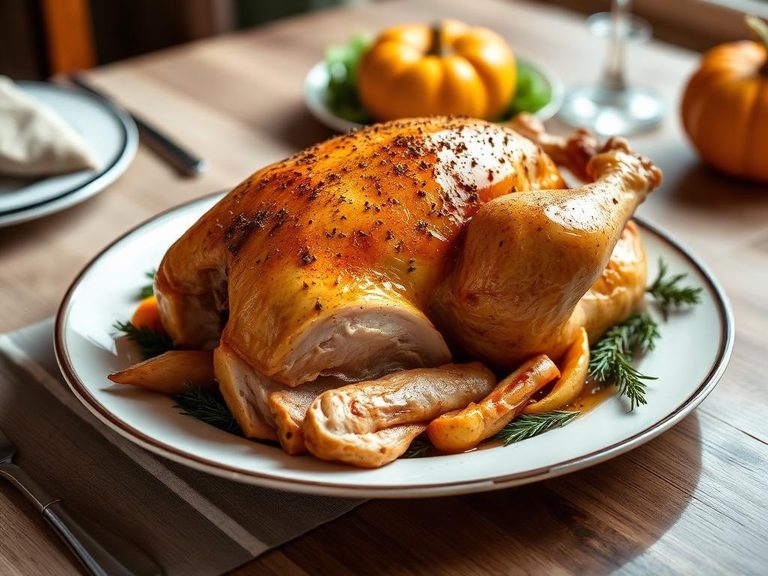
This is lean, oven-roasted turkey meat from a whole bird, typically brined in a saline solution to lock in moisture. The result is a tender, juicy, and savory protein with a clean, mild flavor and a satisfying, slightly firm texture. Nutritionally, it's a powerhouse, delivering an exceptional amount of protein per calorie with virtually no carbohydrates or fat.
Calorie split: 76% protein · 0% carbs · 24% fat
↓ Full nutrition💚 Why it's loved
People love it as a versatile, health-conscious protein that absorbs seasonings well and serves as a blank canvas for countless cuisines. It's a cultural staple for holiday feasts, especially in North America, symbolizing abundance and celebration.
⚠️ Watch-outs & how to enjoy it better
The 'added solution' (brine) can significantly increase sodium content, which is a concern for those monitoring salt intake. To counteract this, you can rinse the meat before cooking or pair it with potassium-rich foods like roasted sweet potatoes or leafy greens to help balance electrolytes. Its lean nature also means it can dry out if overcooked; using a meat thermometer and letting it rest after roasting ensures juiciness.
Key benefits
- Extremely high in lean protein for muscle maintenance.
- Very low in fat and contains zero carbohydrates.
- A good source of essential minerals like selenium and phosphorus.
- Provides B vitamins, particularly niacin and B6, for energy metabolism.
🍽️ Popular dishes


🌍 Where it's eaten
💡 Did you know?
The wild turkey was so revered by Benjamin Franklin that he once suggested it, not the bald eagle, as the national bird of the United States, calling it 'a Bird of Courage.'
Full nutrition (USDA data · scales with serving)
| Water | 68.8 g |
| Energy | 140 kcal |
| Energy | 585 kj |
| Protein | 26.6 g |
| Total lipid (fat) | 3.7 g |
| Ash | 1.4 g |
| Carbohydrate, by difference | 0.00 g |
| Fiber, total dietary | 0.00 g |
| Total Sugars | 0.00 g |
| Calcium, Ca | 14.0 mg |
| Iron, Fe | 0.77 mg |
| Magnesium, Mg | 27.0 mg |
| Phosphorus, P | 235 mg |
| Potassium, K | 239 mg |
| Sodium, Na | 223 mg |
| Zinc, Zn | 2.3 mg |
| Copper, Cu | 0.09 mg |
| Manganese, Mn | 0.01 mg |
| Selenium, Se | 30.7 ug |
| Vitamin C, total ascorbic acid | 0.00 mg |
| Thiamin | 0.04 mg |
| Riboflavin | 0.26 mg |
| Niacin | 9.7 mg |
| Pantothenic acid | 0.95 mg |
| Vitamin B-6 | 0.59 mg |
| Folate, total | 8.0 ug |
| Folic acid | 0.00 ug |
| Folate, food | 8.0 ug |
| Folate, DFE | 8.0 ug |
| Choline, total | 78.2 mg |
| Betaine | 4.3 mg |
| Vitamin B-12 | 1.7 ug |
| Vitamin B-12, added | 0.00 ug |
| Vitamin A, RAE | 4.0 ug |
| Retinol | 4.0 ug |
| Carotene, beta | 0.00 ug |
| Carotene, alpha | 0.00 ug |
| Cryptoxanthin, beta | 0.00 ug |
| Vitamin A, IU | 14.0 iu |
| Lycopene | 0.00 ug |
| Lutein + zeaxanthin | 0.00 ug |
| Vitamin E (alpha-tocopherol) | 0.06 mg |
| Vitamin E, added | 0.00 mg |
| Tocopherol, beta | 0.00 mg |
| Tocopherol, gamma | 0.03 mg |
| Tocopherol, delta | 0.02 mg |
| Tocotrienol, alpha | 0.00 mg |
| Tocotrienol, beta | 0.00 mg |
| Tocotrienol, gamma | 0.04 mg |
| Tocotrienol, delta | 0.00 mg |
| Vitamin D (D2 + D3), International Units | 10.0 iu |
| Vitamin D (D2 + D3) | 0.30 ug |
| Vitamin D3 (cholecalciferol) | 0.30 ug |
| Vitamin K (phylloquinone) | 0.00 ug |
| Alcohol, ethyl | 0.00 g |
| Caffeine | 0.00 mg |
| Theobromine | 0.00 mg |
Fat & fatty acid profile (per 100g)
| Fatty acids, total saturated | 1.1 g |
| SFA 4:0 | 0.00 g |
| SFA 6:0 | 0.00 g |
| SFA 8:0 | 0.00 g |
| SFA 10:0 | 0.01 g |
| SFA 12:0 | 0.01 g |
| SFA 14:0 | 0.04 g |
| SFA 15:0 | 0.01 g |
| SFA 16:0 | 0.70 g |
| SFA 17:0 | 0.01 g |
| SFA 18:0 | 0.32 g |
| SFA 20:0 | 0.00 g |
| SFA 22:0 | 0.00 g |
| SFA 24:0 | 0.00 g |
| Fatty acids, total monounsaturated | 1.2 g |
| MUFA 14:1 | 0.00 g |
| MUFA 15:1 | 0.00 g |
| MUFA 16:1 | 0.11 g |
| MUFA 16:1 c | 0.11 g |
| MUFA 17:1 | 0.01 g |
| MUFA 18:1 | 1.1 g |
| MUFA 18:1 c | 1.0 g |
| MUFA 20:1 | 0.02 g |
| MUFA 22:1 | 0.00 g |
| MUFA 22:1 c | 0.00 g |
| MUFA 24:1 c | 0.00 g |
| Fatty acids, total polyunsaturated | 1.00 g |
| PUFA 18:2 | 0.84 g |
| PUFA 18:2 n-6 c,c | 0.83 g |
| PUFA 18:2 CLAs | 0.01 g |
| PUFA 18:3 | 0.04 g |
| PUFA 18:3 n-3 c,c,c (ALA) | 0.04 g |
| PUFA 18:3 n-6 c,c,c | 0.00 g |
| PUFA 18:4 | 0.00 g |
| PUFA 20:2 n-6 c,c | 0.01 g |
| PUFA 20:3 | 0.01 g |
| PUFA 20:3 n-3 | 0.00 g |
| PUFA 20:3 n-6 | 0.01 g |
| PUFA 20:4 | 0.06 g |
| PUFA 20:5 n-3 (EPA) | 0.01 g |
| PUFA 22:4 | 0.01 g |
| PUFA 22:5 n-3 (DPA) | 0.01 g |
| PUFA 22:6 n-3 (DHA) | 0.00 g |
| Fatty acids, total trans | 0.05 g |
| Fatty acids, total trans-monoenoic | 0.04 g |
| TFA 16:1 t | 0.00 g |
| TFA 18:1 t | 0.04 g |
| TFA 22:1 t | 0.00 g |
| TFA 18:2 t not further defined | 0.01 g |
| Fatty acids, total trans-polyenoic | 0.01 g |
| Cholesterol | 84.0 mg |
Amino acid profile (per 100g)
| Tryptophan | 0.28 g |
| Threonine | 0.97 g |
| Isoleucine | 0.76 g |
| Leucine | 1.8 g |
| Lysine | 2.2 g |
| Methionine | 0.70 g |
| Cystine | 0.25 g |
| Phenylalanine | 0.86 g |
| Tyrosine | 0.79 g |
| Valine | 0.85 g |
| Arginine | 1.5 g |
| Histidine | 0.72 g |
| Alanine | 1.4 g |
| Aspartic acid | 2.1 g |
| Glutamic acid | 3.6 g |
| Glycine | 1.1 g |
| Proline | 1.4 g |
| Serine | 1.1 g |
FAQ
What does 'with added solution' mean?
It means the turkey was injected or soaked in a brine (water, salt, and sometimes sugar, spices, or phosphates) before packaging. This process helps the meat retain moisture during cooking, resulting in a juicier final product.
How is this different from regular roasted turkey?
The key difference is the pre-treatment with a brining solution. This commercial preparation ensures consistent moisture and tenderness, especially in larger birds or lean cuts, but can add sodium and a small amount of weight from the absorbed liquid.
Is this a good option for a low-fat diet?
Yes, it's an excellent choice. With only 3.7g of fat per 100g and being virtually carb-free, it's one of the leanest animal proteins available, ideal for high-protein, low-fat dietary plans.
Nutrient density (calculated · NRF9.3)
Nutrient Rich Foods index: beneficial nutrients (protein, fiber, vitamins, minerals) minus saturated fat, added sugar & sodium, per 100 kcal.
NRF9.3 index — Fulgoni, Keast & Drewnowski, 2009. Computed from USDA nutrients.
Weight-loss friendliness (composite index)
Energy density 1.40 kcal/g · 76% calories from protein · 0.0 g fiber · 0.0 g sugar per 100 g.
Composite of energy density (Rolls et al., 1999), protein & fiber satiety, minus sugar. A calculated heuristic — ranks satiety-per-calorie, not a clinical measure.
Dietary load (calculated from USDA values)
Potential renal acid load. Positive = acid-forming, negative = alkaline-forming.
Sodium-to-potassium ratio: 0.93 (lower is better — aim for ≤ 1)
Sodium:potassium per WHO potassium guidance. Computed from USDA nutrients.