

Restaurant, Latino, pupusas con queso (pupusas, cheese)
Whole food · Restaurant Foods

Photo: Wikipedia
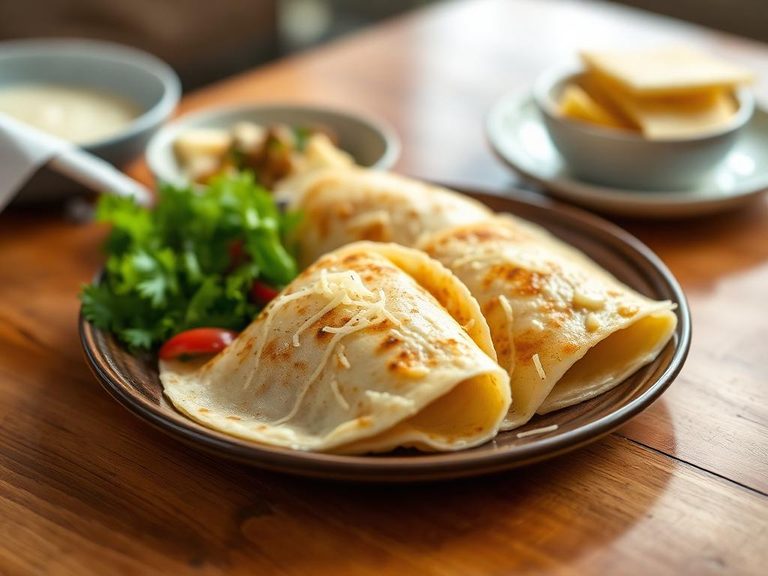
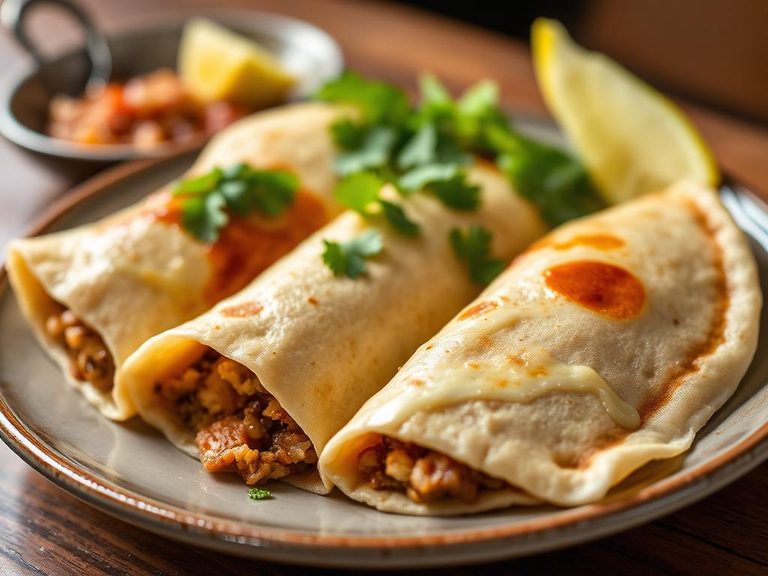
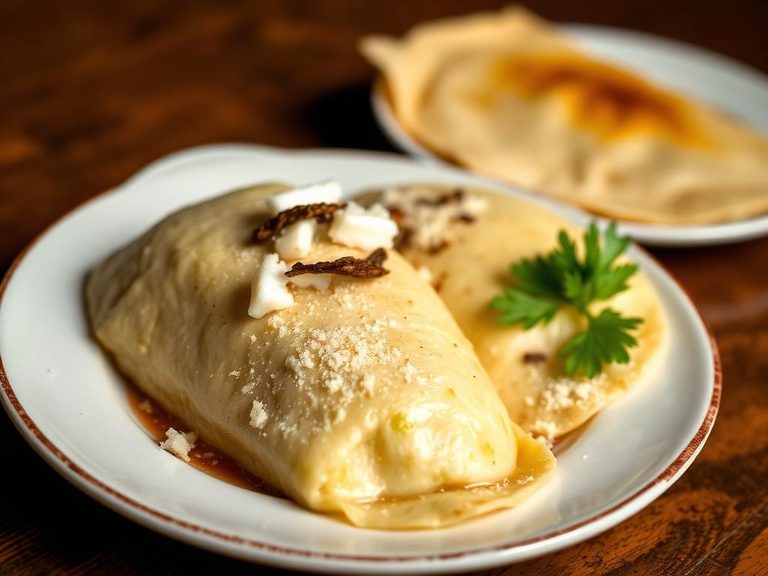
Pupusas con queso are thick, hand-patted corn tortillas stuffed with a molten, salty cheese filling, then griddled until the exterior is crisp and golden while the inside becomes a gooey, stretchy delight. Each bite delivers a satisfying contrast of textures—the slightly chewy masa against the rich, creamy cheese core. Nutritionally, they offer a substantial protein and fat boost from the cheese, making them more satiating than a plain tortilla.
Calorie split: 18% protein · 35% carbs · 47% fat
↓ Full nutrition💚 Why it's loved
People adore pupusas for the irresistible combination of warm, melted cheese and the comforting, earthy flavor of corn masa. They are a beloved cultural staple in El Salvador, often enjoyed as a communal food, and their versatility allows for countless filling variations.
⚠️ Watch-outs & how to enjoy it better
The high fat and refined carbohydrate content can lead to a significant blood-sugar spike, especially if consumed alone. Those watching their saturated fat intake or managing blood sugar should be cautious. To counteract this, pair a pupusa with a fiber-rich curtido (cabbage slaw) and a side of beans to slow digestion, and practice portion control.
Key benefits
- Excellent source of complete protein from the cheese filling.
- Provides a quick and sustained energy release from the corn masa.
- Contains dietary fiber from the corn dough.
- The fat content aids in the absorption of fat-soluble vitamins.
- A traditional, minimally processed food when made from scratch.
🍽️ Popular dishes
🌍 Where it's eaten
💡 Did you know?
The traditional way to eat pupusas is with curtido, a lightly fermented cabbage relish, and a thin tomato salsa—the acidity and crunch of the curtido are designed to cut through the richness of the cheese.
Full nutrition (USDA data · scales with serving)
| Water | 50.4 g |
| Energy | 256 kcal |
| Energy | 1070 kj |
| Protein | 11.7 g |
| Total lipid (fat) | 13.3 g |
| Ash | 2.3 g |
| Carbohydrate, by difference | 22.4 g |
| Fiber, total dietary | 2.9 g |
| Total Sugars | 1.2 g |
| Sucrose | 0.24 g |
| Glucose | 0.23 g |
| Fructose | 0.20 g |
| Lactose | 0.00 g |
| Maltose | 0.35 g |
| Galactose | 0.18 g |
| Starch | 18.1 g |
| Calcium, Ca | 325 mg |
| Iron, Fe | 0.56 mg |
| Magnesium, Mg | 36.0 mg |
| Phosphorus, P | 271 mg |
| Potassium, K | 120 mg |
| Sodium, Na | 400 mg |
| Zinc, Zn | 1.9 mg |
| Copper, Cu | 0.04 mg |
| Manganese, Mn | 0.13 mg |
| Selenium, Se | 15.0 ug |
| Vitamin C, total ascorbic acid | 0.00 mg |
| Thiamin | 0.04 mg |
| Riboflavin | 0.13 mg |
| Niacin | 0.48 mg |
| Pantothenic acid | 0.34 mg |
| Vitamin B-6 | 0.15 mg |
| Folate, total | 3.0 ug |
| Folic acid | 0.00 ug |
| Folate, food | 3.0 ug |
| Folate, DFE | 3.0 ug |
| Choline, total | 16.9 mg |
| Betaine | 0.60 mg |
| Vitamin B-12 | 0.45 ug |
| Vitamin B-12, added | 0.00 ug |
| Vitamin A, RAE | 89.0 ug |
| Retinol | 87.0 ug |
| Carotene, beta | 18.0 ug |
| Carotene, alpha | 0.00 ug |
| Cryptoxanthin, beta | 1.0 ug |
| Vitamin A, IU | 321 iu |
| Lycopene | 0.00 ug |
| Lutein + zeaxanthin | 2.0 ug |
| Vitamin E (alpha-tocopherol) | 0.44 mg |
| Vitamin E, added | 0.00 mg |
| Tocopherol, beta | 0.01 mg |
| Tocopherol, gamma | 1.5 mg |
| Tocopherol, delta | 0.14 mg |
| Tocotrienol, alpha | 0.13 mg |
| Tocotrienol, beta | 0.01 mg |
| Tocotrienol, gamma | 0.31 mg |
| Tocotrienol, delta | 0.01 mg |
| Vitamin D (D2 + D3), International Units | 48.0 iu |
| Vitamin D (D2 + D3) | 1.2 ug |
| Vitamin K (phylloquinone) | 1.7 ug |
| Vitamin K (Menaquinone-4) | 2.9 ug |
| Alcohol, ethyl | 0.00 g |
| Caffeine | 0.00 mg |
| Theobromine | 0.00 mg |
Fat & fatty acid profile (per 100g)
| Fatty acids, total saturated | 6.5 g |
| SFA 4:0 | 0.23 g |
| SFA 6:0 | 0.19 g |
| SFA 8:0 | 0.12 g |
| SFA 10:0 | 0.27 g |
| SFA 12:0 | 0.30 g |
| SFA 14:0 | 0.96 g |
| SFA 15:0 | 0.10 g |
| SFA 16:0 | 2.9 g |
| SFA 17:0 | 0.07 g |
| SFA 18:0 | 1.2 g |
| SFA 20:0 | 0.03 g |
| SFA 22:0 | 0.01 g |
| SFA 24:0 | 0.01 g |
| Fatty acids, total monounsaturated | 3.4 g |
| MUFA 14:1 | 0.07 g |
| MUFA 15:1 | 0.00 g |
| MUFA 16:1 | 0.20 g |
| MUFA 16:1 c | 0.17 g |
| MUFA 17:1 | 0.02 g |
| MUFA 18:1 | 3.1 g |
| MUFA 18:1 c | 2.8 g |
| MUFA 20:1 | 0.03 g |
| MUFA 22:1 | 0.00 g |
| MUFA 22:1 c | 0.00 g |
| MUFA 24:1 c | 0.00 g |
| Fatty acids, total polyunsaturated | 1.6 g |
| PUFA 18:2 | 1.4 g |
| PUFA 18:2 n-6 c,c | 1.3 g |
| PUFA 18:2 CLAs | 0.06 g |
| PUFA 18:3 | 0.10 g |
| PUFA 18:3 n-3 c,c,c (ALA) | 0.09 g |
| PUFA 18:3 n-6 c,c,c | 0.00 g |
| PUFA 18:4 | 0.00 g |
| PUFA 20:2 n-6 c,c | 0.01 g |
| PUFA 20:3 | 0.01 g |
| PUFA 20:3 n-3 | 0.00 g |
| PUFA 20:3 n-6 | 0.01 g |
| PUFA 20:4 | 0.02 g |
| PUFA 20:5 n-3 (EPA) | 0.01 g |
| PUFA 22:4 | 0.00 g |
| PUFA 22:5 n-3 (DPA) | 0.01 g |
| PUFA 22:6 n-3 (DHA) | 0.00 g |
| Fatty acids, total trans | 0.36 g |
| Fatty acids, total trans-monoenoic | 0.28 g |
| TFA 16:1 t | 0.03 g |
| TFA 18:1 t | 0.25 g |
| TFA 22:1 t | 0.00 g |
| TFA 18:2 t not further defined | 0.07 g |
| Fatty acids, total trans-polyenoic | 0.07 g |
| Cholesterol | 32.0 mg |
Amino acid profile (per 100g)
| Tryptophan | 0.15 g |
| Threonine | 0.46 g |
| Isoleucine | 0.56 g |
| Leucine | 1.3 g |
| Lysine | 0.87 g |
| Methionine | 0.35 g |
| Cystine | 0.10 g |
| Phenylalanine | 0.63 g |
| Tyrosine | 0.48 g |
| Valine | 0.74 g |
| Arginine | 0.48 g |
| Histidine | 0.37 g |
| Alanine | 0.46 g |
| Aspartic acid | 0.89 g |
| Glutamic acid | 2.8 g |
| Glycine | 0.27 g |
| Proline | 1.3 g |
| Serine | 0.70 g |
FAQ
What is the difference between a pupusa and a gordita?
While both are stuffed corn cakes, pupusas are stuffed before cooking, with the filling sealed inside the masa. Gorditas are typically cooked first, then sliced open and stuffed after cooking.
Can I make pupusas with pre-made masa dough?
Yes, using masa harina (corn flour) mixed with water is the standard and easiest method. The key is to achieve a pliable, non-sticky dough that can be patted thin without cracking.
What is the best cheese to use for authentic pupusas?
Traditional Salvadoran pupusas use 'quesillo,' a soft, mild, stretchy cheese similar to mozzarella. Low-moisture mozzarella or a mild provolone are good substitutes that melt well.
Nutrient density (calculated · NRF9.3)
Nutrient Rich Foods index: beneficial nutrients (protein, fiber, vitamins, minerals) minus saturated fat, added sugar & sodium, per 100 kcal.
NRF9.3 index — Fulgoni, Keast & Drewnowski, 2009. Computed from USDA nutrients.
Weight-loss friendliness (composite index)
Energy density 2.56 kcal/g · 18% calories from protein · 2.9 g fiber · 1.2 g sugar per 100 g.
Composite of energy density (Rolls et al., 1999), protein & fiber satiety, minus sugar. A calculated heuristic — ranks satiety-per-calorie, not a clinical measure.
Dietary load (calculated from USDA values)
Potential renal acid load. Positive = acid-forming, negative = alkaline-forming.
Sodium-to-potassium ratio: 3.33 (lower is better — aim for ≤ 1)
Sodium:potassium per WHO potassium guidance. Computed from USDA nutrients.