

Pork sausage, link/patty, reduced fat, unprepared
Whole food · Sausages and Luncheon Meats

Photo: Wikipedia
Reduced-fat pork sausage links or patties are a leaner take on the classic breakfast staple, delivering a savory, meaty punch with a firm, slightly coarse texture. They pack a substantial 16.75g of protein per 100g while keeping carbs and sugars at zero, making them a go-to for high-protein, low-carb meals. The flavor remains rich and seasoned, though the lower fat content means they can be slightly less juicy than their full-fat counterparts.
Calorie split: 31% protein · 0% carbs · 69% fat
↓ Full nutrition💚 Why it's loved
People love it for its familiar, comforting savory flavor that anchors breakfast plates and hearty meals, offering a satisfying meatiness without excessive grease. Its versatility shines in everything from breakfast sandwiches to pasta dishes, making it a cultural staple in American and European cuisines.
⚠️ Watch-outs & how to enjoy it better
The reduced fat can make it drier and less flavorful than regular sausage, potentially disappointing those used to richer textures. It may also contain high sodium levels, so pairing with potassium-rich foods like spinach or bananas can help balance electrolytes, and opting for homemade versions allows better control over seasonings.
Key benefits
- High protein content supports muscle maintenance and satiety
- Virtually zero carbohydrates and sugars, ideal for low-carb diets
- Lower fat than traditional pork sausage, reducing overall calorie density
- Provides B vitamins and minerals like zinc and iron from pork
- Versatile for breakfast, lunch, or dinner preparations
🍽️ Popular dishes

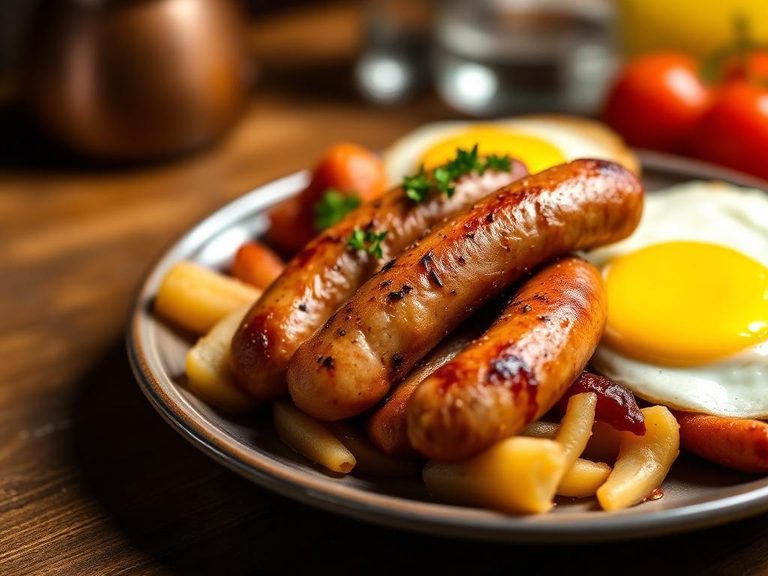
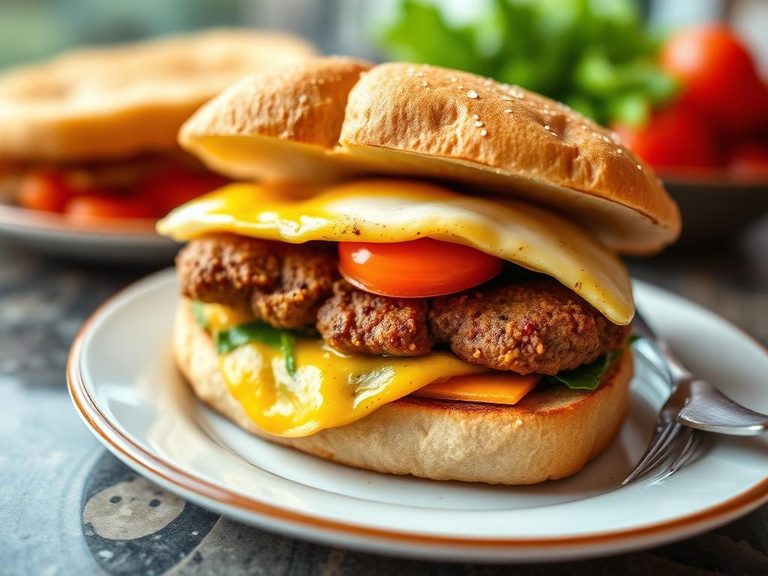
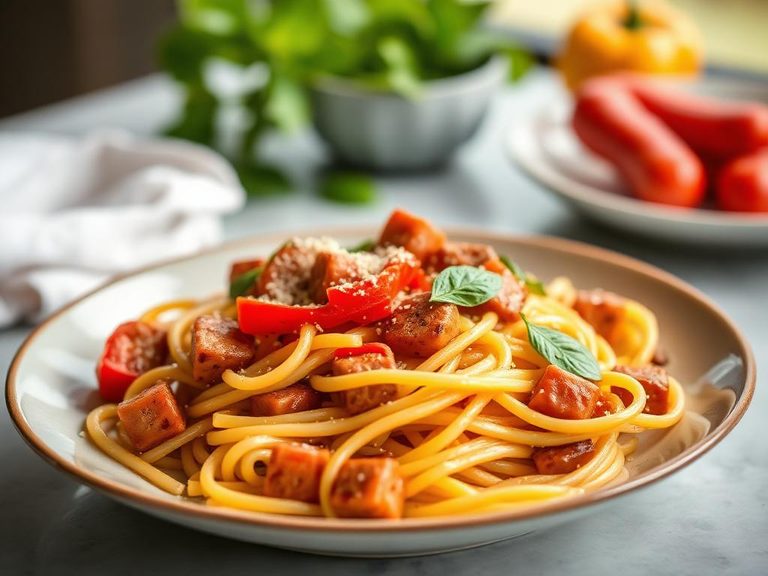

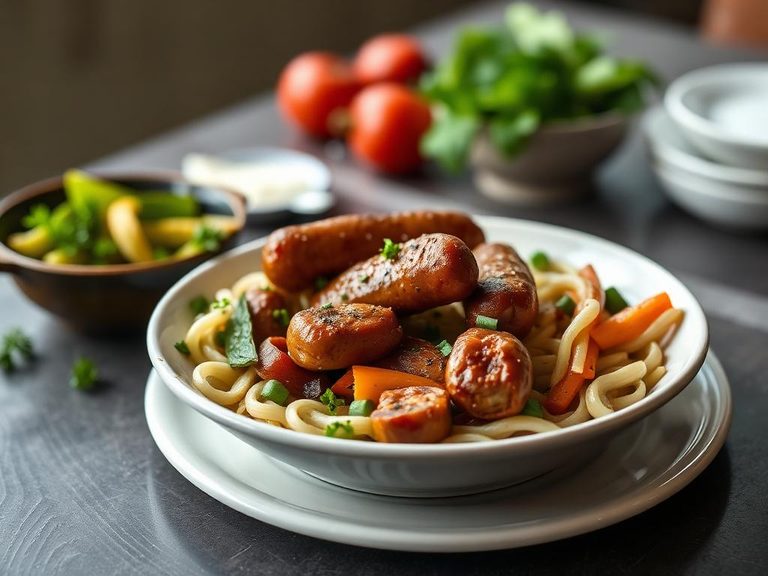
🌍 Where it's eaten
💡 Did you know?
The term 'sausage' comes from the Latin 'salsus,' meaning 'salted,' reflecting the historical use of salt as a primary preservative in sausage-making.
Full nutrition (USDA data · scales with serving)
| Water | 64.2 g |
| Energy | 217 kcal |
| Energy | 907 kj |
| Protein | 16.8 g |
| Total lipid (fat) | 16.6 g |
| Ash | 2.3 g |
| Carbohydrate, by difference | 0.20 g |
| Fiber, total dietary | 0.00 g |
| Total Sugars | 0.00 g |
| Calcium, Ca | 15.0 mg |
| Iron, Fe | 1.5 mg |
| Magnesium, Mg | 18.0 mg |
| Phosphorus, P | 153 mg |
| Potassium, K | 275 mg |
| Sodium, Na | 581 mg |
| Zinc, Zn | 2.4 mg |
| Copper, Cu | 0.09 mg |
| Manganese, Mn | 0.04 mg |
| Selenium, Se | 22.7 ug |
| Vitamin C, total ascorbic acid | 0.00 mg |
| Thiamin | 0.31 mg |
| Riboflavin | 0.17 mg |
| Niacin | 6.2 mg |
| Pantothenic acid | 0.83 mg |
| Vitamin B-6 | 0.27 mg |
| Folate, total | 2.0 ug |
| Folic acid | 0.00 ug |
| Folate, food | 2.0 ug |
| Folate, DFE | 2.0 ug |
| Choline, total | 57.3 mg |
| Betaine | 5.1 mg |
| Vitamin B-12 | 1.1 ug |
| Vitamin B-12, added | 0.00 ug |
| Vitamin A, RAE | 27.0 ug |
| Retinol | 27.0 ug |
| Carotene, beta | 0.00 ug |
| Carotene, alpha | 0.00 ug |
| Cryptoxanthin, beta | 0.00 ug |
| Vitamin A, IU | 92.0 iu |
| Lycopene | 0.00 ug |
| Lutein + zeaxanthin | 0.00 ug |
| Vitamin E (alpha-tocopherol) | 0.99 mg |
| Vitamin E, added | 0.00 mg |
| Tocopherol, beta | 0.00 mg |
| Tocopherol, gamma | 0.08 mg |
| Tocopherol, delta | 0.00 mg |
| Tocotrienol, alpha | 0.03 mg |
| Tocotrienol, beta | 0.00 mg |
| Tocotrienol, gamma | 0.06 mg |
| Tocotrienol, delta | 0.00 mg |
| Vitamin D (D2 + D3), International Units | 16.0 iu |
| Vitamin D (D2 + D3) | 0.40 ug |
| Vitamin D2 (ergocalciferol) | 0.00 ug |
| Vitamin D3 (cholecalciferol) | 0.40 ug |
| Vitamin K (phylloquinone) | 0.00 ug |
| Alcohol, ethyl | 0.00 g |
| Caffeine | 0.00 mg |
| Theobromine | 0.00 mg |
Fat & fatty acid profile (per 100g)
| Fatty acids, total saturated | 4.4 g |
| SFA 4:0 | 0.00 g |
| SFA 6:0 | 0.00 g |
| SFA 8:0 | 0.00 g |
| SFA 10:0 | 0.01 g |
| SFA 12:0 | 0.01 g |
| SFA 14:0 | 0.15 g |
| SFA 15:0 | 0.01 g |
| SFA 16:0 | 2.8 g |
| SFA 17:0 | 0.04 g |
| SFA 18:0 | 1.4 g |
| SFA 20:0 | 0.03 g |
| SFA 22:0 | 0.01 g |
| SFA 24:0 | 0.00 g |
| Fatty acids, total monounsaturated | 5.9 g |
| MUFA 14:1 | 0.00 g |
| MUFA 15:1 | 0.00 g |
| MUFA 16:1 | 0.27 g |
| MUFA 16:1 c | 0.26 g |
| MUFA 17:1 | 0.03 g |
| MUFA 18:1 | 5.4 g |
| MUFA 18:1 c | 5.4 g |
| MUFA 20:1 | 0.17 g |
| MUFA 22:1 | 0.00 g |
| MUFA 22:1 c | 0.00 g |
| MUFA 24:1 c | 0.00 g |
| Fatty acids, total polyunsaturated | 3.0 g |
| PUFA 18:2 | 2.6 g |
| PUFA 18:2 n-6 c,c | 2.6 g |
| PUFA 18:2 CLAs | 0.02 g |
| PUFA 18:3 | 0.08 g |
| PUFA 18:3 n-3 c,c,c (ALA) | 0.08 g |
| PUFA 18:3 n-6 c,c,c | 0.00 g |
| PUFA 18:3i | 0.00 g |
| PUFA 18:4 | 0.00 g |
| PUFA 20:2 n-6 c,c | 0.14 g |
| PUFA 20:3 | 0.04 g |
| PUFA 20:3 n-3 | 0.02 g |
| PUFA 20:3 n-6 | 0.03 g |
| PUFA 20:4 | 0.09 g |
| PUFA 20:5 n-3 (EPA) | 0.00 g |
| PUFA 22:4 | 0.03 g |
| PUFA 22:5 n-3 (DPA) | 0.01 g |
| PUFA 22:6 n-3 (DHA) | 0.00 g |
| Fatty acids, total trans | 0.06 g |
| Fatty acids, total trans-monoenoic | 0.05 g |
| TFA 16:1 t | 0.00 g |
| TFA 18:1 t | 0.05 g |
| TFA 22:1 t | 0.00 g |
| TFA 18:2 t not further defined | 0.01 g |
| Fatty acids, total trans-polyenoic | 0.01 g |
| Cholesterol | 67.0 mg |
Amino acid profile (per 100g)
| Tryptophan | 0.16 g |
| Threonine | 0.60 g |
| Isoleucine | 0.65 g |
| Leucine | 1.3 g |
| Lysine | 1.2 g |
| Methionine | 0.40 g |
| Cystine | 0.22 g |
| Phenylalanine | 0.60 g |
| Tyrosine | 0.49 g |
| Valine | 0.76 g |
| Arginine | 1.1 g |
| Histidine | 0.50 g |
| Alanine | 1.0 g |
| Aspartic acid | 1.5 g |
| Glutamic acid | 2.5 g |
| Glycine | 1.1 g |
| Proline | 1.1 g |
| Serine | 0.70 g |
| Hydroxyproline | 0.33 g |
FAQ
How does reduced-fat pork sausage compare nutritionally to regular pork sausage?
Reduced-fat versions typically have about 20-30% less fat and fewer calories per serving, but they retain similar protein levels and may have slightly higher sodium to compensate for flavor.
Can I use reduced-fat pork sausage in recipes that call for regular sausage?
Yes, but you may need to add a small amount of oil or liquid to prevent dryness, especially in baked or grilled dishes, and adjust cooking times slightly.
Is reduced-fat pork sausage suitable for a low-carb or keto diet?
Absolutely, as it contains virtually no carbohydrates or sugars, making it a good protein source for low-carb and ketogenic eating plans.
What are some healthy ways to cook reduced-fat pork sausage?
Grilling, baking, or pan-frying with minimal oil can help retain moisture, and pairing with vegetables or whole grains adds fiber and nutrients for a balanced meal.
Nutrient density (calculated · NRF9.3)
Nutrient Rich Foods index: beneficial nutrients (protein, fiber, vitamins, minerals) minus saturated fat, added sugar & sodium, per 100 kcal.
NRF9.3 index — Fulgoni, Keast & Drewnowski, 2009. Computed from USDA nutrients.
Weight-loss friendliness (composite index)
Energy density 2.17 kcal/g · 31% calories from protein · 0.0 g fiber · 0.0 g sugar per 100 g.
Composite of energy density (Rolls et al., 1999), protein & fiber satiety, minus sugar. A calculated heuristic — ranks satiety-per-calorie, not a clinical measure.
Dietary load (calculated from USDA values)
Potential renal acid load. Positive = acid-forming, negative = alkaline-forming.
Sodium-to-potassium ratio: 2.11 (lower is better — aim for ≤ 1)
Sodium:potassium per WHO potassium guidance. Computed from USDA nutrients.