

Pork, cured, ham, rump, bone-in, separable lean and fat, heated, roasted
Whole food · Pork Products
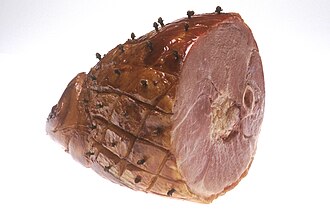
Photo: Wikipedia
This is a classic roasted ham cut from the rump, with the bone left in for flavor and moisture. The lean meat is tender and savory, while the thin layer of fat crisps beautifully, delivering a rich, salty-sweet crust. It's a protein powerhouse with minimal carbs, making it a satisfying centerpiece for any meal.
Calorie split: 54% protein · 1% carbs · 45% fat
↓ Full nutrition💚 Why it's loved
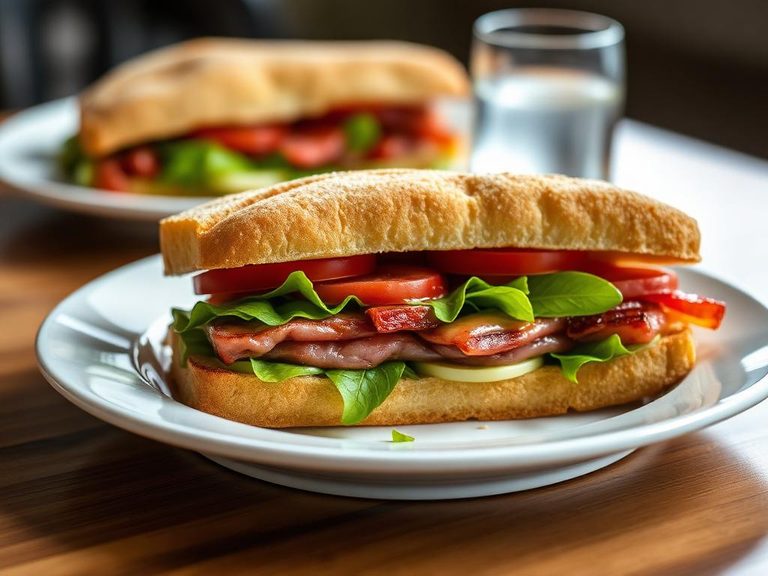
People adore it for its deep, savory flavor that's both comforting and celebratory, often taking center stage at holiday tables. Its versatility allows it to be served hot as a main, sliced cold for sandwiches, or diced into salads and omelets.
⚠️ Watch-outs & how to enjoy it better
The primary concern is its high sodium content from the curing process, which can be problematic for those monitoring salt intake. To counteract this, pair it with potassium-rich vegetables like roasted sweet potatoes or steamed greens, and practice portion control. Also, be mindful of the added sugar in some glazes.
Key benefits
- High-quality protein source for muscle maintenance
- Very low in carbohydrates and sugars
- Provides essential minerals like zinc and selenium
- Bone-in preparation often yields more flavorful, moist meat
🍽️ Popular dishes




🌍 Where it's eaten
💡 Did you know?
The tradition of glazing ham with sweet coatings like honey or brown sugar likely originated as a way to balance the intense saltiness of the cure and to create an appealing, lacquered finish.
Full nutrition (USDA data · scales with serving)
| Water | 63.8 g |
| Energy | 177 kcal |
| Energy | 741 kj |
| Protein | 23.9 g |
| Total lipid (fat) | 8.9 g |
| Ash | 3.0 g |
| Carbohydrate, by difference | 0.64 g |
| Fiber, total dietary | 0.00 g |
| Total Sugars | 0.64 g |
| Sucrose | 0.54 g |
| Glucose | 0.10 g |
| Fructose | 0.00 g |
| Lactose | 0.00 g |
| Maltose | 0.00 g |
| Galactose | 0.00 g |
| Calcium, Ca | 7.0 mg |
| Iron, Fe | 1.5 mg |
| Magnesium, Mg | 23.0 mg |
| Phosphorus, P | 263 mg |
| Potassium, K | 370 mg |
| Sodium, Na | 826 mg |
| Zinc, Zn | 2.9 mg |
| Copper, Cu | 1.1 mg |
| Manganese, Mn | 0.03 mg |
| Selenium, Se | 23.5 ug |
| Vitamin C, total ascorbic acid | 0.00 mg |
| Thiamin | 0.53 mg |
| Riboflavin | 0.28 mg |
| Niacin | 6.9 mg |
| Pantothenic acid | 0.70 mg |
| Vitamin B-6 | 0.45 mg |
| Folate, total | 0.00 ug |
| Folic acid | 0.00 ug |
| Folate, food | 0.00 ug |
| Folate, DFE | 0.00 ug |
| Choline, total | 92.6 mg |
| Betaine | 6.4 mg |
| Vitamin B-12 | 0.61 ug |
| Vitamin B-12, added | 0.00 ug |
| Vitamin A, RAE | 1.0 ug |
| Retinol | 1.0 ug |
| Carotene, beta | 0.00 ug |
| Carotene, alpha | 0.00 ug |
| Cryptoxanthin, beta | 0.00 ug |
| Vitamin A, IU | 5.0 iu |
| Lycopene | 0.00 ug |
| Lutein + zeaxanthin | 0.00 ug |
| Vitamin E (alpha-tocopherol) | 0.33 mg |
| Vitamin E, added | 0.00 mg |
| Tocopherol, beta | 0.00 mg |
| Tocopherol, gamma | 0.04 mg |
| Tocopherol, delta | 0.00 mg |
| Tocotrienol, alpha | 0.01 mg |
| Tocotrienol, beta | 0.00 mg |
| Tocotrienol, gamma | 0.03 mg |
| Tocotrienol, delta | 0.00 mg |
| Vitamin D (D2 + D3), International Units | 33.0 iu |
| Vitamin D (D2 + D3) | 0.80 ug |
| Vitamin D3 (cholecalciferol) | 0.80 ug |
| Vitamin K (phylloquinone) | 0.00 ug |
| Vitamin K (Dihydrophylloquinone) | 0.00 ug |
| Vitamin K (Menaquinone-4) | 1.5 ug |
| Alcohol, ethyl | 0.00 g |
| Caffeine | 0.00 mg |
| Theobromine | 0.00 mg |
Fat & fatty acid profile (per 100g)
| Fatty acids, total saturated | 2.9 g |
| SFA 4:0 | 0.00 g |
| SFA 6:0 | 0.00 g |
| SFA 8:0 | 0.00 g |
| SFA 10:0 | 0.01 g |
| SFA 12:0 | 0.01 g |
| SFA 14:0 | 0.10 g |
| SFA 15:0 | 0.00 g |
| SFA 16:0 | 1.8 g |
| SFA 17:0 | 0.02 g |
| SFA 18:0 | 0.89 g |
| SFA 20:0 | 0.01 g |
| SFA 22:0 | 0.01 g |
| Fatty acids, total monounsaturated | 3.8 g |
| MUFA 14:1 | 0.00 g |
| MUFA 15:1 | 0.00 g |
| MUFA 16:1 | 0.21 g |
| MUFA 17:1 | 0.00 g |
| MUFA 18:1 | 3.5 g |
| MUFA 18:1 c | 3.5 g |
| MUFA 20:1 | 0.06 g |
| MUFA 22:1 | 0.00 g |
| Fatty acids, total polyunsaturated | 1.3 g |
| PUFA 18:2 | 1.1 g |
| PUFA 18:2 n-6 c,c | 1.0 g |
| PUFA 18:2 CLAs | 0.02 g |
| PUFA 18:3 | 0.06 g |
| PUFA 18:3 n-3 c,c,c (ALA) | 0.06 g |
| PUFA 18:3 n-6 c,c,c | 0.00 g |
| PUFA 18:4 | 0.00 g |
| PUFA 20:2 n-6 c,c | 0.04 g |
| PUFA 20:3 | 0.00 g |
| PUFA 20:4 | 0.08 g |
| PUFA 20:5 n-3 (EPA) | 0.00 g |
| PUFA 22:5 n-3 (DPA) | 0.00 g |
| PUFA 22:6 n-3 (DHA) | 0.00 g |
| Fatty acids, total trans | 0.06 g |
| Fatty acids, total trans-monoenoic | 0.04 g |
| TFA 18:1 t | 0.04 g |
| TFA 18:2 t,t | 0.02 g |
| Fatty acids, total trans-polyenoic | 0.02 g |
| Cholesterol | 71.0 mg |
Amino acid profile (per 100g)
| Tryptophan | 0.22 g |
| Threonine | 1.1 g |
| Isoleucine | 1.1 g |
| Leucine | 1.9 g |
| Lysine | 2.0 g |
| Methionine | 0.57 g |
| Cystine | 0.27 g |
| Phenylalanine | 0.95 g |
| Tyrosine | 0.77 g |
| Valine | 1.2 g |
| Arginine | 1.5 g |
| Histidine | 1.0 g |
| Alanine | 1.4 g |
| Aspartic acid | 2.1 g |
| Glutamic acid | 3.4 g |
| Glycine | 1.3 g |
| Proline | 1.0 g |
| Serine | 0.94 g |
| Hydroxyproline | 0.15 g |
FAQ
What's the difference between 'cured' and 'uncured' ham?
'Cured' ham is preserved with salt and sodium nitrites. 'Uncured' ham is preserved using natural sources of nitrates (like celery powder) and is still salty, but the labeling can be confusing—it's not nitrate-free.
Is the fat layer edible?
Yes, the fat is edible and adds significant flavor and moisture. Many people enjoy the crispy, rendered fat cap. You can trim it before eating if you prefer a leaner cut.
How should I store leftover roasted ham?
Wrap tightly in plastic wrap or foil and refrigerate for up to 5 days. For longer storage, slice and freeze in airtight bags for up to 2 months.
Nutrient density (calculated · NRF9.3)
Nutrient Rich Foods index: beneficial nutrients (protein, fiber, vitamins, minerals) minus saturated fat, added sugar & sodium, per 100 kcal.
NRF9.3 index — Fulgoni, Keast & Drewnowski, 2009. Computed from USDA nutrients.
Weight-loss friendliness (composite index)
Energy density 1.77 kcal/g · 54% calories from protein · 0.0 g fiber · 0.6 g sugar per 100 g.
Composite of energy density (Rolls et al., 1999), protein & fiber satiety, minus sugar. A calculated heuristic — ranks satiety-per-calorie, not a clinical measure.
Dietary load (calculated from USDA values)
Potential renal acid load. Positive = acid-forming, negative = alkaline-forming.
Sodium-to-potassium ratio: 2.23 (lower is better — aim for ≤ 1)
Sodium:potassium per WHO potassium guidance. Computed from USDA nutrients.