

Pork, cured, ham and water product, whole, boneless, separable lean only, heated, roasted
Whole food · Pork Products
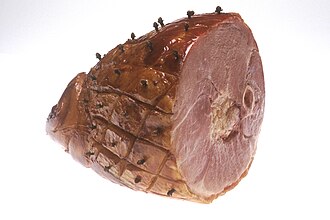
Photo: Wikipedia
This is a lean, boneless ham product that has been cured with water, then roasted to a tender, juicy finish. Its flavor is a classic balance of savory, salty, and subtly sweet, with a smooth, uniform texture that slices easily. Nutritionally, it's a high-protein, low-fat option, providing a substantial 13.88g of protein per 100g with minimal fat.
Calorie split: 45% protein · 15% carbs · 40% fat
↓ Full nutrition💚 Why it's loved
People love it for its familiar, comforting savory-sweet flavor and its incredible versatility, fitting seamlessly into everything from a classic Sunday dinner to a quick weeknight sandwich. It's a staple of American and European comfort food traditions, often associated with holiday feasts and family gatherings.
⚠️ Watch-outs & how to enjoy it better
The primary concern is its high sodium content from the curing process, which can be an issue for those monitoring blood pressure. To counteract this, pair it with potassium-rich foods like roasted potatoes or leafy greens, and practice portion control. Some may also be sensitive to the added sugars (4.61g/100g), so balancing it with fiber-rich vegetables can help moderate blood sugar response.
Key benefits
- High-quality protein source for muscle maintenance
- Low in fat, particularly saturated fat
- Provides essential B vitamins like thiamin and niacin
- Convenient, pre-cooked, and quick to prepare
🍽️ Popular dishes


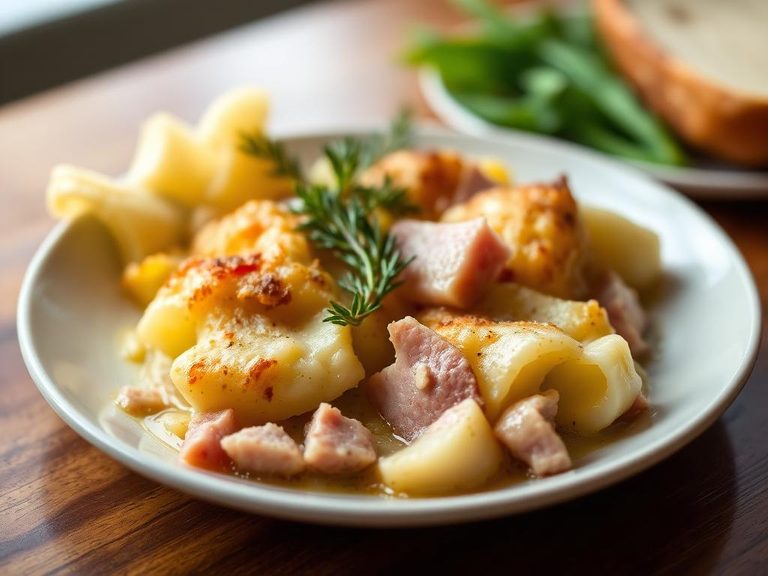


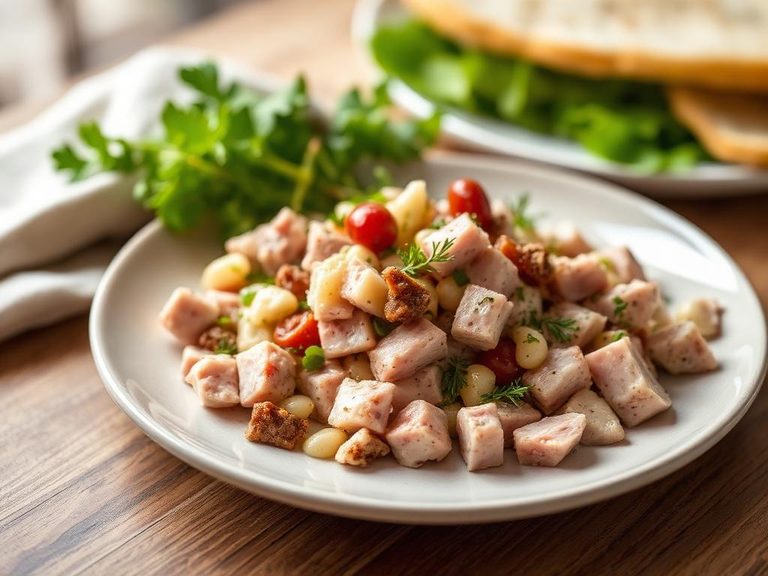
🌍 Where it's eaten
💡 Did you know?
The process of curing ham with water and then roasting it was popularized in the 20th century as a way to produce a more consistent, tender, and less salty product than traditional dry-cured hams.
Full nutrition (USDA data · scales with serving)
| Water | 72.1 g |
| Energy | 123 kcal |
| Energy | 513 kj |
| Protein | 13.9 g |
| Total lipid (fat) | 5.5 g |
| Ash | 4.0 g |
| Carbohydrate, by difference | 4.6 g |
| Fiber, total dietary | 0.00 g |
| Total Sugars | 4.6 g |
| Sucrose | 0.04 g |
| Glucose | 4.0 g |
| Fructose | 0.47 g |
| Lactose | 0.00 g |
| Maltose | 0.15 g |
| Galactose | 0.00 g |
| Calcium, Ca | 8.0 mg |
| Iron, Fe | 0.74 mg |
| Magnesium, Mg | 15.0 mg |
| Phosphorus, P | 224 mg |
| Potassium, K | 245 mg |
| Sodium, Na | 1335 mg |
| Zinc, Zn | 1.6 mg |
| Copper, Cu | 0.10 mg |
| Manganese, Mn | 0.04 mg |
| Selenium, Se | 29.1 ug |
| Vitamin C, total ascorbic acid | 0.00 mg |
| Thiamin | 0.26 mg |
| Riboflavin | 0.14 mg |
| Niacin | 3.6 mg |
| Pantothenic acid | 0.64 mg |
| Vitamin B-6 | 0.26 mg |
| Folate, total | 2.0 ug |
| Folic acid | 0.00 ug |
| Folate, food | 2.0 ug |
| Folate, DFE | 2.0 ug |
| Choline, total | 63.4 mg |
| Betaine | 4.4 mg |
| Vitamin B-12 | 0.37 ug |
| Vitamin B-12, added | 0.00 ug |
| Vitamin A, RAE | 13.0 ug |
| Retinol | 13.0 ug |
| Carotene, beta | 0.00 ug |
| Carotene, alpha | 0.00 ug |
| Cryptoxanthin, beta | 0.00 ug |
| Vitamin A, IU | 44.0 iu |
| Lycopene | 0.00 ug |
| Lutein + zeaxanthin | 0.00 ug |
| Vitamin E (alpha-tocopherol) | 0.22 mg |
| Vitamin E, added | 0.00 mg |
| Tocopherol, beta | 0.01 mg |
| Tocopherol, gamma | 0.04 mg |
| Tocopherol, delta | 0.00 mg |
| Tocotrienol, alpha | 0.04 mg |
| Tocotrienol, beta | 0.00 mg |
| Tocotrienol, gamma | 0.01 mg |
| Tocotrienol, delta | 0.00 mg |
| Vitamin D (D2 + D3), International Units | 27.0 iu |
| Vitamin D (D2 + D3) | 0.70 ug |
| Vitamin D3 (cholecalciferol) | 0.70 ug |
| Vitamin K (phylloquinone) | 0.00 ug |
| Vitamin K (Dihydrophylloquinone) | 0.20 ug |
| Vitamin K (Menaquinone-4) | 4.0 ug |
| Alcohol, ethyl | 0.00 g |
| Caffeine | 0.00 mg |
| Theobromine | 0.00 mg |
Fat & fatty acid profile (per 100g)
| Fatty acids, total saturated | 1.8 g |
| SFA 4:0 | 0.00 g |
| SFA 6:0 | 0.00 g |
| SFA 8:0 | 0.00 g |
| SFA 10:0 | 0.00 g |
| SFA 12:0 | 0.00 g |
| SFA 14:0 | 0.07 g |
| SFA 15:0 | 0.00 g |
| SFA 16:0 | 1.2 g |
| SFA 17:0 | 0.01 g |
| SFA 18:0 | 0.58 g |
| SFA 20:0 | 0.01 g |
| SFA 22:0 | 0.01 g |
| Fatty acids, total monounsaturated | 2.5 g |
| MUFA 14:1 | 0.00 g |
| MUFA 15:1 | 0.00 g |
| MUFA 16:1 | 0.13 g |
| MUFA 17:1 | 0.00 g |
| MUFA 18:1 | 2.3 g |
| MUFA 18:1 c | 2.3 g |
| MUFA 20:1 | 0.04 g |
| MUFA 22:1 | 0.00 g |
| Fatty acids, total polyunsaturated | 0.85 g |
| PUFA 18:2 | 0.74 g |
| PUFA 18:2 n-6 c,c | 0.72 g |
| PUFA 18:3 | 0.03 g |
| PUFA 18:3 n-3 c,c,c (ALA) | 0.03 g |
| PUFA 18:3 n-6 c,c,c | 0.00 g |
| PUFA 18:4 | 0.00 g |
| PUFA 20:2 n-6 c,c | 0.03 g |
| PUFA 20:3 | 0.00 g |
| PUFA 20:4 | 0.05 g |
| PUFA 20:5 n-3 (EPA) | 0.00 g |
| PUFA 22:5 n-3 (DPA) | 0.00 g |
| PUFA 22:6 n-3 (DHA) | 0.00 g |
| Fatty acids, total trans | 0.05 g |
| Fatty acids, total trans-monoenoic | 0.03 g |
| TFA 18:1 t | 0.03 g |
| TFA 18:2 t,t | 0.02 g |
| Fatty acids, total trans-polyenoic | 0.02 g |
| Cholesterol | 43.0 mg |
Amino acid profile (per 100g)
| Tryptophan | 0.13 g |
| Threonine | 0.62 g |
| Isoleucine | 0.63 g |
| Leucine | 1.1 g |
| Lysine | 1.2 g |
| Methionine | 0.33 g |
| Cystine | 0.16 g |
| Phenylalanine | 0.56 g |
| Tyrosine | 0.45 g |
| Valine | 0.70 g |
| Arginine | 0.89 g |
| Histidine | 0.60 g |
| Alanine | 0.82 g |
| Aspartic acid | 1.2 g |
| Glutamic acid | 2.0 g |
| Glycine | 0.72 g |
| Proline | 0.60 g |
| Serine | 0.54 g |
| Hydroxyproline | 0.09 g |
FAQ
Is this the same as 'country ham'?
No. Country ham is typically dry-cured, smoked, and aged, resulting in a much saltier, firmer, and more intensely flavored product. This is a 'water-added' or 'water product' ham, which is wet-cured, moister, and milder in flavor.
How should I store leftovers?
Store sliced or diced ham in an airtight container in the refrigerator for up to 3-4 days. For longer storage, it can be frozen for 1-2 months, though texture may become slightly drier upon thawing.
Can I use this in recipes that call for fresh pork?
Not directly. Since it's already cured and cooked, it has a distinct salty flavor and different texture. It's best used in recipes designed for cooked ham, like soups, salads, or sandwiches, rather than as a substitute for raw pork in roasts or stews.
Nutrient density (calculated · NRF9.3)
Nutrient Rich Foods index: beneficial nutrients (protein, fiber, vitamins, minerals) minus saturated fat, added sugar & sodium, per 100 kcal.
NRF9.3 index — Fulgoni, Keast & Drewnowski, 2009. Computed from USDA nutrients.
Weight-loss friendliness (composite index)
Energy density 1.23 kcal/g · 45% calories from protein · 0.0 g fiber · 4.6 g sugar per 100 g.
Composite of energy density (Rolls et al., 1999), protein & fiber satiety, minus sugar. A calculated heuristic — ranks satiety-per-calorie, not a clinical measure.
Dietary load (calculated from USDA values)
Potential renal acid load. Positive = acid-forming, negative = alkaline-forming.
Sodium-to-potassium ratio: 5.45 (lower is better — aim for ≤ 1)
Sodium:potassium per WHO potassium guidance. Computed from USDA nutrients.