

Nuts, almonds
Whole food · Nut and Seed Products
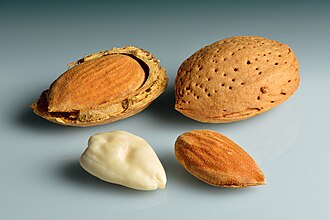
Photo: Wikipedia
Almonds are the edible seeds of the Prunus dulcis tree, prized for their satisfying crunch and subtly sweet, nutty flavor. Nutritionally, they are a powerhouse, delivering nearly 50 grams of heart-healthy monounsaturated fat and over 21 grams of plant-based protein per 100 grams. Their impressive fiber content of 12.5 grams also makes them a standout for digestive health and satiety.
Calorie split: 14% protein · 14% carbs · 72% fat
↓ Full nutrition💚 Why it's loved
People adore almonds for their perfect balance of rich, buttery flavor and versatile texture, which shines whether eaten raw, roasted, or ground into flour. They are a culinary chameleon, seamlessly fitting into sweet pastries, savory dishes, and healthy snacks across global cuisines.
⚠️ Watch-outs & how to enjoy it better
As a common tree nut allergen, almonds must be avoided by those with specific allergies. Their high calorie density (579 kcal/100g) means mindful portion control is essential for weight management. Soaking almonds can reduce phytic acid, which may inhibit mineral absorption for some individuals.
Key benefits
- Excellent source of vitamin E, a potent antioxidant.
- Rich in magnesium, supporting bone health and nerve function.
- High in monounsaturated fats, beneficial for cardiovascular health.
- Provides a substantial amount of plant-based protein.
- Contains significant dietary fiber for digestive health.
🍽️ Popular dishes
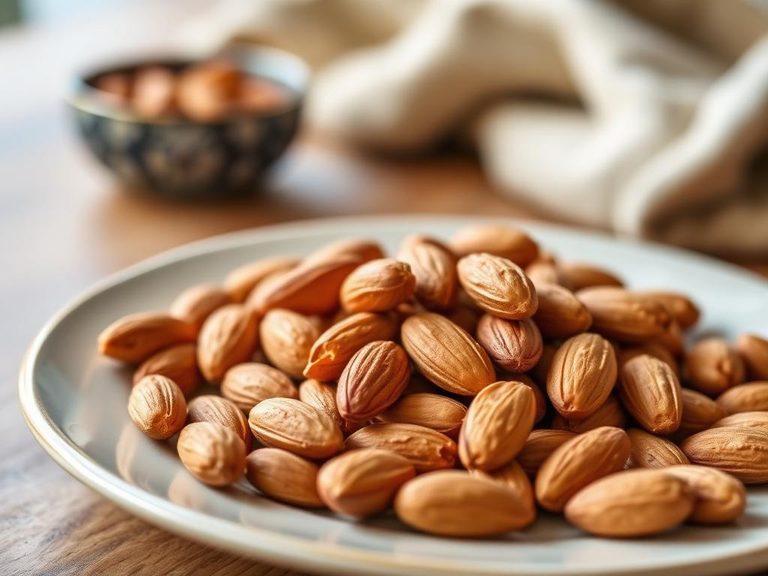
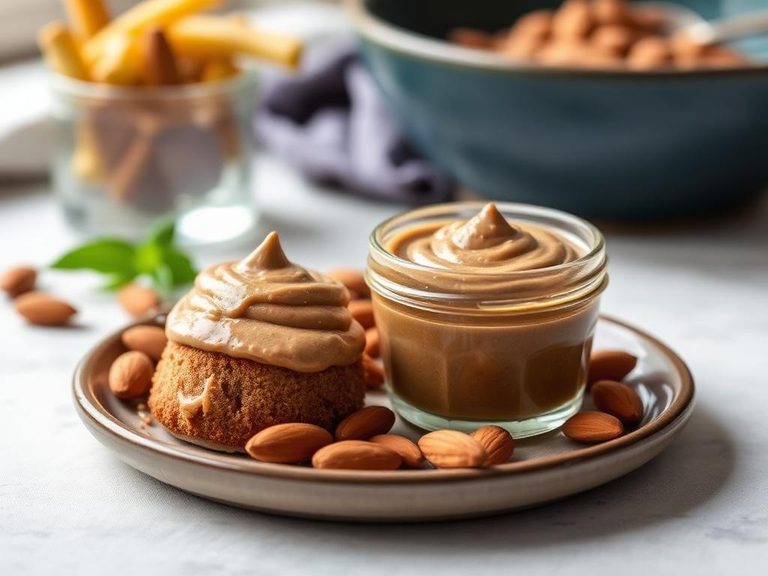



🌍 Where it's eaten
💡 Did you know?
Almonds are not true nuts but are botanically classified as drupes, with the edible seed we eat being the 'kernel' inside a fleshy fruit layer.
Full nutrition (USDA data · scales with serving)
| Water | 4.4 g |
| Energy | 579 kcal |
| Energy | 2423 kj |
| Protein | 21.1 g |
| Total lipid (fat) | 49.9 g |
| Ash | 3.0 g |
| Carbohydrate, by difference | 21.6 g |
| Fiber, total dietary | 12.5 g |
| Total Sugars | 4.3 g |
| Sucrose | 4.0 g |
| Glucose | 0.17 g |
| Fructose | 0.11 g |
| Lactose | 0.00 g |
| Maltose | 0.04 g |
| Galactose | 0.07 g |
| Starch | 0.72 g |
| Calcium, Ca | 269 mg |
| Iron, Fe | 3.7 mg |
| Magnesium, Mg | 270 mg |
| Phosphorus, P | 481 mg |
| Potassium, K | 733 mg |
| Sodium, Na | 1.0 mg |
| Zinc, Zn | 3.1 mg |
| Copper, Cu | 1.0 mg |
| Manganese, Mn | 2.2 mg |
| Selenium, Se | 4.1 ug |
| Vitamin C, total ascorbic acid | 0.00 mg |
| Thiamin | 0.20 mg |
| Riboflavin | 1.1 mg |
| Niacin | 3.6 mg |
| Pantothenic acid | 0.47 mg |
| Vitamin B-6 | 0.14 mg |
| Folate, total | 44.0 ug |
| Folic acid | 0.00 ug |
| Folate, food | 44.0 ug |
| Folate, DFE | 44.0 ug |
| Choline, total | 52.1 mg |
| Betaine | 0.50 mg |
| Vitamin B-12 | 0.00 ug |
| Vitamin B-12, added | 0.00 ug |
| Vitamin A, RAE | 0.00 ug |
| Retinol | 0.00 ug |
| Carotene, beta | 1.0 ug |
| Carotene, alpha | 0.00 ug |
| Cryptoxanthin, beta | 0.00 ug |
| Vitamin A, IU | 2.0 iu |
| Lycopene | 0.00 ug |
| Lutein + zeaxanthin | 1.0 ug |
| Vitamin E (alpha-tocopherol) | 25.6 mg |
| Vitamin E, added | 0.00 mg |
| Tocopherol, beta | 0.23 mg |
| Tocopherol, gamma | 0.64 mg |
| Tocopherol, delta | 0.07 mg |
| Vitamin D (D2 + D3), International Units | 0.00 iu |
| Vitamin D (D2 + D3) | 0.00 ug |
| Vitamin K (phylloquinone) | 0.00 ug |
| Vitamin K (Dihydrophylloquinone) | 0.00 ug |
| Alcohol, ethyl | 0.00 g |
| Caffeine | 0.00 mg |
| Theobromine | 0.00 mg |
Fat & fatty acid profile (per 100g)
| Fatty acids, total saturated | 3.8 g |
| SFA 4:0 | 0.00 g |
| SFA 6:0 | 0.00 g |
| SFA 8:0 | 0.00 g |
| SFA 10:0 | 0.00 g |
| SFA 12:0 | 0.00 g |
| SFA 13:0 | 0.00 g |
| SFA 14:0 | 0.00 g |
| SFA 15:0 | 0.00 g |
| SFA 16:0 | 3.1 g |
| SFA 17:0 | 0.00 g |
| SFA 18:0 | 0.70 g |
| SFA 20:0 | 0.01 g |
| SFA 22:0 | 0.00 g |
| SFA 24:0 | 0.00 g |
| Fatty acids, total monounsaturated | 31.6 g |
| MUFA 14:1 | 0.00 g |
| MUFA 15:1 | 0.00 g |
| MUFA 16:1 | 0.24 g |
| MUFA 16:1 c | 0.23 g |
| MUFA 17:1 | 0.01 g |
| MUFA 18:1 | 31.3 g |
| MUFA 18:1 c | 31.3 g |
| MUFA 20:1 | 0.01 g |
| MUFA 22:1 | 0.00 g |
| MUFA 24:1 c | 0.00 g |
| Fatty acids, total polyunsaturated | 12.3 g |
| PUFA 18:2 | 12.3 g |
| PUFA 18:2 n-6 c,c | 12.3 g |
| PUFA 18:2 CLAs | 0.00 g |
| PUFA 18:3 | 0.00 g |
| PUFA 18:3 n-3 c,c,c (ALA) | 0.00 g |
| PUFA 18:3 n-6 c,c,c | 0.00 g |
| PUFA 18:4 | 0.00 g |
| PUFA 20:2 n-6 c,c | 0.00 g |
| PUFA 20:3 | 0.00 g |
| PUFA 20:4 | 0.00 g |
| PUFA 20:5 n-3 (EPA) | 0.00 g |
| PUFA 22:5 n-3 (DPA) | 0.00 g |
| PUFA 22:6 n-3 (DHA) | 0.00 g |
| Fatty acids, total trans | 0.01 g |
| Fatty acids, total trans-monoenoic | 0.01 g |
| TFA 16:1 t | 0.01 g |
| TFA 18:1 t | 0.00 g |
| TFA 18:2 t not further defined | 0.00 g |
| Fatty acids, total trans-polyenoic | 0.00 g |
| Cholesterol | 0.00 mg |
| Stigmasterol | 4.0 mg |
| Campesterol | 5.0 mg |
| Beta-sitosterol | 130 mg |
Amino acid profile (per 100g)
| Tryptophan | 0.21 g |
| Threonine | 0.60 g |
| Isoleucine | 0.75 g |
| Leucine | 1.5 g |
| Lysine | 0.57 g |
| Methionine | 0.16 g |
| Cystine | 0.21 g |
| Phenylalanine | 1.1 g |
| Tyrosine | 0.45 g |
| Valine | 0.85 g |
| Arginine | 2.5 g |
| Histidine | 0.54 g |
| Alanine | 1.00 g |
| Aspartic acid | 2.6 g |
| Glutamic acid | 6.2 g |
| Glycine | 1.4 g |
| Proline | 0.97 g |
| Serine | 0.91 g |
FAQ
What's the difference between raw and roasted almonds?
Raw almonds are not heat-treated, preserving their natural enzymes and slightly softer texture. Roasting enhances their nutty flavor and crunch but can slightly reduce heat-sensitive nutrients like vitamin E.
Are almonds good for blood sugar?
Yes, their combination of protein, healthy fats, and fiber helps slow digestion and can moderate blood sugar spikes when eaten as part of a balanced meal.
Why are some almonds labeled 'blanched'?
Blanched almonds have been briefly boiled to remove their brown skins, resulting in a smoother texture and lighter color, ideal for pastries and marzipan.
Nutrient density (calculated · NRF9.3)
Nutrient Rich Foods index: beneficial nutrients (protein, fiber, vitamins, minerals) minus saturated fat, added sugar & sodium, per 100 kcal.
NRF9.3 index — Fulgoni, Keast & Drewnowski, 2009. Computed from USDA nutrients.
Weight-loss friendliness (composite index)
Energy density 5.79 kcal/g · 15% calories from protein · 12.5 g fiber · 4.3 g sugar per 100 g.
Composite of energy density (Rolls et al., 1999), protein & fiber satiety, minus sugar. A calculated heuristic — ranks satiety-per-calorie, not a clinical measure.
Dietary load (calculated from USDA values)
Potential renal acid load. Positive = acid-forming, negative = alkaline-forming.
Sodium-to-potassium ratio: 0.00 (lower is better — aim for ≤ 1)
Sodium:potassium per WHO potassium guidance. Computed from USDA nutrients.