

Feijoa, raw
Whole food · Fruits and Fruit Juices

Photo: Wikipedia
Feijoa, also known as pineapple guava, is a fragrant, egg-sized fruit with a gritty, juicy flesh that tastes like a blend of pineapple, guava, and mint. Its skin is tough and inedible, but the creamy, seed-filled interior is a burst of sweet-tart, aromatic flavor. Nutritionally, it's a low-calorie powerhouse, offering more fiber (6.4g) than sugar (8.2g) per 100g, which is unusual for a fruit.
Calorie split: 4% protein · 90% carbs · 6% fat
↓ Full nutrition💚 Why it's loved
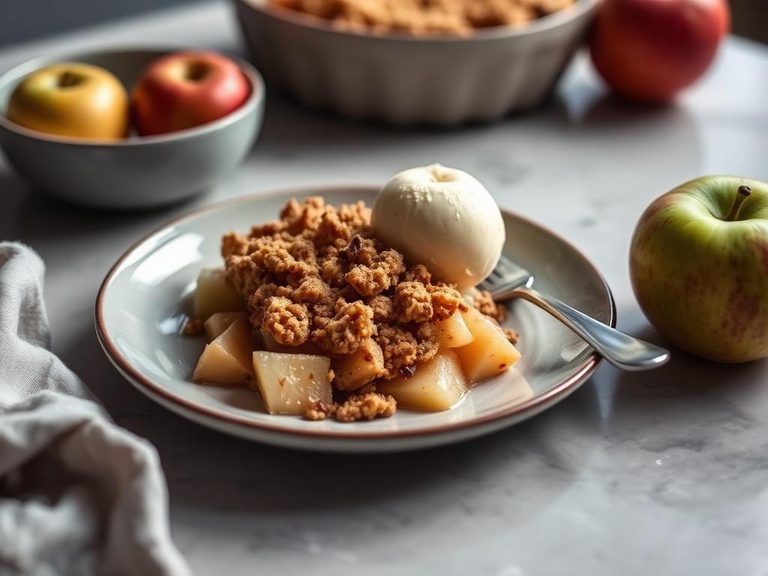
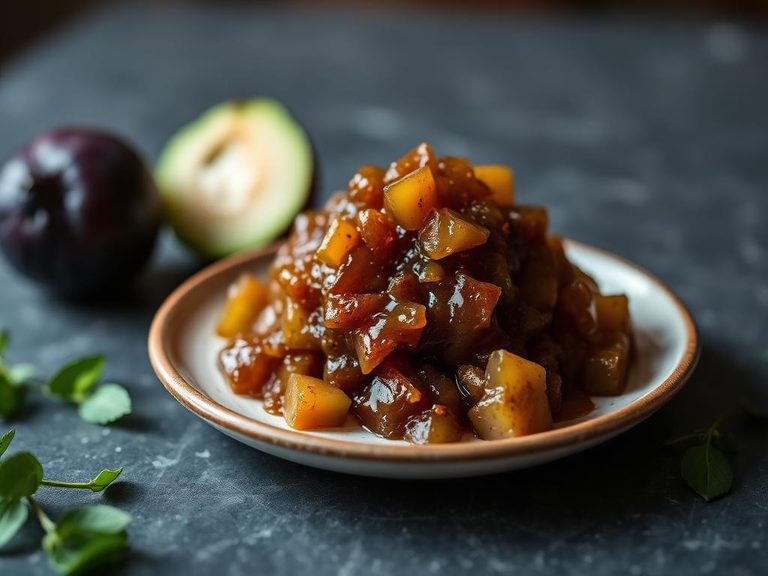
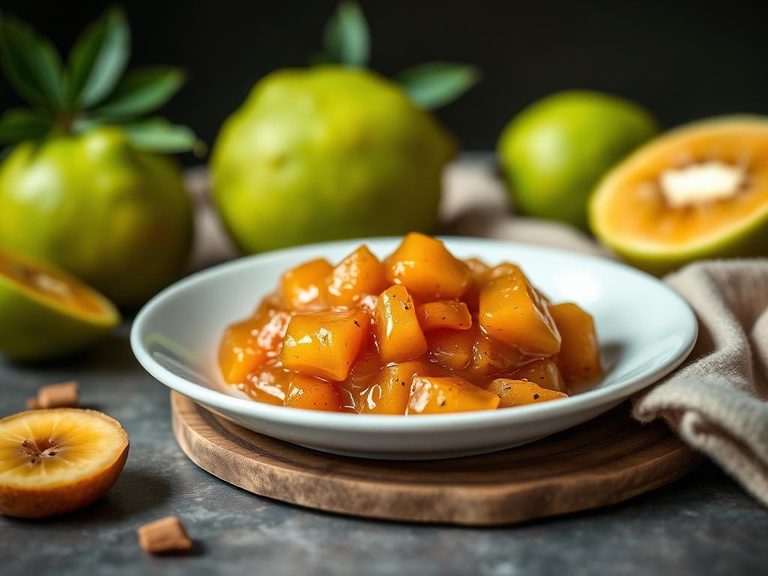
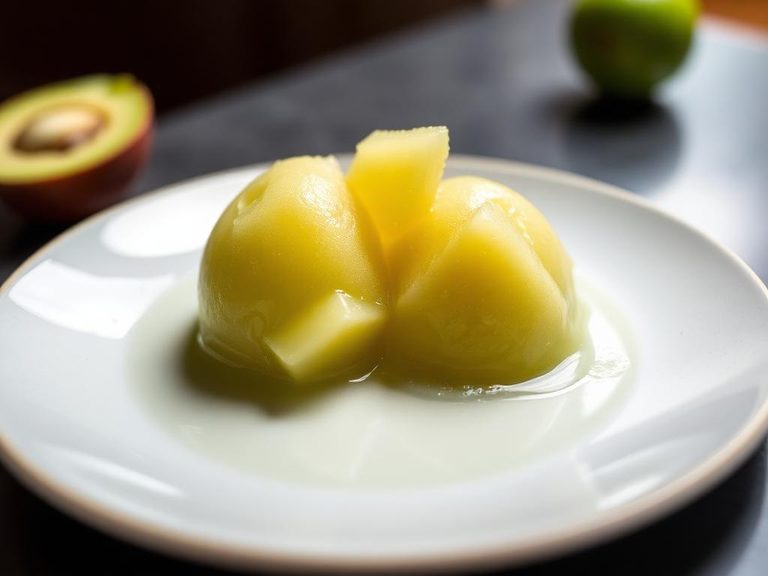
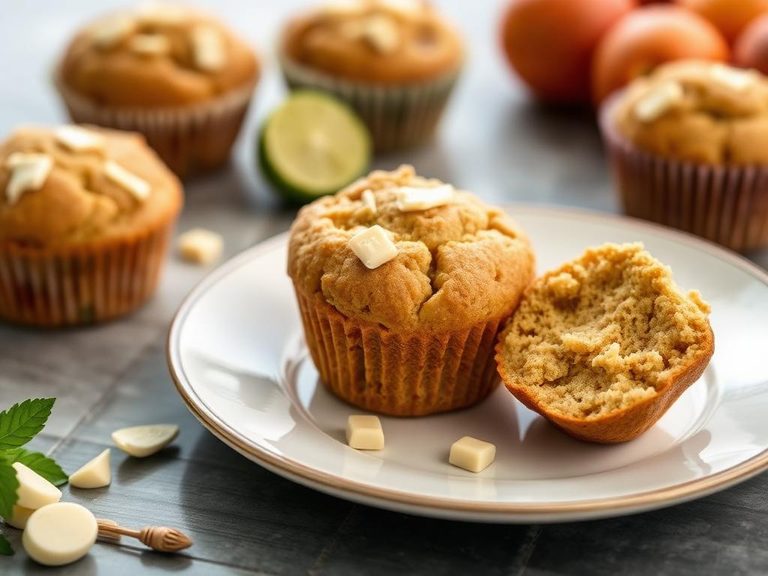
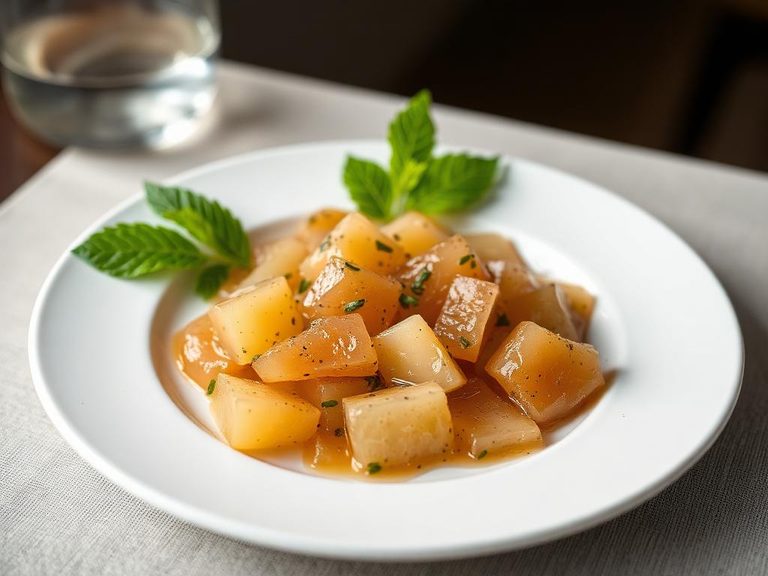
People adore feijoa for its intensely fragrant, complex flavor that transports you to a tropical garden. Its versatility is celebrated—it can be eaten fresh, baked into desserts, or fermented into wine and vinegar, making it a seasonal highlight in many cultures.
⚠️ Watch-outs & how to enjoy it better
The fruit's short season and perishability can make it hard to find fresh outside its growing regions. Its gritty texture from stone cells and strong, perfume-like aroma can be polarizing for some palates. To enjoy it, pair the sweet flesh with a protein or fat like yogurt or nuts to balance its natural sugars, and consume it ripe for the best flavor.
Key benefits
- High in dietary fiber for digestive health.
- Rich in vitamin C, an antioxidant.
- Contains unique aromatic compounds like esters and aldehydes.
- Good source of folate (vitamin B9).
- Provides minerals like potassium and magnesium.
🍽️ Popular dishes
🌍 Where it's eaten
💡 Did you know?
The flower of the feijoa plant is edible and has a sweet, spicy taste, often eaten in salads in its native South America.
Full nutrition (USDA data · scales with serving)
| Water | 83.3 g |
| Energy | 61.0 kcal |
| Energy | 254 kj |
| Protein | 0.71 g |
| Total lipid (fat) | 0.42 g |
| Ash | 0.38 g |
| Carbohydrate, by difference | 15.2 g |
| Fiber, total dietary | 6.4 g |
| Total Sugars | 8.2 g |
| Sucrose | 2.9 g |
| Glucose | 2.3 g |
| Fructose | 3.0 g |
| Lactose | 0.00 g |
| Maltose | 0.00 g |
| Galactose | 0.00 g |
| Starch | 0.00 g |
| Calcium, Ca | 17.0 mg |
| Iron, Fe | 0.14 mg |
| Magnesium, Mg | 9.0 mg |
| Phosphorus, P | 19.0 mg |
| Potassium, K | 172 mg |
| Sodium, Na | 3.0 mg |
| Zinc, Zn | 0.06 mg |
| Copper, Cu | 0.04 mg |
| Manganese, Mn | 0.08 mg |
| Vitamin C, total ascorbic acid | 32.9 mg |
| Thiamin | 0.01 mg |
| Riboflavin | 0.02 mg |
| Niacin | 0.29 mg |
| Pantothenic acid | 0.23 mg |
| Vitamin B-6 | 0.07 mg |
| Folate, total | 23.0 ug |
| Folic acid | 0.00 ug |
| Folate, food | 23.0 ug |
| Folate, DFE | 23.0 ug |
| Vitamin B-12 | 0.00 ug |
| Vitamin A, RAE | 0.00 ug |
| Retinol | 0.00 ug |
| Carotene, beta | 2.0 ug |
| Carotene, alpha | 0.00 ug |
| Cryptoxanthin, beta | 3.0 ug |
| Vitamin A, IU | 6.0 iu |
| Lycopene | 5.0 ug |
| Lutein + zeaxanthin | 27.0 ug |
| Vitamin E (alpha-tocopherol) | 0.16 mg |
| Tocopherol, beta | 0.00 mg |
| Tocopherol, gamma | 0.03 mg |
| Tocopherol, delta | 0.00 mg |
| Tocotrienol, alpha | 0.00 mg |
| Tocotrienol, beta | 0.00 mg |
| Tocotrienol, gamma | 0.01 mg |
| Tocotrienol, delta | 0.00 mg |
| Vitamin K (phylloquinone) | 3.5 ug |
| Vitamin K (Dihydrophylloquinone) | 0.00 ug |
| Vitamin K (Menaquinone-4) | 0.00 ug |
Fat & fatty acid profile (per 100g)
| Fatty acids, total saturated | 0.10 g |
| SFA 4:0 | 0.00 g |
| SFA 6:0 | 0.00 g |
| SFA 8:0 | 0.00 g |
| SFA 10:0 | 0.00 g |
| SFA 12:0 | 0.00 g |
| SFA 14:0 | 0.00 g |
| SFA 15:0 | 0.00 g |
| SFA 16:0 | 0.07 g |
| SFA 17:0 | 0.00 g |
| SFA 18:0 | 0.01 g |
| SFA 20:0 | 0.00 g |
| SFA 22:0 | 0.00 g |
| SFA 24:0 | 0.00 g |
| Fatty acids, total monounsaturated | 0.06 g |
| MUFA 14:1 | 0.00 g |
| MUFA 15:1 | 0.00 g |
| MUFA 16:1 | 0.00 g |
| MUFA 16:1 c | 0.00 g |
| MUFA 17:1 | 0.00 g |
| MUFA 18:1 | 0.06 g |
| MUFA 18:1 c | 0.06 g |
| MUFA 20:1 | 0.00 g |
| MUFA 22:1 | 0.00 g |
| MUFA 22:1 c | 0.00 g |
| MUFA 24:1 c | 0.00 g |
| Fatty acids, total polyunsaturated | 0.14 g |
| PUFA 18:2 | 0.11 g |
| PUFA 18:2 n-6 c,c | 0.11 g |
| PUFA 18:2 CLAs | 0.00 g |
| PUFA 18:3 | 0.03 g |
| PUFA 18:3 n-3 c,c,c (ALA) | 0.03 g |
| PUFA 18:3 n-6 c,c,c | 0.00 g |
| PUFA 18:4 | 0.00 g |
| PUFA 20:2 n-6 c,c | 0.00 g |
| PUFA 20:3 | 0.00 g |
| PUFA 20:3 n-3 | 0.00 g |
| PUFA 20:3 n-6 | 0.00 g |
| PUFA 20:4 | 0.00 g |
| PUFA 20:5 n-3 (EPA) | 0.00 g |
| PUFA 22:4 | 0.00 g |
| PUFA 22:5 n-3 (DPA) | 0.00 g |
| PUFA 22:6 n-3 (DHA) | 0.00 g |
| Fatty acids, total trans | 0.00 g |
| Fatty acids, total trans-monoenoic | 0.00 g |
| TFA 16:1 t | 0.00 g |
| TFA 18:1 t | 0.00 g |
| TFA 22:1 t | 0.00 g |
| TFA 18:2 t not further defined | 0.00 g |
| Fatty acids, total trans-polyenoic | 0.00 g |
| Cholesterol | 0.00 mg |
Amino acid profile (per 100g)
| Tryptophan | 0.01 g |
| Threonine | 0.02 g |
| Isoleucine | 0.02 g |
| Leucine | 0.03 g |
| Lysine | 0.04 g |
| Methionine | 0.01 g |
| Cystine | 0.01 g |
| Phenylalanine | 0.02 g |
| Tyrosine | 0.01 g |
| Valine | 0.02 g |
| Arginine | 0.02 g |
| Histidine | 0.01 g |
| Alanine | 0.04 g |
| Aspartic acid | 0.07 g |
| Glutamic acid | 0.13 g |
| Glycine | 0.03 g |
| Proline | 0.02 g |
| Serine | 0.03 g |
FAQ
How do you know when a feijoa is ripe?
A ripe feijoa will be slightly soft to gentle pressure (like a ripe avocado) and will drop from the tree naturally. Its skin may show slight wrinkling. Unripe fruit is hard and astringent.
Can you eat the skin of a feijoa?
While technically edible, the skin is tough, bitter, and not typically eaten. Most people scoop out the soft flesh with a spoon or cut the fruit in half.
What's the best way to store feijoas?
Store ripe feijoas at room temperature for 2-3 days, or in the refrigerator crisper drawer for up to a week. They can also be frozen, halved or pureed, for months of use.
Nutrient density (calculated · NRF9.3)
Nutrient Rich Foods index: beneficial nutrients (protein, fiber, vitamins, minerals) minus saturated fat, added sugar & sodium, per 100 kcal.
NRF9.3 index — Fulgoni, Keast & Drewnowski, 2009. Computed from USDA nutrients.
Weight-loss friendliness (composite index)
Energy density 0.61 kcal/g · 5% calories from protein · 6.4 g fiber · 8.2 g sugar per 100 g.
Composite of energy density (Rolls et al., 1999), protein & fiber satiety, minus sugar. A calculated heuristic — ranks satiety-per-calorie, not a clinical measure.
Dietary load (calculated from USDA values)
Potential renal acid load. Positive = acid-forming, negative = alkaline-forming.
Sodium-to-potassium ratio: 0.02 (lower is better — aim for ≤ 1)
Sodium:potassium per WHO potassium guidance. Computed from USDA nutrients.