

Bananas, ripe and slightly ripe, raw
Whole food · Fruits and Fruit Juices
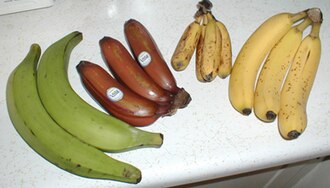
Photo: Wikipedia
A banana at its peak, offering a creamy, custard-like texture and a sweet, mellow flavor with hints of vanilla and honey. Its vibrant yellow peel, often speckled with brown, signals the perfect balance of starches converted to natural sugars. Nutritionally, it's a powerhouse of quick-release energy, providing 97 kcal and 23g of carbohydrates per 100g, making it an ideal natural fuel source.
Calorie split: 3% protein · 94% carbs · 3% fat
↓ Full nutrition💚 Why it's loved
People adore bananas for their unparalleled convenience—no utensils needed, just peel and eat. Their naturally sweet, comforting flavor and creamy texture make them a universal favorite, from a child's lunchbox to a post-workout recovery snack, deeply woven into global food culture.
⚠️ Watch-outs & how to enjoy it better
Due to their high carbohydrate and natural sugar content, ripe bananas can cause a rapid blood-sugar spike, which is a concern for individuals managing diabetes. To counteract this, pair a banana with a source of protein or healthy fat, like a handful of almonds or a dollop of peanut butter, to slow sugar absorption and promote satiety.
Key benefits
- Excellent source of quick, natural energy from easily digestible carbohydrates
- Provides dietary fiber (1.7g per 100g) to support digestive regularity
- Contains potassium, an essential mineral for muscle function and blood pressure regulation
- Rich in vitamin B6, which aids in metabolism and brain health
- Naturally fat-free and cholesterol-free, making it a heart-healthy snack
🍽️ Popular dishes

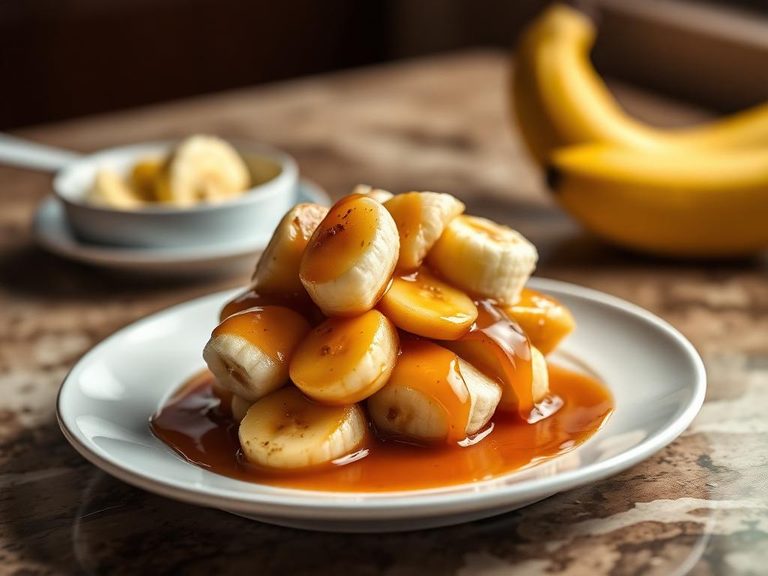
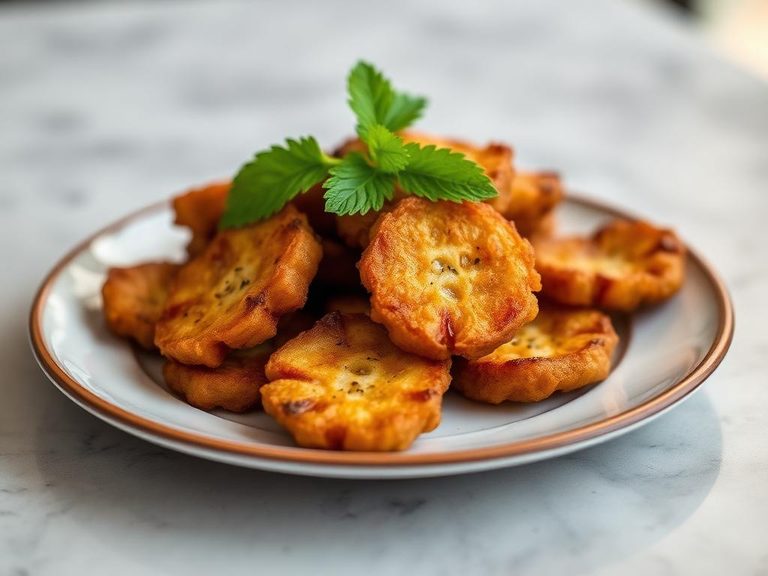
🌍 Where it's eaten
💡 Did you know?
Bananas are technically berries, while strawberries are not, because a berry develops from a single ovary and contains seeds embedded in the flesh.
Full nutrition (USDA data · scales with serving)
| Water | 75.3 g |
| Energy (Atwater General Factors) | 98.0 kcal |
| Energy (Atwater Specific Factors) | 88.0 kcal |
| Energy | 97.0 kcal |
| Energy | 408 kj |
| Nitrogen | 0.12 g |
| Protein | 0.74 g |
| Total lipid (fat) | 0.29 g |
| Ash | 0.70 g |
| Carbohydrate, by difference | 23.0 g |
| Carbohydrate, by summation | 21.2 g |
| Fiber, total dietary | 1.7 g |
| Total dietary fiber (AOAC 2011.25) | 4.6 g |
| Sugars, Total | 15.8 g |
| Sucrose | 4.2 g |
| Glucose | 5.5 g |
| Fructose | 6.1 g |
| Lactose | 0.00 g |
| Maltose | 0.00 g |
| Galactose | 0.00 g |
| Starch | 3.7 g |
| Citric acid | 341 mg |
| Malic acid | 369 mg |
| Calcium, Ca | 5.0 mg |
| Iron, Fe | 0.00 mg |
| Magnesium, Mg | 28.0 mg |
| Phosphorus, P | 22.0 mg |
| Potassium, K | 326 mg |
| Sodium, Na | 0.00 mg |
| Zinc, Zn | 0.16 mg |
| Copper, Cu | 0.10 mg |
| Manganese, Mn | 0.26 mg |
| Iodine, I | 0.00 ug |
| Selenium, Se | 0.00 ug |
| Vitamin C, total ascorbic acid | 12.3 mg |
| Thiamin | 0.06 mg |
| Riboflavin | 0.00 mg |
| Niacin | 0.66 mg |
| Vitamin B-6 | 0.21 mg |
| Biotin | 0.00 ug |
| Folate, total | 14.0 ug |
| Vitamin A, RAE | 1.0 ug |
| Carotene, beta | 8.0 ug |
| cis-beta-Carotene | 1.0 ug |
| trans-beta-Carotene | 7.0 ug |
| Carotene, alpha | 7.0 ug |
| Cryptoxanthin, beta | 0.00 ug |
| Cryptoxanthin, alpha | 0.00 ug |
| cis-Lycopene | 0.00 ug |
| trans-Lycopene | 0.00 ug |
| cis-Lutein/Zeaxanthin | 0.00 ug |
| Vitamin K (phylloquinone) | 0.10 ug |
| Vitamin K (Dihydrophylloquinone) | 0.00 ug |
| Vitamin K (Menaquinone-4) | 0.00 ug |
Fat & fatty acid profile (per 100g)
Estimated from Bananas, dehydrated, or banana powder — USDA does not publish this profile for Bananas.
| Fatty acids, total saturated | 0.70 g |
| SFA 4:0 | 0.00 g |
| SFA 6:0 | 0.00 g |
| SFA 8:0 | 0.00 g |
| SFA 10:0 | 0.01 g |
| SFA 12:0 | 0.01 g |
| SFA 14:0 | 0.01 g |
| SFA 16:0 | 0.47 g |
| SFA 18:0 | 0.02 g |
| Fatty acids, total monounsaturated | 0.15 g |
| MUFA 16:1 | 0.04 g |
| MUFA 18:1 | 0.10 g |
| MUFA 20:1 | 0.00 g |
| MUFA 22:1 | 0.00 g |
| Fatty acids, total polyunsaturated | 0.34 g |
| PUFA 18:2 | 0.21 g |
| PUFA 18:3 | 0.13 g |
| PUFA 18:4 | 0.00 g |
| PUFA 20:4 | 0.00 g |
| PUFA 20:5 n-3 (EPA) | 0.00 g |
| PUFA 22:5 n-3 (DPA) | 0.00 g |
| PUFA 22:6 n-3 (DHA) | 0.00 g |
| Cholesterol | 0.00 mg |
Amino acid profile (per 100g)
Estimated from Bananas, dehydrated, or banana powder — USDA does not publish this profile for Bananas.
| Threonine | 0.17 g |
| Isoleucine | 0.17 g |
| Leucine | 0.36 g |
| Lysine | 0.16 g |
| Methionine | 0.07 g |
| Cystine | 0.06 g |
| Phenylalanine | 0.20 g |
| Tyrosine | 0.12 g |
| Valine | 0.28 g |
| Arginine | 0.18 g |
| Histidine | 0.33 g |
| Alanine | 0.22 g |
| Aspartic acid | 0.50 g |
| Glutamic acid | 0.40 g |
| Glycine | 0.19 g |
| Proline | 0.23 g |
| Serine | 0.23 g |
FAQ
What's the difference between a ripe and slightly ripe banana?
A slightly ripe banana is firmer, less sweet, and higher in resistant starch, which acts as a prebiotic. A fully ripe banana is softer, sweeter, and easier to digest as starches have converted to sugar.
How should I store bananas to slow ripening?
Store bananas at room temperature, away from direct sunlight. To slow ripening further, you can separate the bunch or wrap the stems in plastic wrap. Once ripe, they can be refrigerated for a few days; the peel will brown, but the fruit inside will remain firm.
Are bananas a good source of sugar?
Yes, bananas contain natural sugars (glucose, fructose, sucrose) that provide quick energy. However, they also contain fiber, which helps moderate the blood sugar response compared to refined sugars.
Nutrient density (calculated · NRF9.3)
Nutrient Rich Foods index: beneficial nutrients (protein, fiber, vitamins, minerals) minus saturated fat, added sugar & sodium, per 100 kcal.
NRF9.3 index — Fulgoni, Keast & Drewnowski, 2009. Computed from USDA nutrients.
Weight-loss friendliness (composite index)
Energy density 0.97 kcal/g · 3% calories from protein · 1.7 g fiber · 0.0 g sugar per 100 g.
Composite of energy density (Rolls et al., 1999), protein & fiber satiety, minus sugar. A calculated heuristic — ranks satiety-per-calorie, not a clinical measure.
Dietary load (calculated from USDA values)
Potential renal acid load. Positive = acid-forming, negative = alkaline-forming.
Sodium-to-potassium ratio: 0.00 (lower is better — aim for ≤ 1)
Sodium:potassium per WHO potassium guidance. Computed from USDA nutrients.