

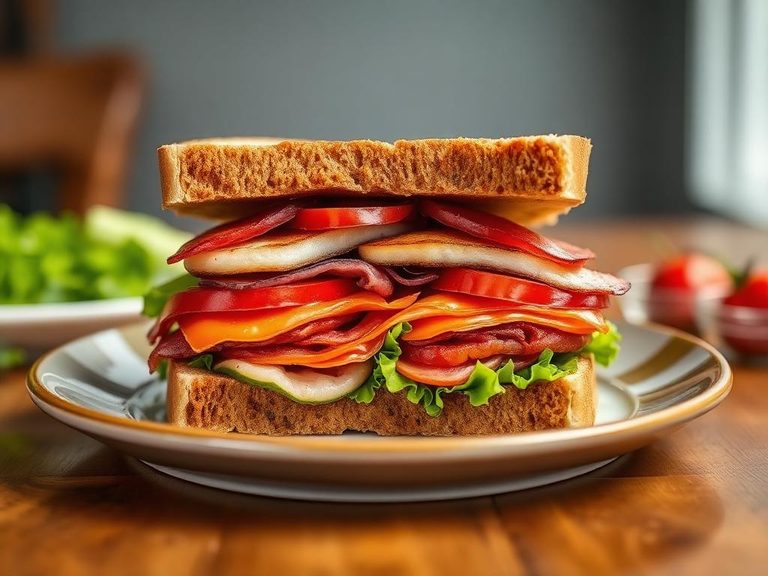
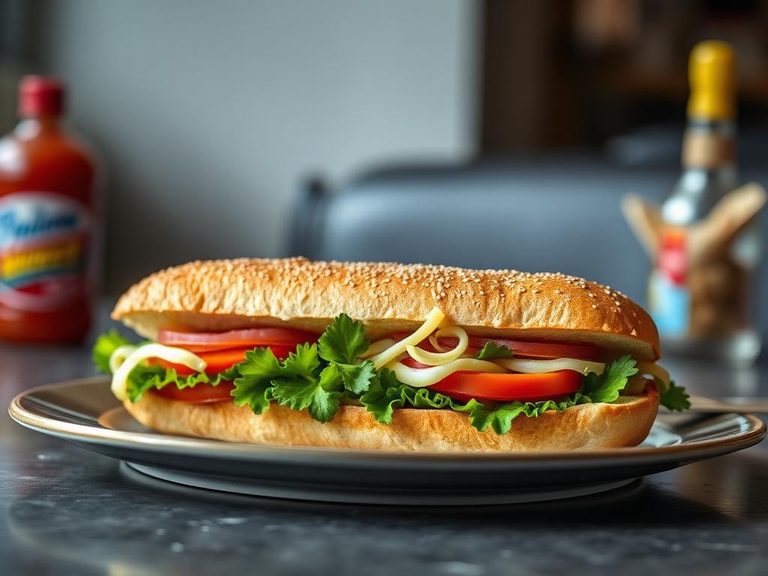
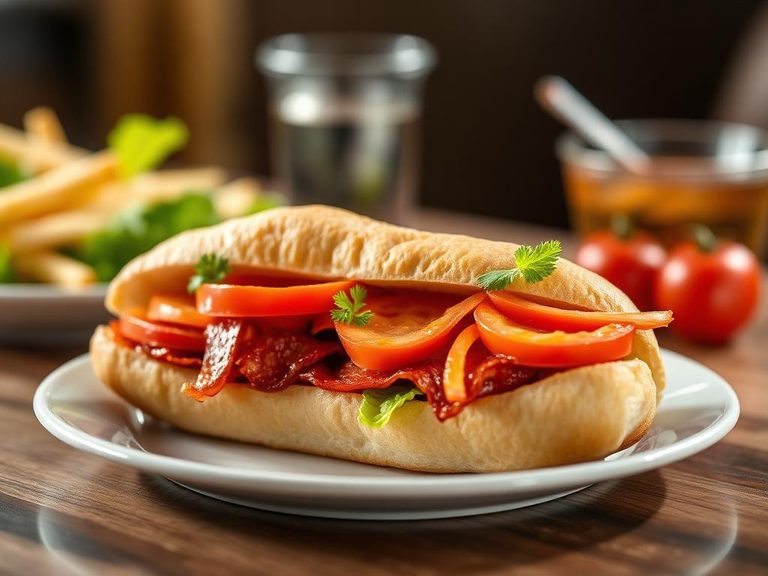
Fast foods, submarine sandwich, bacon, lettuce, and tomato on white bread
Whole food · Fast Foods

Photo: Wikipedia
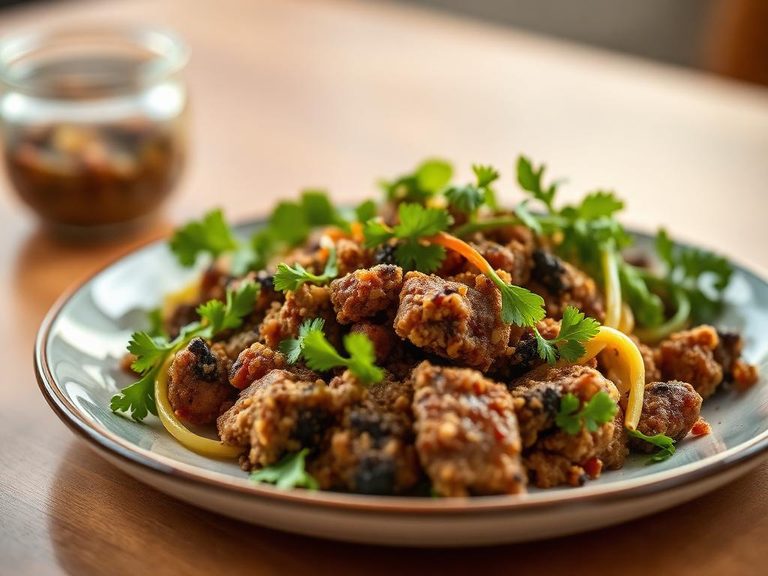
This is a classic American submarine sandwich, a handheld meal built on a soft white hoagie roll. It features crispy bacon, fresh iceberg lettuce, and ripe tomato, delivering a satisfying crunch and a savory, smoky flavor profile. Nutritionally, it offers a moderate 205 calories per 100 grams, with a balance of protein from the bacon and carbohydrates from the bread.
Calorie split: 20% protein · 52% carbs · 28% fat
↓ Full nutrition💚 Why it's loved
People love it for the iconic, satisfying combination of salty, smoky bacon with cool, crisp lettuce and juicy tomato, all held together by soft bread. It's a nostalgic, comforting staple of American deli and lunch counter culture.
⚠️ Watch-outs & how to enjoy it better
The white bread and processed bacon can contribute to blood-sugar spikes and high sodium intake. Those watching their blood sugar or sodium should pair it with a side salad or vegetables, opt for whole-grain bread if available, and enjoy it as an occasional treat rather than a daily meal.
Key benefits
- Provides quick energy from carbohydrates in the white bread.
- Offers a good source of protein (10.06g per 100g) from the bacon.
- Contains fresh vegetables (lettuce, tomato) for some vitamins and fiber.
- Convenient and portable meal option.
🍽️ Popular dishes

🌍 Where it's eaten
💡 Did you know?
The classic BLT sandwich's popularity surged in the 1920s after the development of the modern greenhouse allowed for year-round tomato cultivation.
Full nutrition (USDA data · scales with serving)
| Water | 55.0 g |
| Energy | 205 kcal |
| Energy | 856 kj |
| Protein | 10.1 g |
| Total lipid (fat) | 6.4 g |
| Ash | 1.8 g |
| Carbohydrate, by difference | 26.7 g |
| Fiber, total dietary | 1.6 g |
| Total Sugars | 3.6 g |
| Sucrose | 0.00 g |
| Glucose | 1.1 g |
| Fructose | 1.7 g |
| Lactose | 0.00 g |
| Maltose | 0.82 g |
| Galactose | 0.00 g |
| Starch | 20.1 g |
| Calcium, Ca | 210 mg |
| Iron, Fe | 2.1 mg |
| Magnesium, Mg | 22.0 mg |
| Phosphorus, P | 101 mg |
| Potassium, K | 186 mg |
| Sodium, Na | 354 mg |
| Zinc, Zn | 0.96 mg |
| Copper, Cu | 0.10 mg |
| Manganese, Mn | 0.38 mg |
| Selenium, Se | 23.2 ug |
| Vitamin C, total ascorbic acid | 1.3 mg |
| Thiamin | 0.41 mg |
| Riboflavin | 0.28 mg |
| Niacin | 4.8 mg |
| Pantothenic acid | 0.43 mg |
| Vitamin B-6 | 0.10 mg |
| Folate, total | 89.0 ug |
| Folic acid | 65.0 ug |
| Folate, food | 25.0 ug |
| Folate, DFE | 135 ug |
| Choline, total | 16.4 mg |
| Vitamin B-12 | 0.18 ug |
| Vitamin B-12, added | 0.00 ug |
| Vitamin A, RAE | 3.0 ug |
| Retinol | 0.00 ug |
| Carotene, beta | 42.0 ug |
| Carotene, alpha | 0.00 ug |
| Cryptoxanthin, beta | 0.00 ug |
| Vitamin A, IU | 70.0 iu |
| Lycopene | 195 ug |
| Lutein + zeaxanthin | 72.0 ug |
| Vitamin E (alpha-tocopherol) | 0.29 mg |
| Vitamin E, added | 0.00 mg |
| Tocopherol, beta | 0.07 mg |
| Tocopherol, gamma | 0.56 mg |
| Tocopherol, delta | 0.17 mg |
| Tocotrienol, alpha | 0.00 mg |
| Tocotrienol, beta | 0.40 mg |
| Tocotrienol, gamma | 0.00 mg |
| Tocotrienol, delta | 0.00 mg |
| Vitamin D (D2 + D3), International Units | 1.0 iu |
| Vitamin D (D2 + D3) | 0.00 ug |
| Vitamin K (phylloquinone) | 6.4 ug |
| Alcohol, ethyl | 0.00 g |
| Caffeine | 0.00 mg |
| Theobromine | 0.00 mg |
Fat & fatty acid profile (per 100g)
| Fatty acids, total saturated | 1.9 g |
| SFA 4:0 | 0.00 g |
| SFA 6:0 | 0.00 g |
| SFA 8:0 | 0.00 g |
| SFA 10:0 | 0.00 g |
| SFA 12:0 | 0.00 g |
| SFA 14:0 | 0.06 g |
| SFA 15:0 | 0.00 g |
| SFA 16:0 | 1.3 g |
| SFA 17:0 | 0.01 g |
| SFA 18:0 | 0.55 g |
| SFA 20:0 | 0.01 g |
| SFA 22:0 | 0.01 g |
| SFA 24:0 | 0.00 g |
| Fatty acids, total monounsaturated | 2.4 g |
| MUFA 14:1 | 0.00 g |
| MUFA 15:1 | 0.00 g |
| MUFA 16:1 | 0.12 g |
| MUFA 16:1 c | 0.12 g |
| MUFA 17:1 | 0.01 g |
| MUFA 18:1 | 2.2 g |
| MUFA 18:1 c | 2.2 g |
| MUFA 20:1 | 0.04 g |
| MUFA 22:1 | 0.00 g |
| MUFA 22:1 c | 0.00 g |
| MUFA 24:1 c | 0.00 g |
| Fatty acids, total polyunsaturated | 1.6 g |
| PUFA 18:2 | 1.4 g |
| PUFA 18:2 n-6 c,c | 1.4 g |
| PUFA 18:2 CLAs | 0.01 g |
| PUFA 18:3 | 0.10 g |
| PUFA 18:3 n-3 c,c,c (ALA) | 0.10 g |
| PUFA 18:3 n-6 c,c,c | 0.00 g |
| PUFA 18:3i | 0.00 g |
| PUFA 18:4 | 0.00 g |
| PUFA 20:2 n-6 c,c | 0.03 g |
| PUFA 20:3 | 0.01 g |
| PUFA 20:3 n-3 | 0.00 g |
| PUFA 20:3 n-6 | 0.01 g |
| PUFA 20:4 | 0.02 g |
| PUFA 20:5 n-3 (EPA) | 0.00 g |
| PUFA 22:4 | 0.01 g |
| PUFA 22:5 n-3 (DPA) | 0.00 g |
| PUFA 22:6 n-3 (DHA) | 0.00 g |
| Fatty acids, total trans | 0.03 g |
| Fatty acids, total trans-monoenoic | 0.02 g |
| TFA 16:1 t | 0.00 g |
| TFA 18:1 t | 0.02 g |
| TFA 22:1 t | 0.00 g |
| TFA 18:2 t not further defined | 0.01 g |
| Fatty acids, total trans-polyenoic | 0.01 g |
| Cholesterol | 13.0 mg |
Amino acid profile (per 100g)
Estimated from Fast foods, english muffin, with egg, cheese, and sausage — USDA does not publish this profile for Fast foods.
| Tryptophan | 0.16 g |
| Threonine | 0.52 g |
| Isoleucine | 0.54 g |
| Leucine | 0.98 g |
| Lysine | 0.75 g |
| Methionine | 0.29 g |
| Cystine | 0.20 g |
| Phenylalanine | 0.59 g |
| Tyrosine | 0.41 g |
| Valine | 0.65 g |
| Arginine | 0.65 g |
| Histidine | 0.33 g |
| Alanine | 0.60 g |
| Aspartic acid | 1.1 g |
| Glutamic acid | 2.5 g |
| Glycine | 0.54 g |
| Proline | 0.90 g |
| Serine | 0.70 g |
FAQ
Is a BLT considered a healthy sandwich?
It's a mixed bag. While it provides protein and some fresh vegetables, the white bread, bacon (high in sodium and saturated fat), and any added mayo can make it less healthy. Its nutritional value depends heavily on portion size and specific ingredients used.
Can I make a BLT with different bread?
Absolutely! While white hoagie rolls are traditional, BLTs are versatile. Popular alternatives include whole-grain bread for more fiber, sourdough for tang, or even a lettuce wrap for a low-carb version.
What is the best way to keep a BLT from getting soggy?
To prevent sogginess, assemble it just before eating. Pat the tomato slices dry, place the lettuce between the bread and the tomato/bacon to create a moisture barrier, and avoid adding mayonnaise directly to the bread if packing it for later.
Nutrient density (calculated · NRF9.3)
Nutrient Rich Foods index: beneficial nutrients (protein, fiber, vitamins, minerals) minus saturated fat, added sugar & sodium, per 100 kcal.
NRF9.3 index — Fulgoni, Keast & Drewnowski, 2009. Computed from USDA nutrients.
Weight-loss friendliness (composite index)
Energy density 2.05 kcal/g · 20% calories from protein · 1.6 g fiber · 3.6 g sugar per 100 g.
Composite of energy density (Rolls et al., 1999), protein & fiber satiety, minus sugar. A calculated heuristic — ranks satiety-per-calorie, not a clinical measure.
Dietary load (calculated from USDA values)
Potential renal acid load. Positive = acid-forming, negative = alkaline-forming.
Sodium-to-potassium ratio: 1.90 (lower is better — aim for ≤ 1)
Sodium:potassium per WHO potassium guidance. Computed from USDA nutrients.