

Fast Food, Pizza Chain, 14" pizza, cheese topping, regular crust
Whole food · Fast Foods

Photo: Wikipedia
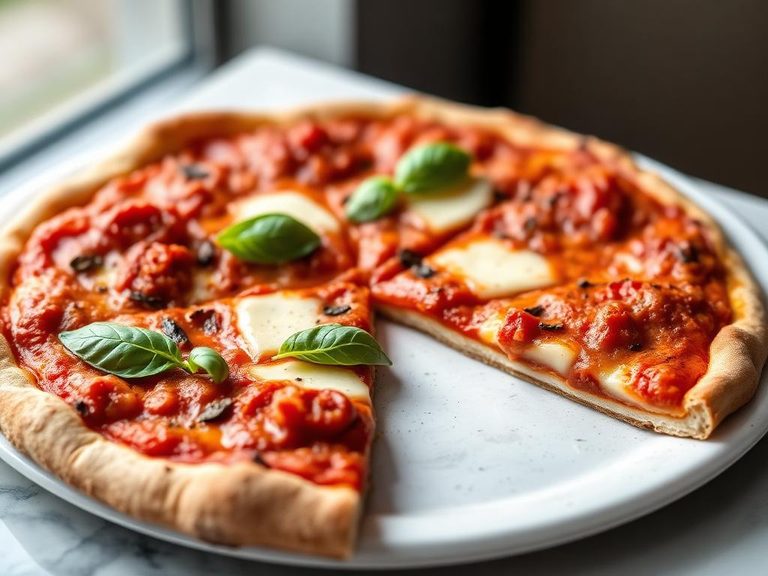
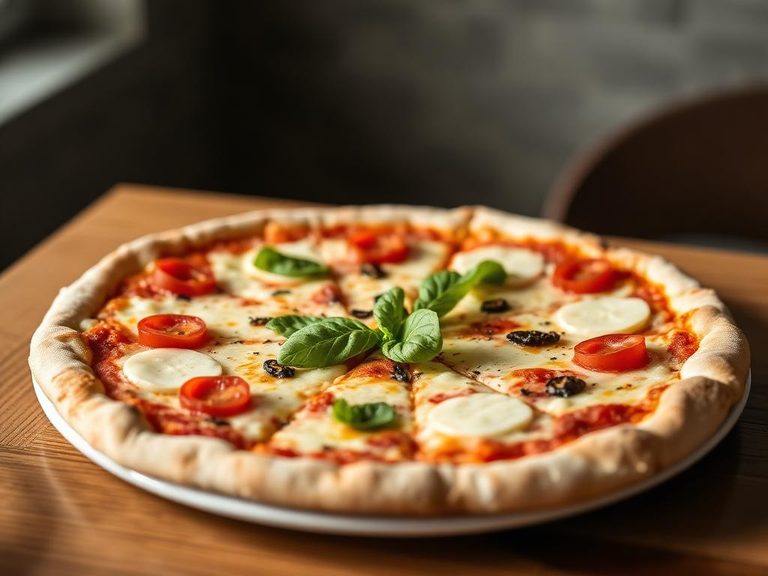
This is a classic, crowd-pleasing slice from a major pizza chain, featuring a simple cheese topping on a standard, bready crust. The texture offers a satisfying chew from the dough, a slight crisp on the bottom, and a stretchy, savory layer of melted mozzarella. Nutritionally, it's a dense source of energy, delivering a moderate amount of protein alongside a significant load of carbohydrates from the refined flour crust.
Calorie split: 17% protein · 50% carbs · 33% fat
↓ Full nutrition💚 Why it's loved
People love it for its perfect, simple harmony of salty, savory cheese, tangy tomato sauce, and bready crust—a flavor profile that's deeply comforting and nostalgic. Its versatility makes it a universal go-to for everything from solo dinners to large social gatherings.
⚠️ Watch-outs & how to enjoy it better
The refined white flour crust can cause rapid blood-sugar spikes, and the meal is often high in sodium and saturated fat, which should be monitored. To counteract this, pair a slice with a large, leafy green salad dressed with olive oil to add fiber and healthy fats, or opt for a thin-crust version and limit yourself to one or two slices.
Key benefits
- Provides a quick, convenient source of energy (calories) and satiety.
- Offers a moderate dose of protein from the cheese and wheat gluten.
- Contains calcium and phosphorus from the dairy component.
- A familiar, comforting food that can support social bonding.
- The fat content helps with the absorption of fat-soluble vitamins.
🍽️ Popular dishes



🌍 Where it's eaten
💡 Did you know?
The world's largest pizza ever made was baked in Rome in 2012, measuring over 13,000 square feet and using nearly 20,000 pounds of mozzarella.
Full nutrition (USDA data · scales with serving)
| Water | 43.2 g |
| Energy | 266 kcal |
| Energy | 1113 kj |
| Protein | 11.4 g |
| Total lipid (fat) | 9.7 g |
| Ash | 2.4 g |
| Carbohydrate, by difference | 33.3 g |
| Fiber, total dietary | 2.3 g |
| Total Sugars | 3.6 g |
| Sucrose | 0.20 g |
| Glucose | 0.78 g |
| Fructose | 1.0 g |
| Lactose | 0.42 g |
| Maltose | 1.1 g |
| Galactose | 0.13 g |
| Starch | 26.9 g |
| Calcium, Ca | 188 mg |
| Iron, Fe | 2.5 mg |
| Magnesium, Mg | 24.0 mg |
| Phosphorus, P | 216 mg |
| Potassium, K | 172 mg |
| Sodium, Na | 598 mg |
| Zinc, Zn | 1.3 mg |
| Copper, Cu | 0.10 mg |
| Manganese, Mn | 0.36 mg |
| Selenium, Se | 19.9 ug |
| Vitamin C, total ascorbic acid | 1.4 mg |
| Thiamin | 0.39 mg |
| Riboflavin | 0.20 mg |
| Niacin | 3.8 mg |
| Vitamin B-6 | 0.08 mg |
| Folate, total | 93.0 ug |
| Folic acid | 52.0 ug |
| Folate, food | 40.0 ug |
| Folate, DFE | 129 ug |
| Choline, total | 16.4 mg |
| Betaine | 27.8 mg |
| Vitamin B-12 | 0.42 ug |
| Vitamin B-12, added | 0.00 ug |
| Vitamin A, RAE | 69.0 ug |
| Retinol | 61.0 ug |
| Carotene, beta | 92.0 ug |
| Carotene, alpha | 0.00 ug |
| Cryptoxanthin, beta | 0.00 ug |
| Vitamin A, IU | 358 iu |
| Lycopene | 1915 ug |
| Lutein + zeaxanthin | 58.0 ug |
| Vitamin E (alpha-tocopherol) | 0.83 mg |
| Vitamin E, added | 0.00 mg |
| Tocopherol, beta | 0.05 mg |
| Tocopherol, gamma | 1.2 mg |
| Tocopherol, delta | 0.34 mg |
| Tocotrienol, alpha | 0.06 mg |
| Tocotrienol, beta | 0.00 mg |
| Tocotrienol, gamma | 0.00 mg |
| Tocotrienol, delta | 0.00 mg |
| Vitamin D (D2 + D3), International Units | 0.00 iu |
| Vitamin D (D2 + D3) | 0.00 ug |
| Vitamin K (phylloquinone) | 6.7 ug |
| Vitamin K (Dihydrophylloquinone) | 0.00 ug |
| Alcohol, ethyl | 0.00 g |
| Caffeine | 0.00 mg |
| Theobromine | 0.00 mg |
Fat & fatty acid profile (per 100g)
| Fatty acids, total saturated | 4.5 g |
| SFA 4:0 | 0.10 g |
| SFA 6:0 | 0.08 g |
| SFA 8:0 | 0.06 g |
| SFA 10:0 | 0.14 g |
| SFA 12:0 | 0.17 g |
| SFA 14:0 | 0.60 g |
| SFA 15:0 | 0.06 g |
| SFA 16:0 | 2.3 g |
| SFA 17:0 | 0.04 g |
| SFA 18:0 | 0.86 g |
| SFA 20:0 | 0.02 g |
| SFA 22:0 | 0.01 g |
| SFA 24:0 | 0.01 g |
| Fatty acids, total monounsaturated | 2.6 g |
| MUFA 14:1 | 0.05 g |
| MUFA 15:1 | 0.00 g |
| MUFA 16:1 | 0.12 g |
| MUFA 16:1 c | 0.09 g |
| MUFA 17:1 | 0.01 g |
| MUFA 18:1 | 2.4 g |
| MUFA 18:1 c | 2.2 g |
| MUFA 20:1 | 0.04 g |
| MUFA 22:1 | 0.00 g |
| MUFA 22:1 c | 0.00 g |
| MUFA 24:1 c | 0.00 g |
| Fatty acids, total polyunsaturated | 1.7 g |
| PUFA 18:2 | 1.5 g |
| PUFA 18:2 n-6 c,c | 1.4 g |
| PUFA 18:2 CLAs | 0.04 g |
| PUFA 18:3 | 0.18 g |
| PUFA 18:3 n-3 c,c,c (ALA) | 0.17 g |
| PUFA 18:3 n-6 c,c,c | 0.00 g |
| PUFA 18:4 | 0.00 g |
| PUFA 20:2 n-6 c,c | 0.00 g |
| PUFA 20:3 | 0.01 g |
| PUFA 20:3 n-3 | 0.00 g |
| PUFA 20:3 n-6 | 0.01 g |
| PUFA 20:4 | 0.01 g |
| PUFA 20:5 n-3 (EPA) | 0.00 g |
| PUFA 22:4 | 0.00 g |
| PUFA 22:5 n-3 (DPA) | 0.00 g |
| PUFA 22:6 n-3 (DHA) | 0.00 g |
| Fatty acids, total trans | 0.24 g |
| Fatty acids, total trans-monoenoic | 0.18 g |
| TFA 16:1 t | 0.02 g |
| TFA 18:1 t | 0.16 g |
| TFA 22:1 t | 0.00 g |
| TFA 18:2 t not further defined | 0.06 g |
| Fatty acids, total trans-polyenoic | 0.06 g |
| Cholesterol | 17.0 mg |
Amino acid profile (per 100g)
| Threonine | 0.41 g |
| Isoleucine | 0.56 g |
| Leucine | 1.1 g |
| Lysine | 0.77 g |
| Methionine | 0.26 g |
| Cystine | 0.16 g |
| Phenylalanine | 0.66 g |
| Tyrosine | 0.52 g |
| Valine | 0.72 g |
| Arginine | 0.49 g |
| Histidine | 0.35 g |
| Alanine | 0.42 g |
| Aspartic acid | 0.84 g |
| Glutamic acid | 3.5 g |
| Glycine | 0.34 g |
| Proline | 1.4 g |
| Serine | 0.70 g |
| Hydroxyproline | 0.00 g |
FAQ
Is cheese pizza a good source of protein?
Yes, a typical slice provides a decent amount of protein (around 12g for a 107g slice), primarily from the cheese and the wheat gluten in the crust.
Why does cheese pizza have so many calories?
It's energy-dense due to the combination of refined carbohydrates from the crust, fat from the cheese, and the often generous portion size.
Can I eat cheese pizza on a diet?
It can fit into a balanced diet with portion control. Consider having one slice alongside a large salad or vegetables to increase fiber and fullness while managing overall calorie intake.
Nutrient density (calculated · NRF9.3)
Nutrient Rich Foods index: beneficial nutrients (protein, fiber, vitamins, minerals) minus saturated fat, added sugar & sodium, per 100 kcal.
NRF9.3 index — Fulgoni, Keast & Drewnowski, 2009. Computed from USDA nutrients.
Weight-loss friendliness (composite index)
Energy density 2.66 kcal/g · 17% calories from protein · 2.3 g fiber · 3.6 g sugar per 100 g.
Composite of energy density (Rolls et al., 1999), protein & fiber satiety, minus sugar. A calculated heuristic — ranks satiety-per-calorie, not a clinical measure.
Dietary load (calculated from USDA values)
Potential renal acid load. Positive = acid-forming, negative = alkaline-forming.
Sodium-to-potassium ratio: 3.48 (lower is better — aim for ≤ 1)
Sodium:potassium per WHO potassium guidance. Computed from USDA nutrients.