

Cookies, sugar, commercially prepared, regular (includes vanilla)
Whole food · Baked Products
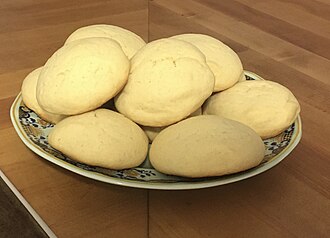
Photo: Wikipedia
A classic sugar cookie is a crisp, buttery biscuit with a tender crumb, often decorated with a smooth, sweet glaze or sparkling sugar. Its flavor is a simple, comforting blend of butter, vanilla, and caramelized sugar. Nutritionally, it's a dense source of quick energy from refined carbohydrates and fats.
Calorie split: 5% protein · 58% carbs · 38% fat
↓ Full nutrition💚 Why it's loved
People love sugar cookies for their nostalgic, comforting sweetness and satisfying crisp-tender texture. They are a beloved canvas for creativity, especially during holidays, and their simple flavor pairs perfectly with coffee, milk, or tea.
⚠️ Watch-outs & how to enjoy it better
The high sugar and refined flour content can lead to rapid blood-sugar spikes and subsequent energy crashes. They are calorie-dense with low satiety, making overconsumption easy. To mitigate, pair a single cookie with a source of protein (like a handful of nuts) or fat (like a glass of milk) to slow sugar absorption, and practice strict portion control.
Key benefits
- Provides quick energy from carbohydrates
- Can be a source of dietary fat for satiety
- Often used in social and celebratory contexts
- Offers a simple, comforting flavor profile
- Versatile base for decorating and flavor variations
🍽️ Popular dishes




🌍 Where it's eaten
💡 Did you know?
The modern sugar cookie is believed to have originated in the 1700s in Nazareth, Pennsylvania, by German Protestant settlers, where they were called 'Nazareth Cookies'.
Full nutrition (USDA data · scales with serving)
| Water | 6.3 g |
| Energy | 464 kcal |
| Energy | 1941 kj |
| Protein | 5.3 g |
| Total lipid (fat) | 19.6 g |
| Ash | 1.5 g |
| Carbohydrate, by difference | 67.3 g |
| Fiber, total dietary | 1.3 g |
| Total Sugars | 27.3 g |
| Sucrose | 25.8 g |
| Glucose | 0.77 g |
| Fructose | 0.61 g |
| Lactose | 0.00 g |
| Maltose | 0.18 g |
| Galactose | 0.00 g |
| Starch | 36.4 g |
| Calcium, Ca | 35.0 mg |
| Iron, Fe | 2.2 mg |
| Magnesium, Mg | 13.0 mg |
| Phosphorus, P | 99.0 mg |
| Potassium, K | 87.0 mg |
| Sodium, Na | 385 mg |
| Zinc, Zn | 0.43 mg |
| Copper, Cu | 0.08 mg |
| Manganese, Mn | 0.31 mg |
| Selenium, Se | 8.2 ug |
| Vitamin C, total ascorbic acid | 0.10 mg |
| Thiamin | 0.23 mg |
| Riboflavin | 0.24 mg |
| Niacin | 2.9 mg |
| Pantothenic acid | 0.28 mg |
| Vitamin B-6 | 0.07 mg |
| Folate, total | 72.0 ug |
| Folic acid | 34.0 ug |
| Folate, food | 38.0 ug |
| Folate, DFE | 95.0 ug |
| Choline, total | 10.8 mg |
| Vitamin B-12 | 0.19 ug |
| Vitamin B-12, added | 0.00 ug |
| Vitamin A, RAE | 7.0 ug |
| Retinol | 7.0 ug |
| Carotene, beta | 1.0 ug |
| Carotene, alpha | 0.00 ug |
| Cryptoxanthin, beta | 1.0 ug |
| Vitamin A, IU | 27.0 iu |
| Lycopene | 0.00 ug |
| Lutein + zeaxanthin | 38.0 ug |
| Vitamin E (alpha-tocopherol) | 3.1 mg |
| Vitamin E, added | 0.00 mg |
| Tocopherol, beta | 0.40 mg |
| Tocopherol, gamma | 4.6 mg |
| Tocopherol, delta | 1.7 mg |
| Tocotrienol, alpha | 1.9 mg |
| Tocotrienol, beta | 1.2 mg |
| Tocotrienol, gamma | 2.6 mg |
| Tocotrienol, delta | 0.45 mg |
| Vitamin D (D2 + D3), International Units | 0.00 iu |
| Vitamin D (D2 + D3) | 0.00 ug |
| Vitamin K (phylloquinone) | 8.6 ug |
| Alcohol, ethyl | 0.00 g |
| Caffeine | 0.00 mg |
| Theobromine | 0.00 mg |
Fat & fatty acid profile (per 100g)
| Fatty acids, total saturated | 7.7 g |
| SFA 4:0 | 0.00 g |
| SFA 6:0 | 0.00 g |
| SFA 8:0 | 0.01 g |
| SFA 10:0 | 0.01 g |
| SFA 12:0 | 0.06 g |
| SFA 14:0 | 0.15 g |
| SFA 15:0 | 0.01 g |
| SFA 16:0 | 5.9 g |
| SFA 17:0 | 0.02 g |
| SFA 18:0 | 1.4 g |
| SFA 20:0 | 0.07 g |
| SFA 22:0 | 0.03 g |
| SFA 24:0 | 0.02 g |
| Fatty acids, total monounsaturated | 7.0 g |
| MUFA 14:1 | 0.00 g |
| MUFA 15:1 | 0.00 g |
| MUFA 16:1 | 0.03 g |
| MUFA 16:1 c | 0.03 g |
| MUFA 17:1 | 0.01 g |
| MUFA 18:1 | 6.9 g |
| MUFA 18:1 c | 6.5 g |
| MUFA 20:1 | 0.04 g |
| MUFA 22:1 | 0.00 g |
| MUFA 22:1 c | 0.00 g |
| MUFA 24:1 c | 0.00 g |
| Fatty acids, total polyunsaturated | 3.7 g |
| PUFA 18:2 | 3.4 g |
| PUFA 18:2 n-6 c,c | 3.3 g |
| PUFA 18:2 CLAs | 0.01 g |
| PUFA 18:3 | 0.28 g |
| PUFA 18:3 n-3 c,c,c (ALA) | 0.27 g |
| PUFA 18:3 n-6 c,c,c | 0.01 g |
| PUFA 18:3i | 0.00 g |
| PUFA 18:4 | 0.00 g |
| PUFA 20:2 n-6 c,c | 0.00 g |
| PUFA 20:3 | 0.00 g |
| PUFA 20:3 n-3 | 0.00 g |
| PUFA 20:3 n-6 | 0.00 g |
| PUFA 20:4 | 0.01 g |
| PUFA 20:5 n-3 (EPA) | 0.00 g |
| PUFA 22:4 | 0.00 g |
| PUFA 22:5 n-3 (DPA) | 0.00 g |
| PUFA 22:6 n-3 (DHA) | 0.00 g |
| Fatty acids, total trans | 0.49 g |
| Fatty acids, total trans-monoenoic | 0.39 g |
| TFA 16:1 t | 0.00 g |
| TFA 18:1 t | 0.39 g |
| TFA 22:1 t | 0.00 g |
| TFA 18:2 t not further defined | 0.10 g |
| Fatty acids, total trans-polyenoic | 0.10 g |
| Cholesterol | 12.0 mg |
Amino acid profile (per 100g)
| Tryptophan | 0.07 g |
| Threonine | 0.18 g |
| Isoleucine | 0.23 g |
| Leucine | 0.39 g |
| Lysine | 0.26 g |
| Methionine | 0.11 g |
| Cystine | 0.10 g |
| Phenylalanine | 0.25 g |
| Tyrosine | 0.17 g |
| Valine | 0.26 g |
| Arginine | 0.22 g |
| Histidine | 0.11 g |
| Alanine | 0.19 g |
| Aspartic acid | 0.31 g |
| Glutamic acid | 1.4 g |
| Glycine | 0.16 g |
| Proline | 0.47 g |
| Serine | 0.30 g |
FAQ
Why do my sugar cookies spread too much in the oven?
This is often caused by dough that is too warm, over-creamed butter and sugar, or insufficient chilling time. Ensure your butter is cool (not melted), chill the dough for at least an hour, and bake on a cool baking sheet.
What's the difference between a sugar cookie and a shortbread cookie?
Sugar cookies typically contain eggs and a leavening agent (like baking powder), giving them a slightly softer, more cake-like texture. Shortbread is richer, with a higher fat-to-flour ratio and no eggs, resulting in a denser, crumblier, and more buttery biscuit.
Can I reduce the sugar in the recipe?
You can reduce the granulated sugar by up to 25% without drastically altering the structure, but it will affect sweetness, spread, and tenderness. For the icing, you can use less powdered sugar or incorporate flavorings like citrus zest to compensate.
Nutrient density (calculated · NRF9.3)
Nutrient Rich Foods index: beneficial nutrients (protein, fiber, vitamins, minerals) minus saturated fat, added sugar & sodium, per 100 kcal.
NRF9.3 index — Fulgoni, Keast & Drewnowski, 2009. Computed from USDA nutrients.
Weight-loss friendliness (composite index)
Energy density 4.64 kcal/g · 5% calories from protein · 1.3 g fiber · 27.3 g sugar per 100 g.
Composite of energy density (Rolls et al., 1999), protein & fiber satiety, minus sugar. A calculated heuristic — ranks satiety-per-calorie, not a clinical measure.
Dietary load (calculated from USDA values)
Potential renal acid load. Positive = acid-forming, negative = alkaline-forming.
Sodium-to-potassium ratio: 4.43 (lower is better — aim for ≤ 1)
Sodium:potassium per WHO potassium guidance. Computed from USDA nutrients.