

Bread, whole-wheat, commercially prepared
Whole food · Baked Products
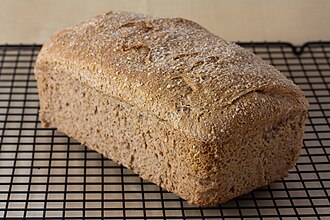
Photo: Wikipedia
Whole-wheat bread is a hearty, nutty loaf made from flour that retains the bran and germ, giving it a denser, chewier texture and a deeper, earthier flavor than white bread. Its nutritional profile is defined by a strong protein content (12.3g per 100g) and significant dietary fiber (6g per 100g), making it a more sustaining staple.
Calorie split: 19% protein · 68% carbs · 13% fat
↓ Full nutrition💚 Why it's loved
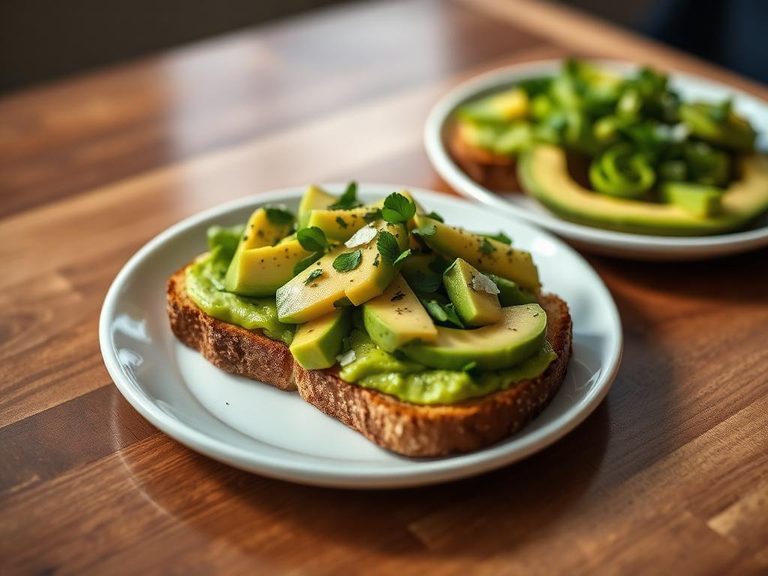
People love it for its robust, wheaty flavor and satisfying texture that holds up well to toppings and sandwiches. It's a versatile, everyday staple that forms the foundation of countless meals, from classic peanut butter sandwiches to hearty avocado toast.
⚠️ Watch-outs & how to enjoy it better
Its dense texture and strong flavor aren't for everyone, and the bran can be harder to digest for some. For those monitoring blood sugar, the carbohydrates can still cause a spike; pairing it with protein (like eggs or nut butter) or healthy fats (avocado) can help slow absorption.
Key benefits
- High in dietary fiber for digestive health.
- Good source of plant-based protein.
- Contains more micronutrients than refined white bread.
- Provides complex carbohydrates for sustained energy.
🍽️ Popular dishes



🌍 Where it's eaten
💡 Did you know?
The bran, germ, and endosperm are all present in whole-wheat flour, meaning it uses about 80% of the wheat kernel, compared to about 70% for white flour.
Full nutrition (USDA data · scales with serving)
| Water | 38.7 g |
| Energy (Atwater General Factors) | 254 kcal |
| Energy | 254 kcal |
| Energy | 1060 kj |
| Nitrogen | 2.0 g |
| Protein | 12.3 g |
| Total lipid (fat) | 3.5 g |
| Total fat (NLEA) | 3.0 g |
| Ash | 2.4 g |
| Carbohydrate, by difference | 43.1 g |
| Carbohydrate, by summation | 39.2 g |
| Fiber, total dietary | 6.0 g |
| Sugars, Total | 4.4 g |
| Sucrose | 0.03 g |
| Glucose | 1.1 g |
| Fructose | 2.2 g |
| Lactose | 0.01 g |
| Maltose | 1.0 g |
| Galactose | 0.00 g |
| Starch | 28.7 g |
| Calcium, Ca | 163 mg |
| Iron, Fe | 2.6 mg |
| Magnesium, Mg | 76.6 mg |
| Phosphorus, P | 212 mg |
| Potassium, K | 250 mg |
| Sodium, Na | 450 mg |
| Zinc, Zn | 1.8 mg |
| Copper, Cu | 0.23 mg |
| Manganese, Mn | 2.2 mg |
| Selenium, Se | 25.8 ug |
| Thiamin | 0.39 mg |
| Riboflavin | 0.17 mg |
| Niacin | 4.4 mg |
| Pantothenic acid | 0.65 mg |
| Vitamin B-6 | 0.22 mg |
| Folate, total | 42.0 ug |
| Choline, total | 27.2 mg |
| Choline, free | 16.3 mg |
| Choline, from phosphocholine | 0.40 mg |
| Choline, from phosphotidyl choline | 2.9 mg |
| Choline, from glycerophosphocholine | 7.6 mg |
| Choline, from sphingomyelin | 0.00 mg |
| Betaine | 126 mg |
| Vitamin E (alpha-tocopherol) | 2.8 mg |
| Tocopherol, beta | 0.24 mg |
| Tocopherol, gamma | 0.90 mg |
| Tocopherol, delta | 0.29 mg |
| Tocotrienol, alpha | 0.41 mg |
| Tocotrienol, beta | 1.3 mg |
| Tocotrienol, gamma | 0.37 mg |
| Tocotrienol, delta | 0.18 mg |
Fat & fatty acid profile (per 100g)
| Fatty acids, total saturated | 0.73 g |
| SFA 4:0 | 0.00 g |
| SFA 6:0 | 0.00 g |
| SFA 8:0 | 0.00 g |
| SFA 10:0 | 0.01 g |
| SFA 11:0 | 0.00 g |
| SFA 12:0 | 0.01 g |
| SFA 14:0 | 0.01 g |
| SFA 15:0 | 0.00 g |
| SFA 16:0 | 0.44 g |
| SFA 17:0 | 0.00 g |
| SFA 18:0 | 0.23 g |
| SFA 20:0 | 0.01 g |
| SFA 22:0 | 0.01 g |
| SFA 24:0 | 0.00 g |
| Fatty acids, total monounsaturated | 0.62 g |
| MUFA 14:1 c | 0.00 g |
| MUFA 15:1 | 0.00 g |
| MUFA 16:1 c | 0.01 g |
| MUFA 17:1 | 0.00 g |
| MUFA 17:1 c | 0.00 g |
| MUFA 18:1 c | 0.58 g |
| MUFA 20:1 | 0.02 g |
| MUFA 20:1 c | 0.02 g |
| MUFA 22:1 c | 0.00 g |
| MUFA 24:1 c | 0.00 g |
| Fatty acids, total polyunsaturated | 1.6 g |
| PUFA 18:2 c | 1.5 g |
| PUFA 18:2 n-6 c,c | 1.5 g |
| PUFA 18:2 CLAs | 0.00 g |
| PUFA 18:3 c | 0.14 g |
| PUFA 18:3 n-3 c,c,c (ALA) | 0.14 g |
| PUFA 18:3 n-6 c,c,c | 0.00 g |
| PUFA 18:3i | 0.00 g |
| PUFA 18:4 | 0.00 g |
| PUFA 20:2 c | 0.00 g |
| PUFA 20:2 n-6 c,c | 0.00 g |
| PUFA 20:3 c | 0.00 g |
| PUFA 20:3 n-3 | 0.00 g |
| PUFA 20:3 n-6 | 0.00 g |
| PUFA 20:3 n-9 | 0.00 g |
| PUFA 20:4 | 0.00 g |
| PUFA 20:4c | 0.00 g |
| PUFA 20:5c | 0.00 g |
| PUFA 20:5 n-3 (EPA) | 0.00 g |
| PUFA 22:2 | 0.00 g |
| PUFA 22:5 c | 0.00 g |
| PUFA 22:4 | 0.00 g |
| PUFA 22:5 n-3 (DPA) | 0.00 g |
| PUFA 22:6 c | 0.00 g |
| PUFA 22:6 n-3 (DHA) | 0.00 g |
| Fatty acids, total trans | 0.02 g |
| Fatty acids, total trans-monoenoic | 0.02 g |
| TFA 16:1 t | 0.00 g |
| TFA 18:1 t | 0.02 g |
| TFA 22:1 t | 0.00 g |
| Fatty acids, total trans-dienoic | 0.01 g |
| TFA 18:2 t not further defined | 0.01 g |
Amino acid profile (per 100g)
Estimated from Bread, salvadoran sweet cheese (quesadilla salvadorena) — USDA does not publish this profile for Bread.
| Tryptophan | 0.07 g |
| Threonine | 0.21 g |
| Isoleucine | 0.30 g |
| Leucine | 0.65 g |
| Lysine | 0.50 g |
| Methionine | 0.28 g |
| Cystine | 0.06 g |
| Phenylalanine | 0.37 g |
| Tyrosine | 0.23 g |
| Valine | 0.43 g |
| Arginine | 0.25 g |
| Histidine | 0.15 g |
| Alanine | 0.36 g |
| Aspartic acid | 0.59 g |
| Glutamic acid | 1.3 g |
| Glycine | 0.20 g |
| Proline | 0.83 g |
| Serine | 0.45 g |
| Hydroxyproline | 0.00 g |
FAQ
Is whole-wheat bread gluten-free?
No. Wheat, including whole-wheat, contains gluten. Those with celiac disease or gluten sensitivity must avoid it.
Why does whole-wheat bread spoil faster than white bread?
The natural oils in the wheat germ can go rancid over time. Storing it in a cool, dry place or freezing slices can extend its shelf life.
What does '100% whole wheat' mean?
It means all the flour used is whole-wheat flour, not a mix with refined white flour. This ensures the full nutritional benefit of the whole grain.
Nutrient density (calculated · NRF9.3)
Nutrient Rich Foods index: beneficial nutrients (protein, fiber, vitamins, minerals) minus saturated fat, added sugar & sodium, per 100 kcal.
NRF9.3 index — Fulgoni, Keast & Drewnowski, 2009. Computed from USDA nutrients.
Weight-loss friendliness (composite index)
Energy density 2.54 kcal/g · 19% calories from protein · 6.0 g fiber · 0.0 g sugar per 100 g.
Composite of energy density (Rolls et al., 1999), protein & fiber satiety, minus sugar. A calculated heuristic — ranks satiety-per-calorie, not a clinical measure.
Dietary load (calculated from USDA values)
Potential renal acid load. Positive = acid-forming, negative = alkaline-forming.
Sodium-to-potassium ratio: 1.80 (lower is better — aim for ≤ 1)
Sodium:potassium per WHO potassium guidance. Computed from USDA nutrients.